
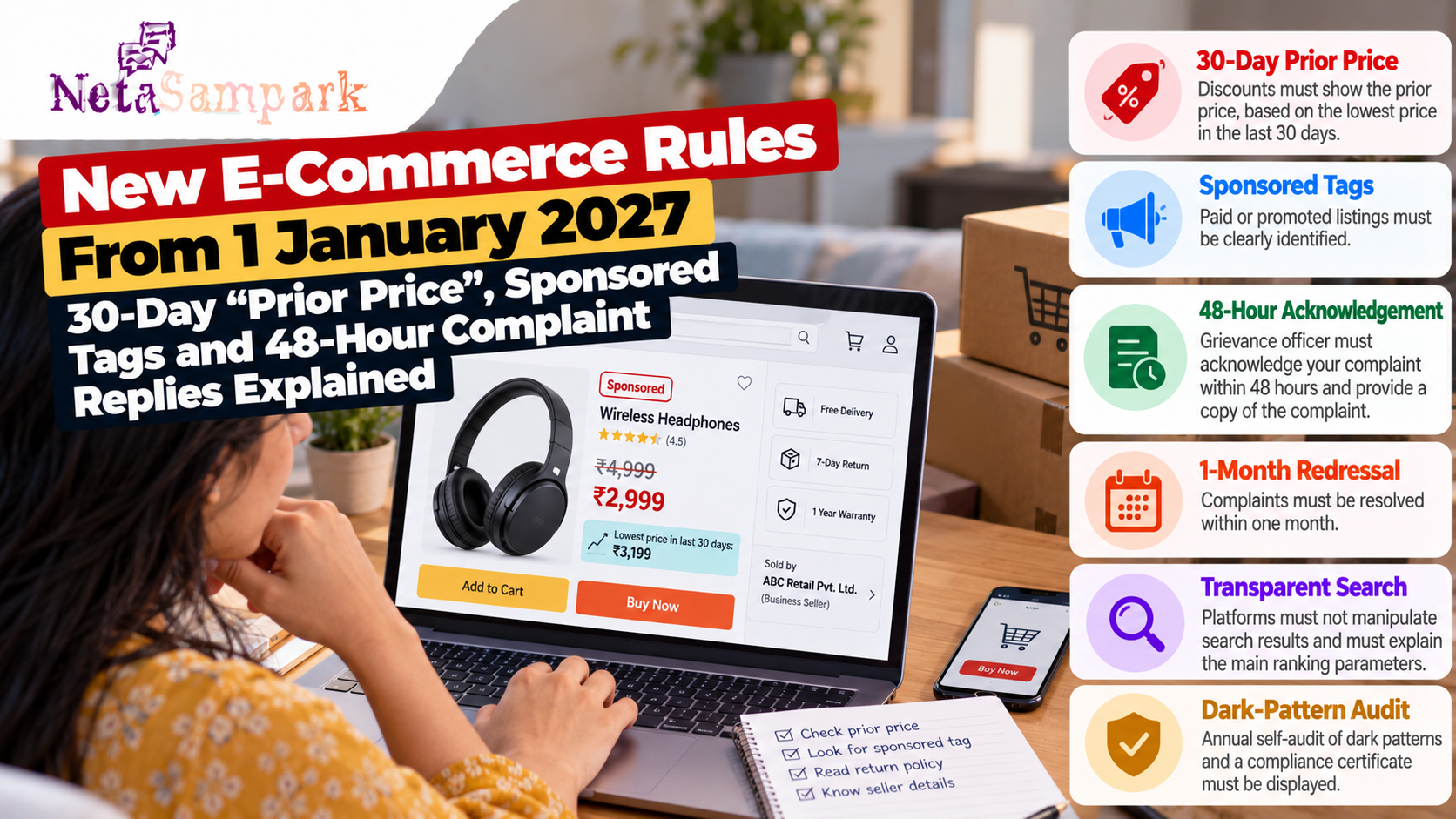
New E-Commerce Rules From 1 January 2027: 30-Day “Prior Price”, Sponsored Tags and 48-Hour Complaint Replies Explained
Buying something online in India may look a little different from 1 January 2027.
The Central Government has notified the Consumer Protection (E-Commerce) (Amendment) Rules, 2026, amending the existing Consumer Protection (E-Commerce) Rules, 2020. The new provisions take effect from 1 January 2027. TaxGuru
For consumers, some of the most visible changes concern discount claims, sponsored listings, search results and complaint handling.
One important clarification: the rules do not require an e-commerce platform to fully resolve your complaint within 48 hours. The grievance officer must acknowledge receipt within 48 hours and provide you with a copy of the complaint as recorded. The complaint must ordinarily be redressed within one month. TaxGuru
Here is what shoppers should know.
What changes from 1 January 2027?
| New requirement | What it means for shoppers |
|---|---|
| 30-day prior price | A claimed price reduction must show the prior price, based on the lowest price during the preceding 30 days |
| Sponsored listings | Paid/promoted listings must be clearly identified |
| 48-hour acknowledgement | Grievance officer must acknowledge a complaint within 48 hours |
| Complaint copy | Consumer must receive a copy of the complaint as recorded by the grievance officer |
| One-month redressal | Complaint must be redressed within one month |
| Search transparency | Platforms cannot manipulate search results to mislead users |
| Dark-pattern audit | E-commerce entities must conduct an annual self-audit and display a compliance certificate |
| Seller visibility | More seller and product information must be available |
| Imported goods | Importer and country-of-origin information must be disclosed |
These requirements come from the 2026 amendment notified under G.S.R. 789(E). TaxGuru
1 The “30-day prior price” rule
This could be one of the most noticeable changes during online sales.
When an e-commerce entity or seller announces a price reduction, the reduced price must be displayed along with the prior price.
The amended rule defines the prior price as the lowest price at which the good or service was offered during the 30 days preceding the announcement of the price reduction. TaxGuru
Example
Suppose a product was sold for:
- ₹2,000 on 1 December
- ₹1,800 on 10 December
- ₹1,900 on 20 December
If a discount is announced on 1 January, the relevant prior price would be ₹1,800, because that was the lowest price during the preceding period.
If the seller now displays:
₹2,500 → ₹1,500
the new framework is designed to make the claimed reference price more meaningful because the prior-price figure has to be based on the preceding 30-day pricing history.
Why this matters
It is intended to make it harder to create a misleading "sale" by temporarily increasing a price and then showing a large discount against that inflated reference price.
The rule applies to an announced price reduction; it does not mean every product must permanently display a 30-day price history.
2 A “70% OFF” label should have a more meaningful reference
Imagine a product was actually available for ₹1,000 shortly before a sale.
A platform should not be able to make the discount appear much larger simply by relying on an artificially high reference price immediately before the sale.
From January 2027, where a price reduction is announced, the prior-price requirement gives consumers a specific reference point: the lowest price during the preceding 30 days. TaxGuru
What shoppers should do
Even after the rule takes effect, don't look only at the percentage discount.
Compare:
Current price + prior price + product's recent price history
rather than assuming that a large "50% OFF" or "70% OFF" label automatically means you are getting an exceptional deal.
3 Sponsored products must be clearly labelled
Search results on shopping platforms can contain both:
- organically ranked products; and
- paid/promoted placements.
The amended rules require sponsored listings of products and services to be distinctly identified with clear and prominent disclosures. TaxGuru
In practical terms, consumers should be able to recognise when a product has been given prominent placement because it is sponsored.
Why this matters
Suppose you search:
"best wireless headphones"
The first result might appear to be the platform's most relevant recommendation.
If it is actually a paid placement, the consumer should be able to see that it is sponsored.
This does not mean sponsored products are necessarily bad products.
It means the commercial nature of the placement should be clear.
4 Search results cannot be manipulated to mislead you
The amended rules also specifically address search-result manipulation.
E-commerce entities cannot manipulate search results or search indexes in a manner that misleads users in relation to their search query. TaxGuru
The rules also require marketplace entities to explain the main parameters used to determine the ranking of goods or sellers, in descending order of significance, in an easily accessible description using plain and intelligible language. Gazette Tracker
What this means
If you search for a product, the platform should not misleadingly present results as though they are purely based on relevance when other ranking factors materially affect what you see.
It does not mean every search result has to be ranked only by price or consumer rating.
5 Your complaint gets a 48-hour acknowledgement
This is an important distinction.
From 1 January 2027, an e-commerce entity's grievance officer must:
Within 48 hours:
- acknowledge receipt of your consumer complaint; and
- provide you with a copy of the complaint as recorded by the grievance officer.
Within one month:
- redress the complaint. TaxGuru
So the headline should not be interpreted as:
"Amazon/Flipkart/other platforms must solve your complaint within 48 hours."
That is not what the rule says.
The 48-hour requirement is an acknowledgement deadline.
6 Why the complaint copy matters
The amendment requires the grievance officer to provide the complainant with a copy of the complaint as recorded.
This gives consumers something concrete to retain about what was officially registered.
If you complain that:
"I received a damaged product and the seller refused a replacement"
the recorded complaint should provide a formal record of what you submitted.
Keep your own evidence too
Save:
- Order ID
- Invoice
- Product listing
- Screenshots
- Delivery photographs
- Messages with the seller
- Return request
- Refund request
- Complaint/reference number
- Platform's response
Don't rely solely on the platform's internal records.
7 One month is the redressal deadline
The amended rule requires the grievance officer to redress the complaint within one month from the date of receipt. TaxGuru
That makes the new timeline:
Complaint filed → acknowledgement within 48 hours → complaint copy → redressal within one month
This does not mean every consumer dispute will necessarily be resolved in the consumer's favour.
A complaint can be rejected if the platform or seller has a valid legal or contractual basis.
The rule concerns the handling and redressal timeline, not an automatic refund guarantee.
8 More seller information should be visible
Marketplace platforms must provide consumers with important information about sellers, including details such as:
- Business name
- Geographic address
- Customer-care information
- Website/email information where available
- Ratings or aggregated feedback
- Other information necessary for an informed purchase decision
The amended rules also provide that, after purchase, a consumer can request specified seller information in writing to help with dispute resolution. Gazette Tracker
This is useful when your problem is actually with the third-party seller, rather than the marketplace platform itself.
9 Seller name must be prominent on invoices
The amendment requires an e-commerce entity to display the seller's name on the invoice in the same font size as the e-commerce entity's name. TaxGuru
This should make it easier for consumers to identify who actually sold the product.
That distinction can matter when:
- a product is defective;
- a warranty dispute arises;
- a return is rejected;
- the seller refuses a refund;
- a counterfeit product is suspected.
Check your invoice
After buying online, look for:
Platform name + actual seller name
and keep the invoice.
10 Imported products get additional information
For imported goods, e-commerce entities will have to disclose:
- The name and details of the importer; and
- The full and complete country of origin of the imported goods, as required under the applicable Legal Metrology framework. TaxGuru
This is particularly relevant when buying:
- electronics;
- cosmetics;
- appliances;
- accessories;
- toys;
- imported food and other packaged goods.
Don't confuse country of origin with the country from which the seller ships your individual order.
11 Dark patterns become a formal compliance issue
The amended rules require e-commerce entities to:
- comply with the Guidelines for Prevention and Regulation of Dark Patterns, 2023;
- conduct a yearly self-audit to ensure their platform is free from dark patterns; and
- prominently display a certificate confirming this. TaxGuru
Dark patterns are interface practices designed to manipulate or deceive consumers into choices they might otherwise not make.
Examples covered by the government's dark-pattern framework include practices such as:
- false urgency;
- basket sneaking;
- confirm shaming;
- forced action;
- subscription traps.
The underlying dark-pattern guidelines pre-date the 2026 amendment; the new e-commerce rules make compliance and annual self-audit an explicit requirement for e-commerce entities from 2027.
12 What is a dark pattern in everyday shopping?
Imagine you are buying a ₹499 product.
At checkout:
Product: ₹499
Delivery: ₹40
Optional protection: ₹99 — already selected
You have to notice the additional charge and manually remove it.
Or imagine:
"Only 2 minutes left!"
followed by a countdown that repeatedly resets.
These kinds of design practices are precisely why consumers should pay attention to the final checkout screen rather than relying on the headline price.
The 2027 rules strengthen the compliance framework around these practices. TaxGuru
13 Platforms must disclose more about ranking
A marketplace must provide an easily accessible explanation of the main parameters that determine the ranking of goods or sellers and their relative importance. Gazette Tracker
This does not mean a platform has to reveal its proprietary algorithm or source code.
Instead, consumers should receive a plain-language explanation of the important ranking parameters.
For example, a platform may explain that ranking is influenced by factors such as relevance, availability, ratings or other specified criteria.
14 Consumer information cannot be freely reused for certain marketplace interests
The amendments also place restrictions on how marketplace entities use information collected from consumers.
For specified purposes involving:
- selling goods under a brand/name common with the marketplace; or
- promoting or advertising a seller as associated with the marketplace,
the marketplace must obtain the consumer's express and affirmative consent where the rule applies. Gazette Tracker
This is particularly relevant to large marketplaces that also have their own brands or associated sellers.
15 Bundled fees face restrictions
The amended framework also restricts marketplace e-commerce entities from collecting bundled fees for services unrelated to the e-commerce platform, subject to the specified exception for loyalty or membership programmes. Gazette Tracker
For consumers, this is another reason to inspect the checkout page carefully.
If a new charge appears, check:
What exactly am I paying for?
16 Return, refund and delivery information gets greater emphasis
Marketplace sellers and platforms must provide information that helps consumers make informed decisions, including information relating to:
- Returns
- Refunds
- Exchanges
- Warranty
- Guarantee
- Best-before/use-before dates where applicable
- Delivery and shipment
- Payment methods
- Grievance redressal
- Other relevant purchase information
The amended rules specifically update these disclosure requirements. Gazette Tracker
For food products, the best-before/use-before requirement remains subject to the applicable food-safety laws and regulations.
What doesn't change?
The new rules do not mean that all existing consumer protections begin only on 1 January 2027.
The 2026 notification amends the existing Consumer Protection (E-Commerce) Rules, 2020. Many obligations already existed before the amendment. TaxGuru
So consumers should not assume that platforms currently have no responsibilities regarding:
- seller information;
- returns/refunds;
- grievance mechanisms;
- unfair trade practices;
- misleading advertisements;
- consumer rights.
The January 2027 date is mainly the point at which the newly amended requirements take effect.
What should shoppers do from January 2027?
Before paying for an online order, make a quick check.
Price
- Check the actual selling price.
- Look at the displayed prior price when a discount is advertised.
- Don't judge a deal solely by the percentage discount.
Sponsored results
- Look for a sponsored/paid-placement disclosure.
- Compare sponsored products with ordinary search results.
Seller
- Check who the actual seller is.
- Look at seller ratings/feedback.
- Save the invoice.
Product
- Check return/refund terms.
- Check warranty/guarantee.
- Check delivery terms.
- Check country of origin for imported goods.
Checkout
- Review every charge.
- Remove unwanted add-ons.
- Check the final payable amount before authorising payment.
What if an online platform ignores the new requirements?
Start by making a formal complaint to the platform's grievance officer.
Keep:
- complaint date;
- order number;
- screenshots;
- invoice;
- correspondence;
- acknowledgement;
- response;
- refund/return records.
From 1 January 2027, the amended rules require acknowledgement within 48 hours and redressal within one month. TaxGuru
If the issue remains unresolved, consumers can use the broader consumer grievance mechanisms available under Indian law, including the National Consumer Helpline and, where appropriate, the consumer commissions.
The Department of Consumer Affairs says the Consumer Protection Act provides a three-tier consumer-commission system and supports online filing through the e-Jagriti system. Consumer Affairs India
A simple example
Imagine you buy a ₹2,000 appliance online after seeing:
"50% OFF — Was ₹4,000, Now ₹2,000!"
From January 2027, where this is an announced price reduction, the platform/seller must display the applicable prior price, with that term tied to the lowest price during the preceding 30 days. TaxGuru
If the product had actually been available for ₹1,800 during that preceding period, the ₹4,000 reference would not fit the new "prior price" definition.
Now imagine the first result for the same product is a paid placement.
The listing should clearly identify itself as sponsored.
And if you later file a consumer complaint, the grievance officer must acknowledge it within 48 hours and provide you with a copy of the recorded complaint, with redressal required within one month. TaxGuru
Three dates and numbers to remember
1 January 2027
The amended Consumer Protection (E-Commerce) Rules take effect.
30 days
The look-back period used to determine the "prior price" when a price reduction is announced.
48 hours
The maximum period for the grievance officer to acknowledge receipt of a consumer complaint.
And remember the fourth number:
1 month
The prescribed period for redressal of the complaint. TaxGuru
Consumer checklist for 2027 online shopping
Before you buy:
- Check the actual seller.
- Look at the price and prior-price disclosure.
- Identify sponsored listings.
- Check return/refund terms.
- Check delivery and warranty information.
- Check country of origin for imported products.
- Review every checkout charge.
- Save your invoice and order confirmation.
If something goes wrong:
- Complain to the platform/grievance officer.
- Save the complaint copy and acknowledgement.
- Expect acknowledgement within 48 hours from 1 January 2027.
- Track the one-month redressal period.
- Escalate through consumer grievance mechanisms if necessary.
Bottom line
From 1 January 2027, India's amended e-commerce rules will give shoppers more information about discount reference prices, sponsored placements, search rankings, sellers, imported goods and complaint handling. TaxGuru
The most useful change to remember during online sales is the 30-day prior-price rule: when a price reduction is announced, the displayed prior price is tied to the lowest price during the preceding 30 days.
And if you have a complaint, remember the wording carefully: 48 hours is the acknowledgement deadline, not the deadline for resolving the complaint. The grievance officer must acknowledge it within 48 hours, provide a copy of the recorded complaint, and redress it within one month. TaxGuru
These changes are designed to make online shopping more transparent — but consumers should still compare prices, inspect sellers and read the final checkout screen before paying.