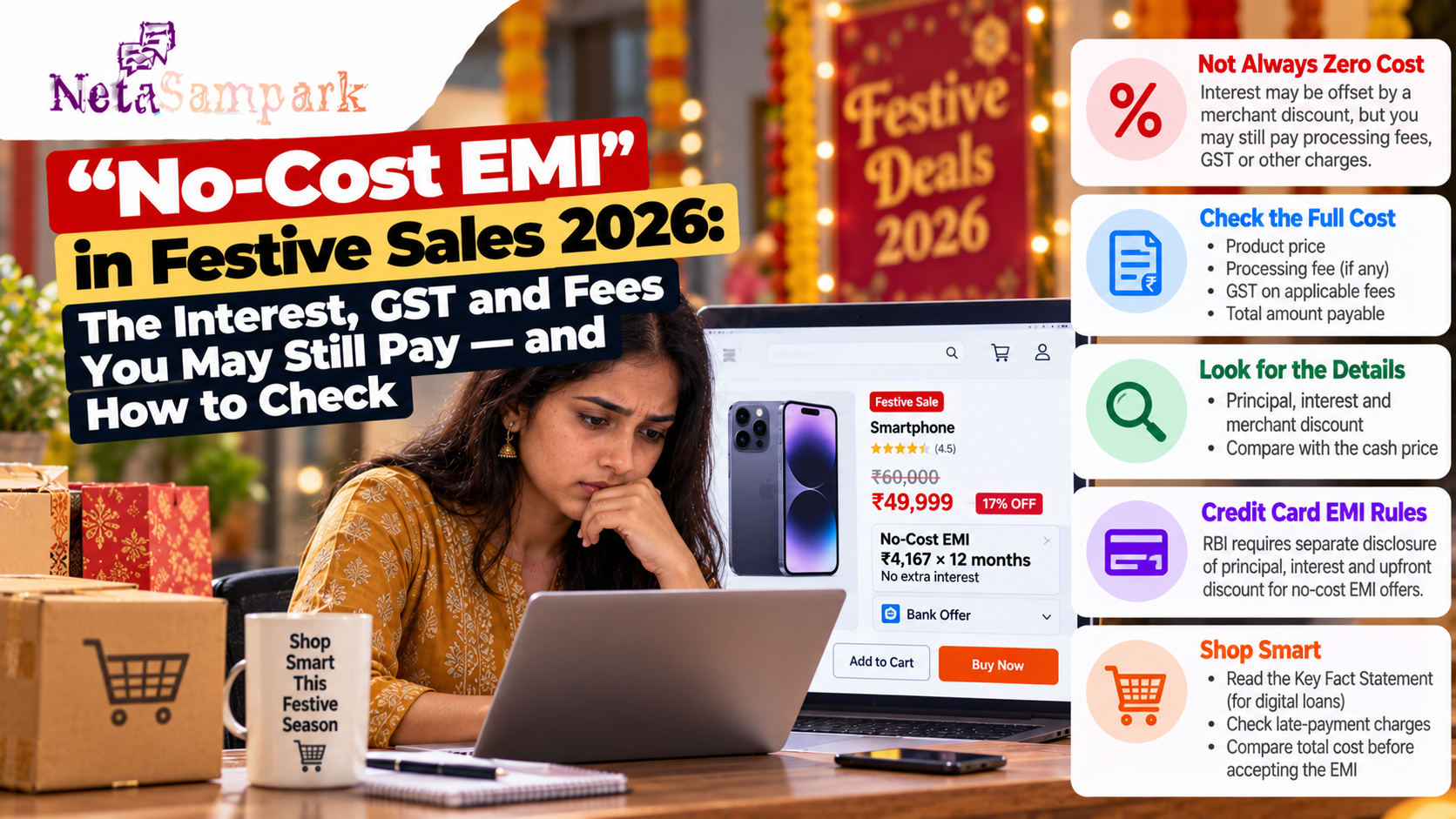
“No-Cost EMI” in Festive Sales 2026: The Interest, GST and Fees You May Still Pay — and How to Check
“No-Cost EMI” is one of the most attractive labels during India's festive shopping season.
A ₹60,000 phone may suddenly appear as:
₹5,000 × 12 months — No Cost EMI
It sounds as though you are borrowing money without paying anything extra.
But “no-cost EMI” does not necessarily mean “zero additional cost.”
Depending on how the offer is structured, you may still encounter a processing fee, GST on applicable fees, credit-card charges, or other costs. The interest itself may be offset through an upfront merchant discount or subsidy rather than disappearing altogether.
The Reserve Bank of India requires credit-card issuers to disclose the principal, interest and upfront discount provided by the merchant/card issuer to make an EMI “no cost”, both before conversion and separately in the card statement. RBI also says an EMI with an interest component cannot simply be disguised as a zero-interest/no-cost EMI. System Health
So before clicking “Convert to EMI” during the 2026 festive sales, compare the total amount you will actually pay, not just the monthly EMI.
What does “No-Cost EMI” actually mean?
A normal EMI has two major components:
Principal + Interest
With a conventional ₹60,000 loan, you might repay more than ₹60,000 because the lender charges interest.
With a no-cost EMI, the interest may still exist in the underlying financing arrangement, but the merchant or another party provides an upfront discount/subvention that offsets the interest.
In simple terms:
Interest charged by lender
↓
Merchant/card issuer discount
↓
Net interest cost advertised as “no cost”
That is why RBI requires the interest and upfront discount to be shown separately for credit-card EMI conversions. System Health
The important distinction
No-cost EMI ≠ no-fee EMI
You could still have a processing or convenience fee.
And applicable taxes may be charged on taxable fees.
Example: A ₹60,000 festive-sale purchase
Suppose a phone costs:
₹60,000
You select a 12-month no-cost EMI.
The lender's underlying financing may calculate, purely for illustration:
- Principal: ₹60,000
- Interest: ₹3,600
- Merchant/card issuer upfront discount: ₹3,600
- Net interest cost: ₹0
But suppose the lender also charges:
- Processing fee: ₹999
- GST on processing fee: ₹179.82
Your effective outflow could become:
₹60,000 + ₹999 + ₹179.82 = ₹61,178.82
So the EMI may legitimately be advertised as “no-cost” while the transaction is not literally fee-free.
The exact structure varies by lender, card, product and offer.
Where can the extra cost hide?
Before accepting a no-cost EMI, check these six areas.
1. Processing fee
Some lenders charge a one-time EMI processing fee even when the interest is offset.
The RBI has specifically noted that processing fees can apply even to no-cost EMI loans offered through digital/BigTech platforms. System Health
2. GST on applicable fees
GST treatment depends on what is being charged.
Under the GST framework, services involving loans/advances are generally exempt to the extent the consideration is represented by interest or discount, but service charges, processing fees, documentation fees and similar charges are taxable. CBIC GST
So if your lender charges a ₹1,000 processing fee, don't assume the ₹1,000 is necessarily the final fee.
Check whether GST is added.
For example:
Processing fee: ₹1,000
GST at 18%: ₹180
Total fee: ₹1,180
The actual applicable tax treatment should be checked on the lender's offer/statement.
What about GST on the interest itself?
This is where consumers need to be careful because there isn't one universal answer for every EMI structure.
CBIC's GST guidance provides an exemption for interest/discount on loans and advances, but specifically excludes interest involved in credit-card services from that exemption. CBIC GST
The RBI has also published research noting that GST was being charged on interest in sampled digital/BigTech no-cost EMI loans, alongside processing fees. System Health
Therefore, don't apply a blanket rule such as:
“GST is never charged on EMI interest.”
or:
“GST is always charged on EMI interest.”
Instead, identify what type of financing you are actually using:
- Credit-card EMI
- Bank/NBFC consumer loan
- Digital lending/embedded finance
- Other financing arrangement
Then check the lender's cost breakdown.
3 Credit-card EMI charges
Credit-card EMI offers are especially important to inspect.
RBI requires card issuers to provide transparency when converting a credit-card transaction into EMI.
Before conversion, the issuer must clearly indicate:
- Principal
- Interest
- Upfront discount provided by the merchant/card issuer
- Other relevant charges
The same principal, interest and discount should also be separately indicated in the credit-card statement. System Health
So if the screen says:
₹5,000 × 12 months — No Cost EMI
look for the detailed breakdown.
You may see something like:
| Component | Example |
|---|---|
| Purchase price | ₹60,000 |
| Principal | ₹60,000 |
| Interest | ₹3,600 |
| Merchant discount | -₹3,600 |
| Processing fee | ₹999 |
| GST on fee | ₹179.82 |
| Effective additional cost | ₹1,178.82 |
The numbers above are illustrative only.
Your actual offer may be different.
4 “Zero interest” does not automatically mean “zero fees”
This is one of the easiest mistakes to make.
Suppose an offer says:
0% interest
That tells you something about the interest rate.
It does not necessarily tell you:
- Processing fee
- Documentation fee
- Convenience fee
- Other applicable charges
- GST on taxable charges
- Late-payment charges
- Foreclosure/prepayment conditions
RBI's lending framework emphasises upfront disclosure of the total cost and applicable fees. For digital loans, the Key Fact Statement (KFS) must contain the applicable APR and other key costs, and fees not mentioned in the KFS cannot subsequently be charged by the regulated entity during the loan term. System Health
5 Late-payment charges are a separate issue
Imagine your no-cost EMI is:
₹5,000 per month
If you pay every instalment on time, the offer may work as advertised.
But if you miss a payment, the consequences can be different.
You may face:
- Late-payment/penal charges
- Applicable GST on taxable charges
- Credit-card consequences
- Possible impact on your credit history
RBI requires applicable penal charges and their basis to be disclosed to borrowers. System Health
So don't judge the offer solely by its promotional EMI calculation.
6 The cash price may be different
This is perhaps the most important consumer check.
Suppose the same product is available for:
Cash/UPI price: ₹54,999
But the no-cost EMI price is:
₹60,000
Even if the EMI interest is completely offset, you should compare the actual transaction price and all charges.
A no-cost EMI can still be less attractive than paying a lower cash price.
Always compare:
Cash price
vs.
EMI purchase price + fees + applicable taxes
A simple festive-sale calculation
Suppose a television has these options:
Option A — Pay immediately
₹48,000
Option B — No-cost EMI
12 × ₹4,000 = ₹48,000
Processing fee = ₹999
GST on fee = ₹179.82
Total EMI outflow:
₹49,178.82
The advertisement can still describe the financing as no-cost EMI because the interest component is offset, but the consumer's actual outflow is higher than the cash price.
Effective difference
₹49,178.82 − ₹48,000
= ₹1,178.82
That is the number you should care about.
What is APR and why should you check it?
APR — Annual Percentage Rate — is intended to represent the annualised cost of borrowing, including applicable interest and other charges.
For digital loans, RBI defines APR as an all-inclusive annualised cost and requires it to be disclosed upfront in the Key Fact Statement. System Health
If the festive-sale EMI is being provided through a regulated digital lending arrangement, look for the:
KFS → APR → Processing fee → Other charges → Repayment schedule
Don't judge a loan only by the monthly EMI.
Your KFS is worth reading
If the purchase involves a digital loan from a regulated bank/NBFC, the RBI framework requires a Key Fact Statement before execution of the loan contract.
It contains important information such as:
- APR
- Loan amount
- Repayment schedule
- Applicable fees/charges
- Penal charges
- Grievance information
- Other key terms
Importantly, fees or charges not mentioned in the KFS cannot be subsequently charged by the regulated entity during the loan term under the digital-lending framework. System Health
Don't close the KFS screen immediately
Take a screenshot or save the document.
It can be useful if the final EMI or fee later differs from what was disclosed.
Check the “total payable” figure
The best number to compare is:
How much money will leave my account/card in total?
For example:
Product price: ₹70,000
Processing fee: ₹1,000
GST on fee: ₹180
Other applicable charge: ₹0
Total effective outflow: ₹71,180
If the screen only highlights:
₹5,833/month × 12
you may miss the extra ₹1,180.
What about the GST already included in the product price?
Don't confuse GST on the product with GST on financing charges.
The product's displayed price may already include applicable GST, depending on how the seller displays the price.
Separately, the financing arrangement may generate taxable fees or charges.
So your check should distinguish:
Product price
Financing charges
GST on applicable financing services/fees
rather than assuming every GST amount relates to the product itself.
Is the merchant really giving you a discount?
Sometimes the economics of a no-cost EMI work through a merchant-funded discount.
RBI's credit-card rules explicitly refer to the upfront discount provided by the merchant/card issuer to make the EMI “no cost.” System Health
This means the interest has not necessarily disappeared from the financing calculation.
It may instead be subsidised or offset.
That's why RBI requires the interest and discount to be shown separately.
Why the same product can have different EMI costs
You may see:
3-month No-Cost EMI
6-month No-Cost EMI
9-month No-Cost EMI
12-month No-Cost EMI
The headline may be identical, but the fees and financing structure can differ.
Check each tenure separately.
For digital lending, RBI research has found that processing fees and financing-related GST in sampled no-cost EMI products varied with the EMI duration. System Health
So don't automatically choose the longest tenure just because the monthly payment is smaller.
Longer EMI does not always mean a better deal
Suppose:
| Option | Monthly EMI | Tenure | Fee |
|---|---|---|---|
| A | ₹10,000 | 6 months | ₹500 |
| B | ₹5,000 | 12 months | ₹1,000 |
| C | ₹3,333 | 18 months | ₹1,500 |
Even if all three are advertised as no-cost, the fees and total outflow can differ.
Calculate:
Monthly EMI × number of instalments + all applicable charges
before choosing.
What if the seller says “No-cost EMI available on selected cards”?
That usually means the offer is conditional.
Check:
- Which bank cards qualify?
- Credit card or debit card?
- Which tenure?
- Minimum purchase amount?
- Maximum discount?
- Processing fee?
- GST?
- Eligible products?
- Whether the offer can be combined with another coupon?
- Whether cashback is immediate or delayed?
A banner saying “No-Cost EMI” is not enough information to calculate your final cost.
Can you combine no-cost EMI with a festive discount?
Sometimes.
For example:
Product: ₹60,000
Festival discount: ₹5,000
Final product price: ₹55,000
No-cost EMI: 11 × ₹5,000
But some promotions may exclude EMI purchases or offer a different price for EMI transactions.
Always compare the final payable amount after every discount and charge.
What if the merchant says the EMI is “free”?
Ask one simple question:
“What is the total amount I will pay from start to finish, including processing fee and taxes?”
If the answer is ₹60,000, you know the true cost.
If the answer is ₹61,200, then it isn't literally cost-free even if the interest component is subsidised.
Before accepting a no-cost EMI, take a screenshot
Save the checkout page showing:
- Product price
- Discount
- EMI tenure
- Interest rate
- Processing fee
- GST
- Total payable
- Bank/card offer
- Terms and conditions
This is particularly useful because festive-sale offers can disappear after the promotion ends.
What if the final statement doesn't match the offer?
Start with the lender/card issuer.
Send:
- Screenshot of the no-cost EMI offer
- Order/invoice
- EMI conversion confirmation
- Credit-card/bank statement
- Fee breakdown
Ask for a written explanation of:
Principal + interest − merchant discount + fees + applicable taxes = final amount
For credit-card complaints, RBI's framework requires transparent EMI disclosures, including principal, interest and the upfront discount. System Health
If the card issuer does not resolve your complaint satisfactorily, you can use the RBI's Integrated Ombudsman Scheme after following the issuer's grievance process and applicable waiting period. RBI's consumer guidance points customers to the Complaint Management System for eligible unresolved complaints. Reserve Bank of India
A five-minute No-Cost EMI check
Before clicking “Buy Now”, check:
Price
- Cash/UPI price
- EMI purchase price
- Festival discount
- Bank discount
Financing
- Interest rate
- Interest amount
- Merchant/card issuer discount
- EMI tenure
- Total number of instalments
Fees
- Processing fee
- Documentation/convenience fee
- GST on applicable fees
- Other charges
Risk
- Late-payment charges
- Prepayment/foreclosure terms
- Credit-card consequences
- Refund/cancellation treatment
Final calculation
Total EMI instalments + all applicable charges = actual cost
Compare that number with the cash price.
Red flags during festive sales
Be cautious if:
🚩 Only the monthly EMI is shown
Ask for the total payable.
🚩 “0% interest” is displayed without a fee breakdown
Zero interest does not automatically mean zero fees.
🚩 The processing fee appears only at the final payment stage
Stop and read the financing terms.
🚩 You cannot find the KFS for a digital loan
Ask the lender/platform for it before accepting the loan.
🚩 The salesperson says “GST is extra” without explaining what it applies to
Ask for the exact charge and tax component.
🚩 The EMI price is higher than the cash price
Calculate the difference before assuming it is a good deal.
No-Cost EMI vs Cash Purchase
| Check | Cash purchase | No-Cost EMI |
|---|---|---|
| Interest | None | May exist but be offset/subsidised |
| Processing fee | Usually none for the purchase itself | May apply |
| GST on financing fee | Not applicable if no financing fee | May apply to taxable fees |
| Monthly payment | Large upfront payment | Smaller instalments |
| Credit impact | Usually no borrowing | Financing may affect credit profile |
| Late-payment risk | None from EMI | Possible |
| Best comparison | Final purchase price | Total EMI outflow + charges |
The most important rule: don't trust the label alone
“No-Cost EMI” describes the promotional financing structure.
It does not necessarily mean:
- no processing fee;
- no GST on taxable fees;
- no other charges;
- no late-payment consequences;
- no difference from the cash price.
For credit-card EMI, RBI explicitly requires the principal, interest and upfront discount to be disclosed so that an interest-bearing EMI is not disguised as “zero-interest/no-cost EMI.” System Health
For digital loans, RBI's KFS framework gives consumers another important tool: the APR and applicable charges must be disclosed upfront, and undisclosed fees cannot subsequently be charged by the regulated entity during the loan term. System Health
Bottom line
During the 2026 festive sales, don't stop at:
“₹5,000/month — No Cost EMI.”
Ask for the full calculation:
Product price → interest → merchant discount → processing fee → GST → other charges → total payable.
Then compare that total with the cash/UPI price.
A genuinely good no-cost EMI can be useful when you want to spread a large purchase without paying an additional financing cost. But if a ₹60,000 product ultimately costs you ₹61,200 after fees and taxes, the EMI is not literally free — even if the interest itself has been fully offset.
The number that matters is not the EMI. It is the total amount you will pay.