
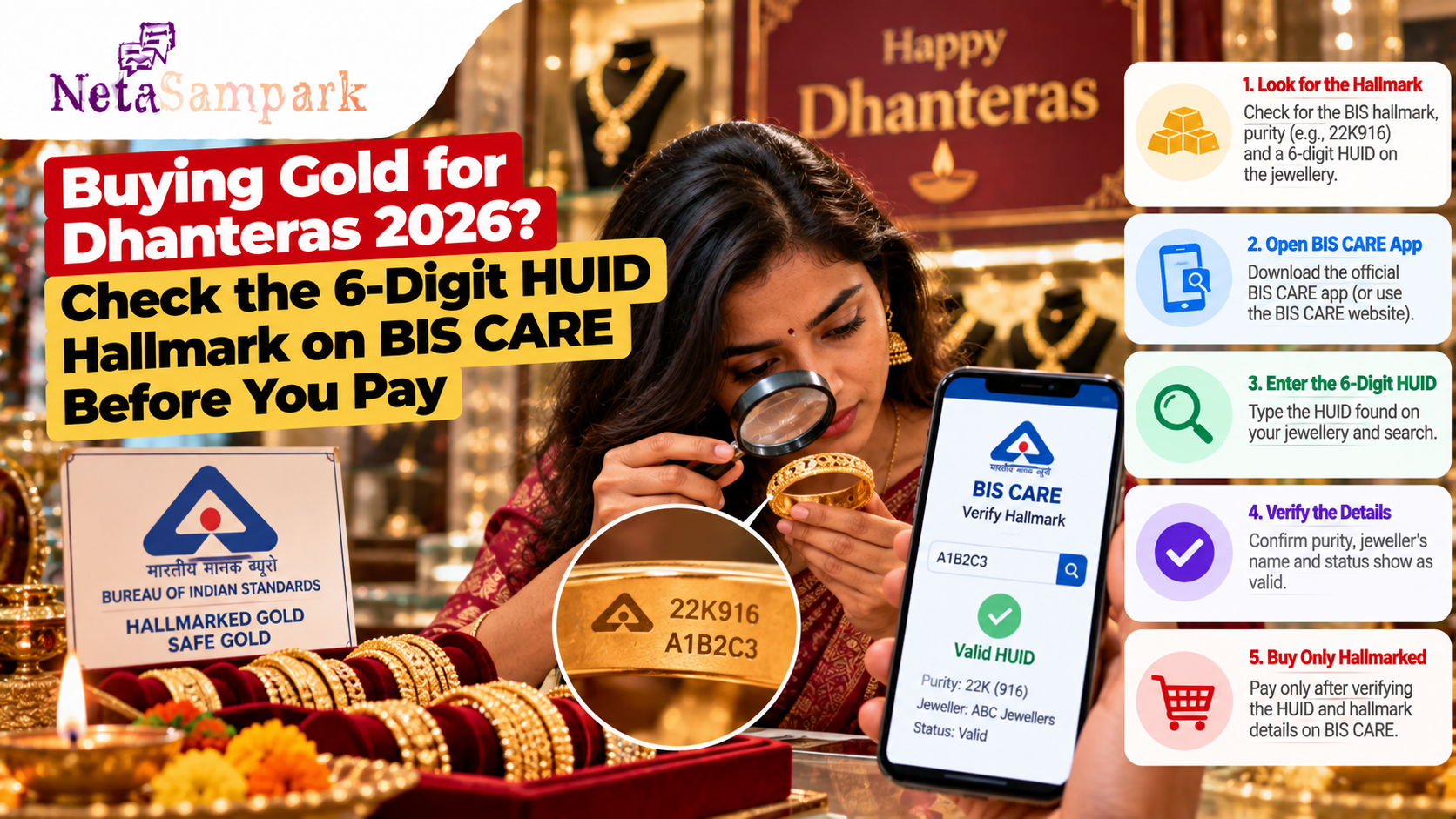
Buying Gold for Dhanteras 2026? Check the 6-Digit HUID Hallmark on BIS CARE Before You Pay
Dhanteras is one of India's biggest gold-buying occasions, but before paying for a new ring, chain, bangle or coin, there is one simple check every jewellery buyer should know: look for the BIS hallmark and verify the six-digit alphanumeric HUID on the BIS CARE app.
The Bureau of Indian Standards (BIS) says HUID stands for Hallmark Unique Identification. It is a unique six-digit alphanumeric code assigned to an individual hallmarked gold article and can be verified through the BIS CARE app. BIS
That verification can help you confirm the jewellery's recorded purity and jeweller-related information before you complete the purchase.
What is HUID?
HUID means Hallmark Unique Identification number.
For hallmarked gold jewellery introduced under the HUID system, the hallmark consists of three key components:
- BIS Standard Mark/logo
- Purity in carat and fineness
- Six-digit alphanumeric HUID
BIS says the HUID is unique to each hallmarked item and is traceable. BIS
For example, a piece could show a purity marking such as:
22K916
along with a six-character HUID such as:
A1B2C3
The example HUID above is only illustrative. Your jewellery will have its own unique code.
Don't check only for "916"
One common mistake is to look at a piece of jewellery and see 916 stamped on it, then assume that is enough.
It isn't the complete hallmark.
BIS says the post-HUID hallmark consists of the BIS logo, purity/fineness and six-digit alphanumeric HUID. BIS
So before buying, look for all three.
For example, on 22K gold you may see:
BIS logo + 22K916 + HUID
The jeweller should also be able to show you the hallmark using a suitable magnifying glass. BIS's consumer guidance says registered jewellers should display their BIS registration certificate and have a magnifying glass of at least 10X magnification to show the hallmark to customers. BIS
How to verify HUID on BIS CARE
The process is straightforward.
Step 1: Find the HUID on the jewellery
Ask the jeweller to show you the hallmark.
Look for the six-digit alphanumeric HUID.
It may be very small because the marking is placed on the jewellery itself.
Step 2: Open the official BIS CARE app
BIS CARE is the Bureau of Indian Standards' official consumer app.
It provides a "Verify HUID" feature specifically for hallmarked jewellery. BIS
Step 3: Enter the HUID
Open the HUID verification feature and enter the code exactly as marked on the jewellery.
Step 4: Check the returned information
The verification can provide information associated with the hallmarked article, including the jeweller registration details.
BIS says consumers can use the HUID feature to verify the authenticity of hallmarked gold jewellery and obtain information related to the jeweller's registration. BIS
Step 5: Check before paying
If the HUID cannot be verified or the information does not match the jewellery being offered, pause the purchase and ask the jeweller to explain the discrepancy.
Don't allow pressure from a salesperson to turn a verification step into an after-purchase exercise.
What should you check on the jewellery?
Use this quick checklist:
| What to check | What you are looking for |
|---|---|
| BIS mark | BIS Standard Mark/logo |
| Purity | Carat and fineness, such as 22K916 |
| HUID | Six-digit alphanumeric code |
| BIS CARE | HUID verification |
| Jeweller | BIS registration details |
| Bill | Correct description, weight and purity |
BIS says the bill for a hallmarked precious-metal article should include the description of each article, net precious-metal weight, purity in carat and fineness, and hallmarking charges. BIS
What do numbers like 22K916 and 18K750 mean?
The purity marking tells you the fineness of the gold.
For example:
- 14K585 = 14-carat gold, fineness 585
- 18K750 = 18-carat gold, fineness 750
- 20K833 = 20-carat gold, fineness 833
- 22K916 = 22-carat gold, fineness 916
- 23K958 = 23-carat gold, fineness 958
- 24KS995 = 24-carat gold, fineness 995
These are the gold grades BIS identifies as permitted for hallmarking under the relevant standard. BIS
So 22K916 does not mean the jewellery weighs 916 grams. It refers to the fineness of the gold.
Does every part of a jewellery set need a hallmark?
BIS consumer guidance says each article in a pair should have a hallmark.
For example, if you are buying earrings as a pair, don't assume that checking one earring is enough.
BIS also says each detachable part of jewellery should have hallmarking and fineness details. BIS
This is particularly relevant for complicated designs containing detachable components.
What about a necklace with multiple detachable pieces?
Ask the jeweller to show you the relevant hallmark markings on the individual detachable parts.
The purpose is to prevent a situation where a component is replaced with another piece of different purity.
BIS specifically advises consumers to check hallmarking and fineness details on detachable parts. BIS
Don't confuse hallmarking with making charges
A hallmark tells you about the purity/fineness of the precious metal. It does not tell you whether the jewellery is fairly priced.
Your final bill can include components such as:
- Gold value
- Making charges
- Wastage, where applicable
- GST and other applicable charges
BIS's consumer FAQ specifically notes that hallmarking charges do not include making charges or wastage charges. BIS
So verifying the HUID is only one part of checking a gold purchase.
You should separately compare:
Net gold weight × applicable gold rate + making/other charges + applicable taxes
with the final invoice.
Ask for a proper bill
Don't leave the jewellery shop with only a box and a payment receipt.
Get the proper invoice.
BIS says an authentic bill is important for dispute, misuse or complaint redressal, and that the bill should contain details of the hallmarked article. BIS
Before leaving the shop, check that the invoice corresponds to what you actually purchased.
Keep:
- Invoice
- Payment receipt
- Jewellery description
- Weight
- Purity
- HUID
- Any certificate supplied by the jeweller
Take a photograph of the invoice and hallmark for your own records as well.
What if the HUID doesn't verify?
Don't automatically assume that you have been cheated.
First:
- Check whether you entered the HUID correctly.
- Ask the jeweller to show the marking again.
- Compare the HUID on the article with the information being displayed.
- Ask the jeweller to explain any mismatch.
- If the issue remains unresolved, do not proceed with the purchase until you are satisfied.
You can also use BIS's consumer complaint channels where appropriate.
The important principle is simple:
A seller's verbal assurance should not replace an official verification check.
What if the jewellery has no HUID?
For a jewellery article that is required to carry the HUID-based hallmark, absence of the required marking is something you should question before buying.
However, hallmarking rules contain exemptions and their application can depend on the type of article and the applicable orders.
BIS maintains the current mandatory-hallmarking orders and phase-wise coverage, including amendments issued in 2026. BIS
So don't assume that every piece of gold sold anywhere in India is governed by exactly the same mandatory-hallmarking requirement.
If the seller says an item is exempt, ask why it is exempt and, if necessary, verify the applicable BIS rules.
What is the mandatory hallmarking system?
India's mandatory hallmarking framework has been introduced in phases.
BIS's current mandatory-hallmarking page lists amendments through 3 August 2026, showing that the coverage continues to be updated. BIS
BIS also published a sixth-phase expansion in March 2026 covering additional districts, including districts in Punjab, Uttar Pradesh, Maharashtra, Tripura, Bihar, Rajasthan and Madhya Pradesh. BIS
This means buyers should rely on the current BIS rules and coverage, rather than an old social-media list of mandatory-hallmarking districts.
What protection do you have if hallmarked gold is later found to be under-purity?
This is one of the important reasons to preserve your invoice.
BIS says that if hallmarked jewellery purchased by a consumer is subsequently found to have less purity than the purity marked on the jewellery, the buyer is entitled to compensation under the applicable rules.
The BIS consumer-protection guidance states that compensation is two times the amount of the difference calculated on the basis of the shortage of purity for the weight of the article sold, plus testing charges, subject to the applicable rules. BIS
A consumer can also have the jewellery/sample tested at a BIS-recognised Assaying and Hallmarking Centre, on a chargeable basis. BIS
That is why the bill and the jewellery's identification details matter.
Can you check old gold too?
Be careful here.
The HUID verification system is designed for hallmarked jewellery bearing a HUID.
If you are selling or evaluating old, inherited or previously purchased jewellery, don't assume that it will automatically have a current HUID.
BIS has separate procedures and guidance concerning testing of consumer jewellery, including old/unhallmarked articles. BIS
If you want to know the actual purity of old gold, a recognised testing facility can provide an assay rather than relying on a visual inspection.
Check the jeweller too
The jewellery itself isn't the only thing you can verify.
BIS maintains a list of BIS-licensed/registered jewellers. BIS
You can use BIS resources to check the jeweller's registration information.
A registered jeweller selling hallmarked precious-metal articles is responsible for the purity and fineness of the article under the applicable hallmarking framework. BIS
For a high-value Dhanteras purchase, it is sensible to deal with a properly registered jeweller and retain the documentation.
Five-minute Dhanteras gold-buying checklist
Before you pay, do this:
1. Inspect the jewellery
Look for:
BIS logo + purity/fineness + six-digit HUID
2. Verify the HUID
Open BIS CARE → Verify HUID.
3. Match the information
Make sure the verification relates to the article you are buying.
4. Check the bill
Confirm:
- Description
- Net weight
- Purity
- Hallmarking details/charges
- Price and applicable taxes
5. Keep the documents
Save the invoice and payment proof after purchase.
What you should not do
Don't buy simply because the shop says "BIS certified"
Ask to see the actual hallmark.
Don't treat "916" alone as sufficient
Look for the complete hallmark including the HUID where applicable. BIS
Don't skip HUID verification for an expensive purchase
It takes only a few minutes.
Don't leave without an invoice
BIS specifically recommends taking an authentic bill for hallmarked articles. BIS
Don't rely on a screenshot of someone else's HUID
Verify the code on the actual piece you are buying.
Don't share OTPs or banking credentials
BIS verification does not require you to hand over your UPI PIN, ATM PIN or internet-banking password to a jeweller.
The bottom line
Buying gold on Dhanteras can be a significant financial purchase, so don't make purity verification a matter of trust alone.
Before paying, look for the BIS hallmark and six-digit alphanumeric HUID, open the official BIS CARE app, use Verify HUID, check the returned details and make sure your invoice correctly records the jewellery's weight and purity. BIS
The simplest rule to remember this Dhanteras is:
See the hallmark. Find the HUID. Verify it on BIS CARE. Then pay.
For high-value purchases, keep the invoice, payment record and jewellery details safely. If a purity dispute arises later, those records can become important for testing and complaint redressal. BIS