
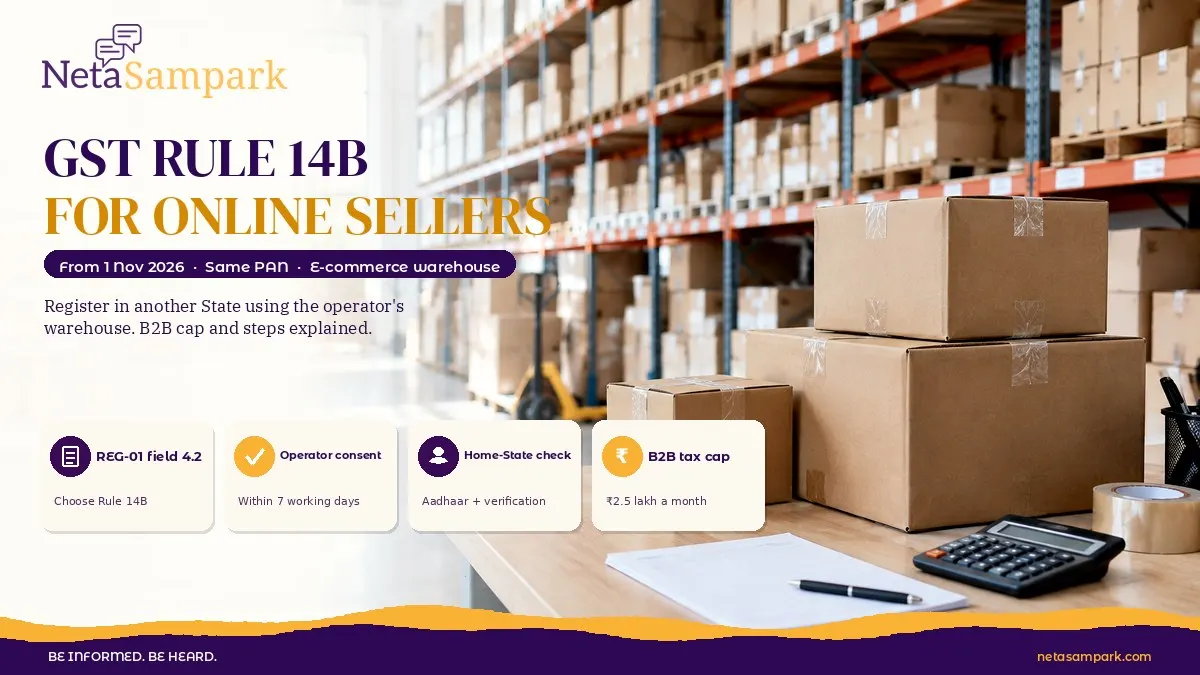
Small online sellers in India will soon have a simpler way to expand into other states without setting up their own office or warehouse there. New GST Rule 14B takes effect on 1 November 2026, allowing eligible sellers to use an e-commerce operator’s warehouse as their principal place of business in another state.
The change is especially relevant to small manufacturers, traders and online businesses selling goods through marketplaces. Instead of arranging a separate physical business location just to obtain GST registration in another state, eligible sellers can apply using the marketplace warehouse, subject to the prescribed conditions.
The Central Board of Indirect Taxes and Customs (CBIC) introduced the provision through the Central Goods and Services Tax (Amendment) Rules, 2026.
Here is how Rule 14B works, who qualifies, how to apply and what sellers should check before using this option.
1 What Is GST Rule 14B?
Rule 14B of the Central Goods and Services Tax (CGST) Rules, 2017, creates an optional registration route for certain suppliers selling goods through electronic commerce operators (ECOs).
An eligible seller who already has GST registration in a state where they have a physical presence can apply for another GST registration under the same PAN in a state where they do not have a physical presence.
The seller can declare a consenting e-commerce operator’s warehouse in that state as the Principal Place of Business (PPoB).
The rule is designed to reduce the cost and administrative burden of expanding through online marketplaces.
Effective date: 1 November 2026.
Sources: CBIC Notification No. 05/2026–Central Tax and Press Information Bureau — GST reforms.
2 Who Can Apply Under Rule 14B?
The scheme is optional, but sellers must satisfy the prescribed conditions.
| Requirement | What it means |
|---|---|
| Existing GST registration | You must already have regular GST registration in a home state where you have a physical presence. |
| Same PAN | The registration in the additional state must use the same Permanent Account Number. |
| No physical presence in the new state | The scheme is intended for states or Union Territories where you do not have a physical presence. |
| Eligible e-commerce operator | You must intend to supply goods through an e-commerce operator required to collect tax at source under Section 52 of the CGST Act. |
| Monthly tax liability limit | The specified output tax liability on relevant supplies to registered persons must not exceed ₹2.5 lakh per month. |
| Warehouse consent | The e-commerce operator must consent to its warehouse being declared as your principal or additional place of business. |
| Verification | The prescribed Aadhaar authentication and home-state verification requirements must be fulfilled. |
The ₹2.5 lakh threshold concerns the specified output tax liability on supplies to registered persons, excluding persons registered under the same PAN. It is not a general limit on turnover or total online sales.
The scheme is intended for eligible suppliers of goods, not a general registration shortcut for businesses supplying only services.
Source: PIB FAQs on simplified registration for e-commerce sellers.
3 What Does the ₹2.5 Lakh Monthly Limit Mean?
The monthly threshold is one of the most important conditions under Rule 14B.
The relevant test concerns the total output tax liability comprising central tax, state or Union Territory tax, and integrated tax on the specified supplies to registered persons, excluding supplies to persons registered under the same PAN.
For example, a seller may operate from Karnataka and use a consenting marketplace warehouse in Maharashtra. Before applying for registration in Maharashtra under Rule 14B, the seller must assess whether the relevant monthly output tax liability stays within the prescribed ₹2.5 lakh limit.
This is a tax-liability test, not a statement that the seller can make only ₹2.5 lakh worth of sales each month.
Sellers should calculate the relevant liability using their actual transactions and seek professional tax advice if their sales mix includes interstate supplies, business-to-business sales or stock transfers.
4 How to Apply for GST Registration in Another State
Eligible sellers must apply through the official GST common portal using FORM GST REG-01.
Step-by-step application process
- Visit the GST common portal.
- Start the registration application for the state or Union Territory where you want the additional registration.
- Select the option for registration under Rule 14B, as provided in the registration form.
- Enter the GSTIN associated with your existing home-state registration under the same PAN.
- Provide the address and particulars of the e-commerce operator's warehouse to be declared as the Principal Place of Business.
- Provide details of other eligible e-commerce warehouses in that state or Union Territory that you want to declare as Additional Places of Business.
- Complete the required application fields and submit the form.
- Complete the prescribed verification and respond to any requests from the authorities.
The application is forwarded to the relevant e-commerce operator for consent regarding the proposed warehouse address.
The operator must decide on the consent request within seven working days of receiving the application. The application then proceeds through the prescribed verification process.
The seven-working-day period applies to the operator's consent decision; it should not be treated as a guarantee that the complete GST registration will be issued within seven days.
Official resource: GST Portal.
5 Can You Use Amazon, Flipkart or Another Marketplace Warehouse?
The rule refers to an electronic commerce operator required to collect tax at source under Section 52 of the CGST Act. Whether a particular marketplace warehouse qualifies depends on the operator, the warehouse arrangement and the operator's consent.
Do not assume that every fulfilment centre or third-party logistics warehouse automatically qualifies.
Before applying, ask the marketplace or its seller-support team:
- Whether it supports Rule 14B registrations.
- Which warehouse address can be used as the Principal Place of Business.
- Whether the operator will provide the required consent through the GST system.
- What documentation it requires from the seller.
- How it handles requests to add another warehouse as an Additional Place of Business.
The rule requires the e-commerce operator's consent. A seller cannot simply enter a warehouse address without the required approval.
6 What Verification Is Required?
Rule 14B includes verification requirements in the seller's home state.
The prescribed process includes biometric-based Aadhaar authentication, photograph and verification of original documents, as well as physical verification of the Principal Place of Business in the home state where the relevant checks have not already been completed.
The exact steps depend on the applicable provisions and the seller's existing registration and verification status.
Applicants should ensure that their home-state registration details are accurate and that they can complete any verification requested through the portal or the jurisdictional tax officer.
7 Can You Sell Outside the E-commerce Marketplace?
No. The Rule 14B registration is intended for supplies made exclusively through eligible e-commerce operators.
A seller using this registration cannot use it as a general registration for independent sales outside the eligible marketplace arrangement.
For example, a seller registered under Rule 14B in Maharashtra may use the registration for eligible supplies through the consenting e-commerce operator. The seller should not assume that the same registration automatically permits direct offline sales or other non-eligible supplies from that state.
If your business needs to sell through your own website, physical shops, distributors or other channels, consult a GST professional about the appropriate registration structure.
8 Can You Register More Than Once in the Same State?
Rule 14B permits one registration per PAN in a state or Union Territory under this scheme.
The seller can provide details of other eligible e-commerce warehouses in the same state as Additional Places of Business, subject to the applicable requirements.
This means sellers should plan their warehouse arrangements before applying rather than assuming that every marketplace warehouse requires a separate Rule 14B registration.
9 What Happens If the Marketplace Withdraws Its Consent?
A Rule 14B registration depends on the approved warehouse arrangement and the seller's qualifying home-state registration.
If the e-commerce operator withdraws its consent for using the warehouse as the Principal Place of Business or an Additional Place of Business, the seller must take the prescribed steps to amend the registration.
Where the operator withdraws consent, the seller is required to submit FORM GST REG-14 within 30 days to change the Principal Place of Business or Additional Place of Business, as applicable.
The rules also provide for electronic cancellation in specified circumstances if the seller fails to make the required changes, or if the qualifying home-state registration is cancelled.
Sellers should monitor communications from their marketplace and respond promptly to warehouse changes.
10 Does Rule 14B Remove Other GST Compliance Requirements?
No. This is a simplified route to registration, not an exemption from GST compliance.
Depending on the business and its transactions, sellers may still need to:
- Issue appropriate tax invoices.
- File the required GST returns.
- Pay applicable GST.
- Reconcile sales, tax collected at source and marketplace reports.
- Maintain books of account and transaction records.
- Comply with input tax credit requirements and other applicable provisions.
The new rule changes how eligible sellers can obtain registration in another state. It does not automatically remove their other obligations under the GST law.
Frequently Asked Questions
1. When does GST Rule 14B come into effect?
Rule 14B takes effect on 1 November 2026, under Notification No. 05/2026–Central Tax.
2. Can a small seller register in another state without renting an office?
Eligible sellers may use a consenting e-commerce operator's warehouse as their Principal Place of Business in a state where they have no physical presence, subject to Rule 14B.
3. Is ₹2.5 lakh the monthly sales limit?
No. It is the specified monthly output tax liability threshold for relevant supplies to registered persons, excluding persons registered under the same PAN. It is not a general sales-turnover cap.
4. Which form should I use?
The application is made in FORM GST REG-01 through the GST common portal.
5. How long does marketplace consent take?
The e-commerce operator must decide on the consent request within seven working days of receiving the application. This is not a guaranteed timeline for completing the entire registration.
6. Can I use the registration for offline sales?
The Rule 14B registration is intended for supplies exclusively through eligible e-commerce operators. Non-marketplace supplies cannot automatically be made under this registration.
7. Can I withdraw from Rule 14B later?
Yes. The rules provide for withdrawal from the scheme through FORM GST REG-32, subject to the applicable procedure and requirements.
Final Takeaway
GST Rule 14B, effective 1 November 2026, creates a new registration route for eligible small online sellers who want to expand into other states using an e-commerce operator's warehouse.
Before applying, confirm your existing home-state GST registration, the ₹2.5 lakh monthly output tax liability condition, marketplace consent and verification requirements. Use FORM GST REG-01 on the official GST portal, and remember that the registration is restricted to the eligible marketplace-based supply arrangement.
For the governing rules and the latest application instructions, consult CBIC and the GST common portal.
This article is for general information and is based on the notified CGST amendment rules and official explanatory material available in October 2026. Check the applicable notification and consult a qualified GST professional before making registration or compliance decisions.