
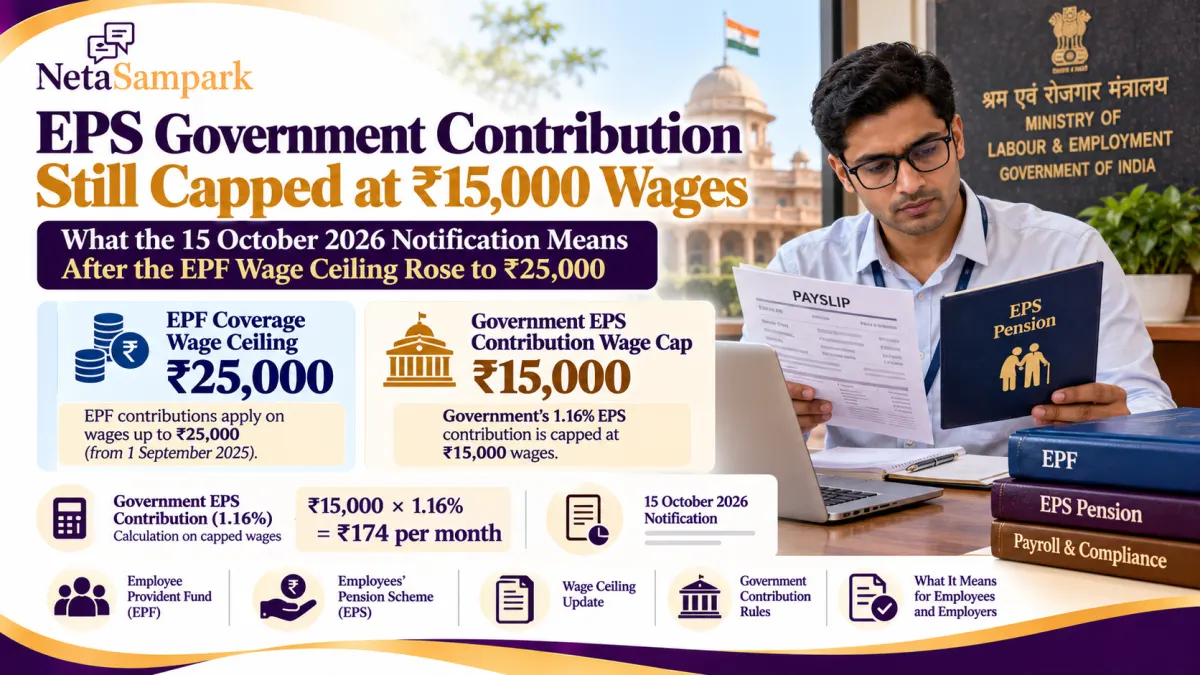
The EPF wage ceiling has increased from ₹15,000 to ₹25,000 per month from 17 September 2026. But a separate notification dated 15 October 2026 has clarified an important point: the government’s contribution to the Employees’ Pension Scheme (EPS) will still be calculated on wages up to ₹15,000 per month.
This means the higher wage ceiling does not automatically increase the government’s EPS contribution to every employee’s pension account.
Here is what the two changes mean for employees, employers and retirement planning.
What Changed in September and October 2026?
| Particular | Position |
|---|---|
| Earlier EPF wage ceiling | ₹15,000 per month |
| Revised EPF wage ceiling | ₹25,000 per month |
| Effective date of revised ceiling | 17 September 2026 |
| EPS government contribution rate | 1.16% |
| Wage limit for government’s EPS contribution | ₹15,000 per month |
| Maximum government EPS contribution under this limit | ₹174 per month |
| Relevant October notification | G.S.R. 890(E), dated 15 October 2026 |
The Ministry of Labour and Employment notified the revised ₹25,000 wage ceiling on 17 September 2026. The subsequent notification, G.S.R. 890(E), dated 15 October 2026, amended the Employees’ Pension Scheme, 2026 to specify that the government’s contribution is based on wages up to ₹15,000 per month.
The October notification states that the amendment takes effect from 17 September 2026.
Sources: PIB — EPFO wage ceiling enhanced to ₹25,000 | Notification details and text of G.S.R. 890(E)
What Is the Government’s EPS Contribution?
The Employees’ Pension Scheme provides pension benefits to eligible EPFO members, subject to the applicable rules.
Under the revised EPS framework, the government’s contribution is 1.16% of the relevant wages, but the 15 October notification limits the wages used for this calculation to ₹15,000 per month.
The calculation is:
₹15,000 × 1.16% = ₹174 per month
Even when an eligible employee’s wages are ₹20,000 or ₹25,000 per month, the government contribution under this provision remains capped at ₹174 per month.
This is the government’s contribution, not the total amount contributed by the employer towards EPS.
Why Did the EPF Wage Ceiling Rise to ₹25,000?
The government announced the higher ceiling to extend mandatory social-security coverage to more employees.
The revised limit can bring eligible employees earning between ₹15,000 and ₹25,000 per month into the statutory EPF framework, subject to the applicable membership rules.
The government estimated that the change could extend mandatory EPFO coverage to more than 51 lakh additional employees.
Eligible workers may receive access to provident fund savings, pension benefits and insurance protection under the applicable schemes.
Source: PIB — Cabinet approves enhancement of EPFO wage ceiling
Does the ₹25,000 Ceiling Increase the Employer’s EPS Contribution?
This is where employees need to distinguish between two separate contributions.
- Government’s EPS contribution: 1.16% of wages up to ₹15,000, capped at ₹174 per month.
- Employer’s EPS contribution: Generally calculated at 8.33% of pensionable wages for eligible EPS members, subject to the applicable scheme rules and wage ceiling.
The revised framework allows the employer’s EPS contribution for eligible members to be calculated using the higher wage ceiling, subject to the applicable provisions.
For example, an eligible employee with pensionable wages of ₹25,000 could have an employer EPS contribution of up to ₹2,082.50 a month at 8.33%, while the government contribution under the 1.16% provision remains ₹174.
These are separate amounts and should not be confused when checking a payslip or EPFO contribution record.
Source: PIB — EPFO explains the revised wage ceiling
Examples: How the Government Contribution Is Calculated
| Monthly wages | Wages considered for government EPS contribution | Government contribution at 1.16% |
|---|---|---|
| ₹10,000 | ₹10,000 | ₹116 |
| ₹15,000 | ₹15,000 | ₹174 |
| ₹20,000 | ₹15,000 | ₹174 |
| ₹25,000 | ₹15,000 | ₹174 |
These examples show only the government’s contribution under the 1.16% provision. They do not represent the employee’s EPF deduction or the employer’s EPS contribution.
What Does This Mean for Employees?
1. Higher wages do not mean a higher government EPS contribution
An eligible employee earning ₹25,000 per month should not assume that the government will contribute 1.16% of the full ₹25,000. Under the October notification, the government contribution remains calculated on wages up to ₹15,000.
2. The employer’s contribution is a separate matter
The employer’s EPS contribution follows its own rate and applicable pensionable-wage rules. Employees should check the employer contribution and government contribution separately rather than treating them as one amount.
3. Pension benefits are not determined by this contribution alone
The amount of pension an employee eventually receives depends on the applicable EPS provisions, pensionable wages, pensionable service and other eligibility requirements.
The October notification does not, by itself, announce a new pension calculation formula or guarantee a higher monthly pension.
4. Existing membership and eligibility rules still matter
The higher wage ceiling does not mean that every employee automatically becomes eligible for every EPS benefit in the same way. Membership status and the applicable rules must be considered.
Employees should ask their employer or EPFO office to clarify how the revised ceiling applies to their individual records.
What Should Employers Check?
Employers should review payroll and EPFO records to ensure that the revised wage ceiling is applied correctly from the effective date.
Important checks include:
- Identify eligible employees whose wages fall between ₹15,000 and ₹25,000.
- Review whether their EPF and EPS membership status needs updating under the revised rules.
- Apply the appropriate wage ceiling to the relevant contribution calculations.
- Check the allocation between EPF and EPS in the employer’s contribution.
- Ensure that electronic challan-cum-return (ECR) filings reflect the applicable rules.
- Keep payroll records and employee communication clear about the difference between government and employer contributions.
For September 2026, employers also need to follow the applicable instructions for calculating contributions across the period before and after 17 September.
Source: EPFO wage-ceiling FAQs and employer guidance
How Can Employees Check Their EPF and EPS Contributions?
Employees can review their available contribution records through the official EPFO services.
- Visit the EPFO website.
- Open the employee services section.
- Use the member passbook service, where available, to review contributions.
- Compare the recorded employee and employer contributions with your payslip.
- Contact your employer’s payroll team if the figures do not match.
- If the issue remains unresolved, seek clarification through EPFO’s official grievance channels.
Remember that the government’s 1.16% EPS contribution and the employer’s EPS contribution are different entries under the applicable framework. A payslip may not display every contribution in the same way as the member passbook.
Frequently Asked Questions
1. Has the EPF wage ceiling increased to ₹25,000?
Yes. The revised ceiling took effect on 17 September 2026, subject to the applicable membership and scheme rules.
2. Why is the government’s EPS contribution still based on ₹15,000?
The Ministry’s notification dated 15 October 2026 amended the Employees’ Pension Scheme, 2026 to limit the wages considered for the government’s 1.16% contribution to ₹15,000 per month.
3. What is the maximum government EPS contribution under this limit?
It is ₹174 per month, calculated as 1.16% of ₹15,000.
4. Does the ₹174 limit apply to the employer’s EPS contribution too?
No. The ₹174 figure relates to the government’s 1.16% contribution. The employer’s contribution is separate and follows the applicable EPS contribution rules.
5. Will the higher wage ceiling automatically increase my pension?
Not necessarily. Pension entitlement and calculation depend on the applicable rules, pensionable wages, pensionable service and eligibility conditions. The higher ceiling alone does not guarantee a higher pension.
6. Where can I check the official rules?
Start with the EPFO website and the Ministry of Labour and Employment’s official notifications. For the October amendment, refer to G.S.R. 890(E), dated 15 October 2026.
Final Takeaway
The September 2026 change raised the EPF wage ceiling from ₹15,000 to ₹25,000 per month to expand social-security coverage. The October notification clarified that the government’s 1.16% EPS contribution remains limited to wages of ₹15,000 per month, or ₹174 a month.
For employees and employers, the main point is to keep three things separate: the EPF coverage ceiling, the employer’s EPS contribution and the government’s EPS contribution.
Official reference: EPFO — Employees’ Provident Fund Organisation
This article is for general information and is not individual pension or legal advice. Refer to the latest Gazette notifications and EPFO instructions for the rules applicable to your membership and payroll records.