
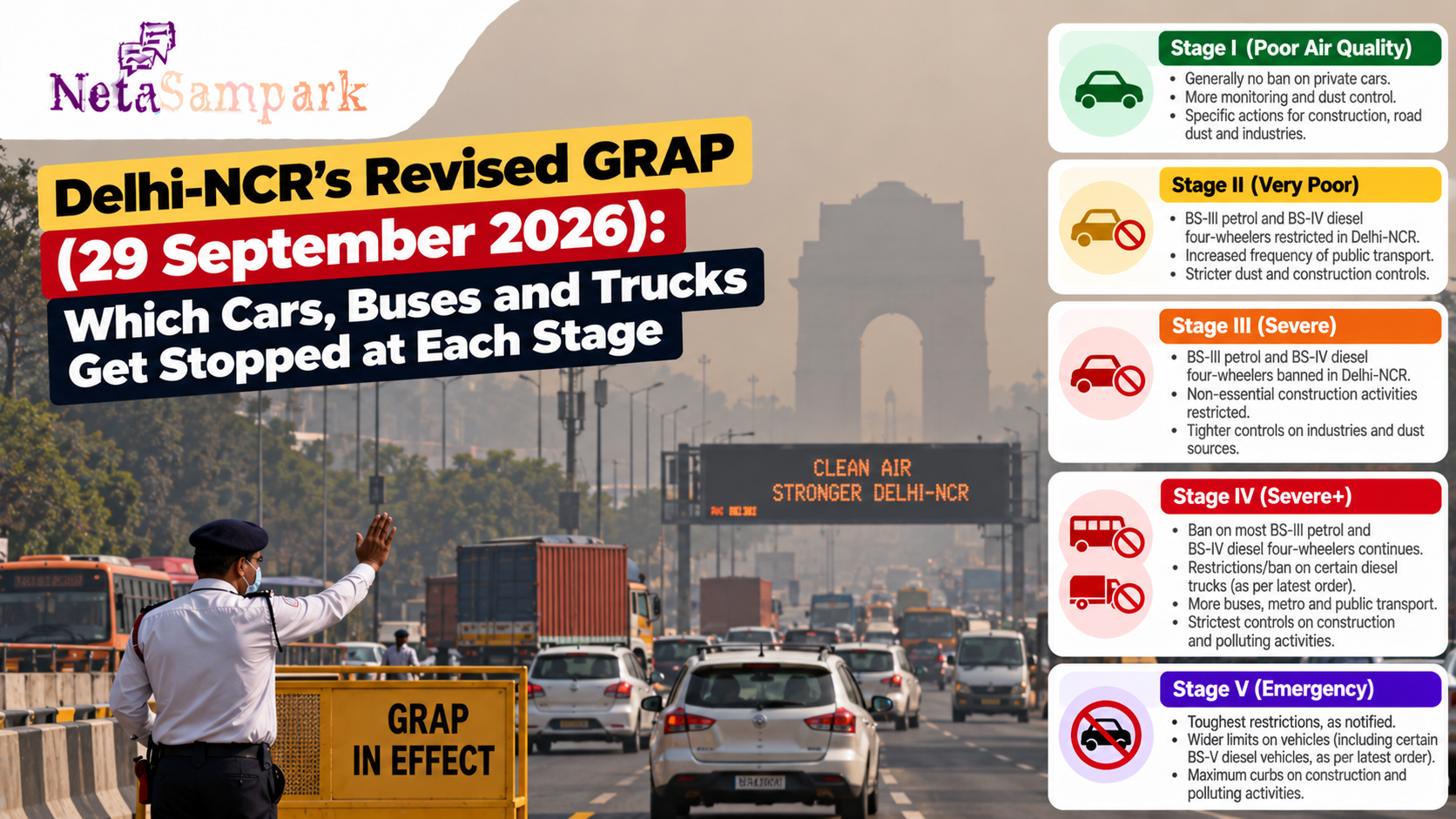
Delhi-NCR’s Revised GRAP (29 September 2026): Which Cars, Buses and Trucks Get Stopped at Each Stage
Delhi-NCR's Graded Response Action Plan (GRAP) has been revised ahead of the winter pollution season, and some vehicle restrictions will now kick in earlier than before.
The revised framework was approved by the Commission for Air Quality Management (CAQM) on 28 September 2026 and announced on 29 September. It contains 48 actions across four stages, linked to Delhi's air-quality levels. Press Information Bureau
The biggest changes for motorists and transport operators are:
- Restrictions on certain BS-IV-and-below buses move from Stage II to Stage I.
- BS-III petrol and BS-IV diesel four-wheelers face restrictions at Stage III in Delhi and five specified NCR districts, with Sonipat newly added.
- The exemption for older goods vehicles carrying essential commodities has been removed at Stages III and IV.
- Restrictions on certain BS-IV-and-below diesel goods vehicles entering Delhi are explicitly included in Stage III.
- Stage IV continues the strongest restrictions on truck traffic. Press Information Bureau
One important correction: the revised GRAP has four stages, not five. Stage IV is the highest GRAP stage.
First: Know the Four GRAP Stages
| Stage | Delhi AQI | Category |
|---|---|---|
| Stage I | 201–300 | Poor |
| Stage II | 301–400 | Very Poor |
| Stage III | 401–450 | Severe |
| Stage IV | Above 450 | Severe+ |
The stages are progressively stricter. When a higher stage is invoked, the measures from the lower stages continue unless specifically modified or withdrawn. CAQM's revised framework contains 25 actions under Stage I, 8 under Stage II, 10 under Stage III and 5 under Stage IV. Press Information Bureau
Stage I: Poor Air Quality — 201 to 300
This is where the revised GRAP starts affecting certain buses.
Which buses are restricted?
Under the revised schedule, inter-city and inter-state buses from Haryana, Uttar Pradesh, Rajasthan and adjoining states — Punjab, Himachal Pradesh, Madhya Pradesh, Uttarakhand and Jammu & Kashmir — are not permitted to ply in Delhi-NCR during Stage I if they are below the permitted cleaner standards.
The buses allowed under this restriction are:
- Electric
- CNG
- BS-VI diesel
The bus restriction was previously positioned at Stage II; CAQM has moved it to Stage I, bringing the measure into force earlier as pollution deteriorates. Press Information Bureau
What about private cars?
There is no blanket ban on private cars at Stage I under the revised GRAP.
However, authorities are required to enforce pollution-control measures, including PUCC requirements, and other Stage-I transport measures apply.
So:
Stage I does not mean "all old cars are stopped."
The specific BS-III petrol/BS-IV diesel car restriction comes later, at Stage III.
Stage II: Very Poor Air Quality — 301 to 400
Stage II adds stronger pollution-control measures, but it does not introduce a blanket ban on private cars.
The revised schedule has moved the certain bus restriction from Stage II to Stage I, so the bus rule described above is already applicable once Stage I is invoked. Press Information Bureau
What happens to private cars at Stage II?
There is no general Stage-II ban on BS-III petrol or BS-IV diesel private cars.
Instead, Stage II includes measures such as:
- increased use of public transport;
- higher parking charges to discourage private vehicle use;
- stronger dust and pollution controls;
- restrictions on pollution-generating activities.
Therefore, a BS-IV diesel car does not automatically become banned merely because GRAP reaches Stage II.
The specific four-wheeler restriction is a Stage III measure.
Stage III: Severe Air Quality — 401 to 450
This is where restrictions become much more important for car owners and goods-vehicle operators.
Which cars are restricted?
At Stage III, restrictions apply to:
BS-III petrol four-wheelers
and
BS-IV diesel four-wheelers
The restriction applies in:
- Delhi
- Gurugram
- Faridabad
- Ghaziabad
- Gautam Buddh Nagar
- Sonipat
Sonipat is the new addition under the 29 September 2026 revision. Previously, the high-vehicle-density districts covered by this provision were Gurugram, Faridabad, Ghaziabad and Gautam Buddh Nagar. Press Information Bureau
What about BS-VI cars?
The Stage III restriction described above does not cover BS-VI petrol/diesel cars merely because they are diesel or petrol.
Similarly, CNG and electric cars are not covered by this particular BS-III petrol/BS-IV diesel restriction.
The rule is based on the vehicle's fuel type and Bharat Stage emission standard, not simply its age.
Is every diesel car banned at Stage III?
No.
This is an important distinction.
The restriction targets BS-IV diesel and older-standard light motor vehicles, not every diesel vehicle.
For example:
| Vehicle | Stage III position |
|---|---|
| BS-III petrol car | Restricted in specified areas |
| BS-IV diesel car | Restricted in specified areas |
| BS-VI diesel car | Not covered by this particular car restriction |
| CNG car | Not covered by this particular restriction |
| Electric car | Not covered by this particular restriction |
The exact implementation can also depend on subsequent orders issued when a particular GRAP stage is invoked.
Stage III: What Happens to Goods Vehicles?
Stage III also brings stronger restrictions on goods vehicles.
The revised schedule specifically provides for restrictions on diesel-operated BS-IV-and-below light goods vehicles (LGVs) and medium goods vehicles (MGVs) registered outside Delhi entering Delhi. Press Information Bureau
The revision also removes the earlier exemption for BS-IV-and-below LGVs and MGVs carrying essential commodities.
That means an operator should not assume that carrying essential goods automatically provides an exemption at Stage III.
The revised GRAP is stricter on this point. Press Information Bureau
Stage IV: Severe+ — Above 450
Stage IV is the highest GRAP stage.
This is where restrictions on trucks become the most significant.
Which trucks are stopped?
Stage IV provides for stopping truck traffic entering Delhi, subject to the cleaner-vehicle categories allowed under the revised framework.
Cleaner trucks such as:
- CNG
- LNG
- Electric
- BS-VI diesel
are permitted under the relevant truck-entry provision. CAQM
The revised 2026 schedule also removes the earlier exemption for BS-IV-and-below trucks/HGVs carrying essential commodities under Stage IV. Press Information Bureau
So an older diesel truck cannot assume that an essential-goods load will automatically allow entry once Stage IV is imposed.
What about Delhi-registered heavy goods vehicles?
Stage IV also applies strong restrictions to Delhi-registered diesel BS-IV-and-below Heavy Goods Vehicles (HGVs).
The cleaner categories remain treated differently under the applicable provisions.
The distinction between:
- entry of trucks into Delhi, and
- movement of Delhi-registered HGVs within Delhi
is important because they are separate provisions of the GRAP framework. CAQM
The Biggest 2026 Changes at a Glance
| Vehicle | Stage I | Stage II | Stage III | Stage IV |
|---|---|---|---|---|
| Normal private car | Generally allowed | Generally allowed | Depends on fuel/BS standard | Restrictions may intensify under invoked measures |
| BS-III petrol car | Allowed under this specific GRAP restriction | Allowed under this specific GRAP restriction | Restricted in Delhi + 5 specified districts | Stage III restrictions continue unless modified |
| BS-IV diesel car | Allowed under this specific GRAP restriction | Allowed under this specific GRAP restriction | Restricted in Delhi + 5 specified districts | Stage III restrictions continue unless modified |
| BS-VI/CNG/EV car | Not covered by this specific car ban | Not covered by this specific car ban | Not covered by this specific car ban | Not covered by this specific car ban |
| Certain BS-IV-and-below inter-state/inter-city buses | Restricted | Stage-I restriction continues | Stage-I restriction continues | Stage-I restriction continues |
| BS-VI/CNG/EV buses | Allowed under bus provision | Allowed | Allowed | Subject to any additional orders |
| Outside-Delhi diesel BS-IV-and-below LGV/MGV | No Stage-III restriction yet | No Stage-III restriction yet | Entry into Delhi restricted | Higher-stage restrictions apply |
| BS-IV-and-below trucks/HGVs | No Stage-IV truck ban yet | No Stage-IV truck ban yet | Stage-IV truck restriction not yet triggered | Strong entry/movement restrictions |
| CNG/LNG/EV/BS-VI diesel trucks | Generally permitted under relevant provisions | Generally permitted | Generally permitted | Permitted under truck-entry provision |
The table simplifies the framework for everyday use; separate CAQM directions can impose additional restrictions outside GRAP or modify implementation for a specific period. Press Information Bureau
What Changed for Buses?
The bus change may affect commuters before the car restrictions do.
Previously, restrictions on certain BS-IV-and-below inter-city/inter-state buses came at Stage II. Under the revised framework, they have moved to Stage I.
The geographical coverage has also been expanded.
The affected originating states include:
- Haryana
- Uttar Pradesh
- Rajasthan
- Punjab
- Himachal Pradesh
- Madhya Pradesh
- Uttarakhand
- Jammu & Kashmir
The cleaner alternatives allowed under this provision are:
EV + CNG + BS-VI diesel buses. The Times of India
This means bus operators should check the active GRAP stage before planning services into Delhi-NCR.
What Changed for Cars?
For private motorists, the most important change is the addition of Sonipat.
At Stage III, BS-III petrol and BS-IV diesel four-wheelers are now subject to restrictions in:
Delhi + Gurugram + Faridabad + Ghaziabad + Gautam Buddh Nagar + Sonipat. Press Information Bureau
This is not a blanket restriction on every petrol or diesel car.
A BS-VI vehicle, CNG vehicle or EV is not covered by this particular restriction.
What Changed for Trucks?
There are two important developments.
1. Stage III
The revised GRAP explicitly restricts entry into Delhi of diesel BS-IV-and-below LGVs and MGVs registered outside Delhi.
2. Stage IV
Restrictions become stronger for trucks and HGVs, and the previous essential-commodity exemption for BS-IV-and-below vehicles has been removed under the revised Stage-IV framework. Press Information Bureau
This is particularly important for logistics operators because an older vehicle carrying essential goods should not be assumed to have an automatic GRAP exemption.
Don't Confuse GRAP With the Separate Year-Round Goods-Vehicle Rule
There is another CAQM direction that operates separately from the GRAP schedule.
CAQM's Direction No. 88 restricts the entry of certain older commercial goods vehicles into Delhi outside the GRAP framework. The broader rule provides for cleaner vehicles — including BS-VI, CNG, LNG and electric goods vehicles — while older categories face restrictions. CAQM
There was also a transitional arrangement for BS-IV commercial goods vehicles that was scheduled to run through 31 October 2026.
Therefore, a truck operator should ask two separate questions:
- Is my vehicle permitted under the standing CAQM goods-vehicle directions?
- Is an additional GRAP restriction currently active?
Passing one test does not necessarily mean the vehicle can enter Delhi.
What About PUCC?
The revised GRAP should also be read alongside CAQM's separate "No PUCC, No Fuel" direction.
A vehicle owner should therefore keep the Pollution Under Control Certificate valid even when a particular GRAP stage has not yet triggered a vehicle-specific restriction.
A valid PUCC, however, does not override a GRAP restriction that applies to your vehicle category.
For example, if a BS-IV diesel car falls under a Stage III restriction, having a valid PUCC does not by itself cancel that restriction. The vehicle's emission standard remains relevant. Press Information Bureau
Are the GRAP Restrictions Automatically Active Every Day?
No.
GRAP is a graded response system.
The restrictions become applicable when the relevant GRAP stage is invoked by the competent authorities based on air-quality conditions and forecasts.
So seeing the Stage III rules published does not mean that every BS-IV diesel car is permanently banned.
The practical question is:
Which GRAP stage is currently in force?
CAQM issues orders when stages are invoked or revoked.
The CAQM website provides the current GRAP status and publishes invocation/revocation orders. CAQM
What Should Car Owners Check Before Driving?
If you drive in Delhi-NCR during the pollution season, keep these details handy:
For private cars
- Fuel: petrol, diesel, CNG or electric
- Bharat Stage: BS-III, BS-IV, BS-VI etc.
- Registration location
- Current GRAP stage
- Current PUCC
- Whether your route enters one of the districts covered by a specific restriction
For commercial vehicles
Also check:
- Vehicle category: LGV/MGV/HGV
- Delhi or outside-Delhi registration
- BS emission standard
- Fuel type
- Whether the vehicle is carrying essential commodities
- Whether a separate CAQM direction applies
What Should Bus Operators Check?
Before operating an inter-state or inter-city service into Delhi-NCR, verify:
- originating state;
- bus fuel;
- Bharat Stage standard;
- whether the current GRAP stage is Stage I or higher;
- whether the service falls within the affected bus category.
Under the revised framework, waiting for Stage II is no longer enough for certain older buses because the restriction has moved to Stage I. Press Information Bureau
What Should Truck Operators Check?
For a goods vehicle, check the vehicle's:
Registration + vehicle category + fuel + BS standard + destination + current GRAP stage.
Do not rely solely on the fact that the truck is carrying:
- food;
- medicines;
- other essential commodities;
- essential services equipment.
The revised 2026 GRAP removes specific essential-commodity exemptions for older goods vehicles at Stages III and IV. Press Information Bureau
Cleaner vehicles such as BS-VI, CNG, LNG and EVs receive different treatment under the applicable provisions.
What Happens to Construction and Dust Controls?
GRAP is not only about vehicles.
The revised schedule merges several repeated measures on:
- road dust;
- construction and demolition;
- municipal solid waste;
- transport;
- open burning;
- diesel generator sets.
CAQM has also strengthened web-portal-based monitoring of eligible construction and demolition projects beyond municipal limits while retaining the 500-square-metre threshold and other applicable requirements. Press Information Bureau
At Stage III and IV, construction and demolition restrictions become substantially stronger.
A limited relaxation at Stage III allows certain pothole repair work, despite broader restrictions on construction and demolition activities. Press Information Bureau
The Simplest Way to Remember the New GRAP
Think of the 2026 changes this way:
Stage I — Watch the buses
Certain older inter-city/inter-state buses are restricted earlier, with EV/CNG/BS-VI buses allowed under the specified provision.
Stage II — More pollution controls
No blanket private-car ban, but stronger measures to discourage private transport and control pollution.
Stage III — Watch your car and goods vehicle
BS-III petrol + BS-IV diesel four-wheelers face restrictions in Delhi and five specified NCR districts.
Older diesel LGVs/MGVs also face restrictions on entry into Delhi.
Stage IV — Watch the trucks
Truck entry is heavily restricted, with cleaner categories such as CNG, LNG, EV and BS-VI diesel treated differently.
GRAP 2026: Quick Citizen Checklist
Before leaving home during a high-pollution episode:
- Check the current GRAP stage.
- Check your car's fuel type.
- Check its Bharat Stage standard.
- Check whether your district is covered by the restriction.
- Keep your PUCC valid.
- If travelling by bus, check whether it is EV/CNG/BS-VI where the Stage-I restriction applies.
- If operating a goods vehicle, check LGV/MGV/HGV classification.
- Check whether a separate CAQM vehicle-entry direction applies.
- Do not assume an "essential goods" load automatically gives an exemption.
- Check CAQM orders before a long-distance commercial trip.
Bottom line
The 29 September 2026 GRAP revision brings several transport restrictions forward and removes some exemptions. The most immediate change is that certain BS-IV-and-below inter-city/inter-state buses are now restricted from Stage I, rather than Stage II. At Stage III, BS-III petrol and BS-IV diesel four-wheelers face restrictions in Delhi, Gurugram, Faridabad, Ghaziabad, Gautam Buddh Nagar and newly added Sonipat. Stage III also restricts specified older diesel LGVs/MGVs entering Delhi. At Stage IV, truck and HGV restrictions become much stronger, with the earlier essential-commodity exemption for older goods vehicles removed. Press Information Bureau
Most importantly, GRAP has four stages, not five, and the rules are not permanently active at their maximum level. What affects you on a particular day depends on which stage CAQM has actually invoked and whether separate CAQM directions also apply to your vehicle. CAQM