
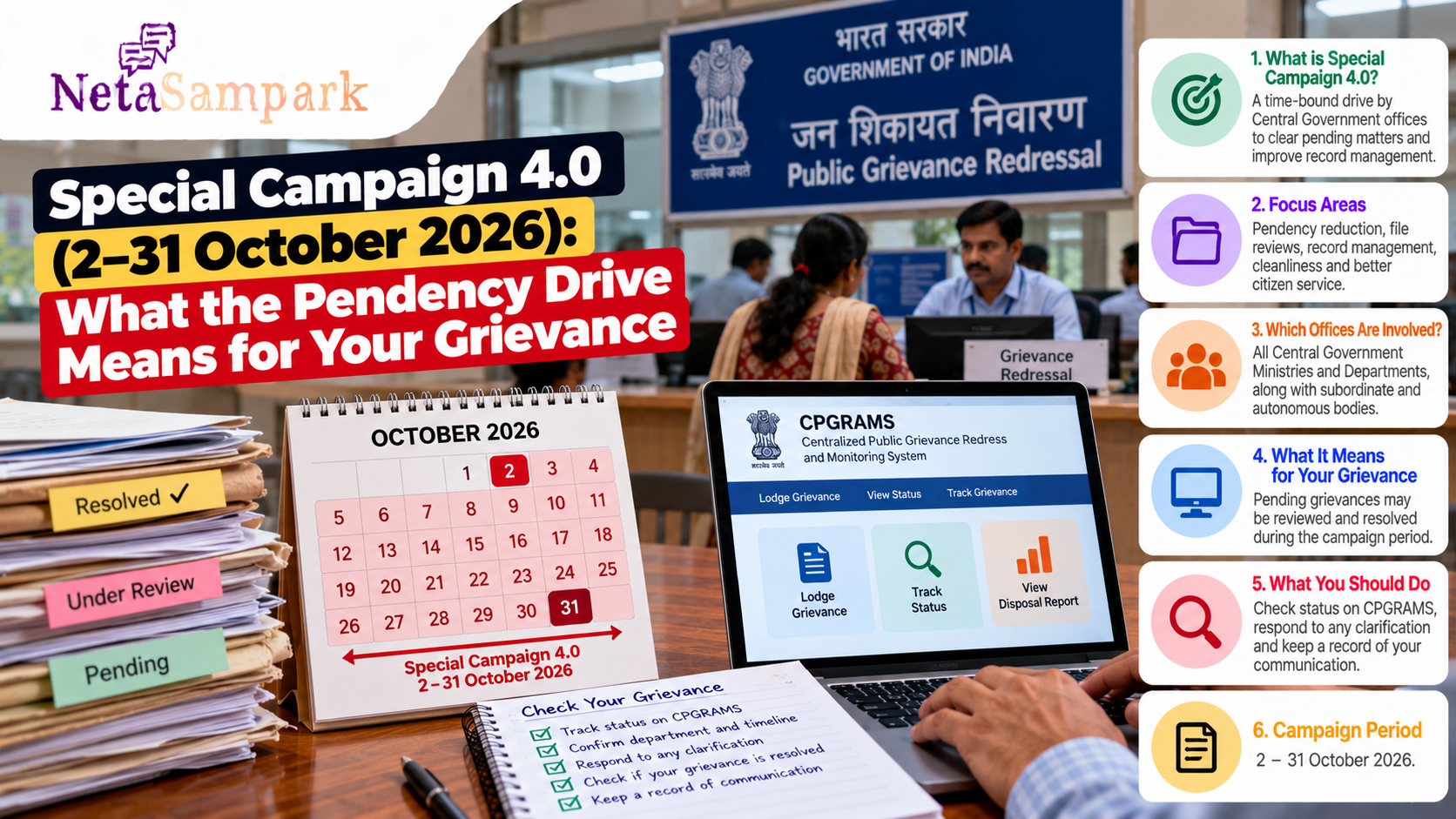
Special Campaign 6.0 (2–31 October 2026): What the Pendency Drive Means for Your Grievance
If you have a pending government grievance, October 2026 is worth watching.
But first, an important correction: the campaign running from 2 to 31 October 2026 is Special Campaign 6.0, not Special Campaign 4.0. Special Campaign 4.0 was conducted in October 2024. The 2026 campaign is the sixth edition of the annual drive led by the Department of Administrative Reforms and Public Grievances (DARPG). Press Information Bureau
For citizens, one part matters more than office cleanliness: government departments are specifically identifying and targeting pending public grievances and grievance appeals for disposal. Press Information Bureau
What is Special Campaign 6.0?
Special Campaign 6.0 is a Government of India drive running from 2 October to 31 October 2026 to reduce pendency and improve the functioning of government offices.
The campaign covers:
- Pending public grievances
- Public grievance appeals
- References from Members of Parliament
- State Government references
- PMO references
- Inter-ministerial matters
- Pending Parliamentary Assurances
- Record management and disposal of obsolete records
- Office-space management
- Scientific collection and disposal of e-waste
The 2026 campaign has also placed particular emphasis on effective collection, segregation and disposal of e-waste. Field and outstation offices that have direct public interaction are also receiving attention. Press Information Bureau
The preparatory phase ran from 15 to 30 September 2026, during which departments identified pending matters and set targets for the implementation phase. Press Information Bureau
What does this mean if your grievance is already pending?
It does not mean that every pending grievance will automatically be resolved during October.
Instead, departments are being asked to identify their pending workload and set disposal targets. Public grievances and appeals are specifically among the categories being targeted.
For example, the Ministry of Panchayati Raj has identified 176 Public Grievances and 100 Public Grievance Appeals for disposal during its Special Campaign 6.0 implementation phase. Press Information Bureau
The Department of Pension & Pensioners' Welfare has set targets of 6,500 public grievances and 800 appeals for its campaign activities. Press Information Bureau
This means an existing grievance can come under closer review during the campaign, but there is no government-wide guarantee that your individual case will be disposed of by 31 October.
If your grievance is on CPGRAMS, check its status now
The Centralized Public Grievance Redress and Monitoring System (CPGRAMS) allows citizens to lodge grievances concerning public-service delivery and track them using the registration number.
The portal also provides an appeal mechanism if you are dissatisfied with the grievance resolution. PG Portal
Before assuming that nothing is happening, check:
- Your CPGRAMS registration number
- The department to which the grievance has been assigned
- Current status
- Whether the department has requested clarification or documents
- Whether a disposal/reply has already been uploaded
A pending grievance is not the same as a rejected grievance
This distinction is important.
A grievance may remain pending because:
- The department is examining the matter.
- Another office has to provide information.
- Additional documents are required.
- The matter has been transferred to the appropriate authority.
- The issue involves a policy or legal question.
- The department has not yet completed its internal action.
DARPG's grievance guidelines state that grievances should be resolved as promptly as possible and normally within a maximum of 30 days. Where resolution is not possible within that period—for example, because of matters such as policy issues or sub-judice proceedings—an appropriate or interim reply should be provided. PG Portal
So an old grievance should not simply be ignored because a campaign is underway.
What you should do during October
1. Check your CPGRAMS status
If you filed a grievance earlier, log in and check the latest status.
Don't rely only on an old SMS or email.
The CPGRAMS dashboard itself provides department-wise information on received, disposed and pending grievances, including different pendency-age categories. PG Portal
2. Look for a request for clarification
CPGRAMS provides a mechanism through which the grievance officer can seek additional information or documents from a citizen.
If such a request appears, respond with the requested information instead of allowing the grievance to remain unresolved. DARPG
3. Keep your supporting documents ready
Depending on the grievance, keep copies of:
- Previous applications
- Acknowledgements
- Orders or notices
- Bills or receipts
- Identity or beneficiary documents where relevant
- Photographs
- Department correspondence
- Previous grievance numbers
- Relevant certificates or records
Don't upload unnecessary personal information. Provide only documents relevant to the grievance.
4. Check whether a reply has actually addressed your complaint
A grievance being marked disposed does not necessarily mean that the underlying problem has been solved to your satisfaction.
Read the department's response carefully.
Ask:
- Did they answer the specific issue I raised?
- Did they explain what action was taken?
- Did they identify the responsible office?
- Did they provide a practical next step?
- Did they simply forward or close the complaint without addressing the substance?
What if the grievance is closed but you are not satisfied?
CPGRAMS provides an appeal facility for citizens who are dissatisfied with the resolution.
The system allows you to provide feedback after closure. If the feedback is rated Poor, the appeal option is enabled according to DARPG's CPGRAMS framework. DARPG
You can also track an appeal separately through the portal.
The appeal is important because the campaign is not merely about reducing the number of cases shown as pending. The objective of grievance redressal is to provide a meaningful response to the citizen.
Does Special Campaign 6.0 change the normal grievance rules?
No.
The campaign is an administrative drive to accelerate disposal of pending matters. It does not replace the ordinary grievance process or create a new right to automatic approval of your claim.
For example, if your grievance concerns:
- A subsidy,
- Pension,
- Government certificate,
- Benefit payment,
- Service delivery,
- Delayed application,
- Government employee-related service,
- Scheme implementation,
the department must still examine it according to the applicable law, rules and scheme conditions.
The campaign can increase administrative attention to pending cases, but it cannot legally require a department to approve something that you are not otherwise entitled to receive.
Don't file a duplicate grievance just because of the campaign
If you already have a valid CPGRAMS complaint, don't automatically submit another identical complaint simply because Special Campaign 6.0 has started.
Instead:
Existing grievance → Check status → Respond to clarification → Wait for disposal → Appeal if necessary
Creating multiple identical complaints can make it harder to follow the history of the matter.
If the situation has materially changed, however, provide the new information through the appropriate mechanism.
What if your grievance is already very old?
This is where the campaign may be particularly relevant.
CPGRAMS' current dashboard separates pending grievances into age categories such as:
- 0–60 days
- 60–180 days
- 180–365 days
- More than one year
This allows citizens to see that pendency is not simply a single number; older cases are separately visible in the monitoring system. PG Portal
If your complaint has been pending well beyond the normal redressal timeline, keep your original registration number and correspondence and check whether an appeal or reminder option is available.
What the campaign does — and does not — promise
| What Special Campaign 6.0 does | What it does not do |
|---|---|
| Targets pending government matters | Guarantee disposal of every grievance |
| Includes public grievances and appeals | Automatically approve a citizen's claim |
| Encourages time-bound disposal | Replace applicable laws or scheme rules |
| Strengthens monitoring of pendency | Guarantee a favourable decision |
| Runs from 2–31 October 2026 | End all grievance processes on 31 October |
A five-minute checklist for citizens
If you have a pending government grievance, do this during the campaign:
☐ Find your CPGRAMS registration number
☐ Check the current status
☐ Check whether clarification/documents have been requested
☐ Read any disposal response carefully
☐ Use the appeal mechanism if the response does not resolve the grievance
Keep screenshots or downloaded copies of important status updates and replies for your records.
The bigger point
Special Campaign 6.0 is not a separate complaint mechanism for citizens. It is an administrative pendency-reduction drive.
Its relevance to you is that public grievances and grievance appeals are explicitly among the matters departments are identifying for disposal during the October campaign. Press Information Bureau
So if you already have a pending grievance, October is a good time to check its status rather than simply waiting.
And if a department closes the complaint without actually addressing the issue, remember that CPGRAMS provides an appeal route.
Bottom line: If your government grievance is pending, check CPGRAMS now, respond promptly to any clarification request, preserve the record of your case, and examine the department's reply before accepting the grievance as genuinely resolved.