
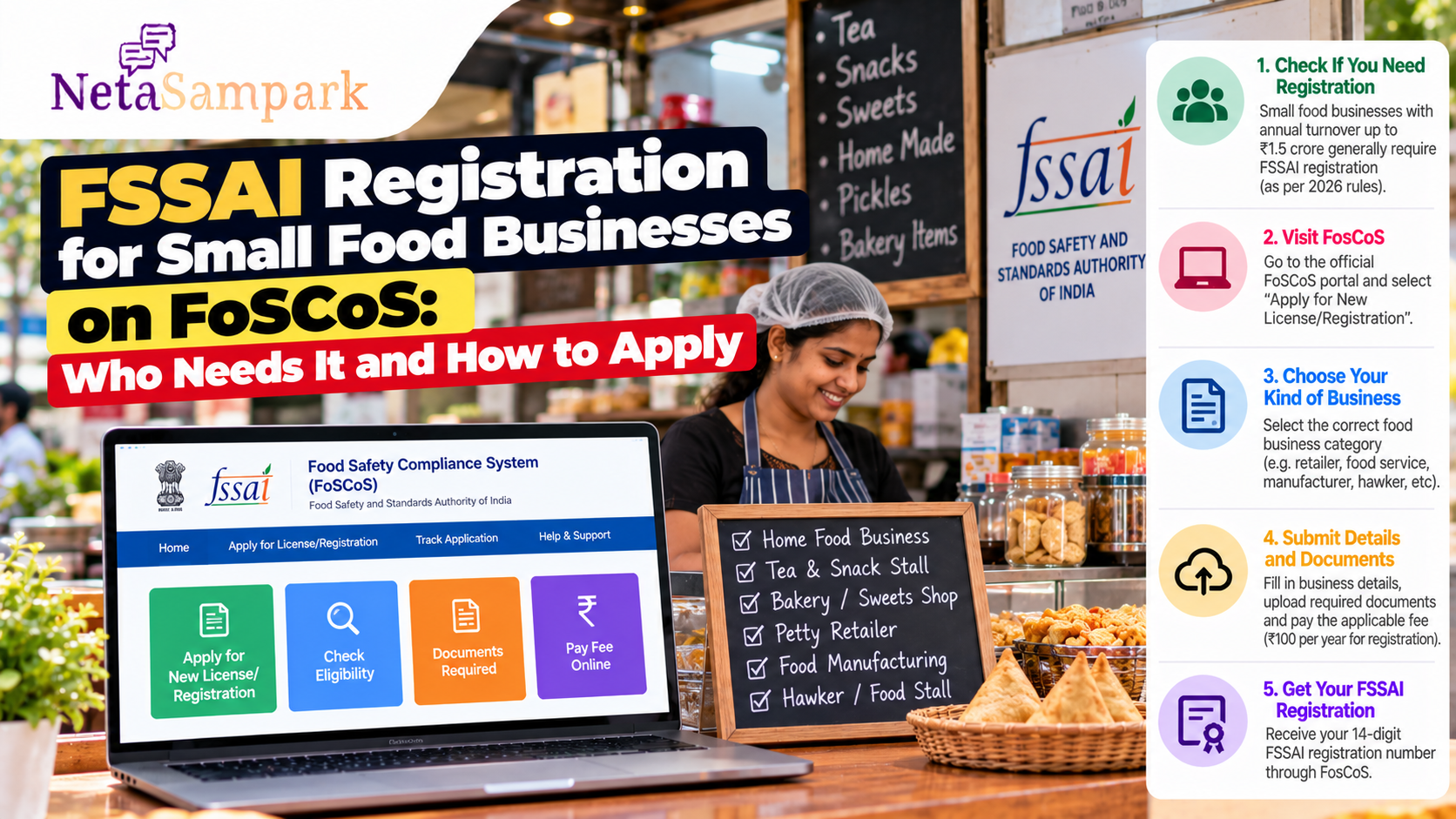
FSSAI Registration for Small Food Businesses on FoSCoS: Who Needs It and How to Apply
If you run a small food business in India — such as a home-based food business, tea or snack stall, petty retailer, hawker, small bakery, sweets shop or temporary food stall — you may need FSSAI registration before carrying on the business.
There is also an important change to know in 2026: FSSAI revised the turnover thresholds from 1 April 2026. For new applications, food businesses with annual turnover up to ₹1.5 crore fall under the registration category. Businesses above ₹1.5 crore and up to ₹50 crore generally fall under a State licence, while those above ₹50 crore generally require a Central licence, subject to the specific kind of business and applicable eligibility criteria. FSSAI
Applications are made through FSSAI's Food Safety Compliance System (FoSCoS).
What is FSSAI registration?
Under Section 31 of the Food Safety and Standards Act, 2006, food business operators are required to be licensed or registered under the FSSAI framework. Registration is the basic category intended for eligible smaller food businesses. FSSAI
The registration certificate is issued through FoSCoS and carries a 14-digit registration number. FSSAI
It is important to distinguish registration from an FSSAI licence. Simply being a small business does not mean every food activity automatically qualifies for registration; the applicable kind of business (KoB), turnover and other criteria have to be checked on FoSCoS.
Who can apply for FSSAI registration?
The FoSCoS eligibility system includes several small food businesses under the registration category.
Examples include:
- Petty retailers
- Hawkers and mobile food vendors
- Tea and snack stalls
- Juice stalls
- Samosa and bread-pakoda stalls
- Small sweets shops
- Temporary food stalls
- Small food retailers
- Small-scale food manufacturers
- Certain home-based food businesses
- Temporary or permanent stalls preparing and selling food
FoSCoS specifically describes petty food businesses as including people who manufacture or sell food, petty retailers, hawkers, itinerant vendors and temporary stall holders. FOSCOS
However, the exact eligibility depends on the Kind of Business selected in FoSCoS.
The important 2026 change: ₹1.5 crore threshold
For new applications made from 1 April 2026, FSSAI implemented revised turnover thresholds:
| Annual turnover | Category | General annual fee |
|---|---|---|
| Up to ₹1.5 crore | Registration | ₹100 |
| Above ₹1.5 crore up to ₹50 crore | State Licence | ₹5,000 |
| Above ₹50 crore | Central Licence | ₹7,500 |
These are the general thresholds announced by FSSAI, although specific food-business categories can have additional conditions or different licensing requirements. FSSAI
Why older information can be confusing
You may still find FSSAI pages or older guides saying that registration is only available up to ₹12 lakh annual turnover.
That was the earlier threshold.
FSSAI's March 2026 order specifically states that the revised ₹1.5 crore registration threshold came into effect on 1 April 2026 and superseded the earlier turnover thresholds. FSSAI
The authority also clarified that the revised thresholds initially apply to FBOs applying for new licences/registrations from 1 April 2026, with migration arrangements for existing businesses. FSSAI
Therefore, businesses applying now should check the current FoSCoS eligibility tool, rather than relying on an old ₹12-lakh article.
What does FSSAI registration cover?
The registration relates to the food business being operated at the declared premises and under the applicable kind of business.
For example, a small business selling:
- Homemade snacks
- Pickles
- Bakery products
- Sweets
- Tea and coffee
- Fresh juices
- Packaged food
- Prepared meals
may need FSSAI registration depending on how the activity is classified.
If the business expands into additional activities, locations or categories, the FSSAI registration/licensing requirements should be reassessed.
How to apply for FSSAI registration on FoSCoS
Step 1: Open the official FoSCoS portal
Go to:
FoSCoS — Food Safety Compliance System
FoSCoS is FSSAI's pan-India platform for food licensing and registration. FSSAI
Use the official portal rather than links sent through WhatsApp, SMS or unofficial agents.
Step 2: Choose “Apply for New License/Registration”
On FoSCoS, select the option for a new licence/registration.
The portal provides separate options depending on where the food business operates, including general premises and certain railway or airport/seaport categories. FOSCOS
Step 3: Select your State/UT
Choose the State or Union Territory where your food business premises is located.
Step 4: Select your Kind of Business
This is one of the most important parts of the application.
FoSCoS asks you to identify the Kind of Business (KoB), such as:
- Manufacturer
- Retailer
- Food service
- Hawker
- Petty retailer
- Temporary stall
- Other applicable categories
Do not select a category merely because it sounds similar to your business.
Read the description provided by FoSCoS and choose the category that actually describes your activity.
Step 5: Check your eligibility
FoSCoS provides an eligibility tool that allows you to check the applicable registration or licence category and fee.
This is particularly useful after the 2026 threshold changes because the applicable category can depend on both turnover and the nature of the food activity.
Step 6: Enter your business details
You will need to provide information such as:
- Name of the food business
- Applicant/proprietor details
- Premises address
- Contact details
- Food business activity
- Relevant food categories
- Turnover and other applicable details
Enter the information exactly as it appears in your supporting documents.
Step 7: Upload the required documents
The documents depend on the type of registration/licence and the business activity.
For a simple registration, keep relevant documents and information relating to the applicant and business premises ready.
FoSCoS provides a Documents Required section for checking the applicable requirements before submission. FOSCOS
Do not upload unrelated documents or select a different business category just because it appears to require fewer documents.
Step 8: Pay the applicable fee
The current FoSCoS eligibility documents generally show ₹100 per year for eligible registration categories. FOSCOS
FSSAI also warns applicants about fraudulent messages and payment requests. Payments for FSSAI registration/licensing should be made through the official FoSCoS system. FOSCOS
Step 9: Submit and save your application number
After submitting the application, save the:
- Application/reference number
- Payment receipt
- Submitted application
- Uploaded documents
You can subsequently use FoSCoS to track the application.
Can you apply without an agent?
Yes.
FoSCoS is an online system through which food businesses can apply directly for registration or licensing. FSSAI also provides user manuals and eligibility/document information on the portal. FOSCOS
If you use a consultant or Food Safety Mitra, verify what they are charging and make sure the application is actually being filed through the official FoSCoS system.
Never give your FoSCoS password or OTP to an unknown person.
How long is FSSAI registration valid?
There is another important 2026 reform.
FSSAI's 2026 amendment introduced perpetual validity for FSSAI registrations and licences, subject to compliance and the possibility of suspension, cancellation or surrender. FSSAI states that businesses will no longer have to renew registrations/licences periodically merely because the validity period has expired. FSSAI
This does not mean a food business can ignore food-safety requirements.
The FBO must continue complying with applicable hygiene, safety and other statutory requirements.
What happens if your turnover increases?
Suppose your business starts within the registration category but later grows beyond the applicable threshold.
You should not simply continue using the old registration indefinitely.
When your business moves into a different licensing category, check FoSCoS and the applicable FSSAI rules for modification/migration to the appropriate licence category.
The 2026 framework provides:
Up to ₹1.5 crore → Registration
Above ₹1.5 crore to ₹50 crore → State Licence
Above ₹50 crore → Central Licence
Specific activities can have additional eligibility rules. FSSAI
What if you operate from home?
A home-based food business can still be a food business for FSSAI purposes.
For example, someone preparing and selling:
- Cakes
- Pickles
- Snacks
- Sweets
- Spice mixes
- Ready-to-eat meals
from their home may need FSSAI registration or licensing depending on the nature and scale of the activity.
The fact that the business does not have a separate commercial shop does not by itself remove the food-safety registration requirement.
What about street-food vendors?
Street-food vendors are covered by the FSSAI framework.
The 2026 amendments also introduced a specific reform for street vendors: FSSAI says street-food vendors already registered under the Street Vendors (Protection of Livelihood and Regulation of Street Vending) Act, 2014 can receive deemed registration under the applicable provisions. FSSAI
FoSCoS continues to list hawkers, petty retailers and temporary food stalls among relevant food-business categories. FOSCOS
If you are a street vendor, check the current FoSCoS instructions rather than assuming that you need to submit a completely new application.
FSSAI registration vs GST registration
These are different registrations.
FSSAI registration concerns food safety and the operation of a food business.
GST registration concerns taxation under the GST framework.
Having one does not automatically mean that you have the other.
A food business may therefore have separate compliance requirements under FSSAI, GST, local municipal rules and other applicable laws.
Common mistakes to avoid
Using the old ₹12-lakh threshold
This is one of the biggest sources of outdated information.
For new applications from 1 April 2026, FSSAI's revised general registration threshold is ₹1.5 crore. FSSAI
Choosing the wrong Kind of Business
The turnover threshold alone does not determine every licensing requirement.
Select the actual food activity in FoSCoS.
Applying through an unofficial website
FSSAI has specifically warned about fraudulent communications requesting payments or sensitive information.
Use only the official FoSCoS portal for payments and applications. FOSCOS
Assuming registration means no inspections
FSSAI's 2026 reforms introduce a more risk-based inspection and food-safety framework, but food businesses remain subject to applicable compliance requirements. FSSAI
Ignoring changes to the business
If you add another food activity, change premises or move into a different licensing category, review your FSSAI registration/licence rather than assuming the existing certificate automatically covers everything.
FSSAI registration checklist for a small food business
Before applying, keep this checklist ready:
- Identify the exact food business activity
- Check the current FoSCoS eligibility category
- Confirm annual turnover
- Check whether registration or a licence applies
- Keep applicant details ready
- Keep premises details ready
- Keep required documents ready
- Apply through the official FoSCoS portal
- Pay only through the official system
- Save the application/reference number
- Track the application
- Display/use the FSSAI registration details as required
- Review compliance if the business expands
Where to apply
Use the official Food Safety Compliance System (FoSCoS):
Apply for FSSAI Registration/Licence on FoSCoS
For assistance, the FoSCoS portal lists the FSSAI helpdesk at 1800-11-2100, with support hours of 9:00 AM to 6:00 PM. FOSCOS
Bottom line
If you run a small food business in India, FSSAI registration is not something to ignore simply because your business is home-based, temporary or small.
And as of 1 April 2026, there is a major threshold change: eligible food businesses with annual turnover up to ₹1.5 crore fall under the registration category for new applications, rather than the older ₹12-lakh threshold. FSSAI
The safest approach is to open FoSCoS, identify your exact Kind of Business, check the current eligibility criteria and then submit the appropriate registration or licence application.