
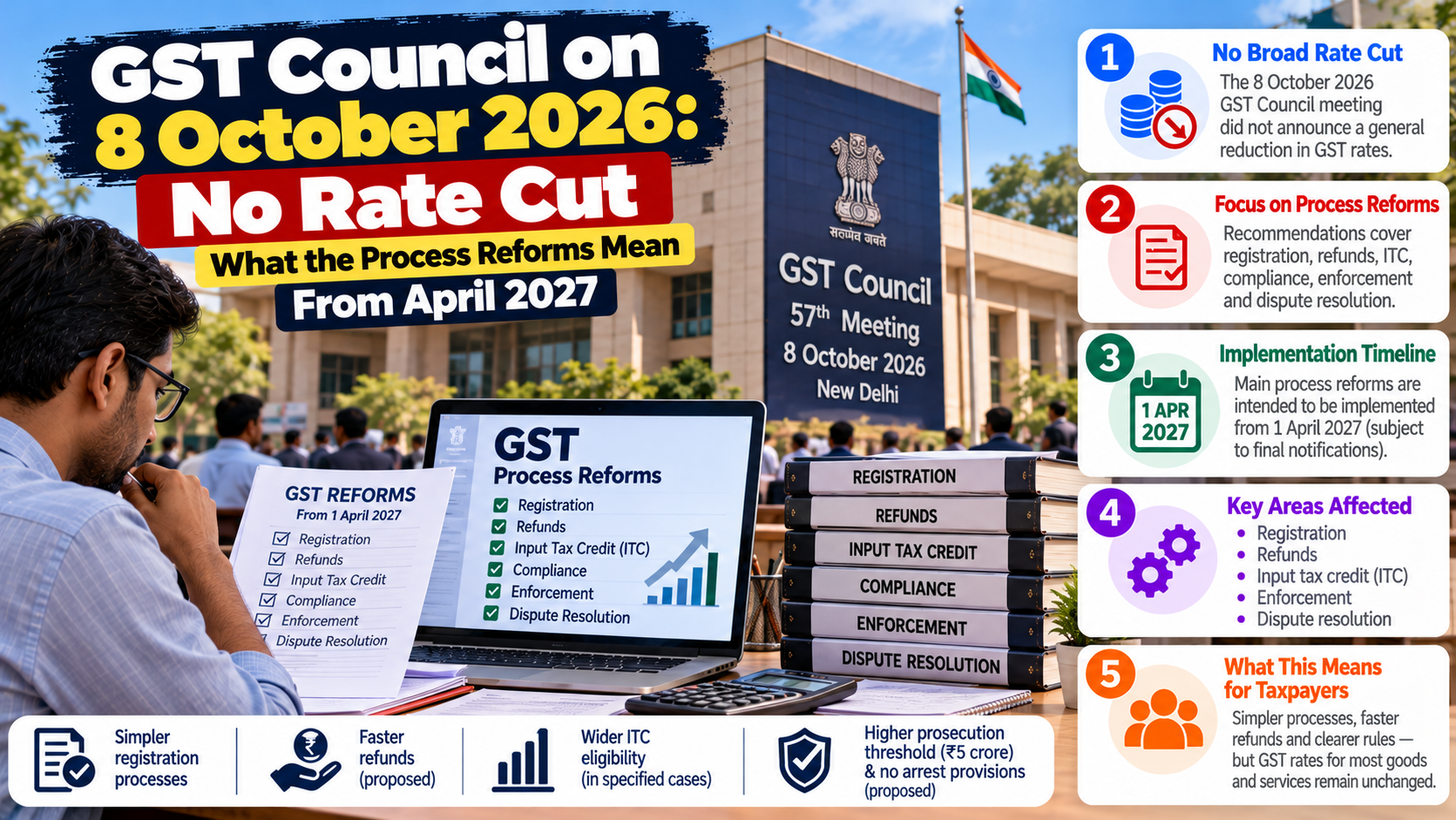
GST Council on 8 October 2026: No Rate Cut — What the Process Reforms Mean From April 2027
The 57th GST Council meeting, held in New Delhi on 8 October 2026, marked a shift in focus from reducing tax rates to improving how India’s Goods and Services Tax system works for businesses, exporters and taxpayers.
There was no broad GST rate-cut package at this meeting. Instead, the Council recommended changes covering GST registration, return filing, refunds, input tax credit (ITC), enforcement and dispute resolution. The stated implementation timeline for the main process reforms is 1 April 2027, although individual measures may have different timelines.
The distinction matters: a simpler GST process could help businesses manage cash flow and reduce compliance friction even when the tax rate on a product remains unchanged. The Council’s official announcement describes these measures as recommendations, so taxpayers should check the relevant notifications and amendments before treating a proposed change as legally effective.
Official source: 57th GST Council meeting — Ministry of Finance / PIB
What changed at the 8 October meeting?
The Council’s recommendations cover several parts of the GST system.
| Area | What the Council recommended | Why it matters |
|---|---|---|
| Registration | Clearer documentation requirements, a more user-friendly portal and simplified registration for eligible small e-commerce sellers | Fewer avoidable queries and less paperwork |
| GST returns | Better reconciliation of tax liability and ITC across return forms | Fewer mismatches and system-generated notices |
| Refunds | Greater automation, faster acknowledgements and risk-based provisional refunds | Potentially quicker access to working capital |
| Input tax credit | Wider eligibility in specified categories and refunds for certain accumulated credits | Less tax credit potentially remaining blocked |
| Enforcement | Removal of GST arrest provisions and a higher prosecution threshold, subject to legal implementation | A proposed shift towards more proportionate enforcement |
| Disputes | Clearer guidance for notices and orders, plus proposed penalty changes | Greater consistency and potentially less litigation |
| Goods in transit | Tighter conditions on interception and action in transit states | Fewer unnecessary disruptions to transport |
| Small businesses | An in-principle optional annual-return, quarterly-payment scheme for eligible businesses | A possible reduction in recurring compliance work |
These are not all immediate changes. Their effect will depend on the final legal amendments, notifications, eligibility conditions and implementation dates.
1 GST rates: why there was no broad rate cut
The previous round of major GST rate rationalisation focused on changing the rates applicable to goods and services. The 8 October meeting concentrated mainly on administrative and compliance reforms.
That does not mean the meeting made no rate-related decisions whatsoever. The official release also contains specific rate changes, exemptions and classification clarifications for certain goods and services. The distinction is that the Council did not announce another broad rate-cut exercise comparable to the earlier rationalisation.
For consumers, this means there is no basis for assuming that every product or service will become cheaper because of the October meeting. The applicable rate depends on the particular item, its classification and the relevant notification.
What consumers should do: Check the GST rate applicable to the specific product or service rather than relying on headlines suggesting a general tax reduction.
2 Registration: a simpler route for eligible businesses
The Council recommended clearer guidance on the documents and information needed for GST registration. Proposed portal improvements include better navigation, drop-down options and contextual guidance.
It also recommended a simplified registration mechanism for certain small suppliers selling goods through e-commerce platforms in states where they do not have a physical presence.
Under the proposed mechanism, eligible sellers could use an e-commerce operator’s warehouse in the relevant state as their principal place of business, subject to prescribed conditions. The recommendation includes a limit connected to the amount of input tax credit the seller intends to pass on.
This could reduce the need for some small sellers to establish a separate physical business location in every state where they want to sell.
However, it is not a blanket exemption from GST registration rules. Sellers must check the final eligibility conditions and comply with applicable registration, invoicing and return requirements.
3 Refunds: a potentially important working-capital reform
For many businesses, a delayed GST refund is not merely an administrative inconvenience. It can leave money unavailable for salaries, inventory, suppliers or expansion.
The Council recommended a more automated refund system covering specified categories, including excess balances in electronic cash ledgers, zero-rated supplies and inverted duty structure refunds.
The proposed measures include:
- Automatic sanction of eligible refunds of excess electronic cash-ledger balances.
- Reducing the period for issuing an acknowledgement or deficiency memo from 15 days to 10 days.
- System-based provisional refunds of up to 90% of eligible claims relating to zero-rated supplies and inverted duty structure, subject to risk assessment and the applicable conditions.
- Greater automation of acknowledgement and sanctioning processes in later phases.
These proposals could reduce manual intervention and improve cash-flow predictability for eligible taxpayers.
Important: A proposed automated refund process does not mean every claim will be paid automatically or without verification. Eligibility rules, risk checks, pending dues and documentation requirements can still matter.
Businesses with pending refunds should continue tracking their applications through the GST portal and respond promptly to any deficiency memo or departmental communication.
4 Input tax credit: what businesses need to watch
Input tax credit allows eligible businesses to offset GST paid on qualifying business purchases against GST payable on their outward supplies. Restrictions or delays in credit can increase working-capital pressure.
The Council recommended changes that could widen ITC eligibility in specified categories, including certain expenses relating to outdoor catering, health and life insurance, telecommunications towers, pipelines outside factory premises, free samples and goods destroyed or written off after expiry of their shelf life where required by law.
These are proposed amendments to the existing restrictions. Businesses should not assume that every expense in these categories will automatically qualify for credit. The final statutory wording, business circumstances, documentation and other conditions will determine eligibility.
Refunds of accumulated credit
The Council also recommended expanding refunds of accumulated ITC for certain capital goods and input services.
The official release specifies different timelines for parts of this proposal:
- Input services: The proposed refund of accumulated ITC for inverted duty structure cases would cover eligible input-service credit availed on or after 1 November 2026.
- Capital goods: The proposed refund of eligible capital-goods ITC in specified zero-rated and inverted-duty cases would be spread over 60 months and apply to credit availed on or after 1 April 2027.
These are specific proposed timelines, not a statement that every ITC reform begins on the same date.
Businesses should review their purchase records, invoices and return reconciliations with a tax professional before changing their credit claims.
5 GST enforcement: proposed changes to arrest powers and prosecution
The Council recommended the complete withdrawal of GST arrest powers by omitting Section 69 of the Central Goods and Services Tax Act, 2017. It also recommended raising the monetary threshold for prosecution from ₹1 crore to ₹5 crore, along with changes to the offences and punishments specified under Section 132.
The Council further recommended reducing the maximum general penalty under Section 125 from ₹25,000 to ₹10,000.
These recommendations are significant for businesses concerned about the consequences of GST disputes. But they should not be read as blanket immunity from tax investigations, recovery proceedings or penalties.
The legal status matters: The Council’s recommendation alone does not establish that the relevant provisions have already been removed from the law. Taxpayers should verify the enacted amendments and their commencement dates before relying on the proposed protections.
Businesses should continue maintaining accurate invoices, return reconciliations, payment records and supporting documents. The proposed changes are not a reason to ignore an existing notice or assume that a pending proceeding has automatically ended.
6 E-way bills and transport: fewer unnecessary interruptions
The Council recommended tighter conditions for intercepting vehicles carrying goods. The proposed framework would generally require specific intelligence and authorisation by an officer of at least Joint Commissioner rank.
It also recommended limiting inspection and further action in transit states, with exceptions including cases where the required e-way bill or documents establishing the origin or destination of goods are missing.
If implemented as proposed, these changes could reduce unnecessary interruptions to inter-state movement of goods.
Transporters and businesses should nevertheless continue carrying the required invoices, e-way bills and other prescribed documents. The recommendation is not a blanket permission to transport goods without documentation.
7 A proposed annual-return, quarterly-payment option for small businesses
The Council approved in principle a concept note for an optional Annual Return Quarterly Payment (ARQP) scheme.
The proposed scheme targets eligible taxpayers with aggregate turnover of up to ₹5 crore in the preceding financial year who deal exclusively in supplies to unregistered persons — commonly known as business-to-consumer (B2C) supplies.
The idea is to allow eligible businesses to file an annual return while making tax payments quarterly.
Because this was approved in principle, businesses should wait for the final scheme, eligibility rules and operating instructions before changing their filing calendar. It should not be treated as an option that every small business can use immediately.
8 What should GST taxpayers do before April 2027?
The best response is to prepare without assuming that every recommendation is already operative.
For small businesses and retailers
- Keep registration details, bank information and principal-place-of-business records updated.
- Reconcile sales invoices with GSTR-1 and GSTR-3B.
- Check ITC against available invoice and portal records.
- Maintain evidence for expenses and credit claims.
- Watch for the final ARQP scheme and its eligibility conditions.
- Do not change return frequency or payment schedules until the applicable rules permit it.
For exporters
- Review outstanding refund claims and identify any documentation gaps.
- Reconcile export invoices, shipping documentation and foreign-payment records where applicable.
- Track the proposed changes affecting zero-rated supplies and accumulated ITC.
- Confirm the effective dates of amendments before revising refund calculations.
For businesses receiving GST notices
- Record the notice number, date, tax period and response deadline.
- Preserve invoices, returns, ledgers, contracts and payment evidence.
- Seek professional advice where the dispute involves allegations of fraud, suppression or wrongful ITC.
- Do not assume a notice is invalid or that prosecution is impossible merely because the Council has recommended changes.
For consumers
- Do not expect a general price reduction simply because process reforms were announced.
- Check the GST rate and invoice for the particular purchase.
- Ask the seller for a proper tax invoice where applicable.
April 2027: what it means — and what it does not
The main process-reform package is intended to begin from 1 April 2027, but individual proposals have their own implementation details. Some recommendations specify earlier or separate dates, and some require amendments to the CGST Act or Rules, or further notifications and instructions.
For taxpayers, the practical question is not just what the Council recommended, but which provisions have legally taken effect and what conditions apply to their own business.
The official announcement is the best starting point for checking each measure: Read the full GST Council release on PIB.
Frequently asked questions
Did the GST Council cut GST rates on 8 October 2026?
There was no broad GST rate-cut package at the meeting. The Council focused primarily on process and compliance reforms, although its official release also includes specific rate-related changes, exemptions and classification clarifications for certain goods and services.
When do the process reforms begin?
The main process reforms are intended to be implemented from 1 April 2027, but the applicable date can differ by measure. Check the final notification or amendment for the provision relevant to you.
Will businesses automatically receive GST refunds?
No. The Council recommended greater automation and risk-based processing for specified refund categories. Eligibility requirements, verification, pending dues and other applicable conditions can still affect a claim.
Are GST officers' arrest powers already removed?
The Council recommended their complete withdrawal through an amendment to Section 69 of the CGST Act. Taxpayers should verify the legal amendment and commencement date before treating the recommendation as operative law.
Will small e-commerce sellers be able to sell across states without opening an office in each state?
The Council recommended a simplified mechanism for eligible small suppliers of goods using e-commerce platforms. It is subject to conditions, including limits related to ITC and the prescribed registration process. Sellers should check the final rules before relying on it.
Does the proposed ₹5 crore prosecution threshold mean that smaller tax disputes are ignored?
No. The proposal concerns the monetary threshold for prosecution under the relevant GST provisions. It does not automatically eliminate tax liabilities, interest, civil proceedings, recovery action or every possible consequence of non-compliance.
The takeaway
The 8 October 2026 GST Council meeting was less about another broad reduction in tax rates and more about making GST administration simpler, more automated and potentially more predictable.
Faster refunds could help working capital. Clearer registration rules could help smaller sellers. Better return reconciliation could reduce avoidable mismatches, while proposed enforcement changes could alter how certain GST offences are treated.
But recommendations and operative law are not the same thing. Businesses should keep complying with current requirements, prepare their records and verify the final legal position as each measure is implemented.
This article is for general information and is not a substitute for professional tax or legal advice.