
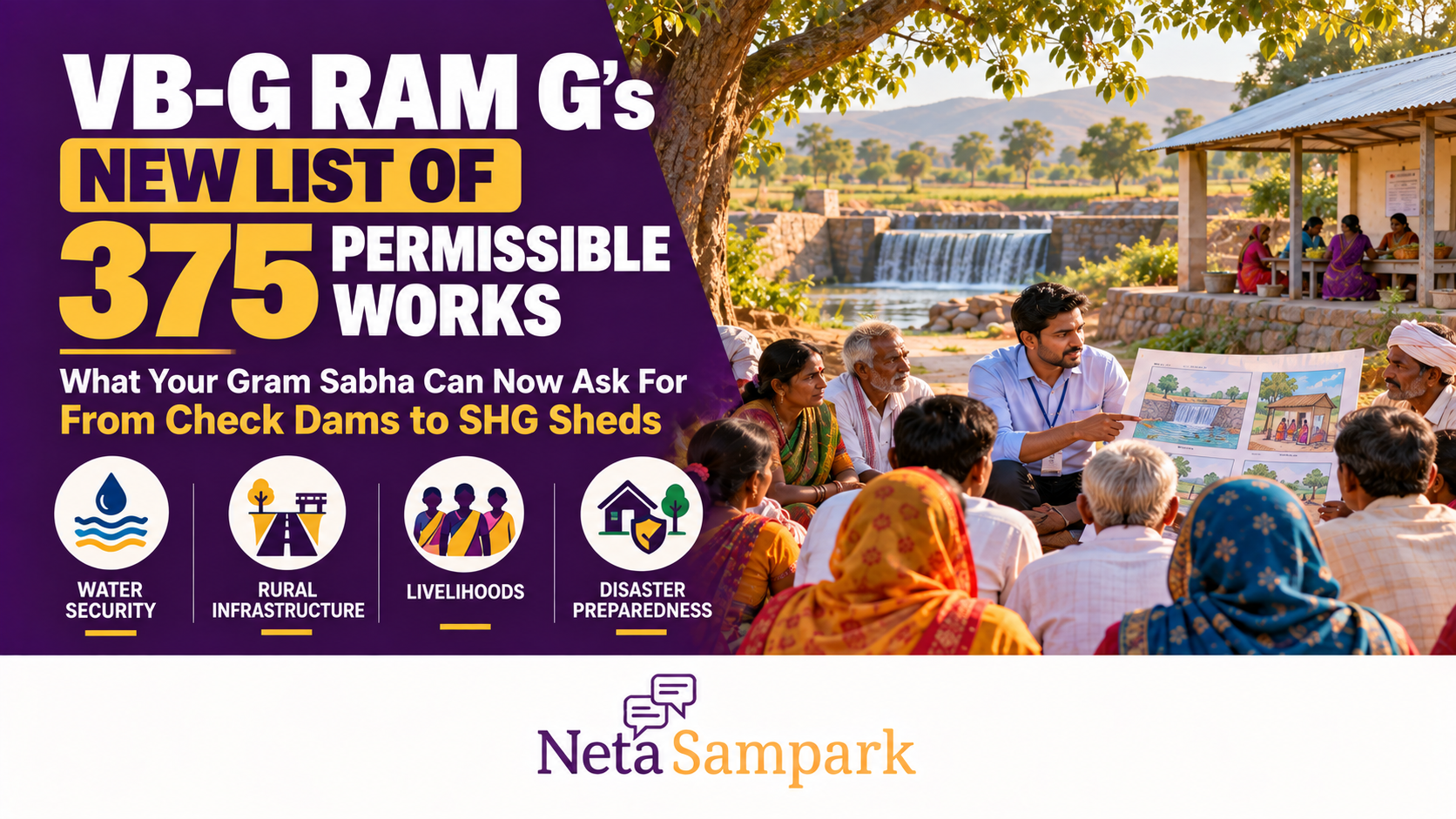
VB-G RAM G’s New List of 375 Works: What Your Gram Sabha Can Now Ask For — From Check Dams to SHG Sheds
Can your village propose a check dam to conserve rainwater, a shed for a Self-Help Group (SHG), a small processing facility for local produce or a flood-protection structure? A newly notified list under Viksit Bharat – Guarantee for Rozgar and Ajeevika Mission (Gramin), or VB-G RAM G, expands the range of rural works that can be planned under the programme.
On 6 October 2026, the Union Ministry of Rural Development announced a schedule of 375 permissible works, organised under four themes: water security, core rural infrastructure, livelihood-related infrastructure and disaster preparedness. The Ministry says the new schedule is 41% larger than the previous framework’s 266 works. <Link url="https://www.pib.gov.in/PressReleaseIframePage.aspx?PRID=2319426&lang=2®=48" title="Read the Ministry’s announcement on PIB" />
For villagers, the practical point is this: the Gram Sabha can help identify local priorities through the Viksit Gram Panchayat Plan (VGPP). A work being on the list does not mean it will be approved automatically. It must fit the applicable rules, respond to local needs and pass through the prescribed planning and approval process.
What is VB-G RAM G?
VB-G RAM G stands for Viksit Bharat – Guarantee for Rozgar and Ajeevika Mission (Gramin). It is the rural employment and asset-creation framework established under the VB-G RAM G Act, 2025.
The framework links rural wage employment with the creation of durable village assets. Rather than treating employment works as isolated projects, it groups them around water conservation, basic infrastructure, livelihoods and resilience to extreme weather.
The Ministry’s October 2026 announcement sets out the 375 permissible works across four categories. These categories help Gram Panchayats and communities identify which kinds of projects may be considered in village planning.
The 375 works at a glance
<text color="secondary" size="sm">Official category-wise distribution announced on 6 October 2026.</text>
| Category | Number of works | What it covers |
|---|---|---|
| Water Security | 128 | Check dams, water harvesting, recharge structures and irrigation-related works |
| Core Rural Infrastructure | 111 | Community facilities, sanitation, village amenities and public infrastructure |
| Livelihood-related Infrastructure | 98 | Agricultural processing, storage, dairy, SHG worksheds and enterprise support infrastructure |
| Disaster Preparedness | 38 | Flood protection, relief shelters and restoration of community assets after disasters |
| Total | 375 | Four categories of permissible rural works |
Source: Ministry of Rural Development announcement, 6 October 2026.
1 Water security: Check dams, ponds and groundwater recharge
Water security is the largest category, with 128 permissible works. These works can help villages conserve rainfall, improve water availability and protect local water resources.
Examples listed by the Ministry include:
- Construction and repair of check dams
- Gully plugs and underground dykes
- Rejuvenation of rivers, rivulets and local drains
- Ponds and other water-harvesting structures
- Recharge pits, recharge shafts and injection wells
- Reclamation of waterlogged land
- Repair or renovation of field water-distribution channels
- Drip irrigation, sprinkler systems and rooftop rainwater harvesting
What can your Gram Sabha ask for?
If a village experiences seasonal water shortages, repeated runoff or falling groundwater levels, residents can ask the Gram Panchayat to assess whether a suitable water-conservation work should be included in the village plan.
For example, residents could raise the need for a check dam in an appropriate location, desilting or rejuvenation of a local water body, or a groundwater-recharge structure.
The proposal should identify the local problem and the location where the work is needed. Technical feasibility, land ownership, permissions and the applicable scheme conditions still matter.
2 Core rural infrastructure: Public facilities and everyday amenities
The second category contains 111 works focused on infrastructure that supports daily life in villages.
The Ministry’s examples include:
- Solar street-lighting systems
- Waste-to-wealth recycling facilities
- Greywater treatment units
- Waste segregation sheds
- Rural libraries
- Veterinary and rural health centres
- Common Service Centres (CSCs)
- Multipurpose youth centres
- Additional classrooms and laboratories in government schools
- Repair and maintenance of Jal Jeevan Mission water-supply infrastructure
- Rural parks, footpaths and other village-level amenities
What can residents propose?
A Gram Sabha discussion could identify a shortage of community facilities, inadequate waste management or a need to repair eligible public infrastructure.
For instance, if a village has a recurring greywater problem, residents can ask the Gram Panchayat to assess a suitable treatment or drainage-related work. If a public facility needs improvement, they can ask whether the proposed work fits the notified schedule and the applicable technical requirements.
Not every request will qualify under this framework. The Gram Panchayat should check whether the work is permissible and whether another government scheme is responsible for funding or implementing it.
3 Livelihood infrastructure: SHG sheds, storage and processing facilities
The new schedule gives substantial attention to livelihood-related infrastructure, with 98 permissible works.
This category is particularly relevant to villages where farmers, women’s collectives and small rural enterprises need shared facilities to improve production, storage or market access.
Examples include:
- SHG worksheds
- Buildings for SHG federations
- SHE Marts
- Training and skill-development centres
- Agro-processing and value-addition facilities
- Cleaning, grading and packaging units
- Cold-storage facilities
- Mini flour mills
- Market yards
- Dairy infrastructure
- Mushroom cultivation sheds
- Sericulture sheds
- Poly-houses and aquaculture structures
What does an SHG workshed mean for a village?
A Self-Help Group may need a shared space to undertake eligible production, processing or related livelihood activities. A workshed can provide a place for members to work together, subject to the approved design and scheme conditions.
Similarly, a suitable processing or grading facility could help local producers handle their goods before sale. A storage facility may address a locally identified need where the proposal meets the applicable requirements.
The Gram Sabha can discuss these needs and ask the Gram Panchayat to assess a proposal. The inclusion of SHG worksheds or SHE Marts in the list does not automatically entitle every group to a building or grant. Eligibility, planning, approvals and convergence with other programmes must be checked.
4 Disaster preparedness: Flood shelters and resilient village assets
The fourth category contains 38 works dedicated to disaster preparedness and extreme weather.
Examples include:
- Flood-relief shelters
- Retaining walls
- Embankment strengthening
- Flood-protection works
- Restoration of rural roads and community assets after disasters
- Forest-fire management measures, including fire lines and fuel-buffer zones
These works can be relevant in areas affected by flooding, storms, landslides, droughts or forest fires.
What should a village discuss?
Residents can document recurring local risks and ask the Gram Panchayat to consider eligible preventive works. A village that repeatedly loses road access during floods, for example, may ask officials to assess the problem and identify a permissible intervention.
Projects must be technically appropriate and follow the applicable disaster-management, land and engineering requirements. Listing a work does not itself authorise construction at any location.
How can your Gram Sabha get a work considered?
The Ministry says works under VB-G RAM G are to be planned through Viksit Gram Panchayat Plans, based on local needs and approved by the Gram Sabha. This is the route through which community priorities can be raised and considered.
Step 1: Identify a specific village need
Be precise about the problem. Instead of saying “our village needs development,” identify a concrete issue, such as:
- A water body that needs rejuvenation
- A drainage or greywater problem
- A missing shared facility for an eligible livelihood activity
- A shortage of community infrastructure
- A location repeatedly affected by floods
Step 2: Identify a matching permissible work
Use the four categories to identify the type of work that may address the problem. The official schedule, not an informal social-media list, should be used to confirm the exact permissible activity.
Step 3: Raise the proposal with the Gram Panchayat
Ask the Gram Panchayat to consider the need during the village-planning process. Provide the location, the problem, the people or community likely to benefit and any useful supporting information.
Step 4: Discuss it in the Gram Sabha
Raise the proposal during the Gram Sabha meeting and ask that it be considered in the Viksit Gram Panchayat Plan. Keep a record of the proposal and any decision or resolution made under the applicable procedure.
Step 5: Ask about feasibility and approval
The Panchayat and responsible officials must assess whether the proposed work is permissible, technically feasible and consistent with the scheme’s rules and available planning arrangements. A Gram Sabha proposal is not a guarantee that funding or work will be sanctioned.
Step 6: Follow up on the recorded decision
Ask whether the work was included in the plan, whether any technical assessment is pending and what the next step is. If the proposal is not accepted, ask for the reason and whether it can be revised or taken up under another suitable programme.
Does every village get all 375 works?
No. The figure of 375 refers to the total schedule of permissible work types, not 375 projects for every Gram Panchayat.
A village’s actual works will depend on its needs, the applicable rules, technical feasibility, planning and approval, and the availability and coordination of resources. Some works may be suitable only for particular locations or types of beneficiaries.
The schedule also does not mean that all 375 works are new. The Ministry describes the overall list as an expansion from 266 works under the previous framework.
What should villagers ask at the next Gram Sabha meeting?
Here is a practical checklist for residents who want to turn the new list into a local discussion.
- Which water, infrastructure, livelihood or disaster-related problems need attention in our village?
- Is there a permissible work in the official schedule that could address each problem?
- Which proposals should be considered for the Viksit Gram Panchayat Plan?
- What site, land, technical or permission requirements need to be checked?
- Can an SHG, farmers’ group or other eligible community benefit from a shared facility?
- Is a similar project already funded under another government scheme?
- How will residents find out whether a proposal was included, revised or rejected?
- Where can the approved plan and subsequent work information be inspected?
Bring specific examples and locations to the discussion. A well-defined proposal is easier to assess than a general demand for development.
Frequently asked questions
What is the new VB-G RAM G list of 375 works?
It is the schedule of permissible works notified by the Union Ministry of Rural Development and announced on 6 October 2026. It contains 375 work types across water security, core rural infrastructure, livelihoods and disaster preparedness.
Can a Gram Sabha propose a check dam?
The Gram Sabha can raise the need for a suitable water-security work through village planning. Whether a particular check dam is approved depends on the official schedule, local feasibility, permissions and the prescribed approval process.
Are SHG worksheds included?
Yes. SHG worksheds, SHG federation buildings and SHE Marts are among the livelihood-related infrastructure examples listed by the Ministry. Inclusion in the schedule does not guarantee that every SHG will receive a facility.
Does the list guarantee funding for every proposed work?
No. The list defines permissible work types. A proposal still has to meet applicable conditions and go through planning, technical assessment and approval.
Where can I verify the official list?
Start with the Ministry of Rural Development’s PIB announcement dated 6 October 2026. For implementation details, consult the relevant state rural-development department and Gram Panchayat.
The key takeaway
The 375-work schedule gives Gram Sabhas and Gram Panchayats a broader set of permissible rural works to consider, ranging from check dams and water-recharge structures to SHG worksheds, processing facilities and disaster-resilient infrastructure.
The practical next step is to identify the village’s most pressing needs, match them to the official schedule and raise specific proposals through the Viksit Gram Panchayat Plan and Gram Sabha process.
A work appearing on the list is an opportunity to seek consideration—not an automatic sanction. Follow the official planning process and keep track of the decision.
This article is an informational guide based on the Ministry of Rural Development’s announcement of 6 October 2026. The official notified schedule, the VB-G RAM G Act and applicable rules govern eligibility and implementation.