
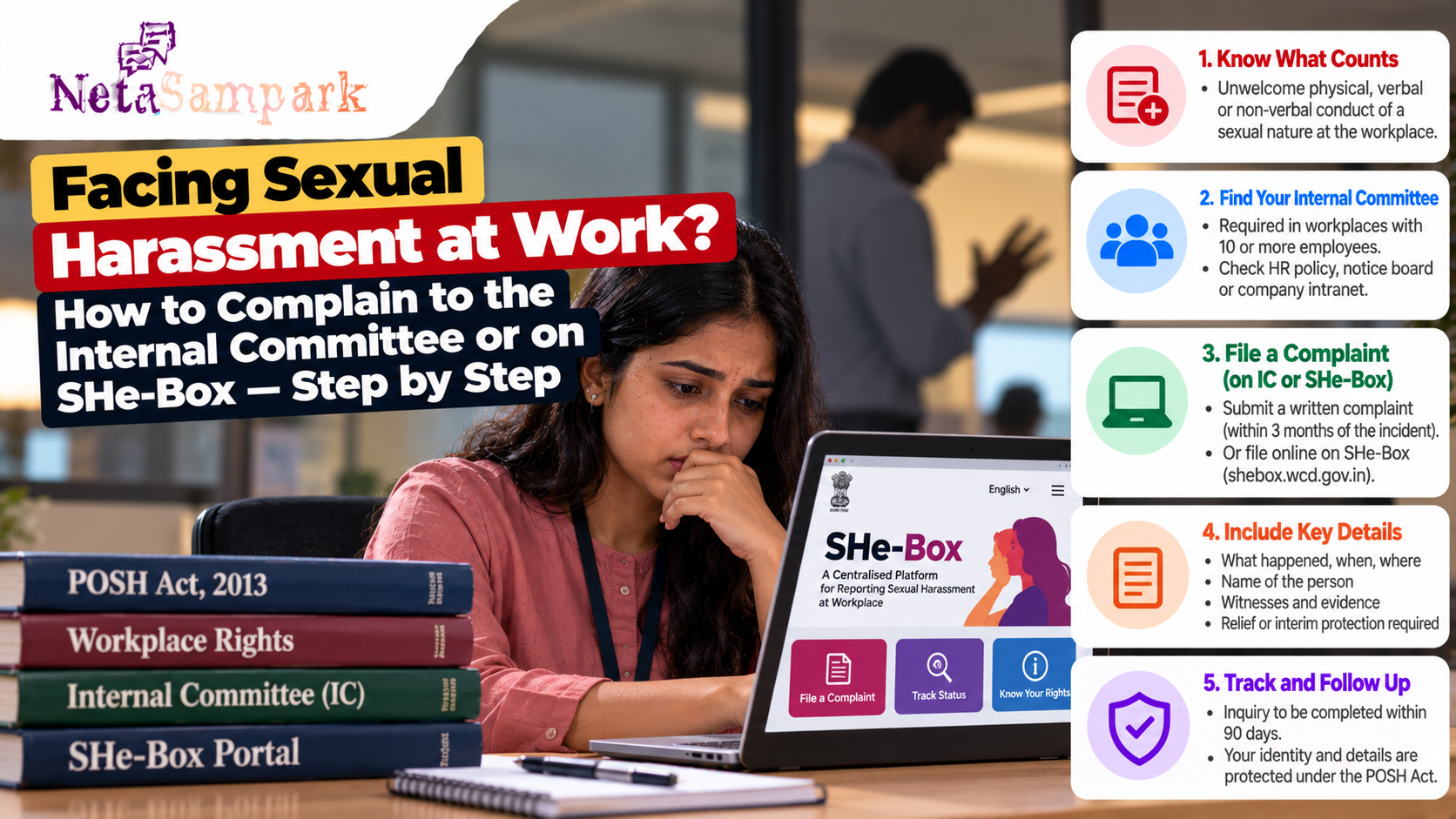
Facing Sexual Harassment at Work? How to Complain to the Internal Committee or on SHe-Box — Step by Step
If you are a woman facing sexual harassment at work, you do not have to handle it informally or simply resign.
India's Sexual Harassment of Women at Workplace (Prevention, Prohibition and Redressal) Act, 2013, commonly called the POSH Act, provides a formal complaint and inquiry mechanism. It covers women across public and private workplaces, organised and unorganised sectors, and different employment arrangements. Press Information Bureau
For workplaces with 10 or more employees, the employer is required to constitute an Internal Committee (IC). The government also operates SHe-Box, a central online platform through which a woman can register and track a workplace sexual-harassment complaint. Press Information Bureau
The important part is knowing where to complain, what to write, what deadline applies and what happens after you submit it.
What counts as sexual harassment at work?
The POSH Act includes unwelcome:
- Physical contact or advances
- A demand or request for sexual favours
- Sexually coloured remarks
- Showing pornography
- Other unwelcome physical, verbal or non-verbal conduct of a sexual nature
The Act also recognises circumstances such as an implied or explicit promise of preferential treatment, threats to employment, interference with work, creating an intimidating or hostile work environment, or humiliating treatment affecting a woman's health or safety. India Code
The incident does not have to happen inside the office building.
The statutory definition of workplace is broad and can include places visited during employment, employer-provided transportation, hospitals, educational institutions, sports venues and other work-related locations. India Code
First: Find out whether your workplace has an Internal Committee
An employer must constitute an Internal Committee (IC) where the workplace has 10 or more employees. The committee must have a woman Presiding Officer and other prescribed members, including an external member familiar with issues relating to sexual harassment; at least half of its members must be women. India Code
Look for:
- POSH policy on the company intranet
- HR policy documents
- Notice-board information
- Employee handbook
- Names/contact details of IC members
- SHe-Box workplace listing
The government says SHe-Box maintains a repository of Internal Committees and Local Committees and can route complaints to the appropriate committee. Press Information Bureau
What if your company says there is no IC?
Don't assume that means you have no remedy.
A Local Committee (LC) is established at the district level for cases covered by the Act where an Internal Committee mechanism is not available, including establishments with fewer than 10 workers and complaints against the employer himself/herself in the circumstances specified by the law. India Code
SHe-Box can also route a complaint to the appropriate IC or LC based on the information provided. Press Information Bureau
Option 1: Complain directly to your Internal Committee
If your workplace has an IC, you can submit a written complaint to it.
Your complaint should clearly state:
1. Who:
Your name and position, and the name/designation of the person against whom you are complaining.
2. What happened:
Describe the conduct factually.
3. When:
Give dates and approximate times.
4. Where:
Mention the office, meeting, work trip, transport, online meeting or other workplace-related location.
5. Who witnessed it:
List witnesses if there were any.
6. What evidence exists:
Mention emails, messages, photographs, recordings, documents or other relevant material.
7. What you want:
For example, a formal inquiry and appropriate interim protection.
Keep the complaint factual rather than using exaggerated language.
The three-month complaint deadline
Under Section 9 of the POSH Act, the written complaint should ordinarily be made within three months from the date of the incident.
If there are a series of incidents, the period is calculated from the date of the last incident.
The IC or LC can extend the period by another three months if it is satisfied that circumstances prevented the woman from filing the complaint within the original period. India Code
So don't wait for the deadline
If something has happened recently, filing promptly makes the process simpler.
If more than three months have already passed, don't automatically assume you cannot complain. Explain the reason for the delay and ask the committee to consider the extension permitted by the Act.
What if you cannot write the complaint yourself?
The law provides assistance where the aggrieved woman is unable to make the complaint in writing.
You can ask the IC/LC to assist you in recording the complaint.
If you are physically or emotionally unable to prepare a detailed document, don't let that stop you from reporting the incident.
Start by communicating the basic facts and ask for assistance with the formal complaint.
What evidence should you preserve?
You do not need a perfect evidence file before making a complaint.
But preserve whatever legitimately exists.
Useful material can include:
- Emails
- WhatsApp or other messages
- SMS
- Workplace chat messages
- Meeting invitations
- Calendar records
- Relevant photographs
- Documents
- Travel records
- Cab/transport details
- CCTV location and approximate time
- Names of witnesses
- Previous complaints or communications
- HR communications
- Medical records where relevant
Don't secretly alter evidence
Don't edit screenshots to change their meaning.
Keep the original files where possible and make backup copies somewhere you can safely access.
If workplace systems may automatically delete messages or CCTV footage, mention this promptly to the appropriate authority.
You can ask for interim protection
You don't necessarily have to wait until the inquiry is finished to ask for protection.
Depending on the circumstances and applicable rules, the IC/LC can recommend interim measures during the inquiry.
These can include arrangements such as:
- Transfer of the aggrieved woman or respondent
- Leave for the aggrieved woman
- Other appropriate measures to protect her from further workplace difficulty
If you are afraid of further contact with the respondent, say so clearly in your complaint.
For example:
"I request appropriate interim measures so that I am not required to report directly to the respondent during the pendency of the inquiry."
The exact measure depends on the circumstances.
Can the complaint be settled?
The Act permits conciliation before the inquiry, but only when requested by the aggrieved woman.
There is an important protection:
A monetary settlement cannot be made the basis of conciliation under the POSH Act. India Code
If you don't want conciliation, you can ask for the formal inquiry process to proceed.
What happens after you file an IC complaint?
The process broadly works like this:
Complaint → notice to respondent → response/evidence → inquiry → findings → recommendations → employer action
The inquiry is required to follow the applicable procedure and principles of fairness.
The Supreme Court has emphasised that POSH inquiries must balance sensitivity with fairness and should not compromise natural justice. Sci API
The statutory inquiry period is 90 days. Press Information Bureau
After the inquiry, the committee prepares its findings and recommendations as provided under the Act.
Confidentiality is important
The identity of the woman, respondent and witnesses and details of the complaint/inquiry are protected from public disclosure under the POSH framework.
Do not post the complaint, screenshots or identifying details publicly on social media simply to create pressure.
The SHe-Box system also has confidentiality safeguards. The government says the portal is designed so that complaint details are protected and routed to the relevant IC/LC. Press Information Bureau
Option 2: File through SHe-Box
If you want a government-backed digital route, you can use the Sexual Harassment electronic Box (SHe-Box).
The current portal is operated by the Ministry of Women and Child Development.
SHe-Box 2.0 provides a single-window system for women across public and private sectors to register and track workplace sexual-harassment complaints. Press Information Bureau
How to complain on SHe-Box
The exact screen labels can change as the portal is updated, but the process broadly involves these steps.
Step 1: Open the official SHe-Box portal
Go directly to:
Avoid links received through random WhatsApp messages or social-media posts.
Step 2: Register your account
The portal requires you to provide the requested registration information.
The government describes SHe-Box 2.0 as a secure, multilingual platform with complaint tracking and routing functionality. Press Information Bureau
Step 3: Select your employment/workplace details
Provide the information requested about:
- Government/private employment
- Organisation
- State/UT
- District
- Workplace
- Relevant committee, where applicable
This information helps SHe-Box identify the appropriate IC or LC.
Step 4: Enter details of the incident
Describe what happened.
A useful structure is:
Date: 5 October 2026
Location: Office meeting room
Respondent: Name/designation
Incident: Brief factual description
Witnesses: Names, if any
Evidence: Messages/emails/documents
Impact: Any relevant workplace consequence
Relief requested: Formal inquiry/interim protection
Keep it chronological and factual.
Step 5: Upload supporting documents
If the portal requests or permits supporting documents, upload relevant evidence.
Don't upload unnecessary personal information unrelated to the complaint.
Keep copies of everything you submit.
Step 6: Submit the complaint
Review the information carefully before submitting.
Save the complaint/reference details generated by the system.
Don't rely solely on an email notification. Keep a screenshot or PDF record of the submission for your own files.
Step 7: Track the complaint
One of SHe-Box's important features is complaint-status tracking.
The government says SHe-Box 2.0 provides real-time tracking and routes complaints to the relevant IC or LC. Press Information Bureau
If the workplace's IC information is not already available, the portal has mechanisms for collecting workplace information and involving the relevant nodal authorities. Press Information Bureau
Do you have to choose between IC and SHe-Box?
Not necessarily.
SHe-Box is a digital access and monitoring mechanism, while the statutory inquiry is conducted through the appropriate IC or LC.
The government says complaints filed through SHe-Box are automatically forwarded to the concerned IC/LC based on the workplace details. Press Information Bureau
So think of it as:
SHe-Box → routes/tracks the complaint → appropriate IC/LC handles the statutory process
What if your employer has no Internal Committee?
This is one situation where SHe-Box can be particularly useful.
The government says the portal contains information about ICs and LCs and can route complaints to the appropriate committee. It also has mechanisms for workplaces whose IC information is not yet registered. Press Information Bureau
You can also contact the appropriate district-level authority regarding the Local Committee.
What if the complaint is against the employer?
This is another situation where the normal internal route can create an obvious conflict.
The POSH Act provides for the Local Committee mechanism in specified circumstances, including complaints against the employer where the Act so provides. India Code
In such a situation, don't assume that you must submit the complaint to the person you are complaining against.
Use the appropriate LC/SHe-Box route.
What if the harassment happened during a work trip?
It can still fall within the workplace framework.
The statutory definition of workplace includes a place visited by the employee arising out of or during employment and transportation provided by the employer for employment-related travel. India Code
So incidents during:
- Official travel
- Conferences
- Work events
- Employer-provided transport
- Client-related work
should not automatically be dismissed as "outside office."
What if the harassment happened over WhatsApp or email?
Electronic communication can form part of the factual record of workplace harassment.
Save:
- Original messages
- Sender information
- Dates and times
- Relevant email headers where possible
- Conversation context
Don't delete the conversation simply because you find it distressing.
If the material is explicit, preserve it securely and provide it to the appropriate committee rather than circulating it among colleagues.
What if the conduct may also be a criminal offence?
The POSH mechanism and criminal law are not necessarily alternatives.
The POSH Act itself says its provisions are in addition to, and not in derogation of, other laws. India Code
For example, conduct involving physical assault, stalking, threats, sexual offences or other criminal acts may require a police complaint in addition to workplace proceedings.
If you believe a crime has occurred or you are in immediate danger, do not wait for the IC inquiry before seeking police or emergency assistance.
What if you are afraid of retaliation?
Tell the committee.
Your complaint can expressly state that you are concerned about:
- Retaliation
- Threats
- Transfer
- Loss of work
- Intimidation
- Contact with the respondent
- Pressure to withdraw the complaint
Keep records of any retaliation occurring after the complaint.
A new incident should be documented separately and reported through the appropriate channel.
What if HR says, "Let's handle this informally"?
You can ask:
"Please provide the contact details of the Internal Committee so that I can make a formal complaint under the POSH Act."
You are not required to rely solely on an informal HR conversation if you want to invoke the statutory complaint mechanism.
If you have already complained informally, preserve that email/message too.
What if the IC refuses to accept the complaint?
Document the refusal.
For example:
- Date and time
- Name of person contacted
- How you submitted the complaint
- What response you received
- Any email or message refusing to accept it
Then consider using SHe-Box and the appropriate Local Committee/nodal mechanism.
The government describes SHe-Box as a centralised mechanism intended to strengthen monitoring and accountability, including tracking complaints and committee functioning. Press Information Bureau
What if the incident happened months ago?
Still consider reporting it.
The ordinary deadline is three months, but the IC/LC can extend this by up to another three months if it is satisfied that circumstances prevented timely filing. India Code
Explain the reason for the delay honestly.
Do not assume that missing the first three months means the door is automatically closed.
A simple complaint format
You don't need complicated legal language.
You can begin with:
Subject: Complaint under the Sexual Harassment of Women at Workplace Act, 2013
I am submitting this complaint regarding an incident/series of incidents of sexual harassment involving [name/designation].
Date(s):
Location(s):
Details of incident(s):
Witnesses, if any:
Supporting evidence:
Previous reporting, if any:
Relief/interim measures requested:
I request that this complaint be treated as a formal complaint under the applicable POSH framework and that appropriate action be taken.
Keep a copy of the final complaint and proof of submission.
What not to do
Don't delete evidence
Even if you never use it, preserve it securely.
Don't confront the person if you feel unsafe
You don't need to personally negotiate with the alleged harasser.
Don't circulate the complaint widely
Use the prescribed channels and protect confidentiality.
Don't pay an agent to file a POSH complaint
SHe-Box is a government platform.
Don't assume resignation is your only option
You have a statutory complaint mechanism.
Don't wait unnecessarily
The normal complaint window is three months.
Quick decision guide
| Your situation | Where to start |
|---|---|
| Workplace has 10+ employees and functioning IC | Internal Committee |
| You want a central online complaint/tracking route | SHe-Box |
| No IC because workplace is below the threshold | Local Committee / SHe-Box |
| Complaint is against employer | Appropriate Local Committee route / SHe-Box |
| IC details unavailable | SHe-Box / appropriate nodal mechanism |
| Immediate physical danger or possible crime | Police/emergency assistance immediately |
| Incident older than 3 months | File promptly and explain delay; extension may be available |
Five-minute action checklist
If you are facing workplace sexual harassment today:
- Get to a safe place if you feel threatened.
- Preserve messages, emails and other evidence.
- Write down dates, locations and what happened.
- Identify your workplace's Internal Committee.
- Submit a written complaint if you want the formal POSH process.
- If necessary, file through SHe-Box.
- Save your complaint/reference number.
- Ask for interim protection if required.
- Record any retaliation or intimidation.
- Seek police help immediately if there is an immediate threat or suspected criminal offence.
Bottom line
You do not have to remain silent because the alleged harasser is your manager, colleague, client or someone connected with your work.
For workplaces covered by the POSH Act, the Internal Committee is the primary institutional mechanism where applicable. If that mechanism is unavailable or another situation covered by the Act applies, the Local Committee can be relevant. SHe-Box provides a central online route to register and track complaints and can route them to the appropriate IC or LC. Press Information Bureau
The most important practical steps are simple: preserve evidence, file promptly, keep a copy of your complaint, and use the official SHe-Box portal rather than an unofficial website.
If there is an immediate threat to your safety or the conduct may amount to a criminal offence, seek emergency or police assistance rather than waiting for the workplace inquiry.