
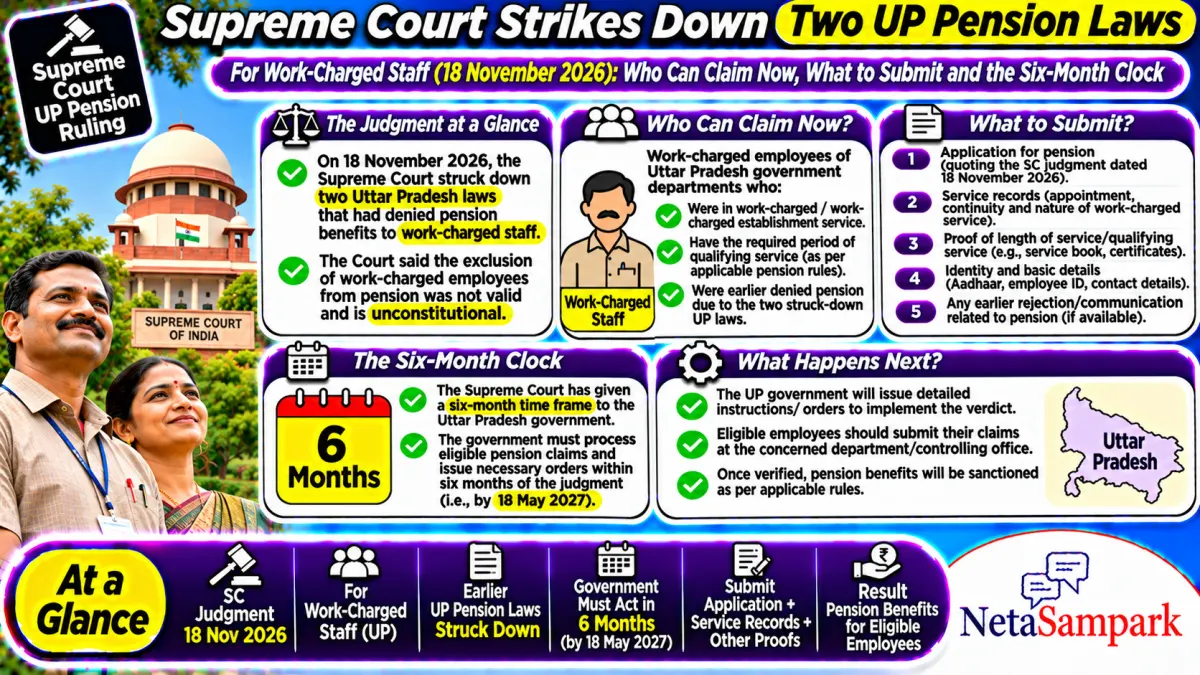
On 18 November 2026 the Supreme Court struck down two Uttar Pradesh laws that denied pension for years served before regularisation. Retired work-charged and similar employees can now send their service details to the competent authority, which must decide each claim within six months. Late payment attracts 9% simple interest.
Updated 23 November 2026
If you or your father worked for a UP department as a work-charged, daily-wage or muster-roll worker and was later made permanent, this ruling matters for your pension. The Supreme Court has said the state cannot wipe out those early years from "qualifying service" just by passing a new law.
This post explains what the judgment says, who it covers, what you can do now and what is still unclear. It is not legal advice. For your own case, talk to a lawyer or your association.
Quick facts
| Item | Details |
|---|---|
| Official portal | Judgment text on the Supreme Court website, sci.gov.in, as 2026 INSC 1252 in Writ Petition (Civil) No. 1458 of 2020 |
| Helpline | UP CM helpline 1076 for complaints. For free legal aid, NALSA helpline 15100 |
| Fee | No fee is mentioned in the judgment for sending a pension claim to the authority |
| Deadline | The authority must decide each claim within 6 months of receiving it. The judgment does not set a last date for you to apply |
| Documents | Your service particulars: appointment, work-charged, regularisation and retirement orders, pay records and PPO, if any |
| Interest | 9% simple interest per year if payment is not made on time |
What did the Supreme Court decide on 18 November 2026?
The case is Uttar Pradesh Ground Water Department Non-Gazetted Employee Association v. Chief Secretary. The judgment was written by Justice Dipankar Datta, and press reports say the bench was Justices Dipankar Datta and Satish Chandra Sharma.
The Court declared two laws unconstitutional:
• the Uttar Pradesh Qualifying Service for Pension and Validation Act, 2021
• the Uttar Pradesh Entitlement to Pension and Validation Act, 2025
Both laws tried to keep out service done in a work-charged establishment, or as temporary, daily-wage or muster-roll staff, from the count of qualifying service. The Court said these laws were old wine in a new bottle. They did not remove the defect that the Court had already pointed out in its 2019 Prem Singh judgment. A new word like "substantive appointee" did not change that.
In simple terms, the Court said that once the government regularises an employee, the earlier years count. A state can change a law, but it can't use a new law to undo a final court judgment.
What was the Prem Singh case?
On 2 September 2019, in Prem Singh v. State of Uttar Pradesh, the Supreme Court read down Rule 3(8) of the UP Retirement Benefits Rules, 1961. It held that service in a work-charged establishment must be counted as qualifying service for pension. Arrears were limited to three years before the order. UP's review petition was dismissed on 13 February 2020, and a curative petition was later withdrawn.
After that, UP brought an ordinance in 2020 and then the 2021 Act, with effect from 1 April 1961. In 2025 it brought another ordinance, which became the 2025 Act (U.P. Act No. 5 of 2026), again with retrospective effect from 1 April 1961. The 18 November 2026 judgment sets both aside.
Who can claim now?
According to the operative directions in the judgment:
• Retired government employees who fall within the judgment can approach the competent authority with full particulars of the service they rendered over the years
• The authority must decide the claim within 6 months of receiving it and give the benefits wherever due
• Benefits are calculated for each employee, including those who died after the Prem Singh decision, keeping the three-year limit on money benefits
• That three-year limit does not apply when the heirs of an employee who retired and died before 2 September 2019 make the claim. Those heirs must produce "unimpeachable proof"
• If the authority thinks a claim is not acceptable, it must first give the person a hearing and then reject it only by a reasoned order
• When a claim is allowed, the authority must give a chart of all payments made and the head under which each was paid
The Court also said that the state need not pay interest on past dues because the laws it passed had stopped the clock. But if payment is not made within the time given above, it must pay 9% simple interest per year until it pays.
What documents should you keep ready?
The judgment says to send "full particulars of service rendered over the years". It does not give a fixed list, so use common sense. These usually help:
1. Your first appointment or engagement letter in the work-charged, daily-wage or muster-roll post
2. Orders moving you into the work-charged establishment, if that happened
3. The regularisation order
4. Retirement order and last pay certificate
5. Pension Payment Order (PPO), if one was issued, and bank passbook showing pension credit
6. Service book pages, muster roll entries or pay slips for the early years
7. For heirs: death certificate, relationship proof and the retirement papers of the employee
Make two copies. Submit one to the competent authority of your department (your last office or the pension sanctioning authority) and get a received copy with the date. The six-month clock starts from when the authority receives your claim, so that date matters.
What about the contempt cases?
Several employees had filed contempt petitions saying UP did not follow Prem Singh. The Court noted that pension orders had been issued in some cases but the record did not show that every petitioner got everything due. As reported by ThePrint on 21 November 2026, the Court gave the state a "further and final opportunity" of six months to pay the remaining dues and warned that another failure would be viewed very seriously.
Does this apply outside Uttar Pradesh?
The two laws struck down are UP laws, and the directions are given for UP employees. But the logic, that regularisation wipes away the "birthmark" of ad hoc, casual or daily-rated entry, is a strong argument for similar claims elsewhere. Pension rules differ from state to state, so I can't say this will automatically apply. If you are in another state, check your state's pension rules and speak to a service-law lawyer.
What if the authority doesn't act?
1. Follow up in writing after 30 days and keep copies
2. File a grievance on the UP CM helpline (1076) or the state's IGRS portal
3. Ask for the status through an RTI application to the department
4. Approach your employees' association, which may already be in touch with lawyers
5. If the six months pass, a written notice mentioning the Supreme Court's direction and the 9% interest is the next step before going to court
You can read our other guides for UP pensioners, like how to check your UP old age pension status and the recent DA hike and arrears calculation for pensioners. For pensioners who need to file a life certificate before 30 November 2026, see the life certificate guide.
Frequently asked questions
Which law did the Supreme Court strike down on 18 November 2026?
It struck down the Uttar Pradesh Qualifying Service for Pension and Validation Act, 2021, and the Uttar Pradesh Entitlement to Pension and Validation Act, 2025, as against the Constitution.
Who is covered by this judgment?
Retired UP government employees whose earlier service was in a work-charged establishment, or was temporary, daily-wage or muster-roll, and who were later regularised. Heirs of those employees can also claim, with proof.
How long will the authority take to decide my claim?
The judgment says each claim must be decided within 6 months of receipt, after a hearing if the authority thinks the claim should be rejected, and by a reasoned order.
Will I get arrears for all the years?
Not automatically. The money benefit is limited to the three years before Prem Singh filed his writ petition, as adopted in the 2019 judgment. That limit doesn't apply to heirs of an employee who retired and died before 2 September 2019, though they must give strong proof.
Do I get interest on the dues?
Not for the past delay. But if the authority doesn't pay within the time given, 9% simple interest per year applies until payment.
What to do next
Gather your service papers, put your claim in writing to the right authority and keep a received copy. If you've been waiting for years, also tell your MLA about the stuck claim. You can find your UP MLA and contact details on NetaSampark's representatives page and check how responsive they have been.
Sources
• ThePrint: Why the Supreme Court struck down two UP laws denying pension (21 November 2026)