
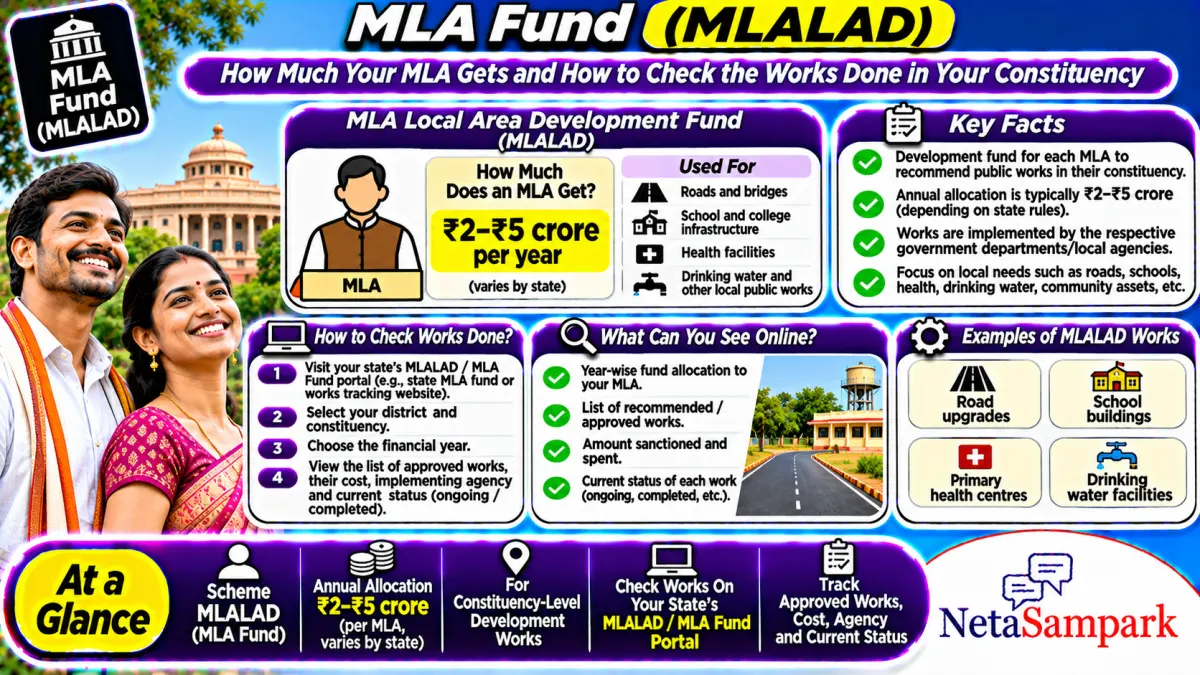
Most states give each MLA a yearly local area development fund (MLALAD) to recommend works like roads, drains and school rooms. The amount is set by each state, for example ₹5 crore a year in Delhi. You can check the works through your district planning office, state portals or an RTI.
Updated 21 November 2026
Ask ten people how much fund their MLA gets and you'll hear ten answers. ₹1 crore, ₹5 crore, ₹15 crore. Part of the confusion is real. Unlike MPLADS, which is one national scheme with one amount, the MLA fund is a state scheme. Every state sets its own amount, its own rules and its own name.
This guide explains how the MLA fund works, gives two verified examples, and shows you how to find out what your MLA has recommended and whether it got built.
Quick facts
| Item | Details |
|---|---|
| Official portal | Your state's planning or rural development department site. For MPs, the national eSAKSHI portal |
| Helpline | District Planning Officer or District Collector's office (MLALAD cell) |
| Fee | None to ask. RTI fee as per your state, usually ₹10 |
| Deadline | Not applicable. Funds are usually released at the start of each financial year |
| Documents | None to view. For RTI: your name, address and a clear list of questions |
| Who sets the amount | The state government, through its budget and scheme guidelines |
| Example: Delhi | ₹5 crore per assembly constituency per year from 2025-26 (Delhi Cabinet decision of 2 May 2025, as reported) |
| Example: Uttar Pradesh | ₹2.5 crore first instalment per legislator for 2026-27 (state statement, 21 April 2026, as reported) |
How does the MLA fund work?
The basic idea is the same in most states, even if the names differ (MLALAD, Vidhayak Nidhi, Kshetra Vikas Nidhi, Constituency Development Fund).
1. The state fixes the amount for each MLA, often each year in the budget.
2. The MLA recommends works in their constituency, in writing or on a state portal.
3. The district checks and sanctions the work. This is usually the District Collector, District Planning Officer or Rural Development department.
4. A government agency builds it. PWD, rural engineering, municipality or panchayat.
5. Money goes to the agency, not to the MLA personally.
So when people say "the MLA spent the money", what they mean is that the MLA recommended works and the district got them built.
How much does an MLA get? Two verified examples
We're only listing amounts we could confirm from a dated report or order. Amounts change often, so always check your state's latest budget or order.
Delhi. As per a Delhi Urban Development Department order reported by NDTV, the Delhi Cabinet decided on 2 May 2025 to keep the MLALAD fund at ₹5 crore per assembly constituency per year from 2025-26. It had been raised to ₹15 crore in October 2024. The order also made it an untied fund that can be used for capital works and for repairs and maintenance.
Uttar Pradesh. On 21 April 2026, the UP government released ₹1,247.5 crore under the Vidhan Mandal Kshetra Vikas Nidhi for 2026-27, as the first instalment, according to the Times of India. That works out to ₹2.5 crore per legislator, for 400 MLAs and 99 MLCs. Check the UP Rural Development Department for the full-year amount.
For other states, look at the state budget speech or the planning department's scheme guidelines. Search for "MLA local area development scheme guidelines" plus your state name on the state's own .gov.in site.
Where do you find the works your MLA recommended?
There's no single national portal for MLA funds, so you'll need one of these routes.
1. State scheme portals. Some states put MLALAD works online through the planning or rural development department, often with a works list by constituency.
2. District websites. Many district sites under the s3waas.gov.in platform post MLA and MP fund works lists, sanction orders or progress reports.
3. The District Planning Office. Walk in and ask for the list of works recommended and sanctioned under the MLA fund for your constituency. Many offices will show it if you ask politely.
4. Your MLA's office. MLAs like showing their work. Ask for the list of works they've recommended this year.
5. RTI. If none of this works, an RTI to the District Planning Officer or Collector is the surest way.
How to write an RTI for MLA fund works
Keep it short and specific. Ask for:
1. The amount allotted under the MLA fund to your constituency for each of the last three financial years.
2. The list of works recommended by the MLA in each year, with location and estimated cost.
3. Which works were sanctioned, which were rejected, and why.
4. The implementing agency, sanction date and completion status of each work.
5. Utilisation certificates or completion certificates for completed works.
6. Unspent balance at the end of each year.
Send it to the Public Information Officer of the District Collector or District Planning Office. Most states have an online RTI portal. We've written state RTI guides for Uttar Pradesh, Bihar, Madhya Pradesh and others.
How do you check if the work was really done?
Paper says one thing. The ground often says another. Do a simple site check.
☐ Find the exact location from the works list
☐ Look for a board or plaque with the scheme name, cost and dates
☐ Check if the size and type match what was sanctioned
☐ Take dated photos
☐ Ask nearby residents when it was built and if it's in use
☐ Note any work that's on paper but missing on the ground
If something's off, write to the District Collector with your photos and the RTI reply. Keep a copy with the received stamp.
MLA fund vs MPLADS: what's the difference?
| Point | MLA fund | MPLADS |
|---|---|---|
| Run by | State government | Centre (MoSPI) |
| Amount | Different in each state | ₹5 crore a year for every MP |
| Rules | State guidelines | MPLADS Guidelines, 2023 |
| Online tracking | Depends on the state | eSAKSHI portal, mplads.mospi.gov.in |
| Who sanctions | District authority | District authority |
For your MP's fund, the eSAKSHI dashboard shows works by MP. Not sure who your MLA or MP is? Our guide to finding your MP, MLA and corporator helps. If you're unsure who handles what between your MP, MLA and corporator, read the difference between an MP, MLA, corporator and panchayat member.
Is the MLA fund a good idea at all?
People argue about this. Supporters say MLAs know local needs and can fix small gaps fast. Critics say it blurs the line between lawmaking and spending, and that works can follow political loyalty rather than need. Whatever your view, the fund exists, so tracking it is the practical thing to do.
Frequently asked questions
How much fund does an MLA get in a year?
It depends on the state. Delhi gives ₹5 crore per constituency per year from 2025-26, as reported. Uttar Pradesh released a first instalment of ₹2.5 crore per legislator for 2026-27. Check your state's latest order.
Does the MLA get the fund money in their personal account?
No. The MLA only recommends works. The district sanctions them and a government agency builds them. Money goes to the agency.
Is there an online portal to check MLA fund works?
There's no single national portal. Some states and districts publish works lists online. If yours doesn't, ask the District Planning Office or file an RTI.
Can I suggest a work to my MLA?
Yes. Write a short letter to your MLA's constituency office with the location, the need and an approximate cost. Get it signed by neighbours if possible.
What if a work was paid for but never built?
Collect photos and the RTI reply, and complain in writing to the District Collector. You can also approach the state Lokayukta in states that have one.
Final reminder
Start with one question: what did my MLA recommend last year? Ask the District Planning Office or file a short RTI. Then check your MLA's record and add your rating on Rate Your Neta at NetaSampark. Your rating helps neighbours see who's actually delivering.
Sources
• MPLADS eSAKSHI portal, MoSPI (for comparison)
• Government of Uttar Pradesh portal
• NDTV: Delhi MLALAD fund at ₹5 crore from 2025-26, 20 May 2025 (news report)
• Times of India: UP releases ₹1,247 crore under MLA fund, 22 April 2026 (news report)