
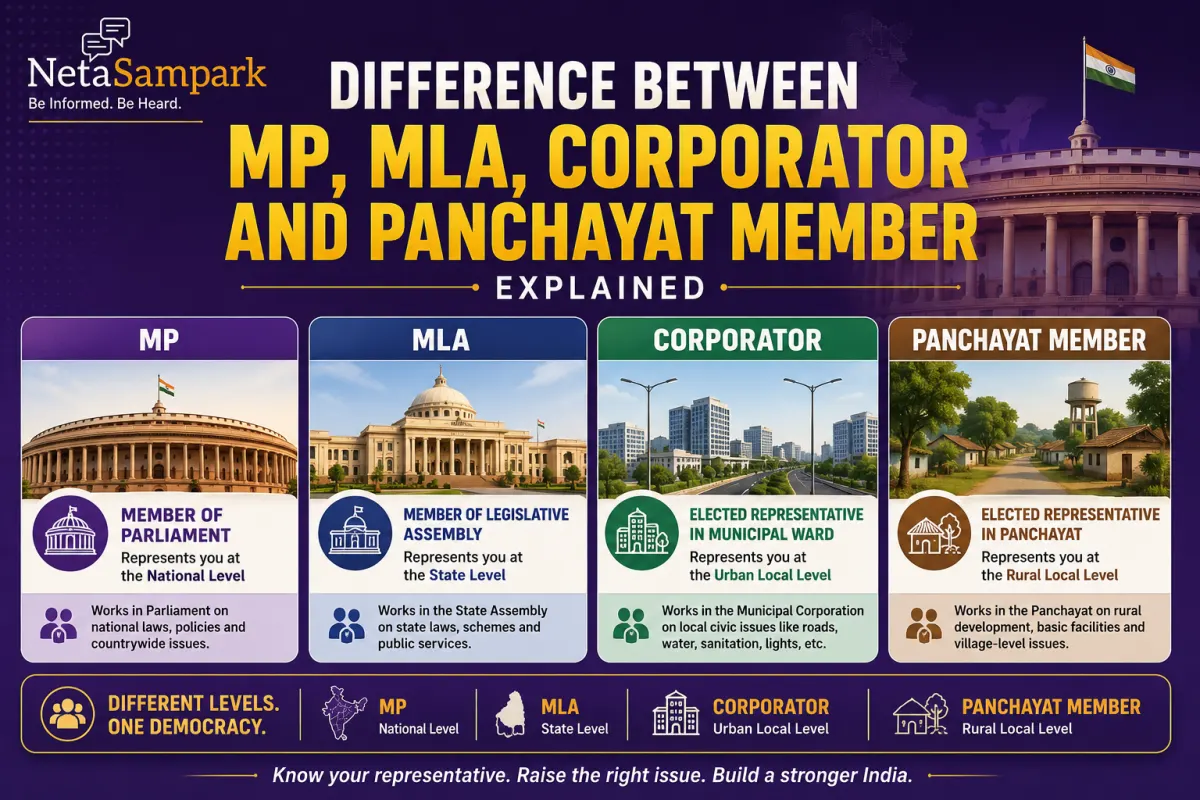
India has several layers of elected government, and each elected representative has a different role. An MP, MLA, Corporator, and Panchayat Member may all represent citizens, but they operate at different levels of government and deal with different kinds of public issues.
Understanding who is responsible for what can help citizens approach the right representative for the right problem.
The Four Levels at a Glance
RepresentativeGovernment LevelRepresentsMain Legislature / BodyMPUnion / NationalParliamentary constituencyParliament of IndiaMLAStateAssembly constituencyState Legislative AssemblyCorporatorUrban LocalMunicipal wardMunicipal Corporation / MunicipalityPanchayat MemberRural LocalPanchayat ward/areaGram Panchayat
The most important distinction is this:
MPs and MLAs primarily work at the national and state levels, while corporators and panchayat representatives work at the local-government level.
1 Who is an MP?
MP stands for Member of Parliament.
An MP represents citizens at the Union level and is part of India's Parliament.
There are two types of MPs:
- Lok Sabha MPs, who are directly elected by voters from parliamentary constituencies.
- Rajya Sabha MPs, who are generally elected by elected members of State Legislative Assemblies or nominated by the President in the case of nominated members.
When people talk about "their MP" in the context of a general election, they usually mean their Lok Sabha MP.
What does an MP do?
A Lok Sabha MP participates in the functioning of Parliament and deals with matters concerning the country as a whole.
Their responsibilities include:
- Participating in parliamentary debates
- Voting on legislation
- Raising issues affecting their constituency
- Asking questions to the government
- Participating in parliamentary committees
- Discussing national policies and programmes
- Representing constituency concerns before the Union government
An MP can raise a local issue in Parliament, but an MP does not directly run the city's municipal services or a village's day-to-day administration.
Examples of issues an MP may raise
- National highways
- Railways
- Airports
- Major central-government projects
- National policies
- Defence and national security
- Union government schemes
- Issues requiring intervention by central ministries
2 Who is an MLA?
MLA stands for Member of Legislative Assembly.
An MLA represents an Assembly constituency within a state and is a member of the State Legislative Assembly.
MLAs are directly elected by voters in their respective Assembly constituencies.
What does an MLA do?
An MLA participates in making laws on subjects within the state's legislative and governmental responsibilities.
Their responsibilities include:
- Participating in state legislative debates
- Voting on state legislation
- Raising constituency issues in the Assembly
- Questioning the state government
- Participating in legislative committees
- Advocating for development and public services in their constituency
Examples of issues associated with the state level
Depending on the subject and division of responsibilities between governments, these can include:
- State roads
- State government hospitals
- Government schools
- State welfare programmes
- Public transport
- State-level infrastructure
- Law and order matters through the state government
- Water and irrigation issues
However, an MLA is not the administrative head of the constituency. Government departments and local bodies are responsible for actually implementing many services.
3 Who is a Corporator?
A Corporator is an elected representative of a municipal ward in an urban local body.
The terminology varies across India. Depending on the city and state, the elected ward representative may be called a corporator, councillor, municipal councillor, or another local term.
A municipal corporation generally represents a larger urban area divided into multiple wards.
What does a corporator do?
A corporator represents residents of their ward in the municipal body.
Their work is primarily connected with local civic issues.
Typical issues include:
- Local roads
- Streetlights
- Garbage collection
- Drainage
- Local sanitation
- Footpaths
- Public spaces
- Local parks
- Municipal water-related issues
- Civic infrastructure
- Ward-level development concerns
A corporator can raise these issues within the municipal body and push the relevant municipal departments to act.
What a corporator does NOT do
A common misconception is that a corporator directly controls every civic service in their ward.
In reality, municipal officials and departments are responsible for administration and implementation. The elected councillor's role includes representation, deliberation, oversight and advocacy within the local government system.
4 Who is a Panchayat Member?
A Panchayat Member is an elected representative in the rural local-government system.
The exact structure and terminology can vary by state because Panchayati Raj institutions are organised under state laws.
In a typical three-tier Panchayati Raj system, there are:
- Gram Panchayat — village/local level
- Panchayat Samiti / Block-level Panchayat — intermediate level
- Zilla Parishad — district level
A member may therefore be elected to a particular tier depending on the state's system.
What does a Gram Panchayat member do?
At the village level, elected members represent their local wards and participate in the functioning of the Gram Panchayat.
Issues can include:
- Village roads
- Drainage
- Sanitation
- Drinking water
- Streetlights
- Local infrastructure
- Village development works
- Implementation of rural development programmes
- Local community facilities
The Gram Panchayat works with its elected representatives and administrative machinery to implement local development and civic functions.
MP vs MLA vs Corporator vs Panchayat Member
The easiest way to understand the difference is to look at where each representative operates.
MP → Country
The MP represents citizens in Parliament.
Their primary legislative and oversight role is at the Union level.
MLA → State
The MLA represents citizens in the State Legislative Assembly.
Their primary legislative and oversight role is at the state level.
Corporator → City/Ward
The corporator represents residents of an urban ward.
Their work is focused on municipal and civic governance.
Panchayat Member → Village/Rural Area
A panchayat member represents people in a rural local-government area.
Their work is focused on local rural governance and development.
Who Should You Contact for Your Problem?
This is perhaps the most useful distinction for citizens.
Your ProblemRepresentative to ConsiderNational policyMPIssue involving a Union ministryMP / relevant Union authorityState government policyMLA / relevant state authorityLocal municipal roadCorporator / municipalityGarbage collectionCorporator / municipal authorityStreetlight in an urban wardCorporator / municipal authorityVillage roadPanchayat representative / PanchayatVillage sanitationPanchayat / local authorityRural drinking-water issuePanchayat / relevant government departmentState-level hospital issueMLA / relevant health authorityRailway-related issueMP / railway authoritiesLocal park maintenanceCorporator / municipal authority
This does not mean that only one representative can raise an issue. Citizens can approach multiple levels when an issue crosses jurisdictions or requires intervention from a higher government.
Who Has More Power: MP or MLA?
This is one of the most common questions—and the answer is not simply "MP" or "MLA."
They operate at different levels of government.
An MP has a role in Parliament and Union-level matters, while an MLA has a role in the State Legislative Assembly and state-level matters.
For example, if the issue concerns a Union government policy, an MP may be the more relevant elected representative.
If it concerns a state government department, an MLA may be more relevant.
If the problem is a broken streetlight outside your home, neither an MP nor MLA may be the primary authority. The municipal body is usually the appropriate local institution.
Why Do Citizens Often Contact the Wrong Representative?
One reason is that elected representatives are often viewed as general-purpose problem solvers.
A citizen may approach an MP about a garbage collection problem or an MLA about a local streetlight because they are the most visible elected representatives they know.
Representatives can certainly raise issues outside their direct administrative jurisdiction, but knowing which level of government is responsible can make grievance resolution much more efficient.
The key question should be:
Which government or local body actually controls this service?
One Citizen Can Have Several Representatives
A voter does not have just one elected representative.
For example, an urban resident could simultaneously have:
- One Lok Sabha MP
- One MLA
- One municipal ward representative
- Other local representatives depending on the local government structure
A rural resident could have:
- One Lok Sabha MP
- One MLA
- A Gram Panchayat representative
- Potentially representatives at intermediate and district Panchayat levels
This means the same citizen is represented at multiple levels of government.
Why This Matters for Citizens
Democracy is not limited to voting once every five years.
Citizens interact with government at multiple levels every day.
A national policy may affect millions of people, while a municipal drainage problem may affect only a few streets—but both are part of governance.
Knowing your representatives and understanding their responsibilities helps citizens:
- Raise complaints with the appropriate authority
- Ask better questions
- Follow up on unresolved issues
- Understand government accountability
- Participate more effectively in local democracy
The Simple Rule to Remember
Think of India's elected representatives as different layers:
🇮🇳 MP → National
🏛️ MLA → State
🏙️ Corporator → Urban Local
🏘️ Panchayat Member → Rural Local
No single representative is responsible for everything.
The most effective citizen engagement starts with understanding who is responsible for what.
And when a problem is not resolved, citizens can use the appropriate government department, grievance mechanism and elected representative together rather than relying on a single office.
Final takeaway
MPs represent you in Parliament. MLAs represent you in the State Assembly. Corporators represent your urban ward in the municipal body. Panchayat members represent your rural local area.
Knowing the difference isn't just political knowledge—it helps you reach the right representative, ask the right questions and hold the right level of government accountable.
Official sources
Confirm fees, dates and eligibility on the official page before you act.