
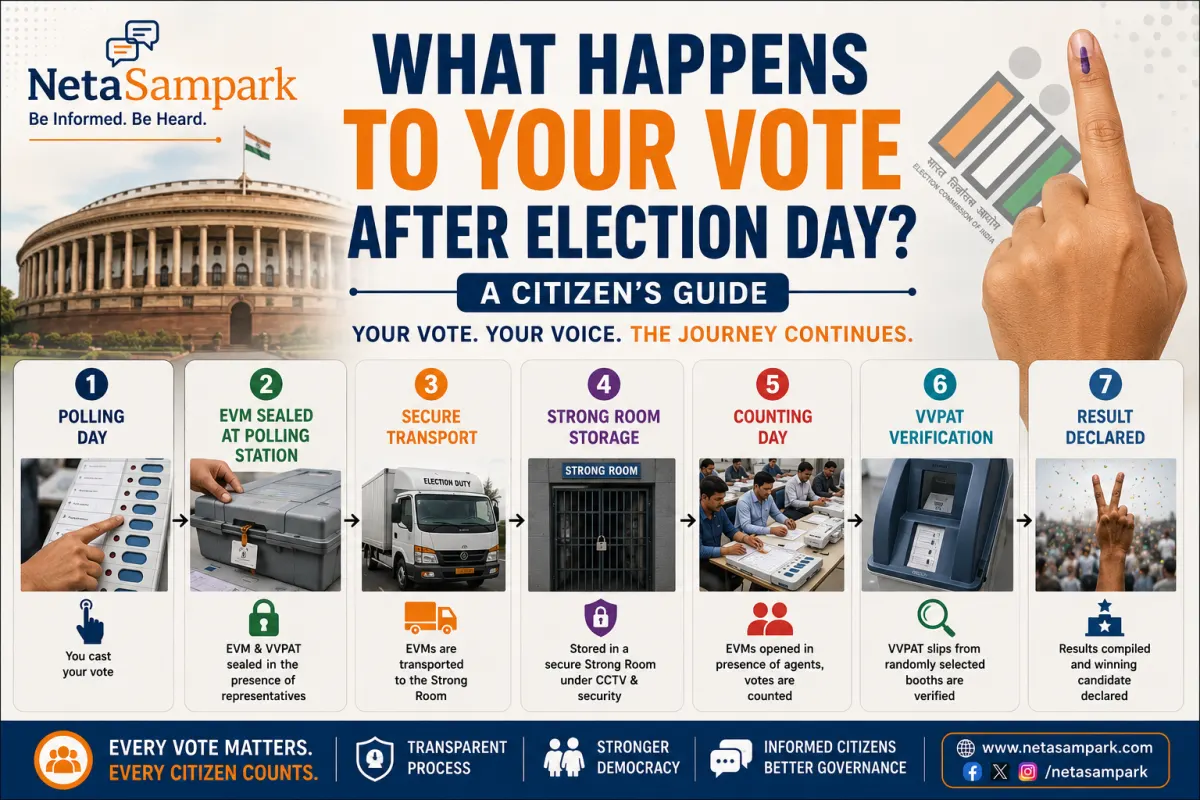
Voting does not end when you press a button on an EVM or leave the polling station. From the moment polling closes until the final result is declared, your vote goes through a carefully defined process involving sealing, transportation, secure storage, counting and verification.
Understanding what happens after polling day can help citizens better understand how an election result is produced.
What happens immediately after polling closes?
Once voting ends, the polling process is formally closed.
The polling officials complete the required records and seal the EVM units and VVPAT according to prescribed procedures. Polling agents representing candidates can witness the sealing process and sign the relevant seals and documents. (Election Commission of India)
The total number of votes recorded at the polling station is also documented in Form 17C, an important record of the votes polled at that station.
The ECI's procedures are designed so that the number of votes recorded after polling can later be checked against the electronic count.
Where does the EVM go after voting?
The EVM does not simply remain at the polling station.
After polling, the machines are transported to a designated collection centre and then placed in a strong room.
Candidates and their representatives are permitted to follow the vehicles transporting the polled EVMs to the collection centre. The ECI also requires the strong room to be secured and monitored. (Election Commission of India)
The strong room has multiple security measures, including:
- Double-lock arrangements
- CCTV surveillance
- Armed security
- Restricted access
- Seals involving election officials and candidate representatives
Candidates or their authorised representatives can also monitor the security arrangements around the strong room until counting day. (Election Commission of India)
What is a strong room?
A strong room is a secure storage facility for election materials, particularly polled EVMs and VVPATs.
It is not simply a locked storage room.
The opening and closing of the strong room is carried out under prescribed procedures and in the presence of relevant stakeholders, including candidate representatives. The process is also videographed. (Election Commission of India)
The purpose is to maintain a documented chain of custody between the end of polling and the beginning of counting.
What happens between polling day and counting day?
This period is important because the machines containing the votes must remain secure until counting.
The ECI's procedures provide for candidate representatives to monitor the strong room and its security arrangements.
The ECI states that polled EVMs remain in secure storage under CCTV and armed security, with candidate representatives able to monitor the strong room. (Election Commission of India)
Meanwhile, election officials complete the administrative work required before counting.
The Returning Officer and election observers also scrutinise relevant polling records and complaints after polling. If circumstances warrant it, the prescribed procedures allow the Election Commission to consider whether a re-poll is necessary. (Election Commission of India)
What happens on counting day?
Counting day is when the votes recorded during polling are converted into candidate-wise results.
Before counting begins, the strong room containing the EVMs is opened in the presence of candidates or their representatives, the Returning Officer and the Election Commission's observer. (Election Commission of India)
The EVM seals and serial numbers are checked before counting begins.
The Control Unit of the EVM contains the electronically recorded votes.
The result is then obtained from the Control Unit and recorded according to the prescribed counting procedure.
Counting takes place in the presence of candidates and their authorised counting agents. (Election Commission of India)
What role does Form 17C play?
Form 17C is an important part of the election record.
It records the number of votes polled at a polling station.
During counting, the total recorded in the relevant documentation is checked against the total displayed by the Control Unit. If there is a discrepancy, the prescribed procedure is followed, which can include setting aside the affected Control Unit and, depending on the circumstances and the margin, counting the corresponding VVPAT slips. (Election Commission of India)
This provides an additional record against which the electronic result can be checked.
What happens to the VVPAT slip?
When you cast your vote, the VVPAT prints a paper slip showing the serial number, name and symbol of the candidate you selected. The voter can see it through the transparent window for a short period before the slip drops into the sealed VVPAT compartment. (Election Commission of India)
The voter does not take this slip home.
After polling, the slips remain securely stored inside the VVPAT.
During the counting process, VVPAT slips from the prescribed sample of randomly selected polling stations are counted and compared with the corresponding electronic counts. (Election Commission of India)
Are all VVPAT slips counted?
No.
The current procedure provides for mandatory verification of VVPAT slips from five randomly selected polling stations per Assembly constituency/segment, in accordance with the applicable Supreme Court-mandated process described by the ECI. (Election Commission of India)
There are also provisions under the election rules for candidates to request VVPAT slip counting in specified circumstances.
Therefore, VVPAT serves two important purposes:
At the polling station: it allows the voter to verify the candidate selected.
During post-poll verification: the paper record can be compared with the electronic count according to the prescribed procedure.
What if the electronic count and VVPAT count don't match?
A mismatch does not automatically mean that an election has been manipulated.
The ECI's procedures provide mechanisms for dealing with discrepancies.
The Commission states that differences, when encountered, can arise from procedural or human errors, such as issues involving mock-poll votes. The applicable counting and verification procedures determine what happens next. (Election Commission of India)
The important point for citizens is that there is a defined process for handling discrepancies rather than simply ignoring them.
How is the winner decided?
Once counting is completed, the candidate who receives the highest number of valid votes in a constituency is declared elected under the applicable electoral rules.
India generally follows the first-past-the-post system for Lok Sabha and State Assembly elections.
This means a candidate does not necessarily need more than 50% of all votes cast.
For example:
- Candidate A — 42%
- Candidate B — 35%
- Candidate C — 23%
Candidate A would win because they received more votes than any other candidate.
This is why every vote matters even when the winning candidate does not receive a majority of all votes.
What happens after the result is declared?
Once the Returning Officer completes the counting and the result is formally declared, the election moves into its post-result stage.
The EVMs, VVPAT slips and other election materials do not simply disappear after the result announcement.
The ECI states that the relevant election materials remain secured for the period prescribed for filing an Election Petition, which it identifies as 45 days from the date of declaration of the result. If an Election Petition is filed, the relevant materials are retained until final disposal of the petition. (Election Commission of India)
This is important because an election result can be legally challenged through the prescribed judicial process.
Can an election result be challenged?
Yes.
An election result is not beyond legal scrutiny.
An aggrieved candidate or voter can challenge an election through an Election Petition before the competent court, subject to the applicable law and procedures.
The court can issue directions regarding election records and VVPAT material where legally appropriate. (Election Commission of India)
This provides a formal legal mechanism for challenging an election rather than relying only on public or political claims.
So, what actually happens to your vote?
In simple terms:
You cast your vote → the vote is recorded → polling closes → EVM/VVPAT is sealed → the machine is transported securely → it is stored in a strong room → counting day arrives → EVM results are counted → prescribed VVPAT verification takes place → results are compiled → the winning candidate is declared.
The process does not rely on a single moment or a single person.
There are records, seals, candidate representatives, observers, secure storage, counting procedures and verification mechanisms at different stages.
Why should citizens understand this process?
Elections are often discussed only in terms of who won and who lost.
But democracy also depends on citizens understanding how the result was produced.
Knowing what happens after polling helps voters understand:
- Why EVMs are taken away after voting
- Why strong rooms are used
- What happens on counting day
- What VVPAT does
- How election records are maintained
- How discrepancies are handled
- How results can be legally challenged
It also helps citizens distinguish between a genuine procedural concern and misinformation circulating online.
Your vote doesn't end when you leave the polling station
The journey of a vote continues long after a voter walks away from the polling booth.
From secure transportation and storage to counting and verification, the election system has procedures intended to protect the integrity of the vote and produce an official result.
For citizens, the takeaway is simple:
Casting your vote is the beginning of the process. Understanding what happens to it afterward is part of being an informed voter.
NetaSampark believes that an informed citizen is a stronger participant in democracy.