
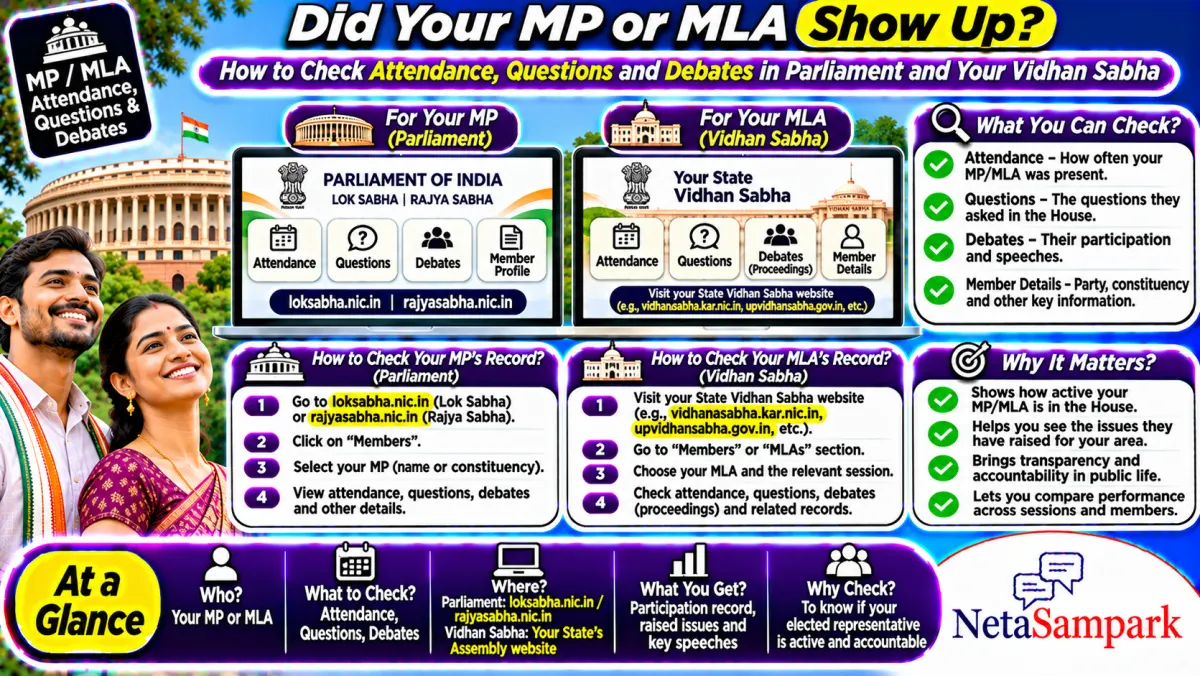
For MPs, check attendance, questions and debates on PRS Legislative Research's MP Track (prsindia.org/mptrack) and search questions on sansad.in. For MLAs, most assemblies don't publish attendance, so check questions and proceedings on the assembly's website or NeVA, and file an RTI with the Assembly Secretariat for attendance.
Updated 21 November 2026
Your MP and MLA are paid from public money to do one main job: make laws and question the government on your behalf. Fixing a road or cutting a ribbon is nice. But if they never turn up in the House, never ask a question and never speak, a big part of the job isn't being done.
Checking this is easier for MPs than for MLAs. Parliament publishes a lot. Most state assemblies publish much less. This guide shows you where to look for both, what the numbers mean, and how to get what isn't online.
Quick facts
| Item | Details |
|---|---|
| Official portal | Parliament: sansad.in (Lok Sabha) and sansad.in/rs (Rajya Sabha). States: your assembly's website or NeVA (neva.gov.in) |
| Helpline | Not applicable. For records, the Public Information Officer of the Lok Sabha, Rajya Sabha or your Assembly Secretariat |
| Fee | None to view. ₹10 for a central RTI; state RTI fees vary |
| Deadline | Not applicable. RTI replies are due within 30 days |
| Documents | None to view. For RTI: name, address and specific questions |
| Easiest MP tracker | PRS MP Track (prsindia.org/mptrack), non-government |
| MLA attendance | Rarely published; ask through RTI |
How to check your MP's attendance and work on PRS MP Track
PRS Legislative Research is an independent research group. Its MP Track pulls together data from Parliament for each MP.
1. Open prsindia.org/mptrack.
2. Choose Lok Sabha or Rajya Sabha, then search your MP by name, state or constituency.
3. Open the MP's profile. You'll usually see attendance, number of debates taken part in, questions asked and private member bills introduced.
4. Compare with averages. PRS shows national and state averages next to the MP's own numbers. That's the fairest way to judge.
Two things to keep in mind:
• Ministers usually don't show attendance. Ministers aren't required to sign the attendance register in the same way, so their attendance may be blank. The Speaker and Deputy Speaker are also special cases.
• Numbers aren't everything. An MP who asks 300 questions on unrelated topics isn't necessarily better than one who asks 40 sharp ones about your district.
How to see the actual questions your MP asked
Numbers tell you how much. The questions tell you about what.
1. Go to the questions and answers section on sansad.in for Lok Sabha, or sansad.in/rs for Rajya Sabha.
2. Search by member name, ministry, or a keyword like your district name.
3. Open the question to read the full answer from the ministry.
Look for questions about your area: railway stations, highways, hospitals, schools, water supply, local industry. That tells you whether your MP is using Parliament for local issues.
Starred, unstarred, Zero Hour: what do these mean?
You'll see these terms everywhere. In simple words:
| Term | What it means |
|---|---|
| Starred question | Answered orally in the House. MPs can ask follow-up (supplementary) questions |
| Unstarred question | Answered in writing. No follow-up in the House |
| Short notice question | On an urgent matter, asked with less notice than usual |
| Zero Hour | Time after Question Hour when MPs raise urgent issues without the usual notice |
| Private member bill | A bill introduced by an MP who isn't a minister |
| Debate participation | Speaking during discussions on bills, budgets or motions |
Why is it harder to check MLA attendance?
Most state legislative assemblies don't publish member-wise attendance online. Some publish the daily list of business, questions and proceedings, but not who was present. So you have to combine a few sources.
1. The assembly's own website. Search "Vidhan Sabha" plus your state on a .gov.in or .nic.in site. Look for sections like Questions, Proceedings, Debates or Business. Many list starred and unstarred questions with the member's name.
2. NeVA. The National e-Vidhan Application at neva.gov.in is the Centre's project to make state legislatures paperless. States sign up one by one. Karnataka signed up on 8 April 2026, Telangana on 1 June 2026 and West Bengal on 4 June 2026, as per NeVA's own site. Where it's live, questions and papers are often easier to find.
3. PRS state data. PRS publishes state legislature trends, such as how many days each assembly sat in a year. It doesn't usually give MLA-wise attendance, but it tells you whether your assembly met enough at all.
4. RTI to the Assembly Secretariat. This is the surest route for attendance.
How to file an RTI for your MLA's attendance
Assembly Secretariats are public authorities under the RTI Act. Address your RTI to the Public Information Officer, Legislative Assembly Secretariat of your state.
Ask clearly:
1. Number of days the assembly sat in each of the last three years.
2. Number of sittings attended by [MLA name], [constituency], in each year, as per the attendance register.
3. Number of starred and unstarred questions submitted by the MLA, and how many were admitted.
4. Copies of questions asked by the MLA, with answers.
5. Committees the MLA is a member of, and meetings attended.
Some information can be refused if it would breach the privilege of the legislature, under Section 8(1)(c) of the RTI Act. Attendance and questions are usually not in that category, but if you get a refusal, file a first appeal within 30 days.
Our state RTI guides cover the process for Uttar Pradesh, Bihar and Maharashtra, and the central route is in our rtionline.gov.in guide.
How should you judge what you find?
Be fair. Here's a simple way to read it.
☐ Compare attendance with the state or national average, not with 100%
☐ Check if your representative is a minister, since ministers work differently
☐ Read a few questions to see if they're about your area
☐ See if they spoke on bills that matter to your district
☐ Note committee work, which often doesn't show up in headlines
☐ Look at the whole term, not one bad session
A first-time MLA who's quiet in year one but active by year three is different from someone who's silent all five years.
Frequently asked questions
Where can I check my MP's attendance in Parliament?
PRS Legislative Research's MP Track at prsindia.org/mptrack shows attendance, questions and debates for each MP, with averages for comparison.
Is MLA attendance available online?
In most states, no. Some assemblies publish questions and proceedings, but member-wise attendance usually needs an RTI to the Legislative Assembly Secretariat.
Why is my MP's attendance blank on PRS?
If your MP is a minister, attendance may not be recorded the same way. Ministers aren't required to sign the attendance register like other members.
What's the difference between a starred and unstarred question?
A starred question gets an oral answer in the House with follow-up questions allowed. An unstarred question gets a written answer only.
Can I see what questions my MLA asked?
Often yes. Check the questions section on your assembly's website or NeVA. If it isn't there, ask for copies through RTI.
Final reminder
Pick your MP on PRS MP Track and read three of their questions. Then, for your MLA, check the assembly site or file a short RTI. Once you've seen the record, add your rating on Rate Your Neta at NetaSampark so others in your constituency can see it too. Our post on how to rate your neta's performance explains what to look at.
Sources
• National e-Vidhan Application (NeVA)
• PRS Legislative Research: MP Track (non-government)