
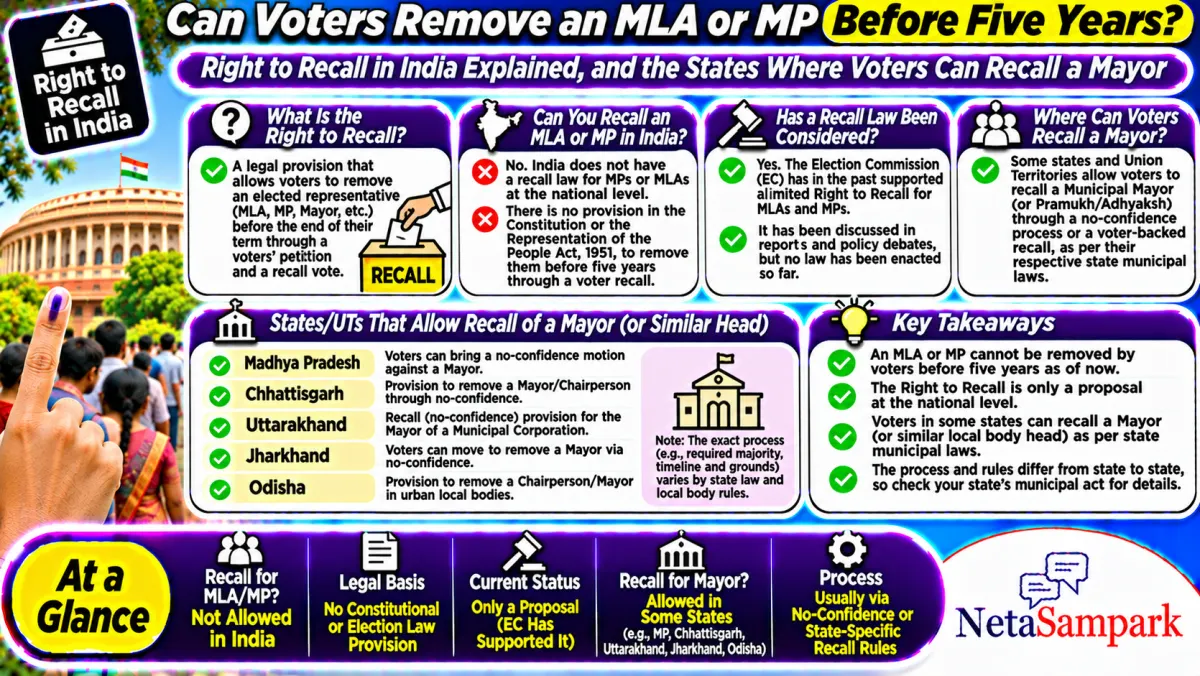
No. Indian voters can't recall an MLA or MP before the five-year term ends, because no law gives that power at the national or state level. A member leaves early only through disqualification, resignation or dissolution. But Madhya Pradesh and Chhattisgarh let voters recall mayors and municipal chairpersons through a ballot.
Updated 23 November 2026
"If we can hire them, we should be able to fire them." You hear this line every time an MLA disappears after the election. The idea is called the right to recall. It sounds simple, but India has a more complicated answer than a plain yes or no.
This guide explains what the law says now, where recall already works in India, why it was rejected for legislators and what ordinary voters can do in the meantime.
Quick facts
| Item | Details |
|---|---|
| Official portal | Constitution and Acts on indiacode.nic.in; Election Commission at eci.gov.in |
| Helpline | ECI voter helpline 1950 for electoral roll queries. For complaints about your representative, your state CM helpline and CPGRAMS |
| Fee | Not applicable. There is no recall petition process for MLAs or MPs |
| Deadline | Not applicable. The five-year term runs until the House ends or is dissolved |
| Documents | None. For local-body recall in some states, the process is run by the State Election Commission and the law of that state |
| Where recall exists | Mayors, municipal chairpersons and nagar panchayat presidents in Madhya Pradesh and Chhattisgarh, and a few other local-body provisions |
What does the law say now?
MPs and MLAs have a fixed five-year term. That term can be cut short only in a few ways. As Frontline summarised in March 2026, a member can lose the seat if disqualified under the anti-defection law, if the member holds an office of profit, if a competent court declares the member of unsound mind, or if the member is convicted and sentenced to two years or more in prison. Death and resignation also end a term, and the House itself ends if it is dissolved.
None of these is a voter-driven process. A voter can't file a petition to remove a legislator because of poor performance, broken promises or being unreachable. The only direct tool voters have is the next election.
Has anyone tried to bring in recall?
Yes, several times, and it has failed each time.
• 1948: In the Constituent Assembly, on 29 November 1948, Lokanath Misra moved an amendment for the right to recall elected members. The Assembly rejected it.
• 1974: Jayaprakash Narayan backed recall in the Sampoorna Kranti movement. The same year, C.K. Chandrappan introduced a bill, supported by Atal Bihari Vajpayee. It was defeated.
• 2011: Activist Anna Hazare raised the demand during the India Against Corruption movement.
• 2017: Varun Gandhi, then a Lok Sabha MP, brought a private member's bill to amend the Representation of the People Act, 1951. It proposed that any voter could file a recall petition signed by at least one-fourth of the electors, and that it would succeed if signed by three-fourths of the number of valid votes the member had won. It also proposed no recall in the first two years and limits on repeat petitions. The bill did not become law.
• 11 February 2026: In the Rajya Sabha's Zero Hour, AAP MP Raghav Chadha said, "If voters in the country can hire leaders, they should also have the power to fire them." Congress MP Pramod Tiwari rose to say he dissociated himself from what he called a dangerous proposal.
Why do critics say no to recall for MPs and MLAs?
Former Chief Election Commissioner S.Y. Quraishi told Frontline the idea is impractical for legislators. His worry is the threshold. If an MLA won with one lakh votes and the runner-up got 80,000, how many signatures should a petition need? If it's low, the losing candidate can start a recall campaign from day one and destabilise the system. He also pointed to signature verification, coercion, misuse and populist decisions, and the cost of repeated polls and Model Code of Conduct periods.
Political scientist Afroz Alam said recall is easier to run at the local level, where a representative's performance is easier to see. At the MP or MLA level, work is spread across lawmaking, oversight, representation and negotiation, and it's hard to reduce to simple delivery numbers. He suggested that if India ever tries recall for legislators, it should go step by step through pilots and narrow, clearly defined grounds.
Where does recall already work in India?
At the local level, in some states.
Madhya Pradesh brought in recall in 2000 by amending the Madhya Pradesh Municipal Corporation Act, 1956, and the Madhya Pradesh Municipalities Act, 1961. It covers mayors, municipal chairpersons and nagar panchayat presidents. Chhattisgarh did the same in 2007. In both states, the process starts with the support of three-fourths of the elected councillors. Then voters decide in a secret ballot.
A recent example is Deori municipality in Sagar district, Madhya Pradesh. On 19 January 2026, voters chose between a "khali kursi" (empty chair, meaning removal) and a "bhari kursi" (occupied chair, meaning continuation) for Chairperson Neha Alkesh Jain. About 7,282 of 13,367 votes backed her continuing and 6,085 backed removal. She stayed. The same report says Madhya Pradesh's provisions were put on hold in 2018 and reactivated in 2025. Between 2000 and 2018, 41 recall petitions were started in Madhya Pradesh and 20 ended with the chairperson being ousted.
Other states, including Uttar Pradesh, Bihar, Rajasthan, Maharashtra, Haryana, Uttarakhand and Himachal Pradesh, have some provision to remove panchayat or municipal heads midterm. But in several of them, such as Bihar, Jharkhand, Uttar Pradesh and Haryana, removal works through a no-confidence motion by a majority of the council members, not through a direct vote of the public.
The Deori case also shows the limit. It was triggered by a fight inside the council and the party, not by a public wave. So recall can be used as a political weapon too.
How does a recall vote work in Madhya Pradesh and Chhattisgarh?
In simple steps, as described in reports on the municipal laws:
1. A recall proposal needs the backing of three-fourths of the elected councillors
2. The State Election Commission arranges a referendum
3. Voters in the city or town vote by secret ballot, choosing between keeping or removing the head
4. As summarised in reports, if more than half of those who vote say remove, the head loses the post
Some summaries also mention a bar on starting recall in the first two years and a limit of one attempt per term. I couldn't open the statute text, so please check the Act of your state before relying on these details.
What can voters do now if an MLA or MP doesn't deliver?
You can't fire them, but you can pressure them and make records.
1. Check their record. Look at attendance, questions asked and debates on the Parliament or Vidhan Sabha website.
2. Check public money. MPs get ₹5 crore a year under MPLADS, and many MLAs have their own area development funds. You can ask where the money went.
3. Use RTI. Ask departments about works recommended by your representative. Our guides for filing RTI online cover state-wise steps.
4. Check their affidavit. If a candidate lied in the affidavit, any voter can complain. See our guide on Section 125A false affidavit complaints.
5. Know the court route. An election petition can challenge an election result on legal grounds, within strict limits. Read our explainer on how to file an election petition.
6. Meet and write. Use the public meeting hours and a written petition.
7. Vote. In the next election, you can vote for someone else, or choose NOTA to register your protest.
If you're not sure who represents you, our guide to finding your MP, MLA and corporator in 2 minutes helps. And the difference between roles is explained in MP, MLA, corporator and panchayat member, explained.
Frequently asked questions
Can voters remove an MLA before five years in India?
No. There is no recall law for MLAs or MPs. They can leave early only through disqualification, resignation, death or dissolution of the House.
Which states allow recall of elected leaders?
Madhya Pradesh (from 2000) and Chhattisgarh (from 2007) allow voters to recall mayors, municipal chairpersons and nagar panchayat presidents. Several other states have removal provisions for local heads, but often through a no-confidence vote of the council.
Did Parliament ever debate the right to recall?
Yes. The Constituent Assembly rejected it on 29 November 1948. Bills were introduced in 1974 and 2017 and did not pass. On 11 February 2026, Raghav Chadha raised it in the Rajya Sabha.
What is the Deori recall referendum?
On 19 January 2026, voters in Deori municipality in Sagar, Madhya Pradesh, voted on whether to keep their municipal chairperson. About 7,282 of 13,367 votes were to keep her and 6,085 to remove her, so she continued.
What can I do if my MLA is not working?
Check their record, use RTI, meet them with a written petition, complain if their affidavit was false, and vote them out at the next election.
What to do next
Look up your MLA and MP, see what they've done and share your experience for others to read. You can do that on Rate Your Neta at NetaSampark.
Sources
• Constitution of India and Acts on India Code
• Election Commission of India
• Lok Sabha and Rajya Sabha, sansad.in
• Frontline: Right to Recall, Accountability Tool or Political Risk? (10 March 2026)