
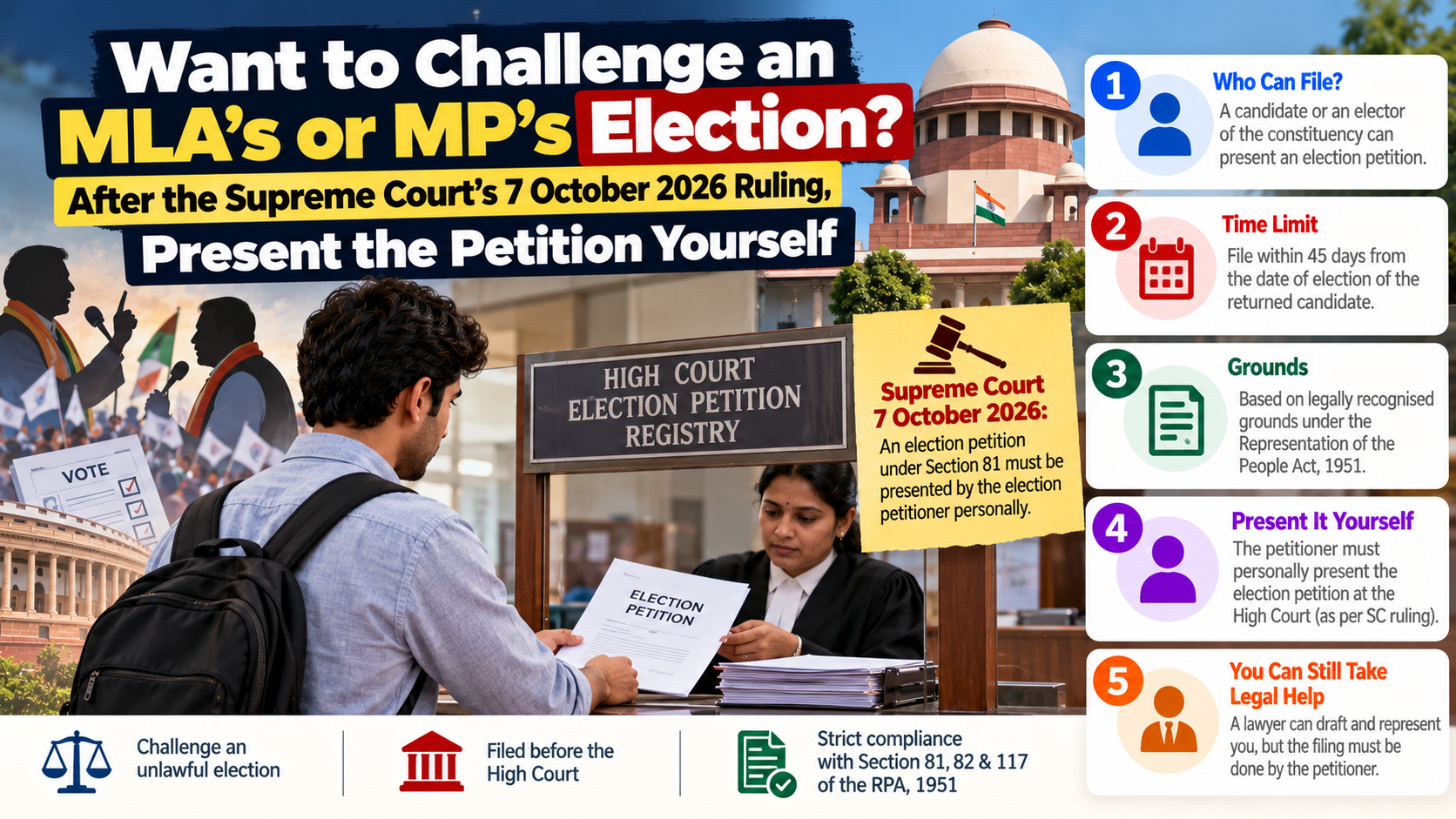
Want to Challenge an MLA’s or MP’s Election? After the Supreme Court’s 7 October 2026 Ruling, Present the Petition Yourself
Think an MLA or MP was wrongly elected? Indian election law does provide a way to challenge the result — but the first filing step has just received an important reminder from the Supreme Court.
On 7 October 2026, the Supreme Court in V. Pon. Paneerselvam v. S. Regupathy held that an election petition under Section 81 of the Representation of the People Act, 1951 (RPA) must be presented by the election petitioner personally. Simply having your lawyer present the petition for you can result in the election petition being dismissed at the threshold. Indian Kanoon
The ruling is particularly important because an election petition has a strict limitation period and the RPA treats several filing requirements as mandatory.
What Exactly Did the Supreme Court Decide?
The case arose from a challenge to the election of S. Regupathy from the Thirumayam Assembly Constituency in the 2026 Tamil Nadu Assembly election.
The petitioner had challenged the election on grounds including alleged undue influence and issues concerning the elected candidate's Form 26 affidavit.
The Madras High Court dismissed the election petition because it had been presented by the petitioner's counsel rather than by the petitioner himself.
The matter reached the Supreme Court.
On 7 October 2026, a Bench comprising Justices Prashant Kumar Mishra and Shree Chandrashekhar upheld that approach and dismissed the challenge. Indian Kanoon
The Court said that Section 81 contains specific requirements and that presentation “by” the petitioner is one of them.
Because Section 86(1) requires the High Court to dismiss an election petition that does not comply with Section 81, the defect is not something that can simply be corrected later. Indian Kanoon
Does This Mean You Cannot Hire a Lawyer?
No.
This is the most important distinction to understand.
The judgment does not mean that an ordinary voter must personally argue the entire election case without a lawyer.
The issue is the presentation of the election petition at the filing stage.
You can take legal assistance to:
- draft the petition;
- identify the correct legal grounds;
- prepare supporting documents;
- prepare affidavits;
- comply with High Court rules;
- represent you during the proceedings.
But the Supreme Court has now reinforced that the election petitioner himself or herself must present the election petition, subject to the applicable High Court's filing procedure.
In the case before the Court, the petitioner argued that he had personally been present in the High Court premises. The Court found that mere presence in the building did not establish that he personally presented the petition. Indian Kanoon
Who Can File an Election Petition?
Section 81 of the RPA allows an election petition to be presented by:
1. A candidate who contested that election; or
2. An elector of that constituency.
An elector means a person who was entitled to vote in the election, whether or not that person actually voted. Indian Kanoon
So you do not necessarily have to be the losing candidate.
A voter can also challenge the election, provided the legal requirements are satisfied.
You Cannot Challenge an Election Through an Ordinary Court Case
Section 80 of the RPA provides that an election can be called into question only through an election petition presented in accordance with Part VI of the Act. India Code
For Lok Sabha and State Assembly elections, the election petition is ordinarily tried by the High Court having jurisdiction over the election under Section 80A.
That means a voter who believes an MLA or MP was improperly elected cannot simply file an ordinary civil suit asking the court to cancel the election.
The challenge has to follow the special procedure prescribed by election law.
The 45-Day Deadline Is Critical
One of the biggest things voters need to understand is the limitation period.
Under Section 81, an election petition must be presented within 45 days from, but not earlier than, the date of election of the returned candidate. India Code
In practical terms, this is generally calculated from the date on which the Returning Officer declares the candidate elected.
Example
Suppose an Assembly election result is declared on:
4 May 2026
The election petition has to be presented within the statutory 45-day period.
Do not assume that you can wait for several months while collecting evidence and then ask the High Court to extend the deadline.
The Supreme Court has repeatedly treated the RPA's election-petition limitation regime as a special and self-contained code. The 7 October 2026 judgment again emphasised the importance of strict compliance with Section 81. Indian Kanoon
What Happens If You Miss the Deadline?
This is not a minor filing mistake.
Section 86(1) says that the High Court shall dismiss an election petition that does not comply with Sections 81, 82 or 117. Indian Kanoon
The Supreme Court has also explained that the Representation of the People Act is a special code governing election disputes and that the ordinary provisions of the Limitation Act cannot simply be used to extend the statutory election-petition period. Indian Kanoon
That makes the filing date extremely important.
Do not wait until the last day if you intend to challenge an election.
What Grounds Can Be Used to Challenge an Election?
An election petition is not simply a complaint saying:
“I believe the election was unfair.”
The petition must be based on legally recognised grounds.
Section 100 of the RPA sets out circumstances in which the election of a returned candidate may be declared void.
These include circumstances such as:
- the returned candidate was not qualified or was disqualified;
- improper rejection of a nomination;
- improper acceptance of a nomination;
- certain improper reception, refusal or rejection of votes;
- non-compliance with the Constitution or the RPA/rules/orders governing the election;
- the result being materially affected by certain acts or circumstances specified by the Act.
There are also provisions concerning corrupt practices, including the grounds recognised under Section 123.
The Supreme Court's 7 October judgment itself involved allegations under Sections 100 and 123 of the RPA. Indian Kanoon
A Suspicion Is Not Enough
This is where many potential election challenges can go wrong.
If you believe there was:
- bogus voting;
- bribery;
- undue influence;
- improper counting;
- an illegal nomination;
- suppression of required information;
- a serious procedural violation;
you need to identify the specific legal ground and provide supporting facts and evidence.
A petition should not simply contain broad allegations.
The RPA requires an election petition to set out the material facts on which the petitioner relies. Where corrupt practice is alleged, additional requirements relating to particulars and affidavits can apply.
That is why professional legal assistance can be extremely useful even though the petitioner must personally present the petition.
What Evidence Should a Voter Preserve?
If you are seriously considering an election petition, start preserving evidence immediately.
Depending on the allegation, this could include:
- polling-day documents;
- counting records;
- Returning Officer documents;
- Form 17 series documents where legally obtainable;
- counting sheets;
- postal-ballot records where applicable;
- nomination papers;
- affidavits filed by candidates;
- certified election documents;
- photographs or videos;
- official communications;
- complaints already submitted to election authorities;
- witness information;
- copies of relevant ECI/CEO orders;
- publicly available speeches or campaign material;
- documents showing alleged disqualification or non-disclosure.
Do not alter, edit or manufacture evidence.
Maintain the original files and note when, where and how each item was obtained.
What If You Want to Challenge an MLA's Election?
The broad roadmap is:
Step 1: Confirm that you have standing
You should be an elector of the relevant constituency or a candidate at that election.
Step 2: Identify the legal ground
Work out whether the facts potentially fall under Section 100, Section 101 or another applicable provision.
Step 3: Calculate the 45-day deadline
Do this immediately after the result is declared.
Step 4: Collect documentary evidence
Obtain the relevant election records and preserve your own evidence.
Step 5: Prepare the election petition
The petition must comply with the RPA and the applicable High Court's election-petition rules.
Step 6: Check the necessary parties
Section 82 contains rules concerning who must be joined as respondents. Getting the respondent structure wrong can create a serious maintainability problem.
Step 7: Arrange the required security
Section 117 provides for security for the costs of the election petition. Non-compliance with Section 117 is expressly covered by Section 86(1). Indian Kanoon
Step 8: Personally present the petition
This is the point reinforced by the Supreme Court's 7 October 2026 ruling.
Follow the specific filing procedure of the relevant High Court Registry, and make sure there is a proper record of your presentation.
Step 9: Keep proof of presentation
Do not rely merely on proof that you entered the court complex.
The 7 October case is a warning on precisely this point: the Supreme Court noted that a CISF entry pass established the petitioner's presence in the premises but did not establish that he personally presented the election petition. Indian Kanoon
What About an MP's Election?
The same basic statutory framework applies to challenges to elections to the Lok Sabha.
An elector or candidate can present an election petition before the appropriate High Court within the statutory period.
The fact that the person elected is an MP rather than an MLA does not remove the Section 81 presentation requirement.
The important questions remain:
Who is filing?
Are they an eligible petitioner?
What legal ground is being alleged?
Was the petition presented in the correct High Court?
Was it presented within 45 days?
Were the mandatory filing requirements satisfied?
What the 7 October Judgment Changes for Ordinary Voters
The most practical lesson is not that election challenges have become impossible.
It is that the filing stage itself cannot be treated casually.
The Supreme Court described the five requirements contained in Section 81(1) as specific requirements:
- The petitioner must be a candidate or elector.
- The petition must be presented by the petitioner.
- It must be based on the legally specified grounds.
- It must be presented in the High Court.
- It must be presented within the prescribed 45-day period. Indian Kanoon
Failure to comply with Section 81 can trigger mandatory dismissal under Section 86(1).
Does the Judgment Mean a Lawyer Cannot Be Present?
Not necessarily.
The Supreme Court's reasoning is specifically about who presents the election petition.
Importantly, the judgment also discussed an earlier case, Sheo Sadan Singh v. Mohan Lal Gautam, where the petition was presented by an advocate's clerk in the immediate presence of the petitioner, and the Court had found substantial compliance in those circumstances. Indian Kanoon
That does not mean every future case involving a lawyer or clerk will automatically be valid.
The safe approach after the 7 October 2026 ruling is:
If you are the election petitioner, personally attend and personally present the election petition in the manner required by the relevant High Court's rules.
Do not assume that your advocate can simply file it on your behalf.
What You Should Not Do
If you are considering an election challenge:
- Do not miss the 45-day deadline.
- Do not assume an ordinary civil suit will substitute for an election petition.
- Do not rely on unverified social-media allegations.
- Do not manufacture or edit evidence.
- Do not file a petition containing only vague accusations.
- Do not ignore Section 82 respondent requirements.
- Do not overlook the security requirement under Section 117.
- Do not assume your lawyer's filing automatically satisfies the personal-presentation requirement.
- Do not wait until the final day to discover that the High Court Registry requires additional documents or copies.
A Simple Checklist Before You Go to the High Court
| Check | What to confirm |
|---|---|
| Who are you? | Candidate or elector |
| What are you challenging? | The election of the returned candidate |
| Where? | Appropriate High Court |
| Deadline | Within 45 days under Section 81 |
| Legal ground | Section 100/101 and applicable provisions |
| Facts | Material facts clearly stated |
| Evidence | Documents and other supporting material preserved |
| Respondents | Correct parties under Section 82 |
| Security | Section 117 compliance |
| Copies | Required copies prepared and signed/attested as prescribed |
| Presentation | Petitioner personally presents it as required |
| Proof | Obtain proper filing/presentation acknowledgement |
The Bigger Point
An election petition is not the same as filing a normal public complaint.
It is a special statutory proceeding that can potentially invalidate an election, which is why courts insist on strict compliance with the procedure Parliament has prescribed.
The Supreme Court's 7 October 2026 judgment in V. Pon. Paneerselvam v. S. Regupathy makes one part of that procedure especially clear: the person challenging the election must personally present the election petition; simply sending the petition through counsel is not enough where Section 81 requires presentation by the petitioner. Indian Kanoon
For a voter considering a challenge to an MLA's or MP's election, the practical message is therefore straightforward:
Get legal help with the case if you need it — but do not outsource the critical act of presenting the election petition to your lawyer without checking the applicable High Court procedure.
And above everything else, watch the 45-day clock. Once that statutory window closes, Section 86 can require the High Court to dismiss a non-compliant election petition before the underlying allegations are even examined on their merits. Indian Kanoon