
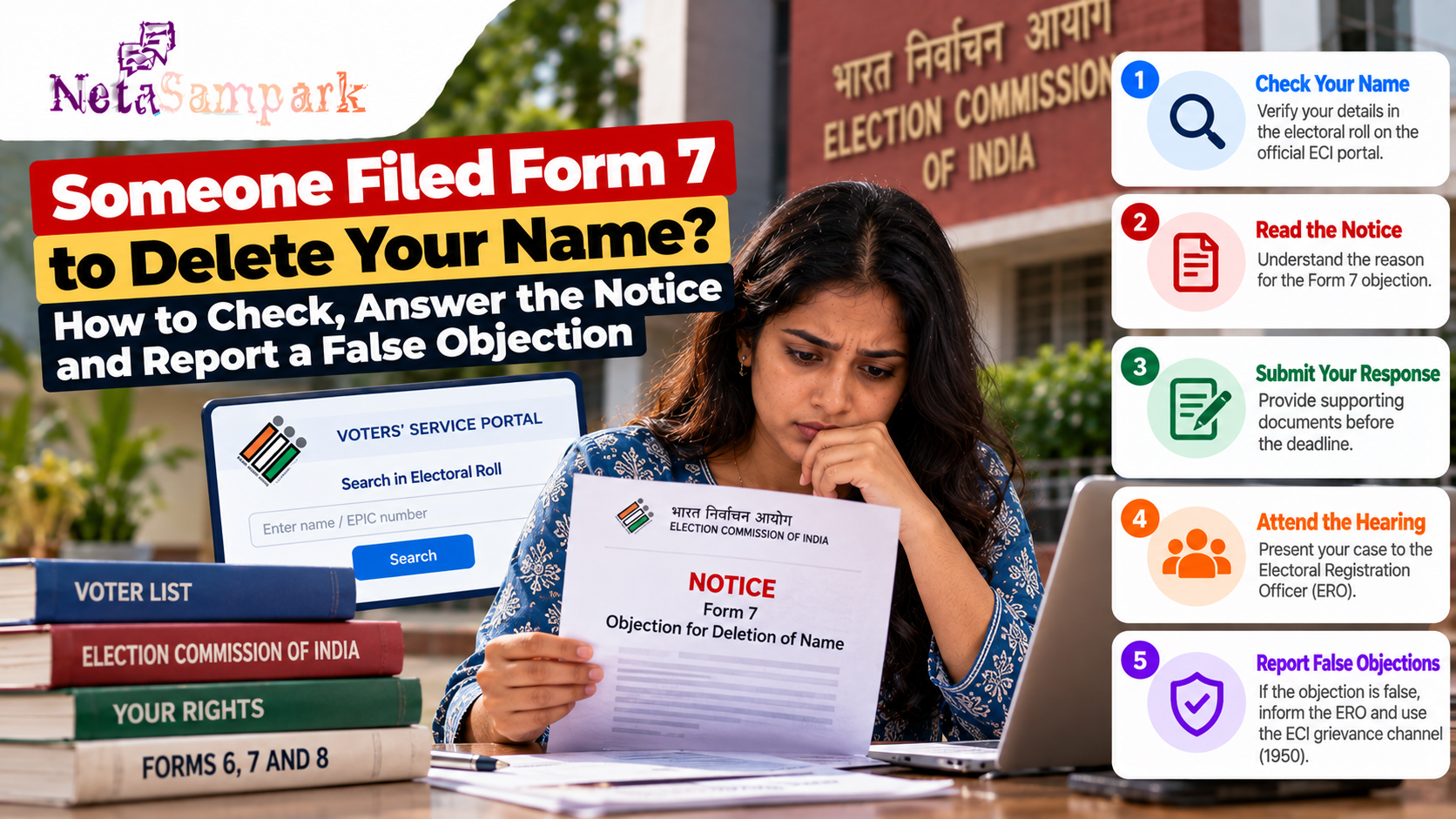
Someone Filed Form 7 to Delete Your Name? How to Check, Answer the Notice and Report a False Objection
Finding out that someone has filed Form 7 against your voter registration can be alarming. But a Form 7 application is an objection/request for deletion, not an automatic deletion of your name.
The Electoral Registration Officer (ERO) has to follow the prescribed process before removing an existing entry. Under the Election Commission of India's Form 7 procedure, an objection can be made on grounds such as death, being underage, being absent/permanently shifted, duplicate enrolment or non-citizenship. The person filing the objection has the onus of proving the reason given for the objection. Voters
If you receive a notice, the most important thing is simple:
Don't ignore it. Check the objection, respond with evidence, attend the hearing if called, and keep proof of everything you submit.
What is Form 7?
Form 7 is the Election Commission of India's form for:
- objecting to the proposed inclusion of another person's name;
- requesting deletion of an existing elector's name; or
- in specified circumstances, requesting deletion of the applicant's own name.
The ECI's current voter portal lists Form 7 specifically under “Deletion or Objection for name from Electoral Roll.” Voters
A voter registered in the constituency can file an objection against another elector's inclusion if they believe that person is not eligible to be registered there. Election Commission of India
That does not mean the objector can simply get another person's name removed by submitting a form.
The ERO has to consider the objection under the electoral-roll procedure.
What reasons can someone give for a Form 7 objection?
The current Form 7 provides specific grounds, including:
- Death
- Under age
- Absent / permanently shifted
- Already enrolled
- Not an Indian citizen
The form requires the applicant to identify the person concerned and provide their EPIC number, if available, along with address details. Voters
For example, someone might claim that:
“This person has permanently shifted from this address.”
Or:
“This voter is already enrolled elsewhere.”
Or:
“This person is deceased.”
If the allegation is wrong, you should specifically address that particular ground rather than merely saying that you want your name retained.
A Form 7 does not automatically delete your name
This is one of the most important points.
ECI's electoral-roll manual describes a procedure in which a Form 7 objection is processed by the ERO. The individual application is displayed for the prescribed seven-day notice period. If the ERO is not satisfied about the validity of the objection, a hearing notice is issued to the objector and the person whose entry is being challenged. The ERO then conducts the required enquiry and disposes of the objection. Election Commission of India
So:
Form 7 filed ≠ name deleted.
The final decision rests with the competent electoral authority after following the prescribed process.
Step 1: Check whether your name is still in the electoral roll
Before doing anything else, check your current electoral-roll entry.
Use the official ECI voter services system to search your name and verify:
- your name;
- EPIC number;
- constituency;
- polling station;
- part number;
- serial number;
- address.
The ECI's electoral-roll services provide name search and access to electoral-roll information. Election Commission of India
If your name is still showing, save a copy or screenshot of the current entry.
Don't rely only on your physical voter ID card.
An EPIC card by itself does not establish that your name remains in the latest electoral roll.
Step 2: Find out whether there is an actual Form 7 objection
If you have received an official notice, read it carefully.
Look for:
- ERO/AERO office;
- Assembly Constituency;
- your name and EPIC;
- Form 7/application reference;
- reason for objection;
- date of notice;
- date of hearing, if specified;
- deadline for submitting your response;
- documents requested.
The ECI's rules and procedures provide for claims and objections to be handled by the concerned electoral-registration authorities. Election Commission of India
If someone merely tells you:
“A person has filed Form 7 against you”
but provides no official reference or notice, verify it through the ERO/official voter services system rather than assuming the claim is genuine.
Step 3: Identify exactly what the objector has alleged
Your response should address the allegation directly.
If they claim you permanently shifted
Show evidence that you continue to be ordinarily resident at the constituency address, as applicable.
Possible supporting documents can include appropriate address/residence records such as:
- government correspondence;
- utility records;
- registered rental/ownership documents;
- bank or insurance correspondence;
- other official documents showing your residence.
Use documents that are genuinely relevant to your circumstances.
If they claim you are already enrolled elsewhere
Check whether you have another active electoral entry.
If there is a duplicate entry, don't simply deny it. Explain the correct position and use the appropriate electoral form/procedure if a correction or deletion of a duplicate entry is required.
If they claim you are dead
Clearly state that the allegation is incorrect and provide appropriate identity/status documents requested by the ERO.
If they claim you are not an Indian citizen
Provide the citizenship-related documents requested by the competent authority and specifically rebut the allegation.
If they claim you are underage
Provide your correct date-of-birth evidence.
The objective is not to submit a huge pile of documents.
It is to provide relevant evidence that directly answers the ground cited in Form 7.
Step 4: Submit a written response
If the notice gives you a deadline, respond within that deadline.
Your response can be structured like this:
Subject: Response to Form 7 objection against my electoral-roll entry
I, [name], EPIC No. [number], am an elector registered in [Assembly Constituency/Part]. I have received notice regarding an objection seeking deletion of my name under Form 7.
The ground stated in the objection is [ground].
The allegation is incorrect because [brief factual explanation].
I continue to satisfy the applicable requirements for registration in the constituency and request that my electoral-roll entry not be deleted on the basis of the objection.
I am enclosing the relevant supporting documents for verification.
I request that the objection be disposed of after considering my response and supporting evidence.
Attach copies of the relevant documents and keep the originals with you unless an official specifically requires them for verification.
Step 5: Attend the hearing if you are called
If the ERO schedules a hearing, don't ignore it.
Take:
- the notice;
- your EPIC;
- copies of your response;
- supporting documents;
- proof of submission of your response;
- any other relevant evidence.
The ERO's role is to consider claims and objections and make the appropriate decision after the prescribed process. Election Commission of India
If you cannot attend for a genuine reason, contact the office promptly and ask what procedure is available for submitting your response or seeking another date.
What if the Form 7 contains a completely false statement?
This is more serious.
The Form 7 declaration requires the applicant to state that the facts and particulars provided are true to the best of their knowledge and belief.
The ECI's Form 7 guidelines specifically state that a false statement in the declaration is punishable under Section 31 of the Representation of the People Act, 1950, with imprisonment that may extend to one year, or fine, or both. Voters
That does not mean every unsuccessful Form 7 automatically becomes a criminal offence.
There is an important distinction between:
“The person made an objection that the ERO rejected”
and
“The person knowingly or falsely made a declaration containing false information.”
Don't make accusations of criminal conduct unless you have a factual basis.
If you believe the objection was deliberately false, tell the ERO exactly which statement is false and provide the evidence supporting your claim.
How to report a suspected false Form 7
Start with the Electoral Registration Officer (ERO) handling your constituency.
In your written representation, clearly state:
- your name and EPIC;
- the Form 7 reference, if available;
- the allegation made against you;
- why it is factually incorrect;
- the evidence disproving it;
- whether you believe the declaration contains false information;
- what action you are requesting.
For example:
“The Form 7 states that I have permanently shifted from the constituency. I continue to ordinarily reside at the stated address. I am enclosing documents supporting this. I request that the objection be rejected after verification and that the false information contained in the objection be placed on record.”
This is stronger than simply writing:
“Someone is trying to delete my vote.”
You can also use the ECI grievance channel
The Election Commission provides a Register Complaint facility through its voter services system, and the ECI lists 1950 as its toll-free voter helpline. Election Commission of India
If the issue is not being properly addressed by the relevant electoral office, you can use the official grievance mechanism and include:
- Form 7 reference;
- notice;
- your response;
- documents;
- details of the ERO/AERO;
- hearing date;
- acknowledgement/proof of earlier submissions.
The ECI voter portal also provides access to electoral-roll services, forms and complaint functionality. Voters
Don't file another Form 7 against the person just because they objected to you
This is an important practical point.
If someone files a false Form 7 against you, the immediate objective should be to defend your own electoral entry.
Don't retaliate by filing an unsupported deletion request against the other person's voter registration.
A Form 7 should be based on a genuine, legally relevant ground and supported by appropriate information. The ECI's guidelines place the responsibility for substantiating the stated ground on the person making the objection. Voters
If the other person is genuinely ineligible, that is a separate matter that should be supported by facts.
What if your name has already disappeared from the roll?
Don't assume that the Form 7 is necessarily the only reason.
First check the current electoral roll and your application/registration status.
If you believe your deletion was incorrect, contact the ERO/AERO immediately and ask for:
- the reason for deletion;
- the relevant application/reference;
- the order or decision, where applicable;
- the procedure available to restore your enrolment.
Depending on your circumstances and the current electoral-roll stage, you may also need to use the appropriate voter-registration form.
The ECI currently provides Form 6 for new voter registration, Form 7 for deletion/objection, and Form 8 for shifting/correction/replacement/PwD marking. Voters
Don't submit the wrong form simply because someone told you to “re-register.”
What documents should you keep ready?
Create one folder—physical or digital—with:
Identity
- EPIC/voter ID;
- Aadhaar or another identity document, where relevant.
Residence
- relevant address/residence documents;
- property/rental records where applicable;
- official correspondence showing residence.
Electoral records
- screenshot/PDF of your current electoral-roll entry;
- Form 7 notice;
- Form 7 reference number;
- ERO correspondence;
- SMS/email received from election authorities.
Your response
- signed representation;
- supporting documents;
- acknowledgement;
- hearing notice;
- hearing outcome/order.
This becomes especially useful if the matter goes beyond one hearing.
Don't hand over your original documents to an unknown person
If someone claiming to be a BLO, election official or intermediary comes to your home:
- ask for official identification;
- verify their details through the official election machinery;
- don't give originals to an unknown person;
- don't share OTPs;
- don't share your banking PIN or payment credentials;
- don't pay anyone to “save your vote.”
If documents are required for official verification, follow the instructions of the competent election authority.
What if the person who filed Form 7 is a political party worker?
The identity of the person filing an objection does not change the legal process.
A party worker, local resident or any other eligible elector cannot personally delete your name.
The ERO is the authority responsible for deciding the electoral-roll objection.
The ECI's Form 7 guidelines say the applicant must substantiate the ground on which the objection is made. Voters
So don't get drawn into a political argument.
Keep the issue focused on:
What does the electoral roll say? What does Form 7 allege? What evidence proves the allegation right or wrong?
A simple response checklist
If you receive a Form 7 notice, do this:
☐ Check your name in the current electoral roll
☐ Read the Form 7 ground carefully
☐ Note the application/reference number
☐ Check the response/hearing deadline
☐ Collect evidence addressing the allegation
☐ Submit a written response
☐ Get acknowledgement/proof of submission
☐ Attend the hearing if called
☐ Explain any suspected false statement factually
☐ Contact ERO/AERO if you need clarification
☐ Use the ECI grievance channel/1950 if the issue is not resolved
☐ Recheck your electoral-roll entry after the decision
Bottom line
Someone filing Form 7 against you does not automatically erase your vote.
Form 7 is a formal mechanism for objections and deletion requests, and the ERO has to process the objection under the electoral-roll procedure. The ECI's own guidelines place the onus of proof on the person making the objection. Voters
If the allegation is genuine, answer it with the requested evidence.
If it is wrong, respond in writing, attend the hearing if called, and preserve your acknowledgement and documents.
And if you believe someone deliberately submitted false information, don't simply fight with them personally. Put the specific false statement and your evidence before the ERO, and use the ECI's official grievance mechanism if further action is necessary.
Check the roll → read the Form 7 → respond with evidence → attend the hearing → preserve the decision.