
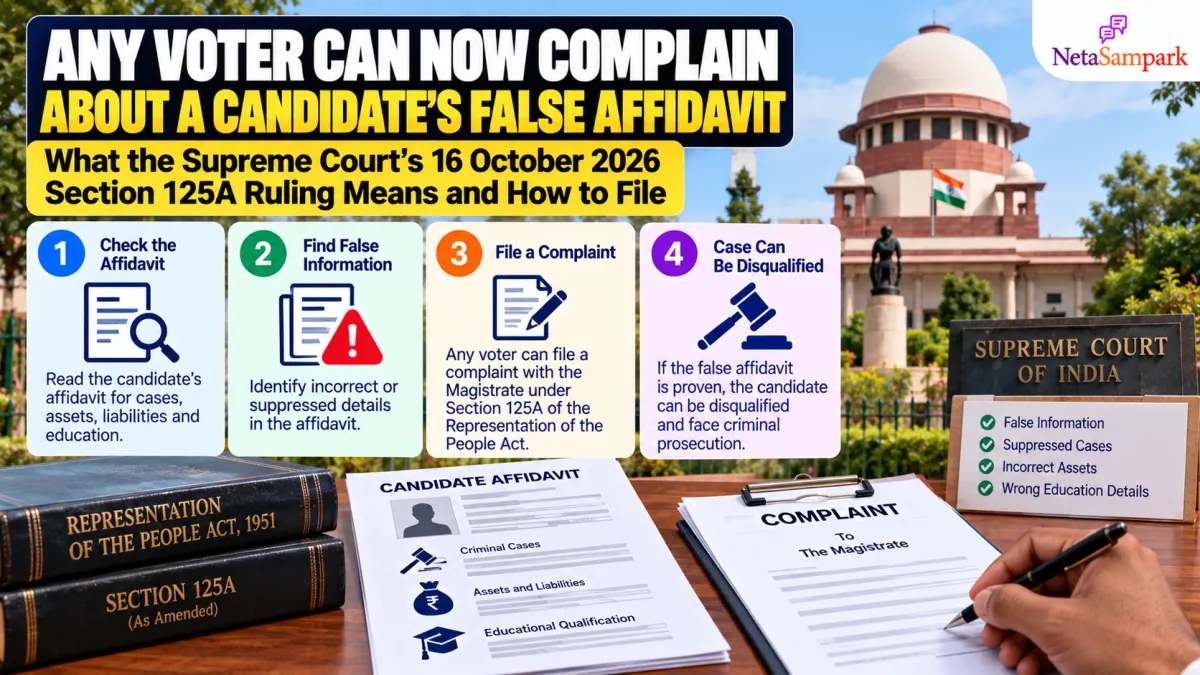
Any Voter Can Complain About a Candidate’s False Affidavit: What the Supreme Court’s 16 October 2026 Section 125A Ruling Means and How to File
A candidate’s election affidavit can reveal important information about criminal cases, assets, liabilities and educational qualifications. But what happens if you believe a candidate has deliberately provided false information or concealed a material fact?
On 16 October 2026, the Supreme Court of India clarified that a private individual can file a criminal complaint against a candidate under Section 125A of the Representation of the People Act, 1951, without the complaint having to come from the Election Commission or another public servant.
The judgment in Rajkumar Madki v. Dr. Shailendra Beldale removes an important procedural barrier to private complaints. It does not mean every allegation is automatically accepted, or that a candidate is immediately disqualified.
Read the judgment: Sri Rajkumar Madki v. Dr Shailendra Beldale — 2026 INSC 1138.
1 What did the Supreme Court decide?
The case concerned a complaint alleging that an elected Karnataka MLA had made a false declaration about his residential address in the affidavit submitted with his nomination papers.
The Karnataka High Court had previously quashed the complaint, reasoning that proceedings under Section 125A could be initiated only through the Election Commission or an authorised public servant.
The Supreme Court disagreed with that interpretation. A bench comprising Justices Dipankar Datta and Sheel Nagu held that the restriction under Section 195(1) of the Code of Criminal Procedure did not bar a private complaint alleging an offence under Section 125A.
However, the Court did not revive the complaint against the MLA. It concluded that documents on record had prima facie rebutted the allegation and that the possibility of conviction appeared remote.
The ruling therefore establishes that a private complaint is legally maintainable; it does not establish that the particular candidate committed an offence.
2 What does Section 125A cover?
Section 125A penalises a candidate who, with the intention of being elected, fails to furnish required information, knowingly or recklessly provides information believed to be false, or conceals information in the relevant nomination paper or affidavit.
The provision covers disclosures required under the Representation of the People Act, including specified information about criminal antecedents.
The prescribed punishment is imprisonment for up to six months, a fine, or both.
Read the provision: Section 125A — Representation of the People Act, 1951.
Examples of discrepancies that may warrant investigation include:
- A criminal case that appears to have been omitted from a disclosure where it was legally required.
- A material declaration that conflicts with reliable official records.
- An asset or liability entry that appears materially inaccurate.
- Information required by the prescribed affidavit that has been deliberately concealed.
A discrepancy alone does not prove a criminal offence. The legal requirements, the candidate’s knowledge or belief, the relevant disclosure obligation and the evidence must all be considered.
3 Who can file a complaint now?
Following the Supreme Court ruling, a private individual can approach the competent criminal court with a complaint alleging an offence under Section 125A. The complainant does not have to wait for the Election Commission to initiate the case.
This can be relevant to voters, residents, researchers and other individuals who obtain credible evidence of a potentially false declaration.
However, there is an important distinction: Section 125A applies to the nomination papers and affidavits governed by the Representation of the People Act, 1951. Municipal and Panchayat elections may be governed by separate state laws and rules. Do not assume that Section 125A automatically applies to every local-body candidate.
For a municipal or Panchayat election, check the applicable state election law and the affidavit requirements for that particular office.
4 How to identify a potentially false affidavit
Before filing a complaint, obtain the actual affidavit and identify the specific statement you believe is incorrect.
Start with these steps:
- Find the official affidavit. Use the relevant election authority’s candidate-information portal or obtain the document from the Returning Officer.
- Identify the exact statement. Record the page, section and entry that appears incorrect or incomplete.
- Find reliable supporting evidence. Depending on the issue, this could include an official court record, property record, company filing or another authenticated document.
- Check the applicable disclosure rule. Confirm whether the information was required to be disclosed in that particular election.
- Distinguish error from deliberate concealment. An inconsistency, spelling error or outdated record does not automatically establish the elements of Section 125A.
Keep the original documents and record where each item came from. Avoid editing screenshots or circulating unverified accusations on social media.
5 How to file a complaint: a practical guide
The Supreme Court’s ruling confirms that a private complaint is not barred merely because it was not initiated by a public servant. The appropriate procedure and court will depend on the facts, the election involved and the criminal-procedure law applicable to the case.
Step 1: Prepare a clear written complaint
Include:
- Your name and contact details.
- The candidate’s name and the election concerned.
- The specific affidavit or nomination-paper entry in question.
- The information you believe is false, omitted or concealed.
- The factual basis for believing the discrepancy is material.
- A list of supporting documents and their sources.
- A request for the competent authority or court to examine the alleged offence under the applicable law.
Keep the complaint factual and avoid claims that go beyond the evidence.
Step 2: Organise your evidence
Attach clearly numbered copies of the affidavit and the records supporting your allegation. Prepare a short chronology explaining what the affidavit says, what the other record shows and why the difference matters.
Preserve the originals and keep a complete copy of everything submitted.
Step 3: Obtain legal guidance on the correct court and procedure
The Supreme Court ruling concerned a private complaint under the former Code of Criminal Procedure. India’s criminal-procedure framework has since transitioned to the Bharatiya Nagarik Suraksha Sanhita (BNSS).
Before filing a new complaint, consult a qualified lawyer or the relevant legal-services authority to determine the proper Magistrate, procedural provision and filing requirements under the law currently applicable.
The Supreme Court judgment can help establish that Section 195 of the former CrPC does not, by itself, bar such a private complaint under Section 125A.
Step 4: Keep proof of filing
Retain the complaint copy, document list, filing receipt or diary number, and any subsequent notices. Follow the court’s directions if additional documents or clarification are required.
Filing a complaint does not guarantee that the court will take cognisance, order an investigation or proceed to trial. The court must assess the complaint under the applicable legal standards.
6 Can a false affidavit lead to disqualification?
A false affidavit can have serious legal consequences, but disqualification is not automatic merely because someone files a complaint.
There are distinct processes:
| Process | Purpose |
|---|---|
| Criminal complaint | Seeks legal action for an alleged offence under the applicable law |
| Election-authority complaint | Requests examination of a disclosure or nomination issue under election rules |
| Election petition | Challenges an election on legally recognised grounds, subject to applicable requirements and deadlines |
The available remedy depends on the type of election, the relevant statute, the stage of the election and the evidence.
For example, an election petition may involve different grounds, limitation periods and requirements from a criminal complaint under Section 125A. A voter considering either route should obtain legal advice promptly rather than assume one process replaces the other.
7 What about frivolous complaints?
The Supreme Court expressly recognised the risk that private complaints could be used to harass elected candidates. It said Magistrates already have the power to deal appropriately with frivolous allegations and proceedings, depending on the facts.
That safeguard matters. The ruling is not permission to file unsupported accusations against political opponents.
A responsible complaint should identify a specific disclosure, explain the apparent discrepancy and provide credible evidence. Deliberately misleading allegations can create legal risks for the complainant.
Frequently asked questions
Do I need the Election Commission’s permission before filing a Section 125A complaint?
The Supreme Court held that a private complaint alleging an offence under Section 125A is not barred by Section 195(1) of the former CrPC merely because it was not filed by a public servant.
Can any person file a complaint, even if they are not from the candidate’s constituency?
The ruling recognises the maintainability of a private complaint. Whether the particular complaint is properly filed and can proceed will depend on jurisdiction, evidence and the applicable law.
Does the judgment mean the candidate is guilty?
No. The ruling addresses who can bring a complaint. The allegations must still be examined, and the prosecution must establish the offence according to law.
Does Section 125A cover every municipal or Panchayat candidate?
Not automatically. Local-body elections may be governed by separate state laws. Check the statute and rules applicable to the specific election.
What is the citation for the judgment?
Rajkumar Madki v. Dr. Shailendra Beldale, Criminal Appeal No. 3387 of 2026, decided on 16 October 2026, reported as 2026 INSC 1138.
Final takeaway
The Supreme Court’s 16 October 2026 judgment clarifies that a private individual can bring a criminal complaint alleging a false election affidavit under Section 125A without first having to secure a complaint from the Election Commission or another public servant.
For voters, the practical lesson is to obtain the original affidavit, identify the specific disclosure at issue, gather reliable supporting evidence and follow the correct legal procedure. A complaint is a request for legal scrutiny—not proof of guilt or an automatic route to disqualification.
Read the judgment and the statutory provision before acting: Supreme Court decision | Section 125A of the Representation of the People Act.