
Want to know why a road repair is delayed, how much a municipality spent on a project, whether your application is pending with a government department, or how a public contract was awarded? You can seek records from Rajasthan government public authorities under the Right to Information (RTI) Act, 2005.
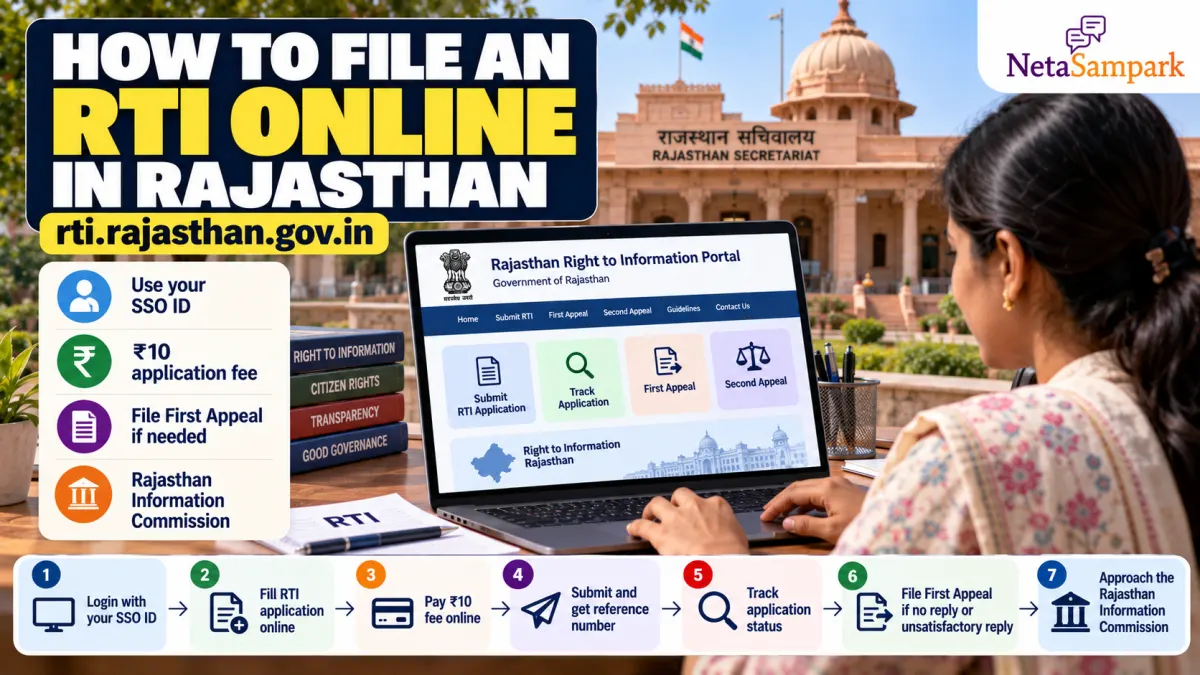
Rajasthan has a dedicated RTI portal at rti.rajasthan.gov.in. Citizens can use the portal to submit an application, track its status and access appeal-related services. The portal’s published guidance describes registration and login through Rajasthan’s Single Sign-On (SSO) system; the current portal may also provide other login options.
The standard RTI application fee under the Rajasthan Right to Information Rules, 2005, is ₹10 per application, subject to applicable exemptions. If the department does not respond within the statutory period or provides an unsatisfactory reply, you can generally file a first appeal. A further appeal can be made to the Rajasthan Information Commission where the Act and applicable rules permit it.
This guide explains how to file your request, what to ask for, how the deadlines work and what to do if the department does not provide the information.
Rajasthan RTI online: Important details
| Item | What you need to know |
|---|---|
| Official RTI portal | rti.rajasthan.gov.in |
| Login | SSO ID or another option currently offered on the portal |
| Standard application fee | ₹10, subject to applicable exemptions |
| Ordinary response deadline | Generally 30 days from receipt by the public information officer |
| First appeal | Generally within 30 days of the relevant decision or expiry of the response period |
| Second appeal | Generally within 90 days of the first appellate authority’s decision, subject to Section 19(3) |
| Information Commission | Rajasthan Information Commission |
The legal framework is the RTI Act, 2005, read with the Rajasthan RTI Rules and any applicable amendments. Check the official Rajasthan RTI portal and the Rajasthan High Court’s RTI rules resources for relevant procedures.
Step 1: Decide exactly what information you want
Before logging in, identify the public authority that holds the records. Depending on your subject, this could be a municipal body, district administration, panchayat, development authority, state department or another public authority.
A strong RTI application asks for specific existing records rather than a general explanation or an opinion.
For example, instead of asking:
“Why has my road not been repaired?”
Ask for:
- Copies of the work order and contract for the road repair.
- The sanctioned estimate and administrative approval.
- The date on which work was ordered to begin and the scheduled completion date.
- Copies of measurement-book entries and inspection reports, where held.
- Records showing payments made to the contractor.
- Copies of notices issued for delay or defective work, if any.
This makes it easier for the Public Information Officer (PIO) to identify the records you are seeking.
Step 2: Open the Rajasthan RTI portal
Visit the official website:
Rajasthan RTI Portal — rti.rajasthan.gov.in
Look for the citizen login or application-submission option. The portal’s published user manual describes citizen registration and login using the SSO system.
Make sure you are using the official Rajasthan government website. Do not enter your SSO password or personal information into a lookalike site linked through an unsolicited message.
Step 3: Log in using your Rajasthan SSO ID
If you already have an SSO ID, use it to log in when prompted.
If you do not have one, visit the official Rajasthan SSO portal and follow the current citizen-registration instructions.
After logging in, return to the RTI portal and select the option to submit an RTI application.
The portal’s interface can change. Follow the instructions displayed on the live website rather than relying entirely on screenshots or older manuals.
Step 4: Select the correct public authority
Choose the department or public authority responsible for maintaining the information.
For example:
| Information sought | Possible public authority |
|---|---|
| Municipal road repair, sanitation or streetlights | Relevant municipal corporation, municipality or local body |
| Panchayat expenditure or village development works | Relevant panchayat or rural development authority |
| Land or revenue records | Relevant revenue office or department |
| Government school records | Relevant education authority |
| Government hospital administration records | Relevant health authority |
| State department expenditure or policy records | Relevant state department |
These are examples, not a substitute for checking which office actually holds the records.
If the application is sent to the wrong public authority, Section 6(3) of the RTI Act provides for transfer to another public authority when its conditions are met. The statutory transfer period is generally five days. It is still better to identify the correct authority at the outset to reduce avoidable delays.
Step 5: Write and submit your RTI application
Enter your subject and the information requested in the relevant fields. Keep the wording concise, numbered and specific.
You can use this structure:
Subject: Request for information under the Right to Information Act, 2005, regarding [project, service or record].
Information requested:
- Please provide a certified copy of [specific document or record].
- Please provide the date-wise status recorded for [application, project or work].
- Please provide copies of the relevant orders, approvals, inspection reports or correspondence held by the department.
- Please provide the name and designation of the office responsible for maintaining these records, if recorded in the relevant documents.
Period covered: [Specify the dates or financial years.]
Preferred format: Electronic copies by email or through the portal, where available and permitted.
Ask for existing documents, registers, orders, reports or recorded data. The RTI Act generally provides access to information held by or under the control of a public authority; it does not require officials to create a new report, give an opinion or answer a hypothetical question.
Before submitting, review the application for spelling errors, the correct authority and a clear description of the records sought.
Step 6: Pay the ₹10 application fee
The Rajasthan RTI Rules, 2005, prescribe a standard application fee of ₹10.
The rules specify permitted payment methods, including cash against a proper receipt or a demand draft or banker’s cheque payable to the public authority. The online portal may provide instructions specific to its electronic filing process, so follow the current payment options displayed there.
Some applicants may qualify for an exemption, including eligible applicants covered by applicable Below Poverty Line provisions. Check the current rules and portal instructions to determine whether you need to pay and what proof is required.
Keep the payment acknowledgement or receipt. Do not assume the application has been successfully registered until you receive the portal’s submission confirmation or reference number.
Are there additional charges?
The ₹10 fee is the application fee; it does not necessarily cover the cost of providing every record.
Depending on the information requested, prescribed charges may apply for copies, larger documents, samples or inspection of records. If additional fees are lawfully required, the PIO should communicate the applicable details under the RTI process.
Under Section 7(3), the time between the dispatch of a valid additional-fee intimation and payment may be excluded when calculating the response period. Section 7(6) also provides for information to be supplied free of charge where the public authority fails to comply with the statutory time limit, subject to the Act’s provisions.
Step 7: Save your application number and track the status
After submitting the application, save the acknowledgement, reference number and payment receipt.
Return to rti.rajasthan.gov.in and look for the application-status option. The portal’s published guidance identifies status checking among its citizen services.
Use the reference number and any other details requested by the portal to check whether the application is registered, pending, transferred or answered.
If the portal does not show an update, retain your acknowledgement and contact the relevant office or portal help desk using the official contact details.
How long does the department have to reply?
Under Section 7(1) of the RTI Act, the ordinary deadline is 30 days from receipt of the request by the PIO, subject to the Act’s specific provisions.
Other important rules include:
- Life or liberty: Information concerning the life or liberty of a person must be provided within 48 hours, as provided under Section 7(1).
- Transfer: Where Section 6(3) applies, a request should generally be transferred to the appropriate public authority within five days.
- Third-party information: Section 11 provides a consultation procedure for certain third-party information; the applicable process can affect the response timeline.
- No response within the deadline: This can be treated as a deemed refusal for appeal purposes.
- Information provided late: Section 7(6) provides for information to be supplied free of charge where the statutory time limit is not met, subject to the Act.
The 30-day period is not a guarantee that every application will be answered within that time in every circumstance. The relevant statutory exceptions and procedures matter.
What if your RTI application is rejected or receives no reply?
You generally have the right to file a first appeal under Section 19(1) of the RTI Act if:
- You receive no decision within the prescribed period.
- The information supplied is incomplete.
- The PIO refuses information and you believe the refusal is not justified.
- You disagree with the fee or other decision covered by the appeal provisions.
The first appeal goes to the designated First Appellate Authority (FAA), who is senior to the PIO in the relevant public authority.
When should you file the first appeal?
Section 19(1) generally allows 30 days from the expiry of the response period or from receipt of the PIO’s decision, as applicable. The FAA may admit a delayed appeal if sufficient cause is shown.
A first appeal under the RTI Act is generally not subject to an application fee under the Act, but check the applicable Rajasthan procedure and portal instructions before submission.
How to write a first appeal
Include:
- Your original RTI application reference number.
- The date of submission and payment, where applicable.
- The date on which the response deadline expired or the reply was received.
- A copy of the original application.
- The PIO’s reply, if one was received.
- The specific reasons you consider the response incomplete, delayed or legally incorrect.
- The relief you are requesting, such as disclosure of the identified records.
Keep the appeal factual. Explain which questions remain unanswered and why the information sought falls within the request.
The FAA is generally expected to decide the appeal within 30 days, or within a maximum of 45 days where an extension is permitted for recorded reasons under Section 19(6).
How to approach the Rajasthan Information Commission
If the first appeal does not resolve the issue, you may be able to file a second appeal with the Rajasthan Information Commission under Section 19(3).
The general statutory time limit is 90 days from the date on which the decision should have been made or was actually received, as applicable. The Commission may admit a delayed appeal if sufficient cause is shown.
Before filing, assemble:
- A copy of the original RTI application.
- Proof of submission and payment, where applicable.
- The PIO’s reply or evidence that no reply was received.
- A copy of the first appeal.
- The FAA’s decision, if any.
- A clear statement of the grounds for the second appeal.
- Supporting correspondence and documents.
Use the Commission’s current filing instructions and verify whether the appeal must be submitted online, by post or through another prescribed method.
The Commission is a statutory authority that hears appeals and complaints within the jurisdiction granted by the RTI Act. It is not a general grievance portal for every problem with a government service. For example, if a road has not been repaired, the repair itself may require a separate municipal complaint; RTI can help obtain records about the work, expenditure and decisions.
Official starting points:
- Rajasthan Information Commission and RTI resources
- Rajasthan government website
- Rajasthan RTI Rules and related resources
Common mistakes to avoid when filing an RTI
- Asking broad questions: Request identifiable records, dates, orders or documents.
- Selecting the wrong department: Identify the public authority that holds the information.
- Forgetting the application fee: Pay the prescribed fee or submit valid exemption proof.
- Losing the acknowledgement: Keep the application number and payment receipt.
- Treating RTI as a complaint: Use the appropriate grievance mechanism if you want a service repaired or a decision reconsidered; use RTI to seek information and records.
- Missing appeal deadlines: Track the response period and calendar the first-appeal deadline.
- Using the Central RTI portal for a Rajasthan department: The Central RTI portal is primarily for central public authorities and is not the correct filing route for most Rajasthan state departments. Use the state’s portal and verify the authority’s instructions.
Frequently asked questions
Can I file an RTI online in Rajasthan?
Yes. Rajasthan has a dedicated portal at rti.rajasthan.gov.in. Follow the current citizen login and submission instructions.
Is the Rajasthan RTI application fee ₹10?
The Rajasthan Right to Information Rules, 2005, prescribe a ₹10 application fee, subject to applicable exemptions and the current payment instructions for the filing route.
Do I need an SSO ID?
The portal’s published guidance describes citizen registration and login using Rajasthan SSO. Check the live portal for the login methods currently available. If you need an SSO ID, use the official Rajasthan SSO portal.
How many days does the government have to respond?
The ordinary statutory deadline is 30 days from receipt by the PIO, subject to the specific provisions of the RTI Act. A request concerning life or liberty is subject to the 48-hour provision in Section 7(1).
What if the department does not reply?
You can generally file a first appeal under Section 19(1). The normal filing window is 30 days from the relevant deadline or decision, as applicable.
Is there a fee for the first appeal?
The RTI Act does not prescribe a first-appeal fee. Check the applicable Rajasthan rules and the current portal instructions for the procedure.
When can I approach the Rajasthan Information Commission?
If the first appeal does not resolve the matter, a second appeal may generally be filed under Section 19(3), usually within 90 days of the relevant decision or date when it should have been made. The Commission’s jurisdiction and current filing requirements apply.
The bottom line
Filing an RTI online in Rajasthan is a practical way to obtain official records about public spending, government decisions, service delivery and administrative action.
Start at rti.rajasthan.gov.in, log in through the available citizen option, identify the correct public authority, describe the records you need and pay the prescribed ₹10 fee unless an exemption applies. Save the acknowledgement, track the response and use the first-appeal process if the department does not respond or the reply is inadequate.
The most effective RTI is specific, record-focused and filed with the correct public authority. If the matter remains unresolved after the first appeal, the Rajasthan Information Commission may provide the next statutory route.
This article is for general information, not legal advice. Verify the current portal instructions, applicable fee rules and appeal procedure before filing.