
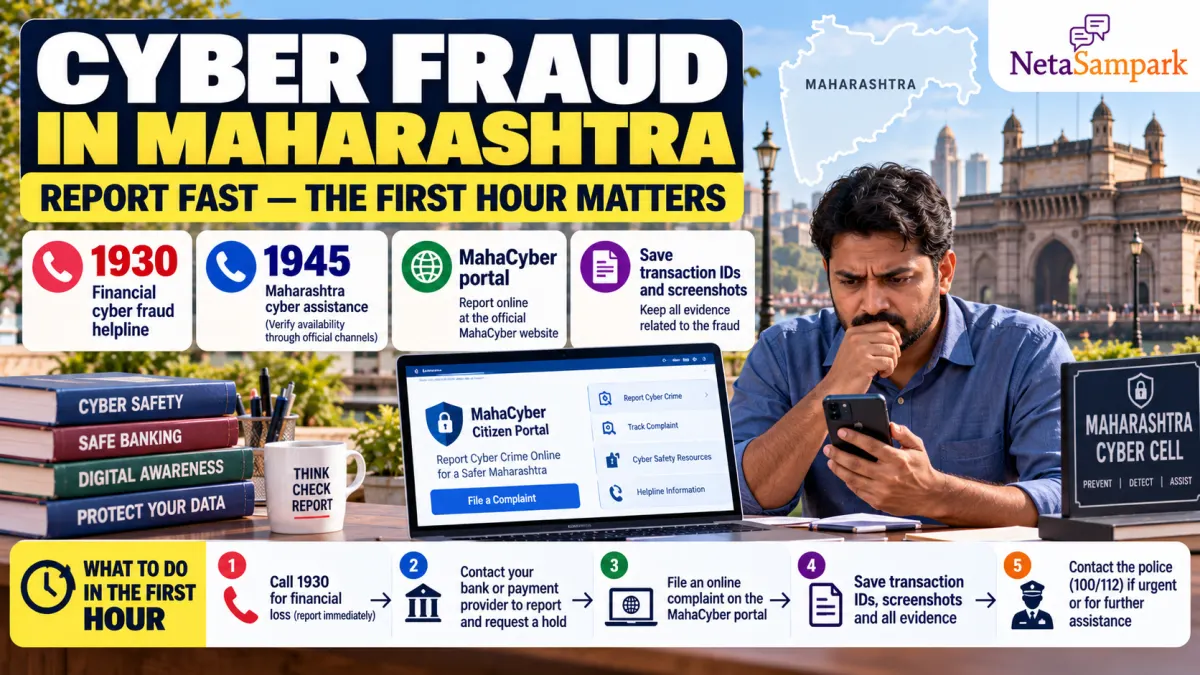
If money has disappeared from your bank account after a UPI scam, a fake investment offer, a phishing link or an impersonation call, the first hour is the time to act—not to negotiate with the scammer or wait for a bank message.
Maharashtra residents can report cybercrime through the state’s MahaCyber reporting service and the Government of India’s National Cyber Crime Reporting Portal. For financial cyber fraud, the national helpline 1930 is the main immediate reporting route. Maharashtra has also publicised 1945 as a cyber assistance helpline; check the current state service information if you need to use it. Maharashtra Police and the national cybercrime authorities continue to direct victims of financial fraud to 1930. (Maharashtra Police, National Cyber Crime Reporting Portal, National Informatics Centre).
This guide explains which number to call, how to report online, what evidence to preserve and how to follow up after lodging a complaint.
Cyber fraud in Maharashtra: Quick reporting guide
| Situation | What to do first |
|---|---|
| Money has been transferred without your consent | Call 1930 immediately and contact your bank or payment provider |
| You need to file a cybercrime complaint online | Use the National Cyber Crime Reporting Portal or the official Maharashtra cybercrime reporting service |
| You received a suspicious link, call or message but lost no money | Report it through the relevant official cybercrime or suspected-fraud reporting facility |
| Someone is threatening you or there is immediate danger | Call 112 or contact the nearest police station |
| You need Maharashtra-specific cyber assistance | Check the current guidance from Maharashtra Police and the official MahaCyber service |
Important: Calling 1930 is not a substitute for completing the online complaint when instructed. Keep the acknowledgement number and follow the instructions sent to you.
What should you do in the first hour after cyber fraud?
First 10 minutes: Stop further loss
If you notice an unauthorised debit, a fraudulent UPI payment or a transfer made under deception:
- Call 1930 and report the financial cyber fraud.
- Contact your bank using the number in its official app, on your card or on its verified website.
- Ask the bank to register a fraud complaint and take any available action to block further transactions or secure the account.
- If a card, UPI account or internet-banking credential may be compromised, ask the bank how to block or secure it.
- Do not send additional money to a person claiming they can reverse the transaction.
If your phone or email account is compromised, secure it from a trusted device. Change affected passwords and revoke suspicious sessions where possible.
Minutes 10–20: Preserve the evidence
Keep copies of:
- Transaction IDs, UTR numbers and payment timestamps.
- Bank SMS messages and relevant account-statement entries.
- UPI IDs, beneficiary details and payment screenshots.
- Phone numbers, email addresses and social-media handles used by the suspect.
- Website links, messages, emails and chat records.
- Any complaint number given by the bank or helpline.
Do not delete the conversation or reset your phone before preserving relevant evidence, unless a security professional or police officer advises a necessary step.
Never share your OTP, UPI PIN, banking password or full card security details with someone who contacts you claiming to be an investigator.
Minutes 20–40: File the online complaint
Open the National Cyber Crime Reporting Portal and select the relevant complaint category. For financial fraud, use the financial cybercrime reporting route.
You will generally need to register or authenticate using your mobile number and OTP, then enter the incident details and supporting information.
Provide a clear timeline: what happened, when you noticed it, how the fraud was carried out, how much money was involved and which account or payment method was used.
If you are using the official Maharashtra cybercrime reporting service, make sure you are on a verified government website. The state portal and national portal are reporting channels; neither guarantees that funds will automatically be recovered.
Minutes 40–60: Confirm and follow up
- Save the acknowledgement or complaint reference.
- Follow any instructions received after calling 1930.
- If you reported through the helpline, complete the online reporting steps requested in the SMS or other official communication.
- Contact your bank again with the complaint reference if necessary.
- If you are facing threats or need urgent police assistance, contact the nearest police station or dial 112.
These steps are a practical sequence, not a promise that every case can be fully reported or resolved within one hour. The key is to start the reporting process immediately.
When should you call 1930?
Call 1930 as soon as you discover a financial cyber fraud.
The national helpline is intended for reporting online financial fraud and is operated under the Indian Cyber Crime Coordination Centre’s reporting and response system. It helps route complaints for coordination with law enforcement, banks and payment intermediaries. The aim is to act quickly when money may still be traceable or available to be held.
Examples include:
- Unauthorised UPI or mobile-wallet transfers.
- Fraudulent net-banking transactions.
- Credit-card or debit-card fraud.
- Fake customer-care calls that trick you into transferring money.
- Investment or trading scams involving online transfers.
- Digital-arrest scams and other impersonation frauds involving payments.
- Fraudulent payment links or QR-code scams.
When you call, be ready to explain the incident and provide the transaction details requested. The official national portal advises financial-fraud victims to report immediately by calling 1930. (Official cybercrime portal, Ministry of Home Affairs, PIB release).
Do not wait until you have every document. Report promptly, then provide additional evidence through the official process.
When should you call 1945?
Maharashtra has publicised 1945 as a state cyber assistance number alongside the national 1930 helpline. The National Informatics Centre’s cyber-security awareness material records Maharashtra’s announcement that both numbers had been made operational. (NIC reference).
However, the national financial-fraud reporting instructions continue to identify 1930 as the immediate helpline for online financial fraud. Therefore:
- If money has been lost, call 1930 first.
- If you need state-specific cyber assistance, check the latest official Maharashtra Cyber or Maharashtra Police instructions for 1945.
- If 1945 does not connect or its current function is unclear, do not delay reporting: use 1930 and the national portal.
- For an immediate physical threat or emergency, dial 112.
Do not rely on an old social-media graphic for helpline instructions. Verify current numbers through official government sources.
How to file a cybercrime complaint online
Option 1: National Cyber Crime Reporting Portal
The national portal accepts reports for many types of cybercrime, including online financial fraud, hacking, social-media offences and other cyber-enabled offences.
Visit cybercrime.gov.in and follow these steps:
- Select the appropriate reporting category.
- Register or log in using the required mobile-number verification.
- Enter the incident date, time and a factual description of what happened.
- For financial fraud, provide the bank or payment-provider details, transaction ID or UTR, transaction date and amount.
- Upload relevant evidence in the file formats and size limits specified by the portal.
- Review the details carefully and submit the complaint.
- Save the acknowledgement number and use the portal’s available tracking facility to check status.
The portal’s official guidance lists incident details, identity information and supporting evidence among the items applicants may need. For financial cases, transaction information is particularly important. (National portal FAQ, complaint checklist).
Option 2: Maharashtra’s MahaCyber reporting service
Maharashtra also has a state cybercrime reporting service for citizens who want to report offences to the state’s cybercrime machinery.
Start with the official Maharashtra Police website and follow its cybercrime reporting links. You can also check current official information from the Maharashtra Cyber service.
Depending on the service and category, the portal may offer complaint registration, tracking or other cybercrime-related facilities. Follow the instructions on the live government site and keep the acknowledgement.
If a portal link is unavailable, do not postpone an urgent financial-fraud report: call 1930 and use the national portal.
What information should you include in the complaint?
A useful complaint is factual and chronological. Avoid guesses about the suspect’s identity if you cannot verify them.
Include the following where available:
| Information | Example of what to record |
|---|---|
| Incident date and time | When the call, message, transfer or account access occurred |
| Amount involved | The exact amount debited or transferred |
| Payment method | UPI, bank transfer, card, wallet or other method |
| Transaction reference | UTR, transaction ID or bank reference |
| Receiving details | Beneficiary name, UPI ID or account details shown in the transaction |
| Contact used by the suspect | Phone number, email, website or social-media account |
| Fraud method | Fake bank call, investment scheme, phishing link or impersonation |
| Evidence | Screenshots, messages, bank notifications and relevant documents |
| Action already taken | Time of call to 1930, bank complaint number and portal acknowledgement |
Do not post this information publicly. Upload it only through official reporting channels or provide it to authorised bank and police personnel.
What if the money has already left your account?
Report the fraud anyway. A completed transfer does not mean that reporting is pointless.
The authorities and financial institutions may be able to trace the transaction, flag the recipient account or take other action depending on the circumstances. But fund recovery is not guaranteed. It can depend on how the funds moved, whether they remain available, the timing of the report and the outcome of the investigation.
Ask your bank to record the complaint and explain the available steps. Keep the bank complaint reference alongside your cybercrime acknowledgement. If you are asked to submit additional records, provide them through the bank’s verified channel.
Be especially wary of people who contact you after the incident claiming to be recovery agents, police officers or court officials and demanding a fee to unlock or return your money.
What if the fraud involves a fake investment, loan app or digital arrest?
The reporting process is still important, but preserve evidence specific to the scam.
Fake investment or trading platform: Save the website address, app name, account statements, deposit instructions, promised returns and all messages from the operators.
Loan-app harassment: Preserve the app details, loan documents, payment records, threatening messages and evidence of unauthorised access to contacts or photographs.
Digital-arrest or impersonation scam: Save the caller’s number, messages, video-call details, payment instructions and any purported notices or identity documents. Do not transfer money simply because someone claims to be a police officer, court official or government investigator.
If the scam involved a transfer, call 1930 immediately and contact your bank. If you face an immediate threat, contact the police through 112.
What happens after you submit the complaint?
A submitted cybercrime complaint is routed for review and action by the relevant law-enforcement authorities. Financial-fraud complaints may also involve coordination with banks and payment intermediaries through the national reporting system.
After filing:
- Save the complaint acknowledgement.
- Complete any additional online steps requested after a 1930 call.
- Respond to requests for further information from authorised investigators.
- Follow up with your bank using its complaint reference.
- Check the official portal for status updates.
- Contact the relevant police station or cybercrime unit if further formal action is required.
An online acknowledgement is not necessarily the same as an FIR. If police direct you to make a formal statement or provide additional documents, follow the lawful procedure. For a serious offence or an unresolved complaint, you may need to contact the appropriate police authority directly.
Common mistakes that can cost time
- Waiting for the bank to investigate before reporting the fraud.
- Calling an unofficial customer-care number found in a search result or social-media post.
- Deleting messages or transaction evidence.
- Filing a vague complaint without the amount, date or transaction reference.
- Assuming that a complaint acknowledgement means money has been recovered.
- Paying a recovery agent who promises guaranteed refunds.
- Sharing an OTP or banking PIN with a caller who claims to be helping.
- Delaying the online complaint after receiving instructions following a 1930 call.
Frequently asked questions
Is 1930 available in Maharashtra?
Yes. Maharashtra Police identifies 1930 as the financial cyber-fraud helpline, and the national cybercrime portal directs victims of online financial fraud to call it immediately. (Maharashtra Police, National Cyber Crime Reporting Portal).
Is 1945 a cybercrime helpline in Maharashtra?
Maharashtra has publicised 1945 as a cyber assistance number alongside 1930. Because the current function and availability of a helpline can change, verify it through official Maharashtra government channels. If money has been lost, use 1930 without delay.
Do I need to file online after calling 1930?
Follow the instructions provided during the call and in the official acknowledgement message. You may need to complete the complaint through the national portal within the specified time. Keep the acknowledgement number and do not ignore follow-up instructions.
Can I report a scam if I did not lose money?
Yes. The national cybercrime portal includes ways to report certain cyber offences and suspicious online activity. The appropriate route depends on whether you were a victim, whether a transaction occurred and the type of incident.
Will I definitely get my money back if I report within an hour?
No. Prompt reporting may improve the chance of timely intervention, but recovery is not guaranteed. Report the fraud, contact your bank and preserve the evidence.
Should I go to the police station as well?
If you need urgent help, have suffered a serious offence or are directed to provide a formal statement, contact the police. The online portal is a reporting channel and does not prevent you from approaching the relevant police station or cybercrime unit.
The bottom line
If you suspect cyber fraud in Maharashtra, act immediately. Call 1930 for financial fraud, contact your bank, file the online complaint, preserve the evidence and keep every acknowledgement number. Use the official MahaCyber and national cybercrime reporting services, and verify the current role of 1945 through Maharashtra’s official channels.
The first hour cannot guarantee recovery, but prompt reporting gives the bank, payment providers and law-enforcement authorities a chance to act while the transaction trail is still fresh.
Official resources
- National Cyber Crime Reporting Portal
- Maharashtra Police
- Maharashtra Cyber
- Maharashtra Police cyber-awareness information
This article is for public information and does not guarantee recovery of lost funds. Follow the latest instructions from official police, bank and government reporting channels.