
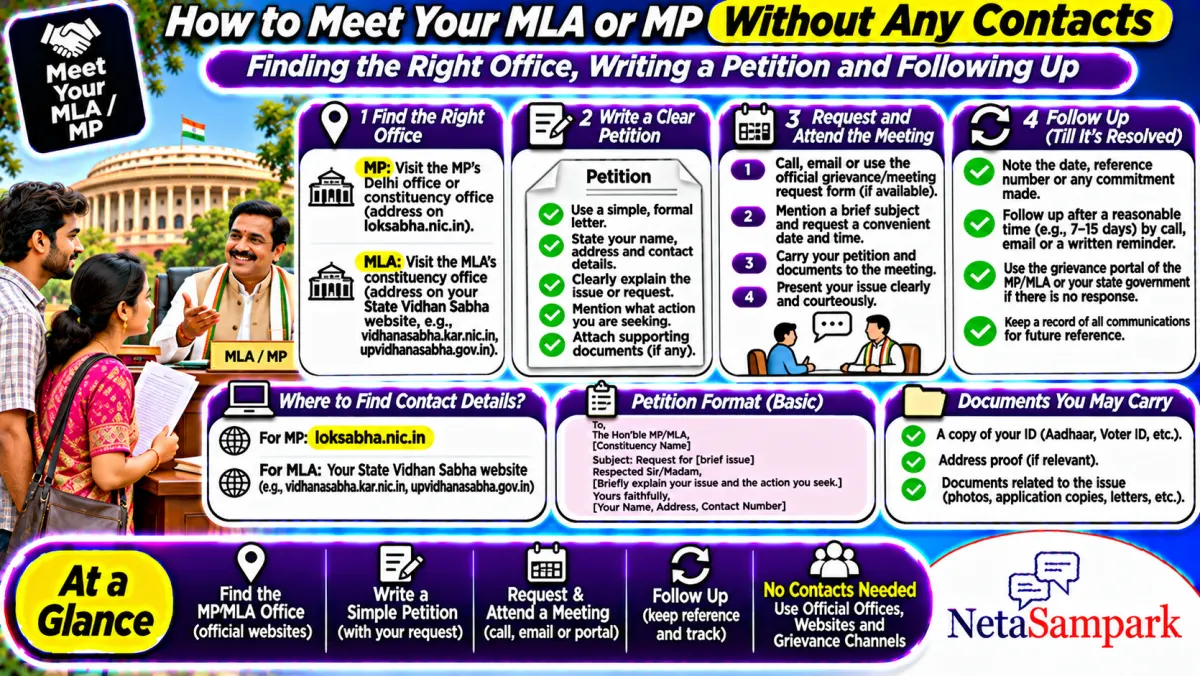
You can meet your MLA or MP without contacts by going to their constituency office (not the party office) during public meeting hours, carrying a short written petition with ID and proof, and getting a received copy. If there's no action, follow up in writing and use CPGRAMS or your state CM helpline.
Updated 21 November 2026
A lot of people think you need a "known person" to meet your MLA or MP. You don't. Meeting the public is part of their job, and most of them hold regular public hours in their constituency. What you do need is the right office, the right timing and a petition that's easy to act on.
This guide walks you through it step by step, from finding the office to what to say, what to carry and what to do if nothing happens. It works for an MLA, an MP or even a city corporator.
Quick facts
| Item | Details |
|---|---|
| Official portal | MP contact details on sansad.in (Lok Sabha) and sansad.in/rs (Rajya Sabha); MLA details on your state assembly website |
| Helpline | Your state CM helpline (for example 1076 in Uttar Pradesh, 181 in Madhya Pradesh) and CPGRAMS for central issues |
| Fee | None. Meeting your representative is free. Never pay anyone for an appointment |
| Deadline | Not applicable. Follow up if there's no reply in 15 to 30 days |
| Documents | ID proof, a short written petition (2 copies), supporting papers like bills, notices or photos |
| Best place | The official constituency office or the MLA's or MP's camp office |
| Best time | Public meeting days, often announced locally or on their social media |
First, are you going to the right person?
Half the frustration comes from going to the wrong representative. A quick guide:
| Problem | Who to approach first |
|---|---|
| Garbage, drains, streetlights, ward roads | Ward corporator or gram panchayat |
| State roads, police, state schemes, hospitals, ration card | MLA |
| Railways, highways, passports, central schemes, telecom | MP |
| Land records, certificates, local officials not acting | MLA, then District Collector |
Our explainer on MP vs MLA vs corporator vs panchayat member goes deeper. If you don't know who represents you, use our guide to finding your MP, MLA and corporator in 2 minutes.
How do you find your MLA's or MP's office?
1. Look up official contact details. For MPs, the member's profile on sansad.in lists addresses, phone numbers and email. For MLAs, check the members' list on your state assembly website.
2. Ask at the local office. The tehsil, block office or municipal office usually knows where the MLA's camp office is.
3. Check their social media. Many MLAs and MPs post their public meeting schedule on X, Facebook or Instagram.
4. Avoid the party office for official work. The party office is for party work. The constituency or camp office is where staff log petitions.
Note down the office phone number and the name of the personal assistant (PA). The PA often decides who gets in and when.
When is the best time to go?
Most representatives hold regular public meetings, sometimes called Janata Darbar, Praja Darbar or public hearing days. They're usually on weekends or when the House isn't in session, because during sessions MPs are in Delhi and MLAs are in the state capital.
Tips:
• Call the office first and ask when the MLA or MP will next be available.
• Go early. Public meetings get crowded fast.
• Avoid days with big events like festivals or party rallies.
• If it's urgent, ask the PA to take your petition and get it signed later.
How to write a petition that actually gets action
A good petition fits on one page. Busy offices read the first five lines and decide. Here's a simple format.
1. To: Name, MLA or MP, constituency name.
2. Subject: One line. For example, "Request to repair the water pipeline in Ward 12, Rampur."
3. Who you are: Name, address, phone number. Mention if you're writing for a group.
4. The problem: What, where, since when. Two or three sentences.
5. What you already tried: Dates of complaints to officials, complaint numbers, replies if any.
6. What you want: One clear ask. "Please direct the Jal Board AE to repair the pipeline."
7. Attachments: Photos, copies of earlier complaints, bills or notices.
8. Signature and date, plus signatures of neighbours if it's a shared problem.
Make two copies. Hand one in and get the other stamped or signed as "received" with the date. That received copy is your proof.
What should you carry?
☐ ID proof (Aadhaar, voter ID or similar)
☐ Two copies of your petition
☐ Copies of earlier complaints and their reference numbers
☐ Photos or documents that show the problem
☐ A pen and the PA's phone number
☐ Patience. You may wait an hour or more
What do you say in the meeting?
You may get two minutes. Use them well.
• Start with your name and area.
• State the problem in one line.
• Say what you've already tried.
• Give your one clear ask.
• Hand over the petition and ask who in the office will follow up.
Stay polite even if you're frustrated. Representatives are more likely to push officials for someone who comes across as reasonable and well-prepared.
What if nothing happens after the meeting?
Follow up, in writing, at a steady pace.
1. After 15 days, call the PA and ask for the status. Quote your received copy's date.
2. After 30 days, send a short reminder letter or email with the original petition attached.
3. Use official grievance systems in parallel. For central issues, file on CPGRAMS. Our guide on how CPGRAMS grievance filing works explains the steps. For state issues, use your CM helpline, like UP Jansunwai 1076 or MP CM Helpline 181.
4. Go as a group. Five neighbours with the same problem get more attention than one person.
5. File an RTI if an official claims the work is done but it isn't.
Can you meet your MP in Delhi?
You can, but it's usually harder and not needed. MPs have offices in their constituencies and are often there on weekends. If you do go to Delhi, call ahead and ask the MP's office for an appointment. You'll need to follow security rules at their official residence or Parliament House, where visitors need passes.
Frequently asked questions
Do I need a reference to meet my MLA?
No. You can visit the MLA's constituency or camp office during public meeting hours. A clear written petition matters more than a reference.
How do I find my MP's phone number or email?
Open your MP's member profile on sansad.in. It lists their contact addresses, phone numbers and email.
What should I do if the MLA's office doesn't respond?
Follow up after 15 days and again after 30 days in writing. File the same issue on your CM helpline or CPGRAMS so there's an official record.
Can the MLA or MP solve every problem?
No. They can push officials, recommend works and raise issues in the House, but many decisions sit with departments. Go to them when officials don't act or when you need policy-level help.
Is it okay to meet as a group?
Yes, and it often works better. A signed petition from many residents shows the issue affects the community, not just one person.
Final reminder
Write your one-page petition, find your representative's official office, and get a received copy when you hand it in. Then check how responsive your MLA or MP has been for others, and add your own experience, on Rate Your Neta at NetaSampark.
Sources
• Lok Sabha members on sansad.in