
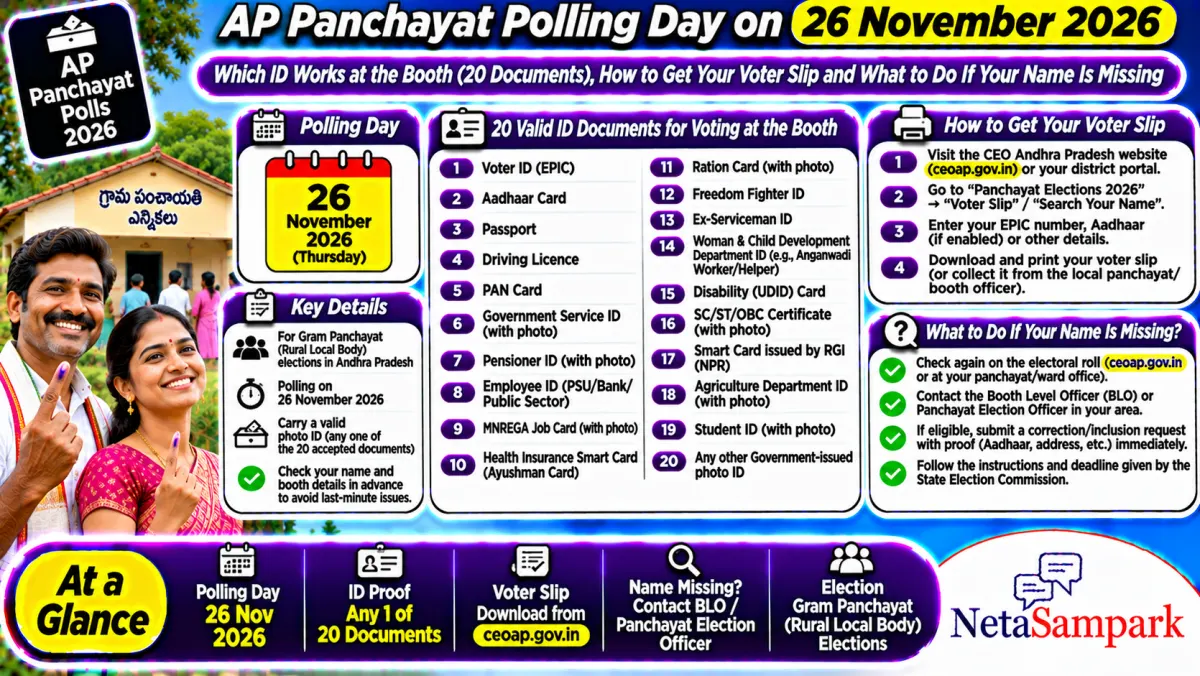
For the AP gram panchayat polls on 26 November 2026 (7 AM to 1 PM), carry your voter ID card or any one of the photo documents APSEC accepts, such as Aadhaar, driving licence, passport or MGNREGA job card. The voter slip only tells you your booth and serial number. Staff will not treat it as proof of identity.
Updated 23 November 2026
Phase 1 of the Andhra Pradesh gram panchayat elections is on 26 November 2026. Most people are asking the same small questions now. Which card do I carry? What if I lost my voter ID? Is the slip enough? What if my name isn't in the list?
This post answers those, using the State Election Commission's own Returning Officer handbook for gram panchayat elections and the latest numbers reported after the withdrawals closed. If you're in a Phase 2 or Phase 3 village, the same rules apply on 29 November 2026 and 2 December 2026.
Quick facts
| Item | Details |
|---|---|
| Official portal | AP State Election Commission at sec.ap.gov.in and its voter portal at sec-ems.ap.gov.in/apsec for polling station and photo voter slip |
| Helpline | Your mandal's Returning Officer or MPDO office, and the district Collector's election control room. APSEC contact numbers are on sec.ap.gov.in |
| Fee | None. Voting, the voter slip and checking your polling station are all free |
| Deadline | Polling on 26 November 2026, 7 AM to 1 PM. Counting starts the same day. Re-poll, if ordered, on 27 November 2026 |
| Documents | EPIC (voter ID card) or any one of the 20 alternative photo documents listed below |
| Phase 1 size | 3,949 sarpanch posts notified, 758 unanimous, 3,191 going to the polls (Deccan Chronicle, 22 November 2026) |
Which documents can you show to vote?
The handbook says every voter has to prove identity at the booth with the voter ID card (EPIC) or, if you don't have it, one of the alternative photo documents the Commission notifies. The list in the Returning Officer handbook for the 2026 gram panchayat elections has 20 documents:
1. Aadhaar card
2. Passport
3. Driving licence
4. PAN card
5. Photo identity card issued by the State or Central government, a public sector company, a local body or a public limited company to its employees
6. Pension documents with photograph, such as the Pension Payment Order, ex-serviceman's pension book, or old age or widow pension order with photo
7. Property documents with photograph, such as pattas, pattadar passbooks or registered deeds
8. Passbooks with photograph issued by public sector banks, post offices, APCOB, DCCBs, or Kisan passbooks
9. ATM cards with photograph issued by banks
10. Ration card with photograph
11. Smart card issued under the National Population Register
12. MGNREGA job card
13. SC, ST or BC certificate with photograph issued by the competent authority
14. Freedom fighter identity card with photograph
15. Arms licence with photograph
16. Physical disability certificate with photograph
17. Bar Council membership card with photograph
18. Health insurance smart card with photograph under the Labour Ministry scheme
19. Identity card with photograph issued to MLAs and MLCs by the Assembly or Council secretariat
20. Identity card with photograph issued to MPs by the Lok Sabha or Rajya Sabha secretariat
For most of the documents from number 6 onwards, the handbook adds that the document must have been issued, registered or opened on or before the date of the election notification for that local body. For Phase 1, the notification is dated 13 November 2026. So a ration card or passbook made after that date may not be accepted.
One important thing. The handbook says these are the documents "generally notified" and that the Commission issues an order for each election, which the polling staff follow. I could not open the Commission's own order for this phase from my end, so use the list as a strong guide and carry Aadhaar or your voter ID as the safest option. Telugu media reported the same list of 20 documents on 1 November 2026 after the Commission's directions for local body polls.
Is the voter slip enough?
No. This is the most common mistake.
Staff at your booth hand over photo voter slips before polling. The handbook for presiding officers says the slip is there to help you find your polling station and to help the staff find your serial number in the roll quickly. The Polling Officer "should not treat the voter slip brought by an elector as a conclusive proof of his identity". At the same time, the handbook says nobody should be turned away only because they forgot the slip.
So the rule of thumb is simple:
• Slip plus a photo ID: smooth and quick
• Photo ID but no slip: you can still vote, the officer looks up your name in the roll
• Slip but no ID: you will be stopped
Officers in the field have said slips should reach voters by 25 November 2026 in many areas. If yours hasn't come, don't wait. You can find your polling station and download your photo voter slip on the APSEC voter portal using your details. The Returning Officer handbook describes this portal as the place where voters "know their polling stations, download their Photo Voter Slips, know their contesting candidates and know the results".
What happens inside the polling station?
Here's the order, as per the APSEC handbook.
1. Queue and entry. Polling hours are 7 AM to 1 PM, so plan to reach the booth well before 1 PM.
2. First Polling Officer. Show your ID. The officer finds your name in the marked copy of the roll and calls out your serial number.
3. Second Polling Officer. Ink is applied on your left forefinger.
4. Third Polling Officer. You sign or give a thumb impression. The officer notes the ID document you showed (the last four digits for non-EPIC documents).
5. Two ballot papers. You get a pink ballot for sarpanch and a white ballot for ward member. Stamp one candidate on each. The last panel on each ballot is NOTA (None of the Above).
6. One box. Both papers go into the same ballot box.
For a longer walk-through with pictures of how to fold and drop the papers, read our guide on how voters cast the pink and white ballots in AP panchayat polls.
What if your name is missing from the list?
The Election Commission of India has said clearly that having your name on the electoral roll is a prerequisite for voting. An ID card alone cannot get you a vote.
So do this before polling day, not at the booth:
• Check the ward-wise voter list at your panchayat office or ask the panchayat secretary
• Look yourself up on the APSEC voter portal (sec-ems.ap.gov.in/apsec)
• If your name is missing or wrong, meet your Returning Officer or MPDO office with your ID and ask what can be done
• If you've recently moved, check the roll of the village where your vote is, not where you live now
I couldn't find any APSEC order that lets a name be added after the election notification. If the Returning Officer tells you something different, go by what the officer tells you in writing. Treat this point as to be verified at your mandal office.
If you worry that your vote may be cast by someone else, the handbook has a process called a tendered ballot. It's for cases where a person claims to be you and has already voted. It's not a way to vote when your name is absent.
Who gets a holiday and when do liquor shops close?
Local holidays and dry days are set by Collector orders. The orders reported so far give a paid holiday for workers in polling areas. Liquor shops close from about 5 PM two days before polling. We have a separate guide on that, along with the model code of conduct rules for villages.
Counting and results on the same day
Counting begins on the same day as polling. For Phase 1, results of your village are expected on 26 November 2026. Our post on where to check your sarpanch and ward member result covers the process step by step. For contesting candidates and unanimous villages in Phase 1, see the Phase 1 final candidate list explainer. To confirm which mandal votes on which day, check the phase-wise mandal list.
Polling-day checklist
☐ Voter ID card, or Aadhaar or another accepted photo document (original)
☐ Photo voter slip, or a note of your polling station and serial number
☐ Your ward number and the symbols of the candidates you plan to vote for
☐ Reach the booth well before 1 PM on 26 November 2026
☐ Keep party badges, flags and campaign items out of the booth
☐ Elderly or disabled voters can ask the polling staff about help and a companion
Frequently asked questions
Can I vote with only Aadhaar in the AP panchayat polls?
Yes. Aadhaar is the first document on the list of alternative photo IDs in the Returning Officer handbook, as long as your name is on the voter list for that panchayat.
I lost my voter ID card. Can I still vote?
Yes, if your name is in the list. Show any one accepted photo document from the list above. You can also download a digital EPIC (e-EPIC), but ask your Returning Officer whether staff will accept it on a phone or printout, as I couldn't confirm that.
Is the voter slip compulsory?
No. You won't be turned away only for not having the slip, but it isn't an ID either. Your photo ID is what counts.
What do the pink and white ballots mean?
Pink is for sarpanch and white is for ward member. Both go in one box. NOTA is the last panel on each ballot.
Which villages vote on 26 November 2026?
Phase 1 covers 201 mandals in 42 revenue divisions across 26 districts, according to figures reported on 22 November 2026. Visakhapatnam and Guntur districts have no gram panchayats going to the polls in this phase.
Final reminder
Pack your ID, find your booth and be in the queue before 1 PM on 26 November 2026. After the results, check who your new sarpanch is and how your local MLA and MP are doing for your area. Use our AP representatives page on NetaSampark to find them and rate their work.
Sources
• AP State Election Commission
• APSEC election schedule for local bodies 2026 (PDF)
• APSEC Returning Officer handbook for gram panchayats 2026 (PDF)
• APSEC handbook for Presiding Officers, MPTC and ZPTC polls 2026 (PDF)
• PIB: Electors can show any one of 12 alternative photo IDs apart from EPIC (10 October 2025)
• Deccan Chronicle: First-phase panchayat polls for 3,191 sarpanch posts (22 November 2026)