
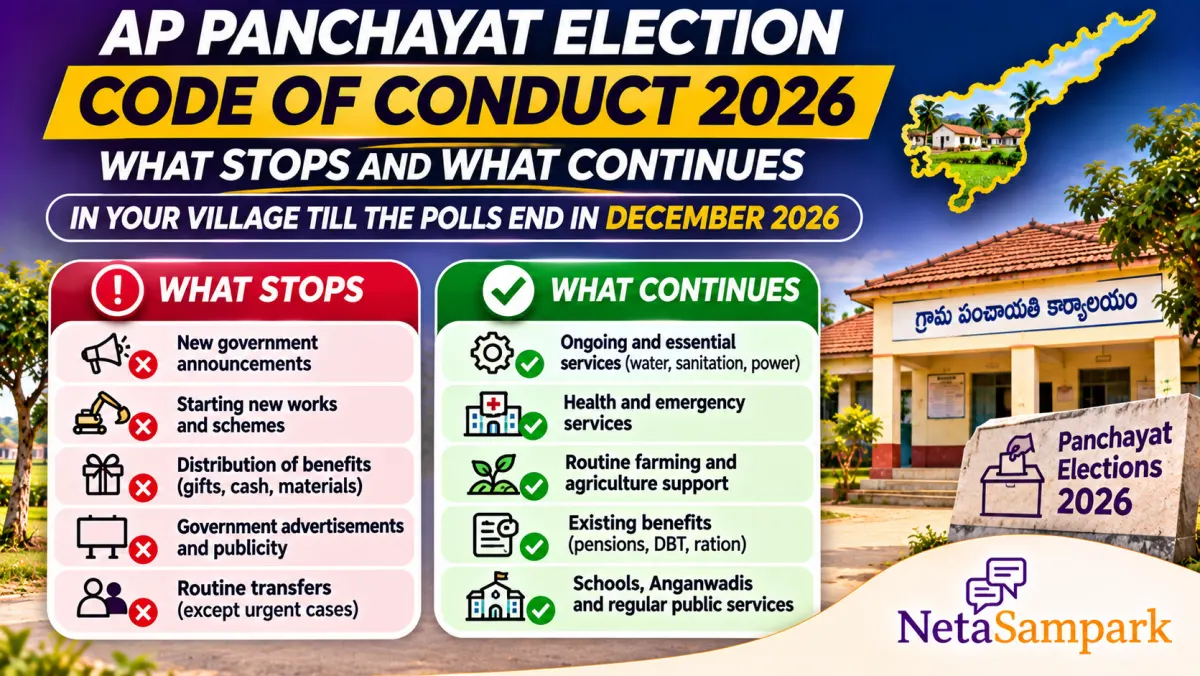
The model code of conduct for Andhra Pradesh's rural local body polls is in force in villages until the election process ends, with the last gram panchayat poll on 2 December 2026. Ongoing schemes for already-named beneficiaries, started works and payments for finished work continue. New schemes, foundation stones, fresh sanctions and discretionary grants wait.
Updated 11 November 2026
Every election season, the same confusion comes up in villages. "Will my pension stop because of the code?" "Why has the new road work not started?" "Can the sarpanch candidate take ten bikes around the village?" With the gram panchayat polls on 26 November 2026, 29 November 2026 and 2 December 2026, these questions are back.
The good news is that the AP State Election Commission (APSEC) has put out a clear FAQ on the model code of conduct (MCC) for rural local bodies in 2026. We've read the whole thing and turned it into plain answers. This post is about what the code means for you as a villager and voter, not a legal manual for candidates.
For the phase dates and how voting works, see our AP gram panchayat poll dates and how to vote guide. To find which phase your mandal is in, use our new district-wise AP panchayat phase list. For the general idea of why a code of conduct exists at all, our older explainer on what the model code of conduct is covers it.
Quick facts
| Item | Details |
|---|---|
| Official portal | AP State Election Commission, MCC FAQ for Rural Local Bodies 2026 |
| Helpline | APSEC office 0866-2970023 / 0866-2970024; locally the Returning Officer, MPDO or the police |
| Fee | Nil. Complaints about code violations are free |
| Deadline | Code applies till the election process is completed; GP polls on 26 November 2026, 29 November 2026 and 2 December 2026 |
| Documents | For a complaint: your name, place, date and time, what happened, and photos or video if you have them |
| Applies to | Rural areas where panchayat elections are being held |
| Campaign silence for GP polls | Last 44 hours before the poll closes at 1 PM |
When did the code start and when does it end?
As per APSEC's FAQ, the MCC comes into force from the date the election schedule is announced or the notification is issued, and it stays till the election process is completed. For the 2026 rural local body round, the schedule came out in mid-October 2026, so the code has been on in villages since then. It covered the MPTC and ZPTC polls and now continues through the gram panchayat phases.
The last gram panchayat poll is on 2 December 2026, with repolls and Upa-Sarpanch meetings up to 3 December 2026. APSEC issues a separate order lifting the code once everything is done, so don't assume it ends on poll day.
What continues as normal in my village?
This is the part people worry about most. The FAQ (questions 27, 29, 32 and 33) is clear that the code is not meant to stop ongoing benefits.
☐ Ongoing beneficiary schemes where specific beneficiaries were identified by name before the code came in can continue. That's the logic that keeps existing benefits going.
☐ Works already started on the ground, with all sanctions, can go on. If the road was already being laid, it continues.
☐ Payments for completed work can be released, once officials are satisfied.
☐ PMAY-G houses already sanctioned and started keep getting help as per norms.
☐ VB-G RAM G (rural jobs) work: ongoing works continue and job card holders who demand work get it in ongoing works. New works can start only from the already-approved shelf of projects, with the District Election Authority informed or consenting.
☐ Relief in emergencies like floods or drought, and welfare for the aged and infirm, can be done only after prior approval from the Commission, without any show or function.
So regular pensions and existing benefits for people already sanctioned by name shouldn't stop because of the code. If someone tells you "pension stopped because of elections", ask the MPDO office in writing. Our understanding comes from the FAQ's rule on named beneficiaries; the FAQ doesn't name individual state schemes.
What stops until the election is over?
The FAQ (questions 23 to 31 and 35) lists what can't happen during the code:
☐ No announcement of new schemes, financial grants or promises, like "we'll build a road" or "we'll give drinking water".
☐ No foundation stones, and no inauguration of schemes, even ones that were sanctioned or budgeted earlier. Finished buildings can be put to use, but without politicians.
☐ No new grants from discretionary funds of ministers or officials.
☐ No fresh releases from MP or MLA local area development funds.
☐ No new PMAY-G sanctions or new house construction.
☐ No work that had a work order but hadn't actually started on the ground.
☐ No loan write-offs by government-funded financial institutions.
☐ No government-paid ads or hoardings showing the achievements of the ruling party. Existing ones must be removed.
☐ No ad hoc appointments in government or public undertakings.
What are the campaign rules for sarpanch and ward member candidates?
This is where villagers can actually spot violations. From the APSEC FAQ:
| Rule | What it means |
|---|---|
| Vehicles for sarpanch candidate | One vehicle for campaigning and one on poll day, with a permit from the Tahsildar |
| Vehicles for ward member candidate | None, neither for campaigning nor on poll day |
| Filing nomination | No procession. Only one vehicle within 100 metres of the RO's office, and only three people (candidate plus two, including the proposer) can enter |
| Loudspeakers | Not allowed between 10 PM and 6 AM |
| Campaign silence | Campaign ends 44 hours before the poll closes |
| Diaries, calendars, stickers with candidate photos | Not allowed; treated as bribery under Section 173 of the Bharatiya Nyaya Sanhita |
| Ferrying voters | Arranging any vehicle to carry voters to or from the booth is a criminal offence |
The campaign silence works out like this, since GP polling ends at 1 PM:
| Phase | Poll date | Campaign must stop by |
|---|---|---|
| Phase I | 26 November 2026 | 5 PM on 24 November 2026 |
| Phase II | 29 November 2026 | 5 PM on 27 November 2026 |
| Phase III | 2 December 2026 | 5 PM on 30 November 2026 |
Outsiders who came for campaigning are also expected to leave the area once the campaign period closes.
What are the rules on polling day?
Step 1: No canvassing within 100 metres of the polling station on poll day. That's Section 219 of the AP Panchayat Raj Act, 1994.
Step 2: No mobile phones inside the 100-metre area around the booth, except for officials like the Presiding Officer and observers, on silent.
Step 3: Candidates' election booths (the small tables with voter slips) must be beyond 200 metres from the polling station. The slips can only have the voter's name, serial number, booth and date, not the candidate's name or symbol.
Step 4: No one can carry arms near the polling station.
Step 5: Buses and public transport run normally. But private vehicles carrying voters to booths are not allowed.
How do I complain about a code violation, and what if nothing happens?
If you see cash, liquor or gifts being handed out, a ward member candidate campaigning in a vehicle, or a foundation stone being laid, here's what to do:
Step 1: Note the date, time, place and who was involved. Take a photo or short video if it's safe.
Step 2: Complain to the Returning Officer for your panchayat or the MPDO, in writing if you can. For threats or cash distribution, the local police station is the right place.
Step 3: If nothing happens, write to the District Election Authority (the Collector) or call the APSEC office.
Step 4: Keep a copy of your complaint with a received stamp.
Please don't take matters into your own hands. In villages, things can turn tense fast.
Documents checklist for a complaint
☐ Your name and contact number (you can ask for confidentiality)
☐ Village, mandal and district
☐ Date, time and exact spot
☐ Name of the candidate or person involved, if known
☐ Photos, video or the item distributed (calendar, sticker, diary)
☐ Names of witnesses, if any
Frequently asked questions
Will my old age pension stop because of the panchayat election code?
The APSEC FAQ says ongoing beneficiary schemes where beneficiaries were identified by name before the code can continue. So pensions already sanctioned shouldn't stop due to the code. New sanctions may wait till the polls are over.
Can new development works start in my village during the code?
Only works that had actually started on the ground before the code can continue. Works with only a work order, new foundation stones and new announcements have to wait till the election process is over.
How many vehicles can a sarpanch candidate use?
One for campaigning and one on poll day, with a permit from the Tahsildar. A ward member candidate can't use any vehicle for campaigning or on poll day.
When does campaigning stop for the gram panchayat polls?
44 hours before the poll closes at 1 PM. For Phase I on 26 November 2026, that's 5 PM on 24 November 2026.
Is distributing calendars with a candidate's photo allowed?
No. APSEC says printing and distributing diaries, calendars or stickers like this counts as bribery under Section 173 of the Bharatiya Nyaya Sanhita, and a complaint can be filed.
Final reminder
The code is there to keep the village poll fair, not to stop your benefits. If someone uses "code of conduct" as an excuse to hold back an existing pension or wage payment, ask for the reason in writing. After the results, if you want to see who represents your area at the MLA and MP level, check the Andhra Pradesh representatives page on NetaSampark. And for MPP and ZP chair elections, our post on how MPP presidents and ZP chairpersons are elected explains the indirect vote.
Sources
• APSEC: Model Code of Conduct FAQs for Rural Local Bodies 2026 (PDF)
• APSEC: Model Code of Conduct 2026 (English, PDF)
• APSEC: Election Schedule 2026 (PDF)