
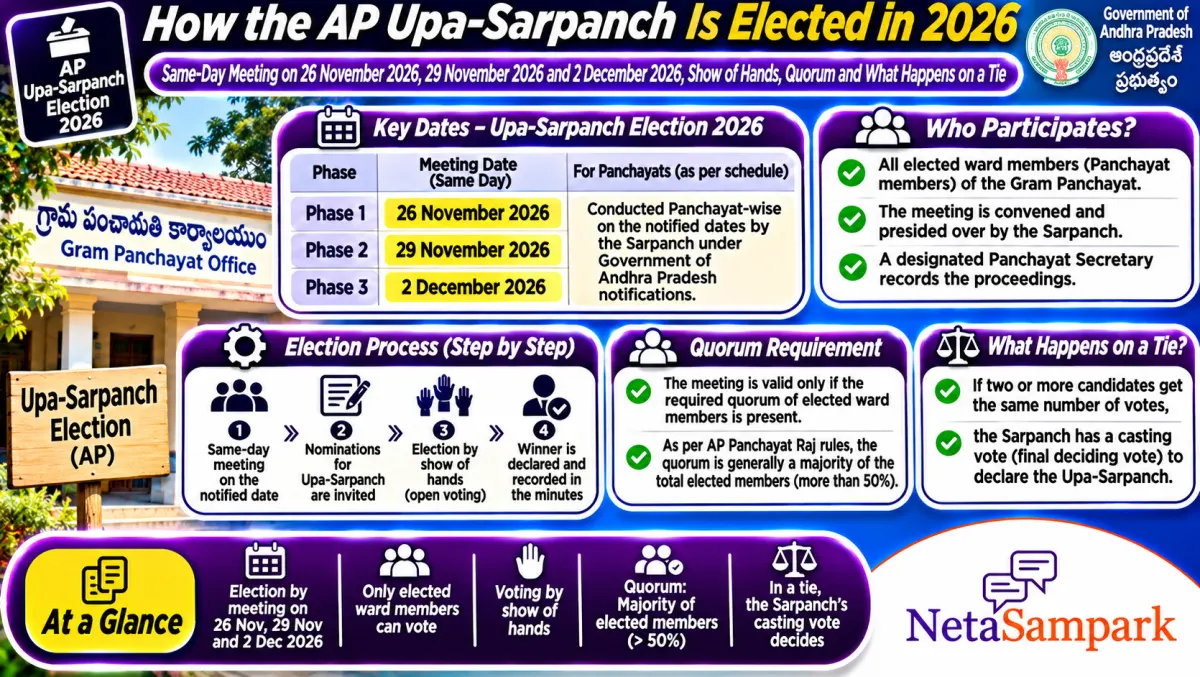
In Andhra Pradesh, the Upa-Sarpanch is elected by the newly elected sarpanch and ward members at a special meeting on the same day results are declared: 26 November 2026, 29 November 2026 or 2 December 2026, depending on your phase. One ward member wins by show of hands. If it fails, the meeting happens the next day.
Updated 14 November 2026
Everyone in the village watches the sarpanch count. But a few hours later, in the panchayat office, there's a second election that decides who becomes the deputy, the Upa-Sarpanch. Voters don't vote in it. And because it happens fast, on the same evening, a lot of people only find out who won the next morning.
This guide explains exactly how that meeting works in 2026, using the AP Panchayat Raj (Election of Upa-Sarpanch of a Gram Panchayat) Rules, 2006 and the State Election Commission's 2026 handbook for Returning Officers.
Quick facts
| Item | Details |
|---|---|
| Official portal | sec.ap.gov.in (AP State Election Commission) |
| Helpline | Your Returning Officer (Stage-I) or the MPDO office. No separate public helpline is listed for this |
| Fee | None. There's no nomination fee or deposit for Upa-Sarpanch |
| Deadline | Meeting on results day: 26 November 2026 (Phase 1), 29 November 2026 (Phase 2), 2 December 2026 (Phase 3). Fallback the next day |
| Documents | None for voters. Members get a notice in Form-I. The result is published on the panchayat notice board |
| Who votes | The elected sarpanch and all elected ward members |
| Who can be elected | Only one of the elected ward members |
| Method | Proposed and seconded, then show of hands. Lots if there's a tie |
| Legal basis | Section 14(10) of the AP Panchayat Raj Act, 1994 and G.O.Ms.No.172 (10 May 2006) |
What does the Upa-Sarpanch do?
The Upa-Sarpanch is the deputy head of the gram panchayat. When the sarpanch is absent, or the post falls vacant, the Upa-Sarpanch usually steps in for day-to-day work. Since the post goes to a ward member, it often becomes the place where groups inside the panchayat make deals. That's why this small meeting can get tense.
When is the Upa-Sarpanch election in 2026?
The APSEC schedule puts the indirect election for each phase on the same date as the counting, with the next day as the backup:
| Phase | Polling and counting | Upa-Sarpanch meeting | Fallback date |
|---|---|---|---|
| Phase 1 | 26 November 2026 | 26 November 2026 | 27 November 2026 |
| Phase 2 | 29 November 2026 | 29 November 2026 | 30 November 2026 |
| Phase 3 | 2 December 2026 | 2 December 2026 | 3 December 2026 |
Polling runs from 7 AM to 1 PM and counting starts at 2 PM, according to news reports of the SEC's schedule. The Upa-Sarpanch meeting comes after results are declared, at the time and place mentioned in the RO's election notice. So in many villages it'll be in the evening.
Not sure which phase your village is in? Check our AP panchayat phase-wise mandal list.
Who can vote and who can stand?
• Voters: only the members of the newly elected gram panchayat. That means the sarpanch plus every ward member.
• Candidates: only ward members. The sarpanch can't become Upa-Sarpanch.
• The sarpanch votes too. Rule 5(6) says the candidate and the sarpanch are both entitled to vote.
• The candidate can vote for themselves. Same rule.
• Ordinary voters: they don't vote. They can't be inside the meeting as voters either.
How the Upa-Sarpanch election works, step by step
1. Results are declared. The RO publishes the sarpanch and ward results in Form-XXVII.
2. Notice goes up. Right after that, the RO pastes a notice for the special meeting (Form-I) on the gram panchayat notice board. It also says that if the meeting doesn't happen, it'll be held the next day.
3. The meeting is held at the panchayat office. The District Panchayat Officer can shift it elsewhere, for example if the office is in a member's house.
4. Quorum check. At least half of all members, counting the sarpanch, must be present within one hour of the fixed time. Any fraction is counted as one. So in a panchayat of a sarpanch plus 10 wards (11 members), you need 6 present.
5. Proposals. Any member can propose one ward member, and someone else has to second it. The RO reads out all names that are properly proposed and seconded.
6. Withdrawal window. Candidates get 30 minutes to withdraw.
7. One name left? That person is declared elected straight away.
8. Two or more? Members vote by show of hands. The RO counts the hands for each candidate and announces the numbers.
9. Highest votes wins. The candidate with the most hands is declared Upa-Sarpanch.
10. Tie? The RO draws lots in front of the members. The handbook says each name goes on five slips of the same size and colour, folded and mixed, and the first name drawn wins.
11. Record and notice. The RO writes and signs a record of the meeting. Any member who wants to can sign it too. Then the RO puts up a notice with the winner's name and sends copies to the District Panchayat Officer, Collector, Commissioner of Panchayat Raj and the SEC.
What if members don't turn up?
This is a common pressure tactic. A group stays away so the quorum fails.
• Day 1 fails: the meeting is held the next day, whether or not it's a holiday.
• Day 2 fails too: the RO reports it to the SEC through the Collector, and the SEC gives directions. The 2006 rules say meetings after the first two can go ahead even without a quorum.
• The SEC also has the power, for recorded reasons, to fix a different date.
So staying away can delay the result, but it can't block it forever.
What happens in a fully unanimous panchayat?
If the sarpanch and all ward members are declared elected unopposed after withdrawals close, there's no polling at all. The RO handbook says the Upa-Sarpanch election should still be held by the RO (Stage-I) in the same way. Those villages may also get the state's new incentive. Read our guide on the ₹15 lakh to ₹50 lakh unanimous panchayat incentive for how that works.
Is the vote secret?
No. It's by show of hands, so everyone in the room sees how each member voted. This is different from the sarpanch and ward polls, which use secret ballot papers. It's also different from the MPP president and ZP chairperson elections, which have their own rules. Our MPP and ZP chair explainer covers those.
What if the Upa-Sarpanch post falls vacant later?
Rule 7 says a casual vacancy has to be filled within 30 days. Before that, any vacant ward member seats must be filled first. A person authorised by the District Panchayat Officer, not below the rank of Revenue Inspector, calls the meeting with at least three clear days' notice in Form-II. The same quorum and show-of-hands rules apply.
A real example
Say Ward 3 member Lakshmi and Ward 8 member Ravi are both proposed and seconded. Nobody withdraws in the 30 minutes. In an 11-member panchayat, 10 members are present. Six raise hands for Lakshmi, four for Ravi. The RO announces 6 to 4 and declares Lakshmi elected. If it had been 5 to 5, the RO would draw lots right there.
Frequently asked questions
Do ordinary villagers vote for the Upa-Sarpanch?
No. Only the elected sarpanch and ward members vote, at a special meeting held on results day.
Can the sarpanch vote in the Upa-Sarpanch election?
Yes. Rule 5(6) of the 2006 rules lets both the sarpanch and the candidates vote.
What happens if the votes are equal?
The Returning Officer draws lots in front of the members. The first name drawn is declared elected.
What if the meeting doesn't happen on results day?
It's held the next day: 27 November 2026, 30 November 2026 or 3 December 2026 for the three phases. If the quorum fails again, the RO reports to the SEC.
Where will the result be shown?
On the gram panchayat notice board, in a notice signed by the RO. Copies go to the District Panchayat Officer, Collector, Commissioner of Panchayat Raj and the SEC.
Final reminder
Know your phase, and on results day (26 November 2026, 29 November 2026 or 2 December 2026) keep an eye on the panchayat notice board for the meeting time. If you're a newly elected member, carry your Certificate of Election and be there within the hour. Want to tell your MLA how the panchayat election went in your village? Find them on NetaSampark's Andhra Pradesh representatives page. And for polling day itself, see how AP's sarpanch and ward voting works.
Sources
• AP State Election Commission: Schedule for 2nd Ordinary Elections to Local Bodies, 2026 (PDF)
• AP State Election Commission: Returning Officer Handbook, Gram Panchayat 2026 (PDF)
• AP State Election Commission: 2026 Training Material, Gram Panchayat (PDF)
• AP Panchayat Raj (Election of Upa-Sarpanch of a Gram Panchayat) Rules, 2006 (text on LegitQuest)
• Deccan Chronicle on the Phase 1 notification, 13 November 2026 (news report)