
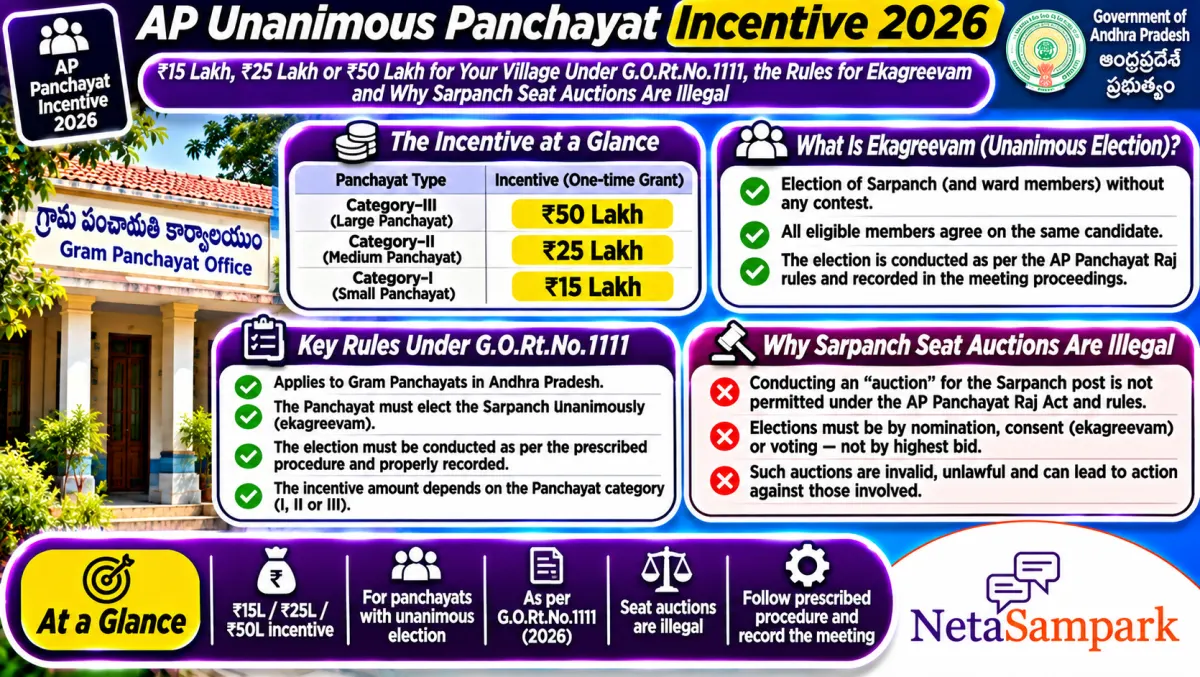
Andhra Pradesh will give a village ₹15 lakh (population up to 5,000), ₹25 lakh (5,001 to 10,000) or ₹50 lakh (above 10,000) if its sarpanch and every ward member are declared elected unopposed in the 2026 panchayat polls, under G.O.Rt.No.1111 issued on 13 November 2026. Unanimous results get declared after withdrawals close at 3 PM.
Updated 14 November 2026
If you live in an AP village, you've probably heard the word "ekagreevam" ten times since the evening of 13 November 2026. The state has more than doubled the reward for villages that pick their whole panchayat without a vote, and Phase 1 nominations open on 15 November 2026. Some villages are already talking about "settling" the seat. Some have gone further and held auctions.
So here's the full picture in plain words: how much money your village can get, what exactly counts as unanimous, the dates when it gets decided in each phase, and where the line is between a genuine consensus and a crime.
Quick facts
| Item | Details |
|---|---|
| Official portal | sec.ap.gov.in (AP State Election Commission) for schedules and results |
| Government order | G.O.Rt.No.1111, issued 13 November 2026 (as reported by TOI, Deccan Chronicle and NTV) |
| New incentive | ₹15 lakh (up to 5,000 people), ₹25 lakh (5,001 to 10,000), ₹50 lakh (above 10,000) |
| Old incentive | ₹5 lakh (below 2,000), ₹10 lakh (2,001 to 5,000), ₹15 lakh (5,001 to 10,000), ₹20 lakh (above 10,000) |
| Who qualifies | Only panchayats where the sarpanch AND all ward members are declared elected unopposed |
| Helpline | Your Returning Officer, MPDO office or the District Collector's election cell. The SEC home page doesn't show a single public helpline |
| Fee | None. The village doesn't apply or pay anything to get the incentive |
| Deadline | Withdrawals close at 3 PM on 21 November 2026 (Phase 1), 24 November 2026 (Phase 2) and 27 November 2026 (Phase 3) |
| Documents | None for voters. The RO declares the result in Form-X and issues each winner a Certificate of Election in Form-XXIX |
| Applies to | Only the ordinary gram panchayat elections of 2026 |
How much will a unanimous village get in 2026?
The new slabs, as reported from G.O.Rt.No.1111, are simple. Three bands, based on population:
| Panchayat population | Incentive before 13 November 2026 | Incentive under G.O.Rt.No.1111 |
|---|---|---|
| Up to 2,000 | ₹5 lakh | ₹15 lakh |
| 2,001 to 5,000 | ₹10 lakh | ₹15 lakh |
| 5,001 to 10,000 | ₹15 lakh | ₹25 lakh |
| Above 10,000 | ₹20 lakh | ₹50 lakh |
So a small village of 1,800 people goes from ₹5 lakh to ₹15 lakh. That's triple. A big panchayat with 12,000 people goes from ₹20 lakh to ₹50 lakh. The old four slabs have been merged into three.
According to the Times of India, the scheme has been running since 2001 and was revised in 2008, 2013 and 2020. This is the biggest jump so far. Officials quoted by ETV Bharat expect 20 to 30% of panchayats to go unanimous this time. Treat that as an estimate, not a promise.
Who is eligible for the unanimous panchayat incentive?
This is the part most people get wrong. The money is for the panchayat as a whole, not for the sarpanch, and it comes only when the entire body is unopposed.
• The sarpanch post must be declared elected unopposed, and
• every single ward member post in that panchayat must also be declared unopposed, and
• the declaration must be made by the election authorities under the election rules, and then checked and certified before release.
If even one ward has a contest and goes to polling on 26 November 2026, the village doesn't qualify, as per the G.O. reports. A unanimous sarpanch with a fight in Ward 7 gets nothing.
Panchayats where polls are stayed by a court, or skipped for other legal reasons, aren't in the race at all.
When does a panchayat become "unanimous"? The dates for each phase
Under Rule 16 of the AP Panchayat Raj Conduct of Election Rules, as explained in the APSEC's 2026 Returning Officer handbook, if only one validly nominated candidate is left after the last hour for withdrawal, the RO "shall forthwith declare such candidate as duly elected" in Form-X. That's the moment a post becomes unanimous.
Here are the dates from the APSEC's official schedule:
| Step | Phase 1 | Phase 2 | Phase 3 |
|---|---|---|---|
| APSEC notification | 13 November 2026 | 16 November 2026 | 19 November 2026 |
| Nominations | 15 to 17 November 2026 | 18 to 20 November 2026 | 21 to 23 November 2026 |
| Scrutiny | 18 November 2026 | 21 November 2026 | 24 November 2026 |
| Appeal against rejection | 19 November 2026 | 22 November 2026 | 25 November 2026 |
| Withdrawal closes (3 PM) and unanimous results declared | 21 November 2026 | 24 November 2026 | 27 November 2026 |
| Polling where there's a contest | 26 November 2026 | 29 November 2026 | 2 December 2026 |
Phase 1 covers 3,967 sarpanch and 40,012 ward member posts in 26 districts, as per the SEC figures reported by the New Indian Express. Guntur and Visakhapatnam have no seats in Phase 1. Statewide, 13,167 sarpanch and 1,32,514 ward posts are up for election.
Nominations are taken from 10:30 AM to 5 PM on each nomination day, according to Deccan Chronicle. Our sarpanch and ward member nomination guide covers Form-III, deposit and documents, and the phase-wise mandal list tells you which phase your mandal is in.
How will the money reach the village?
Going by what the government told the press, this is how it works:
1. Withdrawals close. The RO declares each unopposed winner in Form-X and hands over a Certificate of Election in Form-XXIX.
2. If the sarpanch and all wards are unopposed, the RO also holds the Upa-Sarpanch election for that panchayat, as per the RO handbook.
3. After the whole election process ends, the Commissioner of Panchayat Raj and Rural Development collects population-wise lists of eligible panchayats and works out the total money needed.
4. Competent authorities verify and certify each panchayat's eligibility.
5. The amount is released in phases during the elected body's term, not as one lump sum.
6. It can be spent only on approved development works and public welfare, with the normal accounting and audit rules.
So nobody gets a cheque on 21 November 2026. And it's village money. A sarpanch who treats it like a personal prize is asking for an audit problem.
Is auctioning a sarpanch seat legal?
No. And it's happening anyway. The New Indian Express reported on 14 November 2026 that the sarpanch post in Durgada panchayat of Gollaprolu mandal, Kakinada district, reserved for a woman from the general category, was "auctioned" at the village temple for a reported ₹1.20 crore, with the money said to be meant for the temple. Sakshi has reported a similar story from West Godavari. These are news reports; police or SEC action, if any, hadn't been reported when we checked.
Here's why it's a problem in law, in plain words:
• The Bharatiya Nyaya Sanhita, 2023 defines "electoral right" to include the right to stand, not stand, or withdraw as a candidate (Section 169).
• Giving or taking any gratification to make someone use or not use that right is bribery (Section 170). The punishment is up to one year in jail, or a fine, or both (Section 173).
• So when money changes hands so that others don't file papers, or withdraw, that fits the definition of bribery. Calling it a "donation to the temple" doesn't change what it is.
• Section 19A of the AP Panchayat Raj Act, 1994 disqualifies anyone convicted of an election offence under Chapter IX of the BNS from contesting for six years, and a sitting winner loses the post.
• Any voter or candidate can also challenge an election through an election petition under Section 233 of the Act if corrupt practice is involved.
A genuine consensus, where people sit together and agree on one candidate with nobody paid or threatened, is legal. That's what the incentive is meant to reward. The government order itself says it won't interfere with anyone's right to contest or vote freely.
What if someone forces you to withdraw?
1. Don't sign a withdrawal form under pressure. Only you, your proposer or your election agent can hand it to the RO, and only till 3 PM on the last withdrawal day of your phase.
2. Write down who threatened you, when and what was said. Keep messages and call records.
3. Complain in writing to the Returning Officer and the local police station. Keep the acknowledgement.
4. Send a copy to the District Collector and District Election Authority, and to the AP State Election Commission.
5. If you think an auction is being planned in your village, report it before the withdrawal deadline. After 3 PM, the unanimous result is already declared and fixing it gets much harder.
Frequently asked questions
Does the sarpanch personally get the ₹15 lakh, ₹25 lakh or ₹50 lakh?
No. It goes to the gram panchayat for approved development and welfare works, released in phases during the term. It's audited like other panchayat funds.
Our sarpanch is unopposed but two wards have a contest. Do we get anything?
As per the reported G.O., no. The incentive needs the sarpanch and all ward members declared unopposed. One contested ward rules the whole village out.
When will we know if our village is unanimous?
Right after 3 PM on the last withdrawal day: 21 November 2026 for Phase 1, 24 November 2026 for Phase 2 and 27 November 2026 for Phase 3. The RO declares unopposed winners in Form-X then.
Which population figure decides the slab?
The reports say the slab depends on the panchayat's population. The exact census base isn't spelt out in the reports we've seen (APSEC uses the 2011 Census for spending limits), so check with your MPDO.
Is it legal for villagers to agree on one candidate?
Yes. A real consensus without money, threats or pressure is legal, and that's what the incentive rewards. Paying people to stay out, or auctioning the seat, is bribery under the BNS.
Is this incentive only for 2026?
Yes. The enhanced amounts apply only to the ordinary gram panchayat elections of 2026, according to the government's statement as reported by the Times of India.
Final reminder
If your village is heading for a unanimous result, make sure it's a real one: every ward, nobody paid, nobody pushed. Note your phase's withdrawal deadline (21, 24 or 27 November 2026, 3 PM) and check the RO's notice board that evening. If you're facing pressure, complain before the deadline, not after. Want to take it to your MLA? Find them on NetaSampark's Andhra Pradesh representatives page. You can also read how candidates get elected unopposed in AP local polls, what the panchayat model code of conduct stops, and how voting works on polling day.
Sources
• AP State Election Commission: Schedule for 2nd Ordinary Elections to Local Bodies, 2026 (PDF)
• AP State Election Commission: Returning Officer Handbook, Gram Panchayat 2026 (PDF)
• AP State Election Commission: 2026 Training Material, Gram Panchayat (PDF)
• Bharatiya Nyaya Sanhita, 2023 on India Code
• Times of India on G.O.Rt.No.1111 incentive slabs, 13 November 2026 (news report)
• Deccan Chronicle on the incentive and eligibility, November 2026 (news report)
• New Indian Express on the Phase 1 notification, 14 November 2026 (news report)
• New Indian Express on the Durgada sarpanch seat auction, 14 November 2026 (news report)