
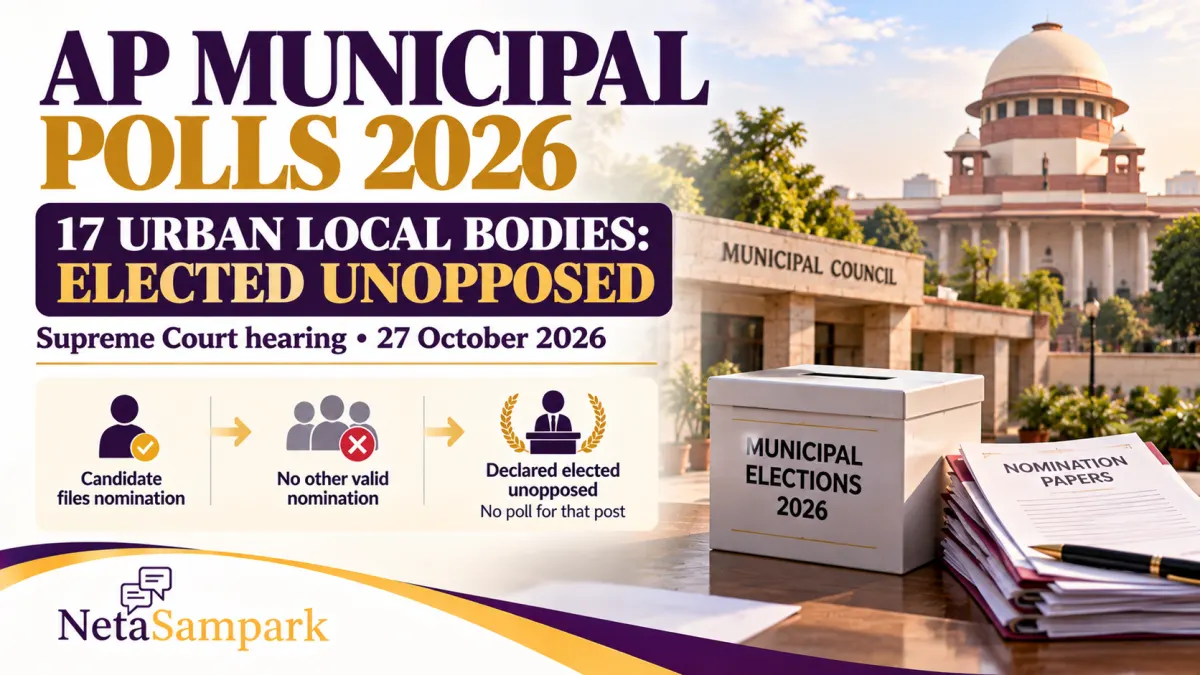
Elected Unopposed in AP Municipal Polls: How a Candidate Wins Without a Vote, What It Means for 17 Councils and the Supreme Court Hearing
In Andhra Pradesh’s 2026 municipal elections, candidates backed by the ruling TDP-led alliance secured chairperson posts in 17 urban local bodies without a contest. The results have drawn attention because they came amid allegations that some opposition candidates were prevented from filing nominations.
The Supreme Court heard the dispute on 27 October 2026. Here’s how an unopposed victory works, what the numbers mean and what the court said.
What Does “Elected Unopposed” Mean?
A candidate is elected unopposed when they are the only eligible candidate remaining for a seat after the nomination, scrutiny and withdrawal process.
In simple terms:
- A candidate files a nomination.
- Other nominations are rejected, withdrawn or no other valid candidate remains.
- The election authority declares the remaining candidate elected, following the applicable rules.
- No polling is needed for that particular seat.
An unopposed victory is not the same as winning after votes are counted. It means there was no competing candidate on the ballot for that position.
However, if someone was wrongly prevented from filing a valid nomination, that can raise a separate legal question about whether the process was fair.
What Happened in Andhra Pradesh?
According to reports based on the State Election Commission’s announcement, chairperson candidates in 17 of the state’s 87 municipalities and nagar panchayats were elected unopposed.
The reported breakdown was:
| Party | Chairperson posts won unopposed |
|---|---|
| Telugu Desam Party (TDP) | 15 |
| Jana Sena Party | 1 |
| Bharatiya Janata Party (BJP) | 1 |
| Total | 17 |
These figures concern chairperson posts in urban local bodies. They should not be confused with the number of individual wards or divisions where candidates were also elected unopposed. (Hindustan Times)
The state’s broader municipal elections cover 100 urban local bodies, including 13 municipal corporations and 87 municipalities and nagar panchayats. Polling for contested seats was scheduled for 1 November, with counting on 3 November, under the revised schedule.
Why Did the Supreme Court Become Involved?
The opposition YSR Congress Party (YSRCP) approached the Supreme Court, alleging that some of its candidates were assaulted, threatened or prevented from reaching nomination centres before the nomination deadline.
The allegations included incidents in Kadapa, Tirupati, Punganur and Rayachoti. The party sought additional time and safeguards to ensure candidates could file their papers.
These are allegations, not findings that every reported incident occurred as claimed.
On 21 October, the Supreme Court directed the State Election Commission to examine complaints and supporting material, including electronic evidence, and extend nomination deadlines where candidates were found to have been prevented from filing because of law-and-order problems. The Commission subsequently reopened the nomination process for four urban local bodies for 48 hours. (LiveLaw)
What Happened at the 27 October Hearing?
At the latest hearing, the Court considered whether further intervention was needed over the alleged obstruction of candidates.
Reports of the proceedings indicate that the Court did not order a broad, roving inquiry into the allegations. It said individual candidates claiming they were wrongly prevented from filing nominations would need to establish their cases through the appropriate election-petition process.
The Court also indicated that safeguards for the election process, including preservation of CCTV recordings, were important. The earlier directions on CCTV were to remain in force, according to reports of the hearing. (Bar and Bench, LiveLaw)
The key distinction is that the Court’s handling of the nomination dispute does not itself establish that every unopposed result was improper. Nor does an unopposed declaration prevent a candidate with a specific, legally sustainable grievance from pursuing the prescribed remedy.
Can an Unopposed Victory Be Challenged?
Potentially, yes. A candidate who believes they were unlawfully prevented from contesting may pursue the applicable legal remedy, including an election petition, subject to the relevant law and deadlines.
The person challenging the result would need to support the claim with evidence. Relevant material may include:
- Copies of nomination papers and acknowledgements.
- Communications with the Returning Officer or election authorities.
- Complaints filed at the time of the incident.
- Witness statements and available CCTV footage.
- Orders or decisions issued by election officials.
The exact procedure and limitation period depend on the applicable election law. Anyone affected should obtain the relevant order and seek legal advice promptly rather than assume that a general complaint automatically cancels a result.
What Does This Mean for Voters?
For voters, the immediate point is that an unopposed declaration applies to a particular post or seat—not necessarily every position in that municipality.
Where other wards or posts remain contested, polling can still take place for those positions under the notified schedule. The legal dispute over nomination access is also separate from the question of how the remaining votes are counted.
The larger issue is whether every eligible candidate had a fair opportunity to enter the contest. The Election Commission’s procedures, the evidence preserved during nominations and the remedies available to affected candidates are central to answering that question.
Official and reference links
- Andhra Pradesh State Election Commission
- Supreme Court hearing report — LiveLaw
- Supreme Court proceedings — Bar and Bench
- Unopposed results — Hindustan Times
Information checked on 28 October 2026. Election schedules and court directions can change; consult the State Election Commission and the latest court order for authoritative updates.