
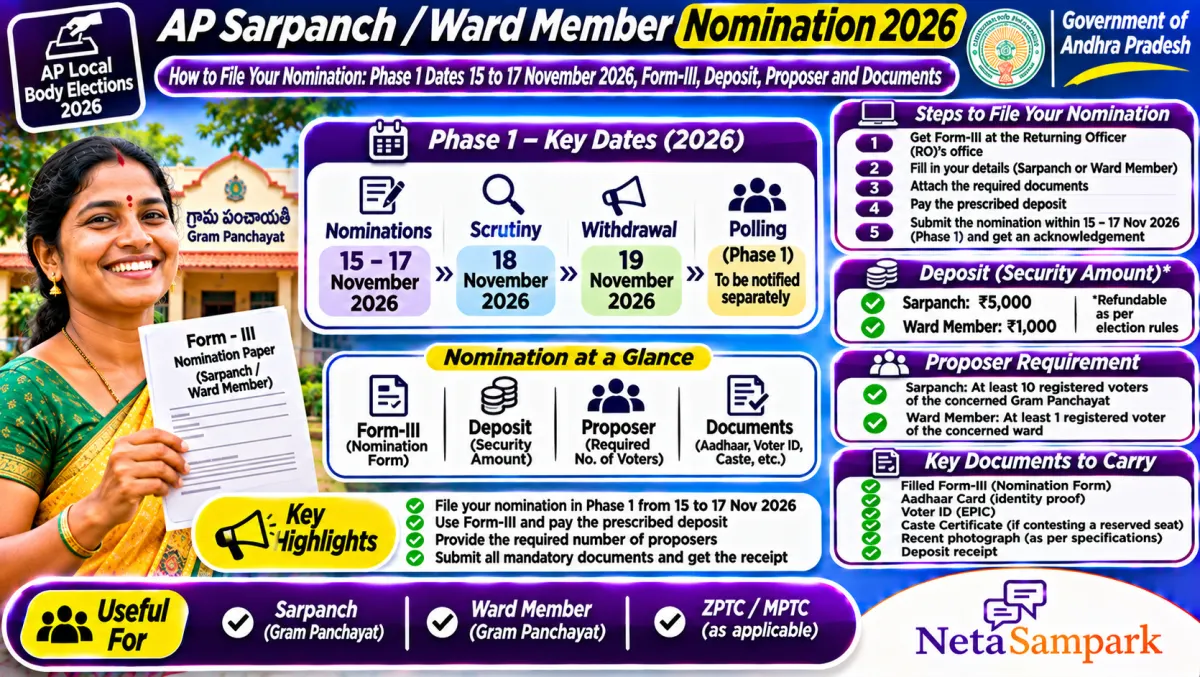
To contest as sarpanch or ward member in an AP Phase 1 village, file Form-III with your Returning Officer between 15 November 2026 and 17 November 2026, from 10:30 AM to 5 PM. You must be 21 or older and on that panchayat's voter list, bring a proposer, pay the deposit and attach the self-declarations.
Updated 13 November 2026
APSEC issued the Phase 1 gram panchayat notification on 13 November 2026. That means if your mandal is in Phase 1, you have exactly three days, 15 November 2026 to 17 November 2026, to get your papers in. Miss one signature or one declaration, and your nomination can be thrown out at scrutiny on 18 November 2026.
This guide is built from APSEC's own 2026 training material and Returning Officer handbook for gram panchayat elections. It covers who can contest, who can't, what to fill, what to carry and what happens after you file.
Quick facts
| Item | Details |
|---|---|
| Official portal | AP State Election Commission (training material, RO handbook, schedule) |
| Helpline | Your Returning Officer (Stage-I) and the MPDO office of your mandal |
| Fee | Nomination forms are free. Security deposit as fixed by APSEC, lower for SC, ST and BC candidates |
| Deadline | Phase 1: 5 PM on 17 November 2026. Phase 2: 20 November 2026. Phase 3: 23 November 2026 |
| Documents | Form-III, self-declaration (attested by two witnesses), expenditure declaration, deposit receipt, caste certificate or declaration if needed |
| Who can contest | Age 21 or above on scrutiny day, name on that gram panchayat's voter list |
| Poll | Phase 1 on 26 November 2026, 7 AM to 1 PM, counting from 2 PM the same day |
What are the nomination dates for all three phases?
These dates are from the APSEC Election Schedule 2026. Which phase your village is in depends on your mandal. Our AP panchayat phase-wise mandal list helps you find it.
| Step | Phase 1 | Phase 2 | Phase 3 |
|---|---|---|---|
| APSEC notification | 13 November 2026 | 16 November 2026 | 19 November 2026 |
| RO's election notice, nominations open | 15 November 2026 | 18 November 2026 | 21 November 2026 |
| Last date for nominations | 17 November 2026 | 20 November 2026 | 23 November 2026 |
| Scrutiny | 18 November 2026 | 21 November 2026 | 24 November 2026 |
| Appeal against rejection | 19 November 2026 | 22 November 2026 | 25 November 2026 |
| Appeal disposal | 20 November 2026 | 23 November 2026 | 26 November 2026 |
| Withdrawal (till 3 PM) and final list | 21 November 2026 | 24 November 2026 | 27 November 2026 |
| Poll and counting | 26 November 2026 | 29 November 2026 | 2 December 2026 |
| Upa-Sarpanch meeting | 26 or 27 November 2026 | 29 or 30 November 2026 | 2 or 3 December 2026 |
Andhra Jyothy reported on 13 November 2026 that Phase 1 covers 4,180 panchayats and 42,006 wards. In all, 13,168 of the state's 13,354 panchayats are going to polls in three phases.
Who is eligible to contest for sarpanch or ward member?
APSEC's training material keeps it simple:
• Your name must be on the electoral roll of that gram panchayat.
• You must be at least 21 years old.
• The date that counts for eligibility is the scrutiny date, not the day you file.
Your proposer matters too. For sarpanch, the proposer can be a voter from any ward of that panchayat. For ward member, the proposer must be a voter of that same ward.
Who cannot contest?
The APSEC material lists these disqualifications under the AP Panchayat Raj Act, 1994:
• Central or state government employees, local body employees and PSU employees
• Anganwadi workers
• Office bearers of Water Users' Associations
• Chairmen and members of Marketing Committees
• Chairmen and trust board members of charitable or religious institutions
• Fair price shop dealers
• Anyone with a running contract or work with the gram panchayat, MPP, ZPP or the state or central government
• Anyone with unpaid dues to the gram panchayat (pay up and keep the receipt, and the bar goes away from that date)
• People convicted under certain laws, for set periods, and those who didn't file election expense accounts in an earlier poll (barred for three years)
Office bearers of cooperative societies are not disqualified. That's a common confusion in villages.
How do you file your nomination step by step?
Step 1: Get the forms from the RO office
Collect Form-III (the nomination paper) and the declaration formats from your Returning Officer's office. They're free. Nobody should charge you for blank forms.
Step 2: Fill Form-III with your proposer
You and your proposer both sign Form-III. Check your name, voter serial number and part number against the voter list. A mismatch here is a classic reason for trouble at scrutiny.
Step 3: Fill the self-declaration
You need a declaration on criminal cases, assets and liabilities, and education. It must be attested by two witnesses. Don't leave any column blank. Write "Nil" or "Not applicable" where needed. APSEC's handbook says a missing declaration can get your nomination rejected.
Step 4: Pay the security deposit
Pay at a government treasury, at a bank where the gram panchayat has an account, or in cash to the RO, who gives you a receipt. Telugu helper sites put the deposit at ₹3,000 for sarpanch (₹1,500 for SC, ST and BC) and ₹1,000 for ward member (₹500 for SC, ST and BC). Confirm the amount with your RO, since APSEC sets it. To get the lower rate, SC, ST and BC candidates must fill the declaration in Part-III of the nomination paper, even when contesting a general seat.
Step 5: Submit in person
You or your proposer must hand over the papers in person, between 10:30 AM and 5 PM, on any of the three days, holidays included. Post or a third person won't work. Only three people can enter the RO's office, and only one vehicle can come within 100 metres.
Step 6: Collect the checklist
The RO checks your papers and gives you a checklist with any defects. Fix them and submit missing papers before 5 PM on the last nomination day. You'll also get an acknowledgement slip from Part-VI of the form. Keep it safe.
Step 7: Sign the expenditure declaration
Before scrutiny, you sign a declaration about keeping election expense accounts, in front of the RO.
Documents checklist
☐ Form-III signed by you and your proposer
☐ Self-declaration on criminal cases, assets, liabilities and education, attested by two witnesses
☐ Election expenditure declaration
☐ Deposit receipt (treasury, bank or RO's cash receipt)
☐ Caste certificate, or the declaration made before a gazetted officer or Tahsildar, if contesting a reserved seat
☐ Copy of the voter list page showing your name and your proposer's name
☐ Receipt showing gram panchayat dues are cleared, if you had any
☐ Passport-size photos and ID proof, in case the RO asks
Can you contest more than one seat?
Yes, with conditions. You can file for both sarpanch and ward member. If you win both, you keep one and give up the other within 15 days. You can also file for more than one ward, but you must withdraw from all except one before the withdrawal deadline. If you don't, all your nominations become invalid.
What happens after you file?
1. Daily list. The RO puts up the list of nominations received each day on the notice board.
2. Scrutiny. For Phase 1, it's on 18 November 2026. You, your proposer and one more person you authorise can attend.
3. Appeal. If your papers are rejected, you can appeal on 19 November 2026. It's decided by 20 November 2026.
4. Withdrawal. Till 3 PM on 21 November 2026, using Form-VII. Once you withdraw, you can't take it back.
5. Symbols and final list. The final list, in Telugu and in alphabetical order, comes after 3 PM on 21 November 2026.
6. Poll and counting. On 26 November 2026, from 7 AM to 1 PM. Sarpanch ballots are pink and ward ballots are white. Counting starts at 2 PM.
Your deposit comes back within 30 days of the result, unless you get one-eighth or less of the valid votes (NOTA votes not counted). Winners get the deposit back too. And file your expense account within 45 days of the result through the MPDO. Skipping it can bar you from contesting for three years.
Remember, the model code of conduct already applies. Our AP panchayat code of conduct explainer covers what's allowed while you campaign, and our sarpanch reservation guide shows how to check if your seat is reserved.
Frequently asked questions
What is the last date for AP sarpanch nomination in Phase 1?
The last date is 17 November 2026, up to 5 PM. Nominations open on 15 November 2026. Phase 2 closes on 20 November 2026 and Phase 3 on 23 November 2026.
What is the minimum age to contest sarpanch in Andhra Pradesh?
You must be at least 21 years old, and your name must be on that gram panchayat's voter list. Age is checked as on the scrutiny date.
Can a cooperative society president contest the sarpanch election?
Yes. APSEC's training material says office bearers of cooperative societies are not disqualified. Fair price shop dealers and anganwadi workers are disqualified.
How much is the deposit for sarpanch in AP 2026?
APSEC fixes it, and SC, ST and BC candidates pay a lower rate. Telugu helper sites report ₹3,000 for sarpanch (₹1,500 concessional) and ₹1,000 for ward member (₹500 concessional). Confirm with your RO.
Can I file my nomination online?
No. The nomination must be handed over in person by you or your proposer at the RO's office, between 10:30 AM and 5 PM.
Final reminder
If your mandal is in Phase 1, the window shuts at 5 PM on 17 November 2026. Collect Form-III on 15 November 2026, fill the declarations with no blank columns, pay the deposit and file early so you have time to fix anything on the checklist. Want to see what people in your area are asking for before you campaign? Browse live polls and ideas on NetaSampark Explore. For poll dates and ballots, read our AP gram panchayat election guide.
Sources
• APSEC Elections to Gram Panchayats 2026 training material (PDF)
• APSEC Returning Officer handbook, Gram Panchayat elections 2026 (PDF)
• APSEC Election Schedule 2026 (PDF)
• AP State Election Commission
• Andhra Jyothy report on Phase 1 panchayats and wards, 13 November 2026 (news report, Telugu)