
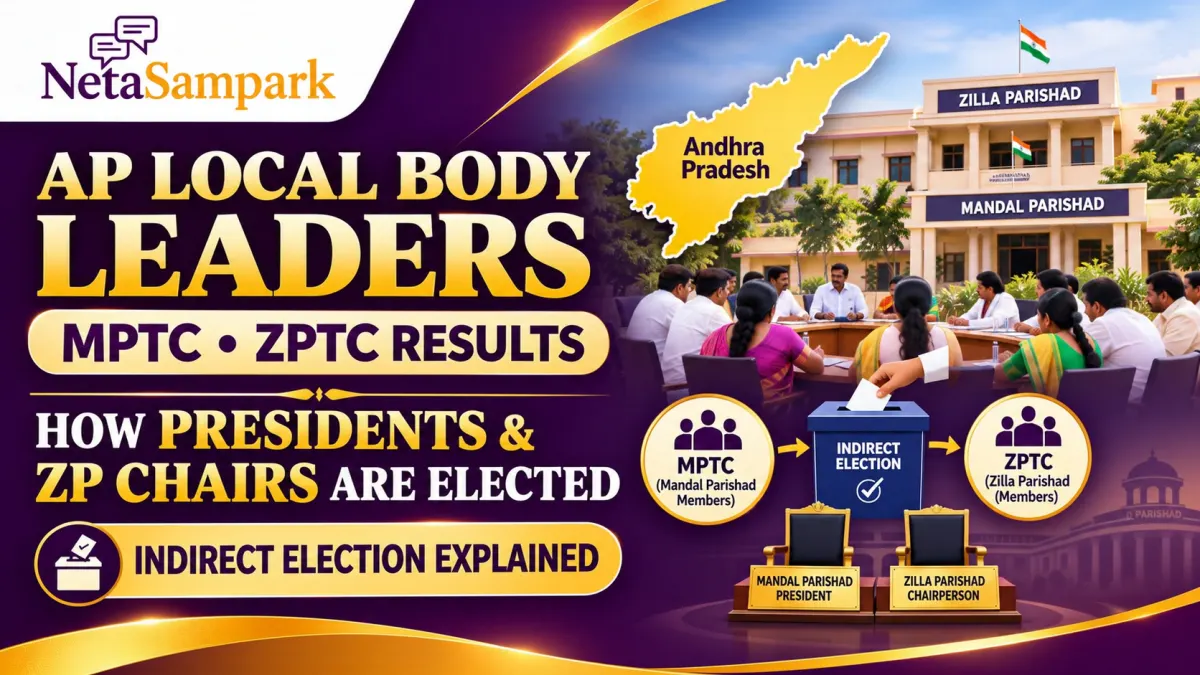
In Andhra Pradesh you don't vote directly for the Mandal Parishad President or the Zilla Parishad Chairperson. After the MPTC and ZPTC results on 7 November 2026, the newly elected MPTCs pick the MPP president and the ZPTCs pick the ZP chairperson at special meetings, reported for around 11 and 12 November 2026.
Updated 4 November 2026
Here's something a lot of people in AP villages don't realise. On 5 November 2026 you stamped two ballot papers, one for your MPTC and one for your ZPTC. But the people who'll actually run the Mandal Parishad and the Zilla Parishad, the MPP president and the ZP chairperson, are not on your ballot at all. They're chosen by the members you elected. This post explains how that works, why it matters, and what to watch for.
Quick facts
| Item | Details |
|---|---|
| Official portal | AP State Election Commission and its latest updates page |
| Helpline | Your MPDO office for Mandal Parishad meetings; the Zilla Parishad CEO's office for ZP meetings |
| Fee | None. These are elections among elected members |
| Deadline | Results on 7 November 2026; indirect elections reported for around 11 November 2026 to 12 November 2026 (confirm on APSEC) |
| Documents | Members need their certificate of election to take part |
| Law | Andhra Pradesh Panchayat Raj Act, 1994 and APSEC rules and instructions |
| Who votes | MPTCs elect the MPP president and vice president; ZPTCs elect the ZP chairperson and vice chairperson |
Direct vote vs indirect vote: what's the difference?
In a direct election, you vote for the person who'll hold the post. That's how you elect your MLA, your MP, your MPTC and your ZPTC.
In an indirect election, the people you elected vote among themselves to fill the top post. That's how AP fills the Mandal Parishad President (MPP) and Zilla Parishad Chairperson posts. It's similar to how MLAs choose a Chief Minister, except here the vote is formally held at a special meeting.
So your vote on 5 November 2026 still matters a lot for these posts. Whichever party or group wins the most MPTC seats in your mandal usually gets to choose the MPP president. Whoever wins most ZPTC seats in your district usually gets the ZP chairperson post.
The order of events after counting
Here's the usual sequence. Dates below follow news reports, and the exact date for your mandal or district will be in the APSEC notification.
| Step | What happens | When (as reported) |
|---|---|---|
| 1 | MPTC and ZPTC results declared | 7 November 2026 |
| 2 | Notice of special meeting sent to every elected member | Soon after results |
| 3 | Co-opted member elected at the Mandal Parishad meeting | Around 11 November 2026 |
| 4 | MPP president and vice president elected | Around 11 November 2026 |
| 5 | Co-opted members elected at the Zilla Parishad meeting | Around 12 November 2026 |
| 6 | ZP chairperson and vice chairperson elected | Around 12 November 2026 |
Step one: the co-opted member
Before anyone votes for the president, the Mandal Parishad co-opts a member. Under the AP Panchayat Raj Act, this is someone from the minority community, chosen by the elected MPTCs. The Zilla Parishad similarly co-opts members from minorities. The idea is to make sure minority voices are present even if no minority candidate won directly.
Co-opted members can take part in the council's work. Whether they can vote in the president or chairperson election depends on the rules, so check the APSEC instructions for the current position rather than assuming.
Step two: the meeting and the quorum
The presiding officer, usually an official appointed by the State Election Commission or the Collector, calls a special meeting. For the vote to go ahead, a minimum number of members, called the quorum, has to be present. If not enough members turn up, the meeting is adjourned, usually to the next day, under the rules.
This is where a lot of drama happens on the ground. Parties sometimes keep their members together in one place before the meeting, sometimes called "camp politics", to stop rivals from winning them over. If a mandal has a close split, every single member counts.
Step three: how the vote happens
Members vote at the meeting, generally by raising hands, and the presiding officer records the votes. Parties issue a whip, a written instruction telling their members whom to vote for.
Why does the whip matter? AP's rules for these local bodies have anti-defection provisions. A member elected on a party symbol who votes against the party's whip can face disqualification proceedings. The exact rules and process are in the AP Panchayat Raj Act and rules, and a member facing this should get legal advice.
If two candidates get equal votes, a tie is usually decided by drawing lots in front of the members.
Reservation of MPP and ZP chairperson posts
The posts of MPP president and ZP chairperson are reserved by rotation for Scheduled Castes, Scheduled Tribes, Backward Classes and women, as notified by the state. So in some mandals only, for example, a BC woman MPTC can become the MPP president. The reservation list is notified before the elections. If the party with the most members doesn't have an eligible member for the reserved category, the post can go to another group. That's why the reservation list sometimes matters as much as the seat count.
We covered how reservation works at the village level in our AP sarpanch reservation list post.
What an MPP president and ZP chairperson actually do
• MPP president heads the Mandal Parishad, chairs its meetings and works with the MPDO on mandal-level matters. Think primary schools, rural roads within the mandal, drinking water works and the selection lists for some welfare schemes.
• ZP chairperson heads the Zilla Parishad, which handles bigger district-level works and funds, and coordinates with the Collector and departments.
They don't replace your MLA. Your MLA still handles the bigger state-level issues for your constituency. You can check who your MLA and MP are on NetaSampark's Andhra Pradesh page.
Why you should care, even though you don't vote in it
Because it decides who controls local funds and works for the next five years. A few things you can do:
• Know the numbers. After the results on 7 November 2026, look at how many MPTC seats each party won in your mandal. That tells you who's likely to form the Mandal Parishad.
• Watch the meeting outcome. Results of these meetings are usually announced the same day. Your MPDO office will have them.
• Talk to your MPTC. Ask whom they're backing and why. They're answerable to you.
• Follow the first meeting. Mandal Parishad general body meetings are where budgets and works get discussed.
For the result-day details, read our AP MPTC and ZPTC results guide, and for the big picture, our three rounds explainer.
Frequently asked questions
Who elects the MPP president in Andhra Pradesh?
The newly elected MPTCs of that Mandal Parishad elect the MPP president and vice president at a special meeting called after the results. Ordinary voters don't vote directly for this post.
Who elects the Zilla Parishad chairperson?
The ZPTCs elected from all the mandals in the district elect the ZP chairperson and vice chairperson at a special meeting of the Zilla Parishad.
What is a co-opted member?
It's a member chosen by the elected members rather than by voters, from the minority community, to make sure minorities are represented in the Mandal Parishad and Zilla Parishad. The co-option happens at the start of the special meeting.
Does the party whip apply in these elections?
Yes. Parties issue whips to their members, and AP's local body rules include anti-defection provisions. A member who goes against the whip can face disqualification proceedings.
What happens if there's a tie?
If two candidates get the same number of votes, the result is usually decided by drawing lots in front of the members, following the State Election Commission's instructions.
Sources
• AP State Election Commission: official website
• AP State Election Commission: latest notices and schedules
• India Code: state and central Acts, including the AP Panchayat Raj Act, 1994