
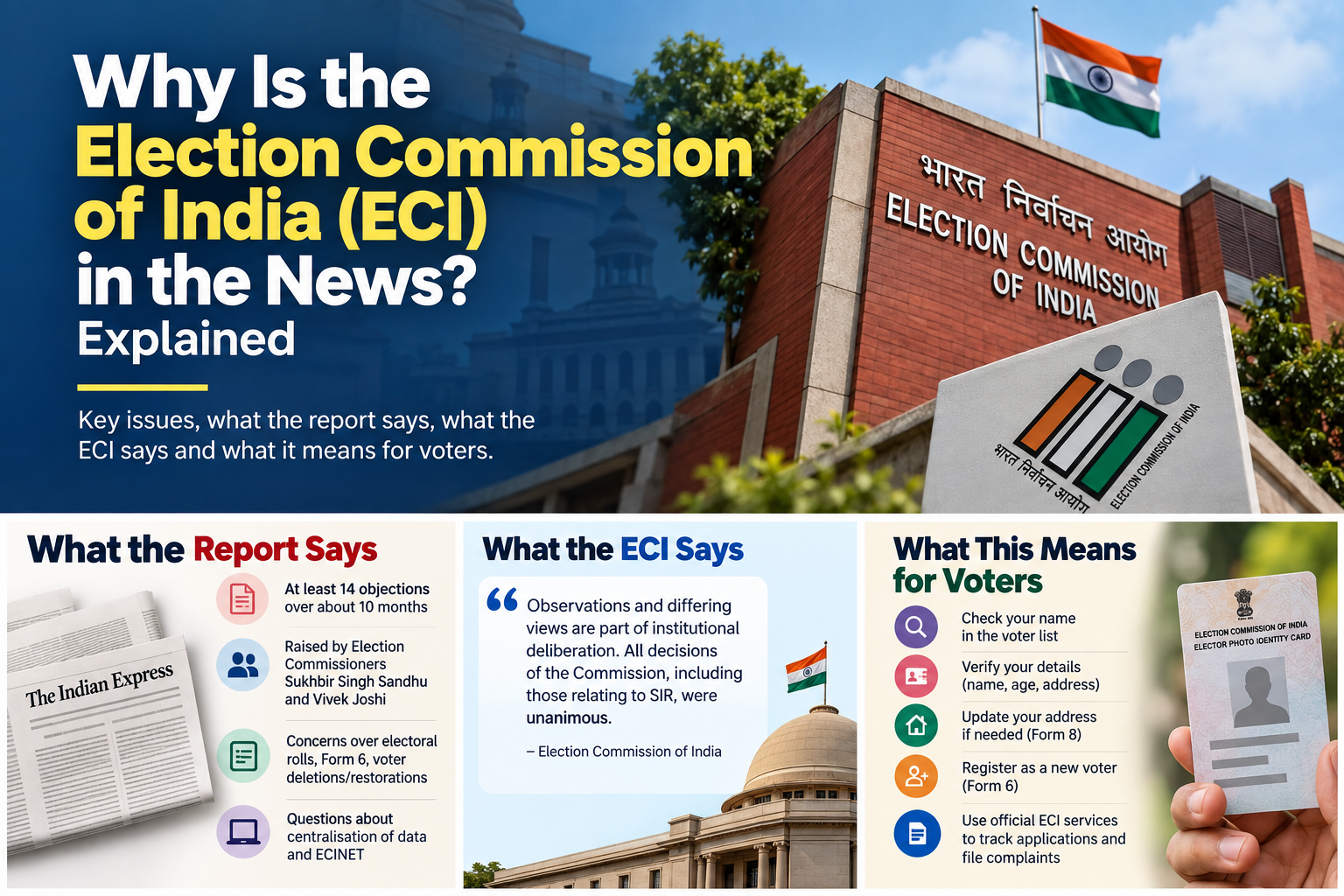
The Election Commission of India (ECI) is in the news following a report about internal objections raised by two Election Commissioners over several decisions concerning electoral rolls, voter registration, the Special Intensive Revision (SIR) exercise and the Commission's technology systems.
An investigation published by The Indian Express reported that Election Commissioners Sukhbir Singh Sandhu and Vivek Joshi recorded objections at least 14 times over a period of about 10 months. The issues reportedly included changes to Form 6, voter deletions and restorations, appeals relating to electoral-roll decisions and the centralisation of electoral-roll data.
The Election Commission has responded that the existence of internal notes does not mean there was a split in the Commission. It said that observations and differing views are part of institutional deliberation and that all decisions of the Commission, including those relating to SIR, were unanimous.
So, what exactly is happening?
This article explains the issue, the role of the three Election Commissioners, what SIR has to do with the controversy, why Form 6 and voter databases have become part of the discussion, and what citizens should know.
Quick Summary: Why Is the ECI in the News?
The current controversy centres on reported internal objections within the three-member Election Commission.
According to The Indian Express investigation:
- Election Commissioners Sukhbir Singh Sandhu and Vivek Joshi recorded at least 14 objections over around 10 months.
- The objections concerned electoral-roll management and related administrative and technology issues.
- Some objections reportedly concerned changes to Form 6, which is used by new voters to register.
- The commissioners reportedly raised concerns about aspects of voter deletion and restoration.
- Questions were also raised about the centralisation of electoral-roll data and the role of ECI's technology systems.
- Some objections were reportedly copied to Chief Election Commissioner Gyanesh Kumar.
The ECI, however, has said that the objections were part of the normal process of deliberation and that the final decisions were unanimous.
Who Are the Three Members of the Election Commission?
The Election Commission currently consists of three members:
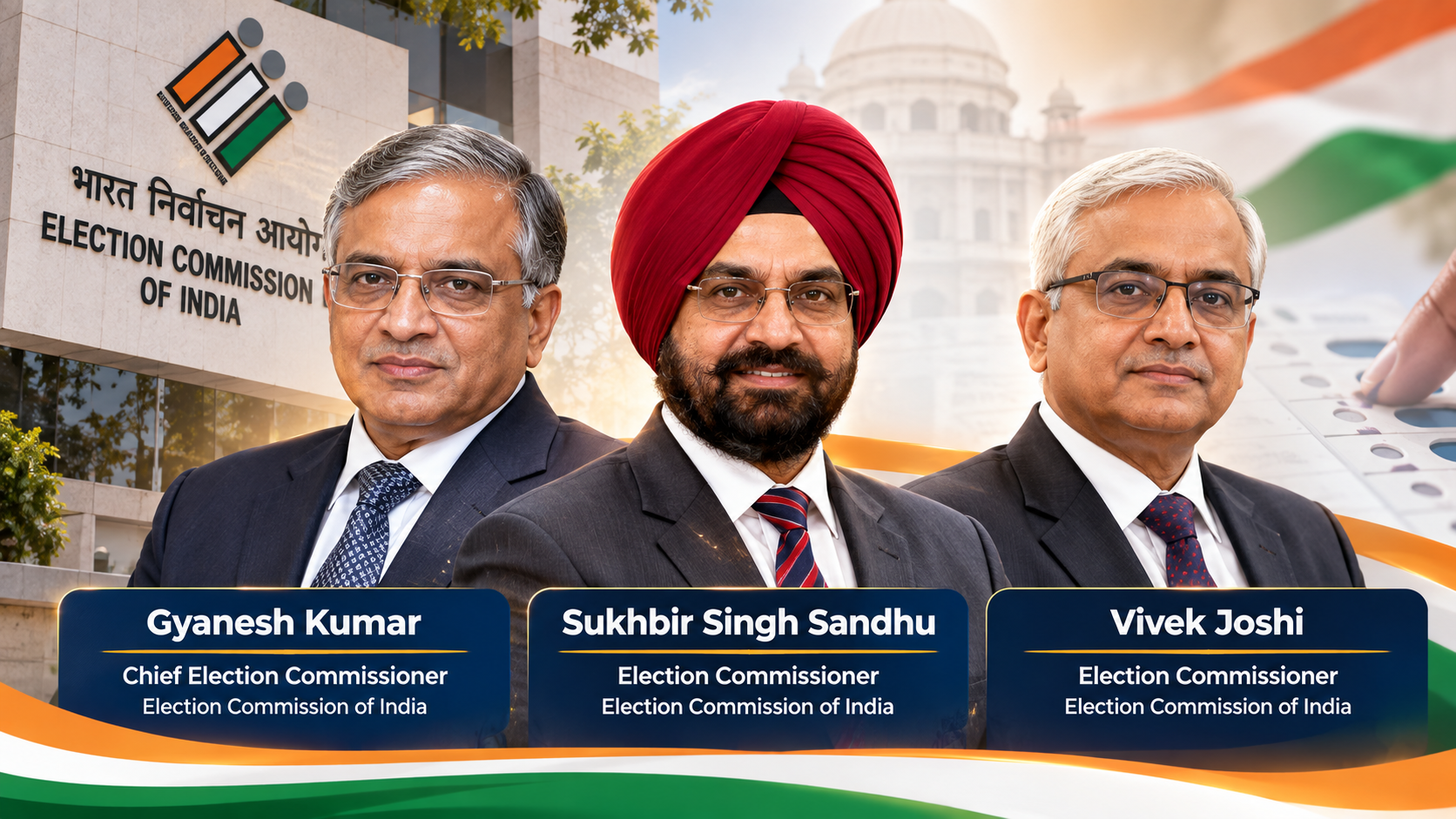
The ECI's official directory currently lists Gyanesh Kumar as Chief Election Commissioner and Sukhbir Singh Sandhu and Vivek Joshi as Election Commissioners.
The Commission is a constitutional authority responsible for administering elections in India, including elections to the Lok Sabha, State Legislative Assemblies, and the offices of the President and Vice-President.
What Triggered the Latest ECI Controversy?
The immediate trigger was an investigation published by The Indian Express on September 23, 2026.
The report examined internal notes and correspondence involving Election Commissioners Sukhbir Singh Sandhu and Vivek Joshi.
According to the report, the two commissioners raised objections on multiple occasions to decisions or actions concerning electoral-roll management.
The reported objections covered several areas rather than a single issue.
These included:
- Changes relating to new voter registration
- Deletion and restoration of names from electoral rolls
- Appeals involving voter-related orders
- Centralised management of electoral-roll data
- Changes to Form 6
- Access and control over election-related software
The report said some of the objections were made in writing and were copied to the Chief Election Commissioner.
What Has the Election Commission Said?
The Election Commission has rejected the suggestion that the reported objections demonstrate a breakdown or split within the Commission.
In its response, the ECI said that individual Election Commissioners can record observations, technical suggestions and concerns during internal deliberations.
The Commission said that focusing on specific internal notes without considering the larger body of approvals and decisions gives only part of the picture.
Most importantly, the ECI stated that all decisions of the Commission over the period, including those relating to SIR, were unanimous and had the approval of all three members.
This distinction is important when understanding the current news cycle:
Reported internal objections are one fact; the ECI's position that final decisions were unanimous is another.
What Is SIR and Why Is It Part of the Controversy?
SIR stands for Special Intensive Revision of electoral rolls.
It is an exercise aimed at reviewing and updating electoral rolls.
The current SIR exercise has become a major national political and legal issue because electoral rolls determine who is registered to vote.
The ECI has said that electoral-roll revision is intended to improve the accuracy of voter lists and identify issues such as duplicate, shifted, deceased or otherwise ineligible entries.
At the same time, political parties and other stakeholders have raised concerns about the possibility of eligible voters being excluded during the process.
The latest controversy adds another layer because the reported internal objections involved aspects of electoral-roll management during this broader revision exercise.
Why Is Form 6 Mentioned in the ECI Controversy?
Form 6 is the application used by eligible citizens to register as new voters.
The recent reporting concerns changes made to Form 6 in connection with the SIR process.
According to The Indian Express, a new declaration related to whether the applicant or certain relatives appeared in an earlier electoral roll was added to the process.
The report said Election Commissioner Vivek Joshi objected to the change, arguing that Form 6 is prescribed under electoral rules and that the proposed change could not be made without the relevant rule amendment. Election Commissioner Sukhbir Singh Sandhu subsequently supported the objection, according to the report.
The issue is significant because Form 6 is the entry point for citizens seeking registration as new voters.
What Is the Issue With Voter Deletions and Restorations?
Another reported area of concern involves the deletion and restoration of names from electoral rolls.
Electoral rolls are periodically updated because voter circumstances change.
For example, a voter may:
- Move permanently to another place
- Die
- Appear more than once in electoral records
- Become otherwise ineligible
However, deletion is a sensitive part of electoral-roll management because an eligible voter needs to remain on the roll to exercise their franchise.
The Indian Express investigation reported that the two Election Commissioners raised concerns regarding certain deletion and restoration matters in different states.
The ECI has maintained that its decisions were taken unanimously.
Why Has ECINET Become Part of the Discussion?
Another important part of the story is ECINET, the Election Commission's unified digital platform.
The ECI has been developing ECINET as a single platform integrating several election-related applications and services.
According to the ECI, ECINET brings together services including:
- Voter registration
- Application-status tracking
- Voter-card complaints
- Electoral-roll search
- e-EPIC download
- Communication with election officials
- Model Code of Conduct complaints
- Candidate information
- Election information
- Polling trends
The ECI describes ECINET as a unified platform connecting citizens, candidates, political parties and election officials.
The Commission had previously said that ECINET was intended to integrate more than 40 existing applications and platforms.
Why Is Centralisation of Electoral Data Being Discussed?
According to The Indian Express investigation, Election Commissioners Sandhu and Joshi raised concerns about the centralisation of electoral-roll database controls.
The report said the commissioners questioned whether greater centralisation could affect the role and authority of officials responsible for electoral-roll preparation at the state and local levels.
This is an important technology-governance question because electoral rolls contain information about millions of voters.
The issue is therefore not simply about software.
It also concerns:
- Who can access electoral data?
- Who can make changes?
- Which authority approves changes?
- How are changes recorded?
- How can changes be audited?
- How are errors corrected?
- What safeguards exist against unauthorised changes?
The ECI has previously stated that ECINET data would be entered by authorised ECI officials and that statutory forms would remain the primary source where conflicts arise.
Does This Mean the Election Commission Is Divided?
The reported objections demonstrate that there were differences of view recorded internally on certain issues.
However, it would be inaccurate to automatically conclude that the Commission was unable to function as a three-member body.
The ECI has explicitly said that its final decisions were unanimous.
India Today also reported that despite the internal objections described in the investigation, the three commissioners appeared together at several public briefings during the period in question.
Therefore, two things should be kept separate:
What has been reported:
Two Election Commissioners recorded multiple objections to certain decisions and processes.
What the ECI says:
Those observations were part of normal internal deliberation and did not change the unanimous final decisions of the Commission.
Why Does This Matter to Voters?
The controversy matters because several of the issues under discussion directly affect the electoral-roll system.
For ordinary voters, the most important questions are practical:
Is my name on the voter list?
Check your electoral-roll record before an election.
Are my details correct?
Verify your name, age, address and other relevant information.
Has my name been removed?
If you cannot find your name, investigate the reason and use the available ECI grievance and appeal mechanisms where applicable.
Has my address changed?
Existing voters can use Form 8 for shifting residence.
Am I a new voter?
Eligible citizens can use Form 6 for new registration.
The ECI's voter-services portal currently provides facilities for new registration, Form 8 corrections, electoral-roll search, application tracking, complaints and other services.
What Should Citizens Do If They Are Concerned About Their Voter Record?
The current news cycle is a useful reminder for voters to verify their own electoral information.
You can:
- Search your name in the electoral roll.
- Check your EPIC number and voter details.
- Confirm your polling station.
- Correct errors using the appropriate ECI service.
- Track applications submitted to the Election Commission.
- Contact election officials or use the ECI's complaint mechanisms if necessary.
The official ECI voter-services portal provides electoral-roll search, application tracking, Form 6, Form 8, complaints and the facility to book a call with a Booth Level Officer.
What Is the Election Commission of India Responsible For?
The Election Commission is a constitutional authority responsible for administering elections in India.
Its responsibilities include administering elections to:
- Lok Sabha
- Rajya Sabha
- State Legislative Assemblies
- President of India
- Vice-President of India
It also oversees important parts of the electoral process, including electoral-roll management and election-related procedures.
Because electoral rolls form the foundation of voter participation, decisions about their preparation, revision and maintenance have a direct effect on the electoral process.
ECI, SIR and Electoral Rolls: How Are They Connected?
The relationship can be understood simply:
The current controversy involves questions about how some of these processes were being administered and digitised, alongside the ECI's response that its final decisions remained unanimous.
What Happens Next?
The latest reporting is likely to keep attention focused on several areas:
- Electoral-roll revisions
- SIR implementation
- Form 6 and voter registration
- Voter deletion and restoration processes
- ECINET and electoral technology
- Internal decision-making within the ECI
- Transparency and auditability of electoral databases
The significance of each issue will depend on the underlying documents, subsequent decisions and any judicial or administrative proceedings that follow.
For voters, however, the immediate practical step is simpler:
Check your voter record rather than relying only on news reports.
Frequently Asked Questions
Why is the Election Commission of India in the news?
The ECI is in the news following reporting about internal objections recorded by Election Commissioners Sukhbir Singh Sandhu and Vivek Joshi on several issues involving electoral rolls, SIR, Form 6, voter deletions and electoral technology. The ECI has said its final decisions, including SIR decisions, were unanimous.
Who is the Chief Election Commissioner of India in 2026?
The ECI's official directory lists Gyanesh Kumar as Chief Election Commissioner, with Sukhbir Singh Sandhu and Vivek Joshi as Election Commissioners.
What is SIR in elections?
SIR stands for Special Intensive Revision of electoral rolls. It is an exercise involving intensive review and updating of electoral-roll records.
What is Form 6?
Form 6 is used by eligible citizens to apply for inclusion in the electoral roll as new voters. The ECI's voter-services portal currently provides Form 6 for new voter registration.
What is Form 8?
Form 8 is used by existing electors for services including correction of electoral-roll entries and shifting residence.
What is ECINET?
ECINET is the Election Commission's unified digital platform designed to bring several election-related services and applications onto one platform. The ECI says it connects citizens, candidates, political parties and election officials.
Did two Election Commissioners object to ECI decisions?
According to an investigation published by The Indian Express, Sukhbir Singh Sandhu and Vivek Joshi recorded at least 14 objections over approximately 10 months. The ECI has acknowledged that observations and concerns were part of internal deliberations but says its final decisions were unanimous.
Does the ECI say there was a disagreement over SIR?
The ECI says that all decisions relating to SIR were unanimous. Reports about internal objections concern differences recorded during deliberations on specific issues and processes.
How can I check whether my name is on the voter list?
You can use the official ECI voter-services system to search your name in the electoral roll and check polling-related information.
How NetaSampark Helps Citizens Stay Connected With Their Representatives
The current discussion around electoral rolls also highlights a broader issue: citizens need accessible information about elections, representatives and their constituencies.
NetaSampark is built around this connection between citizens and elected representatives.
Citizens can use the platform to:
- Find their representatives
- Share community ideas
- Raise local issues
- Participate in polls and surveys
- Rate their representatives
- Follow constituency developments
- Stay informed about local political and civic activity
For representatives and political teams, NetaSampark provides tools for voter and contact management, communication, surveys, constituency information, team operations and election analytics.
The goal is to make political engagement more structured and accessible for both citizens and representatives.
Conclusion:
The Election Commission of India is currently facing intense public scrutiny following reports about internal objections raised by two of its Election Commissioners over issues involving electoral rolls, SIR, Form 6, voter deletions and the management of electoral technology.
The Indian Express investigation reported at least 14 formal objections over around 10 months, while the ECI has said that such observations form part of institutional deliberation and that all final decisions, including those concerning SIR, were unanimous.
The controversy therefore involves two separate questions: what concerns were recorded internally, and how those concerns relate to the final decisions taken by the Commission.
For citizens, the most useful response is to stay informed and verify their own electoral records.
Check your name. Check your details. Know your polling station. And use official ECI channels when you need to update or challenge your voter information.