
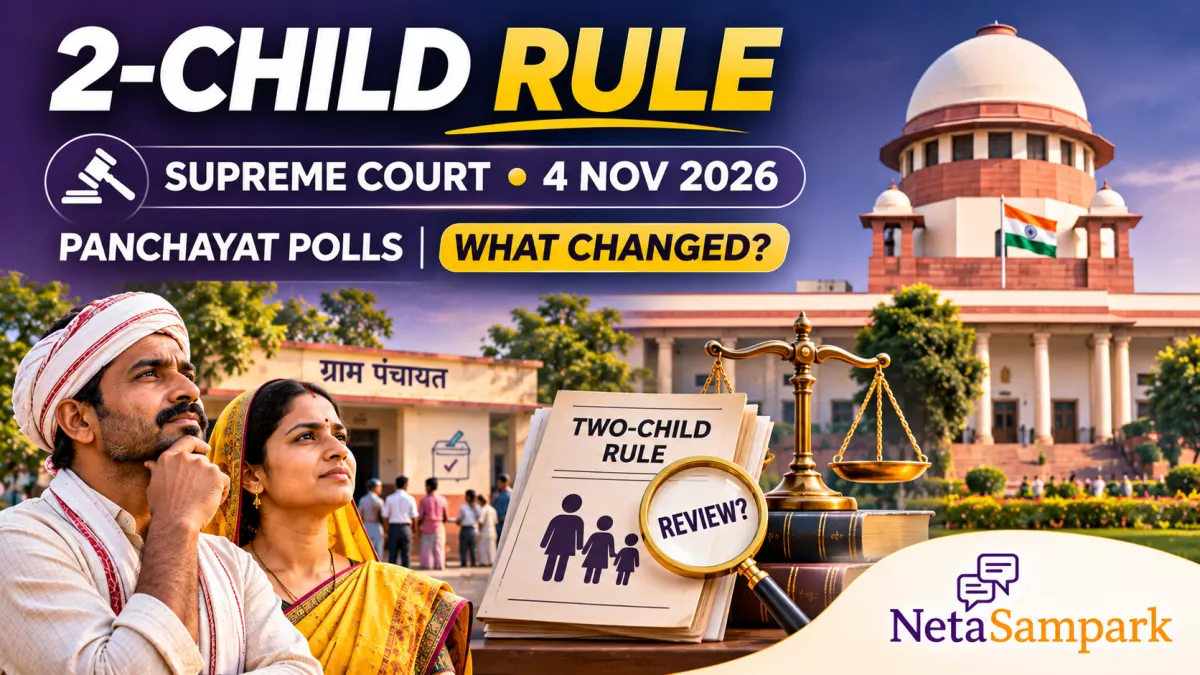
On 4 November 2026 the Supreme Court said laws barring people with more than two children from panchayat elections have "lost their relevance" and sent the 2003 Javed judgment to a larger bench. It did not strike down any state law yet. It stayed a Maharashtra High Court order, so the sarpanch in that case keeps her post for now.
Updated 5 November 2026
If you've seen headlines like "SC ends two-child rule" on your phone since 4 November 2026, hold on a second. The judgment is big, and the court's words are strong, but the legal position on the ground hasn't flipped overnight. Here's what the court actually did, which states still have such rules, and what a candidate or sitting sarpanch with three kids should do right now.
Quick facts
| Item | Details |
|---|---|
| Official portal | Supreme Court of India judgment: Mangala Bhimrao Ingle v. Additional Commissioner, Amravati Division, 2026 INSC 1193 |
| Helpline | Your State Election Commission or District Legal Services Authority for free legal advice (NALSA helpline 15100) |
| Fee | None to read the judgment; free legal aid is available through DLSA if you qualify |
| Deadline | No deadline. The matter now waits for a larger bench to be set up by the Chief Justice of India |
| Documents | If you face a disqualification case, keep your election certificate, the petition copy and children's birth certificates handy |
| Bench | Justice P.S. Narasimha and Justice Alok Aradhe |
| Decided on | 4 November 2026 |
The case in simple words
Mangala Bhimrao Ingle was elected Sarpanch of Kakoda Gram Panchayat in Maharashtra in the 2022 elections. Someone pointed out that she had a third child, born in 2014. Under Section 14(1)(j-1) of the Maharashtra Village Panchayats Act, 1959, a person with more than two children (subject to the cut-off date in the law) can't be a panchayat member. Her election was set aside, the High Court agreed, and she went to the Supreme Court.
Her lawyer mainly argued that there was no conclusive proof of the third child. The Supreme Court wasn't very impressed by that point. But the bench went into a much bigger question: does a rule like this still make sense in 2026?
What the court said
Here are the big lines from the judgment, in plain words.
1. These laws have lost their relevance. When the Supreme Court upheld such laws in Javed v. State of Haryana in 2003, the fear was a "population explosion". The court noted India's Total Fertility Rate has since fallen from 3.02 to 1.9, which is below the replacement rate of 2.1. So the foundation of the law, it said, has "crumbled".
2. The law may have been valid then, but could be invalid now. The court said a law can become unconstitutional over time if the facts it was based on have changed. Courts can't order a legislature to repeal a law, but they can check whether its continued operation is still constitutionally sustainable.
3. It hits women harder. Javed had said men and women are equally disqualified, so there's no discrimination. This bench disagreed with that reasoning. It pointed to a 2009 study sponsored by the Ministry of Panchayati Raj on Rajasthan, Madhya Pradesh and Gujarat, which found the two-child norm tended to weaken women's position, since decisions about children are often not in their hands.
4. It shuts people out of democracy. The court said such rules exclude a whole class of citizens from political representation for reasons that have little to do with their ability to hold office, and force a choice between having children and contesting elections. It linked this to reproductive autonomy under Article 21.
5. Why only panchayats? The court noted there's no such rule for MLAs or MPs. A constitutional amendment bill on this from 1992 never went anywhere. Applying it only to grassroots leaders, it said, is full of prejudice.
What the court actually ordered
This is the part that matters for your village.
☐ The bench referred the question to a larger bench to reconsider Javed. The Registry has to place the matter before the Chief Justice of India to set up that bench. ☐ It stayed the High Court's judgment, so Mangala Ingle continues as Sarpanch of Kakoda Gram Panchayat until the appeal is decided. ☐ It did not declare any state's two-child law unconstitutional. A two-judge bench can't overrule a three-judge bench decision like Javed. Only a larger bench can.
So as of 5 November 2026, the two-child disqualification is still on the statute book in states that have it. Election officers in those states are still bound to apply it.
Which states still have the two-child rule?
The amicus curiae in this case, advocate Rukhmini Bobde, put together a state-wise picture. As per reports on that compilation, the rule is still in force for panchayat polls in at least six states: Assam, Goa, Gujarat, Maharashtra, Odisha and Uttarakhand. Seven states have repealed it over the years, and 15 never had it. Haryana, where Javed came from, repealed the provisions examined in that case through an amendment in 2006, the judgment notes.
The exact list changes as states amend their laws, so treat this as a starting point. Before you file nomination papers or an objection, read your state's current Panchayati Raj Act or ask the Returning Officer.
| State group | What reports say |
|---|---|
| Rule still in force (at least) | Assam, Goa, Gujarat, Maharashtra, Odisha, Uttarakhand |
| Repealed earlier | Seven states, including Haryana (2006) as per the judgment |
| Never had it | 15 states |
| Rajasthan | Reported to have removed the condition through an amendment in 2026; verify with the current Act |
I'm a sitting sarpanch or member with three children. Am I safe?
It depends on your state and on whether someone has challenged you.
If nobody has filed a case against you, nothing changes because of this judgment. The law in your state is what it was on 3 November 2026.
If there's a disqualification case pending against you, this judgment gives your lawyer a strong argument to ask for a stay, citing the stay granted to Mangala Ingle and the reference to a larger bench. But a stay isn't automatic. Each court decides on its own.
If you were already removed, you can talk to a lawyer about whether an appeal is still possible and whether the reference helps you. Free legal aid is available through your District Legal Services Authority.
I want to contest the next panchayat election. Should I?
If your state still has the rule, your nomination can still be rejected or challenged. The safest approach is to get advice from a local lawyer before filing, and keep your documents in order. If your state has repealed the rule, this judgment doesn't change anything for you.
Watch for the larger bench hearing. If that bench overrules Javed, it could open the door for challenges across all states that still have such laws. That could take months, so don't plan your nomination around a ruling that hasn't come yet.
Why this matters beyond one sarpanch
There are lakhs of elected panchayat posts in India. Every election, some winners lose their seats on technical grounds like this, often through complaints filed by rivals. The court's message is that rules made in a different era can't be applied blindly forever. If the larger bench agrees, it would be one of the biggest changes to who can contest rural local body elections since the 73rd Amendment.
If you want to understand how panchayat posts compare with MLAs and MPs, our post on the difference between MP, MLA, corporator and panchayat member is a good primer. If you're following local polls right now, see our guide to Rajasthan panchayat elections in 2026 and our explainer on election petitions after a local body poll. You can also look up and rate your representatives on NetaSampark.
Frequently asked questions
Did the Supreme Court cancel the two-child rule on 4 November 2026?
No. It said such laws have lost their relevance and referred the issue to a larger bench to reconsider the 2003 Javed judgment. State laws stay in force until a larger bench decides or states repeal them.
Who is the sarpanch in this case?
Mangala Bhimrao Ingle, Sarpanch of Kakoda Gram Panchayat in Maharashtra. The Supreme Court stayed the High Court order against her, so she continues in office until the appeal is decided.
What was the Javed case?
Javed v. State of Haryana, decided in 2003, upheld Haryana's law disqualifying people with more than two children from panchayat posts. It has been the main precedent for such rules since then.
Does this apply to MLA or MP elections?
There is no two-child rule for MLAs or MPs under central law. The court specifically pointed out that such restrictions have been imposed only at the panchayat level.
Which states still have the rule?
As per reports on the amicus compilation, at least Assam, Goa, Gujarat, Maharashtra, Odisha and Uttarakhand. Check your state's current Act before relying on any list.
Sources
☐ Supreme Court of India: judgment dated 4 November 2026 in Mangala Bhimrao Ingle v. Additional Commissioner, Amravati Division (PDF) ☐ Supreme Court of India: official website ☐ Office of the Registrar General, India: Sample Registration System reports ☐ NALSA: free legal aid