
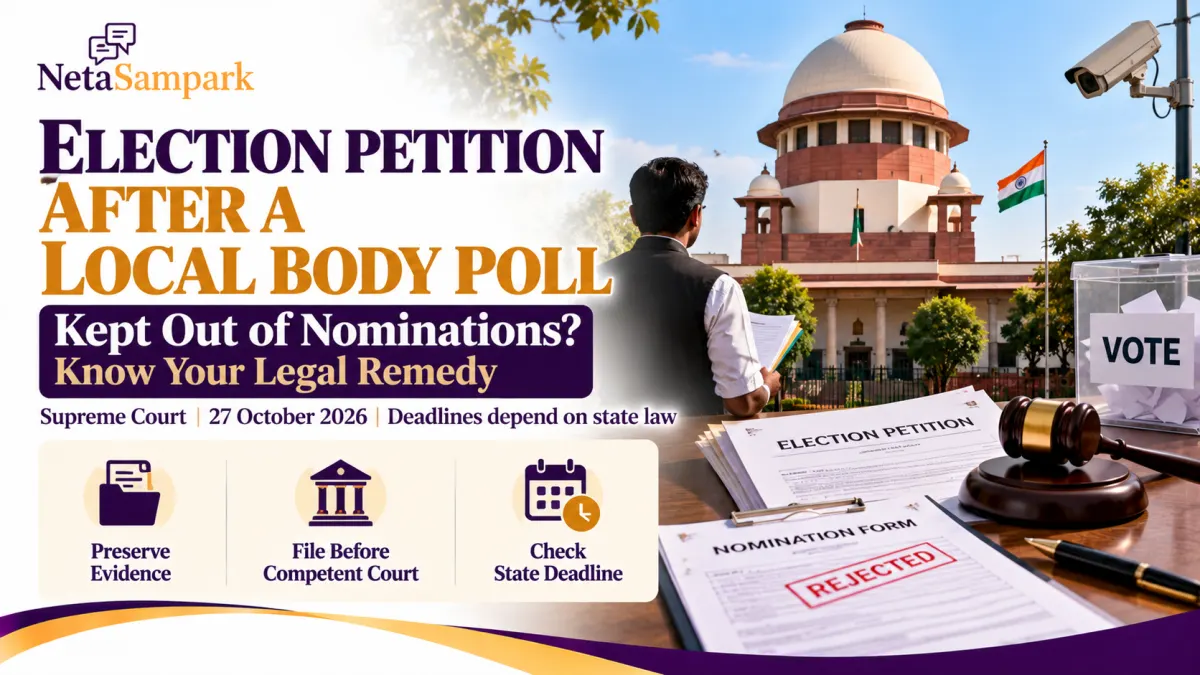
Were you prevented from filing a nomination for a municipal, panchayat or other local-body election? If you believe the process was unfair, the law may allow you to challenge the election through an election petition.
On 27 October 2026, the Supreme Court considered allegations that candidates had been prevented from filing nominations for local-body elections in Andhra Pradesh. The Court said these claims involved disputed questions of fact and could not be examined through a broad, roving inquiry during the ongoing election process. Aggrieved candidates could pursue election petitions under the applicable law.
Here is what that means, what evidence to preserve and why you should not miss the filing deadline.
1 What did the Supreme Court say on 27 October 2026?
The case arose from allegations by the Yuvajana Sramika Rythu Congress Party (YSRCP) that candidates had been obstructed from filing nominations in Andhra Pradesh municipal elections.
The Court had earlier directed the Andhra Pradesh State Election Commission to examine complaints and supporting evidence, including electronic material, and extend nomination deadlines where it found that candidates had been prevented from filing because of law-and-order problems.
At the 27 October hearing, the Court noted that the Commission had acted on representations and extended deadlines in certain cases. It declined to conduct a broad inquiry into every allegation during the ongoing election process.
The Court also discussed safeguards for preserving CCTV recordings and indicated that wider guidelines could be issued to protect the electoral process.
What this means: If you say you were wrongly prevented from filing a nomination, you will generally need to establish what happened using evidence and follow the legal remedy available under the relevant election law.
Read the reports:
- Bar & Bench: Supreme Court hearing on Andhra Pradesh municipal polls
- LiveLaw: Supreme Court proceedings on nomination obstruction
2 What is an election petition?
An election petition is a formal legal challenge to an election. It is filed before the court or authority designated by the applicable election law.
Depending on the relevant statute, an election petition may raise issues such as:
- Improper rejection of a nomination.
- Improper acceptance of another candidate’s nomination.
- Corrupt practices or other specified election offences.
- Serious violations of election rules that affected the result.
- Other grounds expressly permitted under the applicable law.
A candidate who says they were prevented from filing a nomination should identify the legal ground that applies to their case. The petition must meet the required format, limitation period and evidence requirements.
Important: Not every procedural mistake automatically invalidates an election. The applicable law may require the petitioner to establish particular facts and, for some grounds, show that the result was materially affected.
3 What should you do if you were kept out of nominations?
If you believe you were prevented from submitting your nomination, preserve the evidence as soon as possible.
Step 1: Record what happened
Write down the date, time and location of the incident. Record the names or designations of officials involved, any stated reason for refusing the nomination and the names of people who witnessed the incident.
Step 2: Preserve your nomination documents
Keep copies of your completed nomination form, supporting documents, fee receipts, acknowledgements and any written objections or rejection orders.
If you attempted to submit the form online, preserve screenshots, error messages, timestamps and confirmation emails.
Step 3: Save electronic evidence
Identify CCTV cameras at the nomination centre, election office or nearby locations. Preserve original videos, photographs, messages and other electronic records.
If footage is held by an authority, make a written request for preservation promptly. CCTV systems may overwrite recordings after a limited period. Do not edit original files; retain the originals and their metadata where possible.
Step 4: Make a written representation
Submit a dated complaint to the Returning Officer or the relevant State Election Commission, following the applicable procedure. Attach supporting documents and request an acknowledgement.
A representation may help document your complaint, but it does not necessarily stop the election-petition limitation period.
Step 5: Get legal advice quickly
Consult a lawyer familiar with local election law. Ask which court or authority has jurisdiction, what grounds are available and when the limitation period expires.
Do not assume that a complaint to the election authorities gives you unlimited time to file a petition.
4 What is the deadline for filing an election petition?
There is no single deadline for every local-body election in India. The limitation period depends on the state law, the type of local authority, the election being challenged and the event from which time is calculated.
For example, Section 43 of the Karnataka Municipal Corporations Act, 1976 provides for an election petition within 30 days from publication of the election result for elections covered by that Act. Other municipal and panchayat laws may prescribe different periods and procedures.
You should check the exact statute and rules governing your election. Do not automatically apply the 45-day period used for certain parliamentary or Assembly election petitions to a municipal or panchayat election.
Official legal source: India Code — Karnataka Municipal Corporations Act, 1976
Why you should act early
- Evidence may disappear or become difficult to obtain.
- Witnesses may become harder to contact.
- Preparing the petition and supporting documents takes time.
- Missing a mandatory limitation period can prevent the case from being heard.
If the result has already been declared, get the deadline confirmed immediately rather than waiting for a reply to your complaint.
5 Can you go directly to the High Court or Supreme Court?
Election disputes are subject to special constitutional and statutory rules. Courts generally avoid interrupting an ongoing election when the law provides a specific election-petition remedy after the election.
However, the precise legal position depends on the type of election, the relief requested and the circumstances. The Supreme Court's 21 October 2026 interim directions in the Andhra Pradesh matter show that courts can, in appropriate circumstances, issue limited directions to protect a fair nomination process.
That does not mean every candidate can obtain an extension or have the election stopped. In the 27 October hearing, the Court declined to conduct a broad inquiry into disputed allegations during the ongoing process.
The practical approach is to document the complaint, follow the State Election Commission's procedure and obtain advice on the statutory election-petition remedy.
6 What can an election petition achieve?
The available remedies depend on the relevant election law and the facts proved. A competent court may be able to:
- Declare an election void on a legally established ground.
- Examine whether a nomination was improperly rejected.
- Consider other statutory grounds for challenging the result.
- Grant another remedy authorised by the applicable law.
Filing a petition does not guarantee that the election will be cancelled or that the excluded candidate will be declared elected. The court must assess the evidence and apply the statutory requirements.
7 Quick checklist before filing
Before approaching the court, make sure you have:
- The election notification and applicable election rules.
- Your nomination papers and supporting documents.
- Any rejection order or written explanation.
- Proof of attempted submission, including receipts and timestamps.
- Copies of complaints and acknowledgements.
- Witness details and preserved electronic evidence.
- The declared election result and its publication date.
- Confirmation of the competent court and the exact limitation period.
Keep your documents organised and retain copies of everything you submit.
Frequently asked questions
Can I challenge an election if officials refused to accept my nomination?
Potentially, yes. You will need to establish the relevant facts and use the remedy available under the election law governing that local body.
Did the Supreme Court cancel the Andhra Pradesh local-body elections on 27 October 2026?
The reported hearing did not result in a blanket cancellation of the elections. The Court declined a broad inquiry into disputed allegations and indicated that aggrieved candidates could pursue election petitions under the law.
Is the election-petition deadline always 45 days?
No. Different laws prescribe different deadlines. For example, Section 43 of the Karnataka Municipal Corporations Act provides a 30-day period for elections covered by that Act. Check the statute governing your specific election.
Does filing a complaint with the State Election Commission extend the deadline?
Not automatically. A representation and an election petition are different legal steps. Confirm the limitation period with a lawyer or the competent authority.
Should I save CCTV footage?
Yes. Preserve available footage and make a prompt written request to the authority controlling the cameras. Retention periods may be short, and the footage could be important evidence.
The bottom line
If you believe you were prevented from filing a nomination in a local-body election, document what happened, preserve your evidence and identify the legal remedy under the applicable state law.
The Supreme Court's 27 October 2026 proceedings reinforce the importance of proving allegations through the proper legal process. Because election-petition deadlines can be short and vary by state, confirm your exact filing deadline immediately after the result is published.