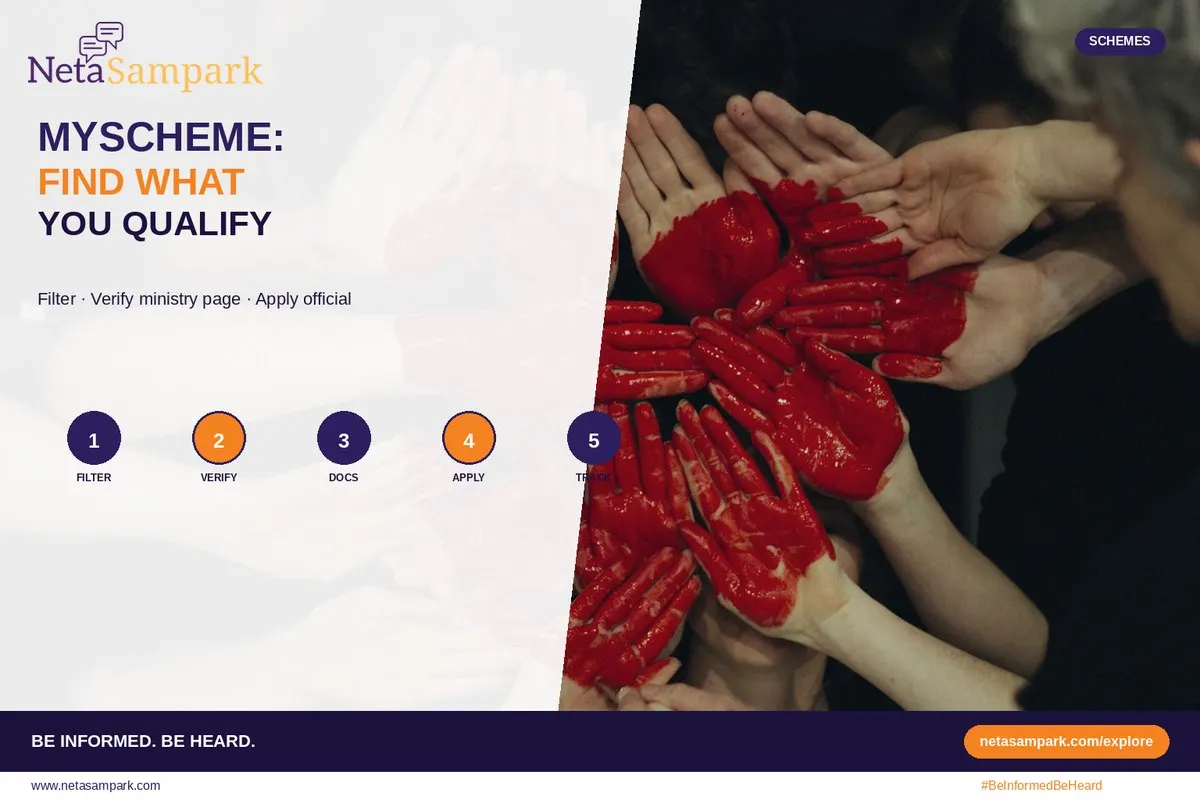
Quick take: You may be eligible for a government scheme you have never heard of.
That doesn't necessarily mean the government has failed to tell you. India has thousands of Central and State/UT government schemes, spread across different departments, websites and eligibility rules. The harder part is often knowing where to look.
That is where myScheme can help.
Instead of starting with a forwarded WhatsApp message saying “New government scheme — apply immediately,” start with your own profile: your age, state, occupation, income, category and circumstances.
Then check what the government says you may actually qualify for.
The important distinction: myScheme is primarily a scheme discovery and information platform. For many schemes, it takes you to the concerned ministry or department's official application page. It is not a magic button that approves benefits.
Official portal: myScheme
Why people miss government schemes
Most families don't have a "government benefits" problem.
They have a discovery problem.
A student may know about a scholarship only because someone in college mentioned it.
A farmer may hear about a scheme from another farmer.
A senior citizen may depend on a neighbour to tell them what documents to carry.
A woman starting a small business may never know that a relevant government programme exists.
And when information does reach people, it often arrives as a forwarded message with half the details missing.
The result is predictable:
“I didn't know I was eligible.”
myScheme was built to reduce that problem. The official platform describes itself as a national one-stop platform for the search and discovery of government schemes, using citizen information to identify schemes that may be relevant.
As of its current official FAQ, myScheme provides access to more than 4,700 Central Government and State/UT Government schemes, with additional schemes continuing to be onboarded.
That is exactly why searching once is worth your time.
Start with yourself, not with a scheme name
This is the biggest change in mindset.
Don't begin with:
“What scheme should I apply for?”
Begin with:
“What schemes might I qualify for?”
The myScheme Find Schemes For You flow asks for basic information and uses it to identify relevant schemes. The official platform lists factors such as age, gender, marital status, state, rural/urban residence, social category, disability status and employment status among the information used for personalised discovery.
You don't need to know the government's terminology before you start.
You simply need to answer the questions honestly.
Open Find Schemes For You
A 20-minute household scheme checkDon't do this only for yourself.
Sit down once with the family and check different profiles.
1. Check the student
Look for:
- Scholarships
- Education support
- Skill-development programmes
- Training opportunities
- Category-specific assistance
If you're already using the National Scholarship Portal, that's useful—but don't assume every scholarship in India sits there. myScheme itself supports keyword-based discovery of scholarship schemes.
2. Check the farmer
Look for schemes related to:
- Agriculture
- Irrigation
- Equipment
- Livelihood
- Insurance
- Credit
- Animal husbandry
- State-specific agricultural support
The relevant scheme may depend heavily on your state and circumstances.
3. Check women in the household
Don't search only for generic "women schemes."
Look at:
- Employment
- Entrepreneurship
- Education
- Maternal support
- Skill development
- Social welfare
- Financial assistance
The right scheme depends on age, income, occupation, state and other eligibility conditions.
4. Check senior citizens
Look for:
- Social security
- Pension-related schemes
- Healthcare support
- Assistance programmes
- State-specific benefits
Again, don't assume that a scheme available in one state automatically applies in another.
5. Check the person who may be overlooked
This could be:
- A person with a disability
- A worker
- A self-employed person
- A small business owner
- A student living away from home
- A person from a notified category
- Someone recently unemployed
- A rural household
- A migrant who has changed state
Government benefits are often tied to circumstances, not simply income.
How myScheme actually worksThe official platform describes the process in three broad steps:
Enter details → Search → Select and apply.
You provide basic information.
The platform searches its scheme database and presents schemes relevant to your profile.
You then open the individual scheme page to understand:
- Eligibility
- Benefits
- Application process
- Required documents
- FAQs
From there, myScheme can direct you to the relevant application URL of the concerned ministry or department.
That last step matters.
Finding a scheme is not the same as being approved for it.
Treat the result as your starting point—not a guarantee.
Don't stop at the green tickOne of the easiest mistakes is seeing a scheme that looks relevant and immediately assuming:
“I'm eligible.”
Slow down.
Open the detailed scheme page.
Read the actual conditions.
Check:
- Age limit
- Income limit
- State or district restriction
- Occupation
- Category requirements
- Land or property conditions
- Educational requirements
- Whether the scheme is currently accepting applications
- Documents required
myScheme says its scheme pages provide detailed eligibility, benefits, application procedure, documents and FAQs.
There is also a scheme-specific eligibility questionnaire for some schemes, allowing users to answer Yes/No questions against the scheme's eligibility conditions.
That is much better than asking a WhatsApp group.
The five-minute verification ruleBefore you submit anything, ask five questions:
1. Who owns this scheme?
Find the ministry, department or state authority responsible for it.
2. Where does the application actually go?
If myScheme redirects you elsewhere, check that the destination is the official department or authorised application channel.
3. What documents are required?
Don't discover this halfway through the application.
4. Is the scheme currently open?
A scheme can exist while its application window, budget cycle or local implementation status differs.
5. Where will I track the application?
Know this before you submit.
That one step can save you weeks later.
Don't confuse myScheme with the application portalThis is important.
myScheme helps you discover and understand schemes.
For many schemes, the actual application happens on the concerned ministry, department or state portal.
The official FAQ currently states that myScheme redirects users to the respective scheme application page.
So your workflow should look like this:
myScheme
↓
Check eligibility
↓
Read scheme details
↓
Open official application link
↓
Submit documents
↓
Save acknowledgement
↓
Track with the concerned department
Think of myScheme as the map.
The department's application portal is usually the destination.
What documents should you keep ready?This depends entirely on the scheme.
But a household document folder can save enormous time.
Keep digital copies of commonly requested documents such as:
- Aadhaar, where required
- Bank account details
- Income certificate
- Residence / domicile documents
- Caste certificate, where applicable
- Disability certificate, where applicable
- Educational certificates
- Marksheets
- Land records, where relevant
- Employment or occupation documents
- Passport-size photograph
- Existing scheme or beneficiary IDs
Don't assume every scheme needs all of these.
The scheme's official requirements should win over any generic checklist.
The bank account mistake that comes laterImagine this.
You complete the application.
The scheme approves you.
Then the money doesn't arrive.
That's when people discover that their bank details are wrong, the account is inactive, the beneficiary details don't match, or a required DBT-related condition hasn't been satisfied.
Don't wait until payment day.
When you apply, record:
Bank account → beneficiary name → account status → IFSC → any required Aadhaar/DBT linkage
But only provide information that the official scheme actually asks for.
And never give an OTP to someone who claims they can "activate" your benefit.
Using a CSC? Stay in control.Common Service Centres can be useful for people who aren't comfortable completing government forms online.
That's fine.
But assistance should not mean surrendering control.
If someone is helping you:
- Watch what is being entered.
- Read the final application before submission.
- Keep your own phone nearby for OTPs.
- Ask for the acknowledgement.
- Take the receipt.
- Record the application number.
- Ask what the official service charge is.
- Never hand over an OTP simply because someone says they're "from the government."
The person helping you click the buttons should not become the owner of your application.
Five red flags that should make you stopBe especially careful if someone says:
“Pay ₹500 and your scheme will be approved.”
No genuine middleman can guarantee government approval.
“Send me your Aadhaar OTP.”
Stop.
“The government scheme closes tonight. Pay now.”
Verify the deadline through the official department.
“This WhatsApp PDF is the application form.”
Check the official scheme page first.
“Give me your bank details. I'll check your benefit.”
Don't hand sensitive information to strangers.
A genuine scheme has an eligibility framework, an official department and an application process.
What if you cannot find your scheme?Don't immediately assume the scheme doesn't exist.
myScheme currently covers 4,700+ Central and State/UT schemes, but its own FAQ says additional schemes continue to be added.
Try searching by:
- Scheme name
- Keyword
- Benefit
- Category
- State/UT
- Central ministry
The platform supports multiple discovery methods, including keyword search, personalised recommendations, State/UT and Central Government filters, benefit categories and its AI-powered chatbot.
If a scheme is missing or information appears incorrect, myScheme provides feedback channels and advises citizens to refer to the concerned ministry or department for the most accurate and updated information.
Don't trust an old scheme article blindlyThis is where many citizens get trapped.
A blog from 2023 may say:
“Apply now.”
But the scheme may have changed.
The income limit may have changed.
The application portal may have changed.
The deadline may have passed.
The scheme may have been modified or merged.
Government schemes evolve.
So use articles—including ours—as a starting point, not as the final authority for a deadline, eligibility condition or payment promise.
Before you submit:
Check the current official department information.
A simple family scheme registerYou don't need an elaborate spreadsheet.
Keep a note like this:
PersonSchemePortalApplication IDStatusNext actionStudentScholarshipOfficial portalXXXXXSubmittedCheck verificationMotherWomen/health schemeOfficial portalXXXXXPendingUpload documentFatherFarmer schemeOfficial portalXXXXXApprovedCheck paymentGrandparentPension schemeOfficial portalXXXXXPendingFollow up
The most important column isn't scheme.
It's next action.
Because an application that nobody follows up on is just a number sitting in a database.
The monthly 20-minute habitYou don't have to spend every weekend hunting government schemes.
Do this once a month.
First Sunday. 20 minutes.
Check:
- Has anyone in the family changed jobs?
- Has someone crossed an age threshold?
- Has a student started a new course?
- Has a new child joined the family?
- Has anyone become eligible for a certificate?
- Has anyone moved to another state?
- Has an existing benefit stopped?
- Has a new state or Central scheme become relevant?
Then run the relevant profile through myScheme again.
Your eligibility can change even when your name and address haven't.
For RWAs, volunteers and community groupsThere is also a useful community-level application.
Instead of telling 100 families:
“Here is a scheme. Apply.”
Help them ask:
“Which schemes are relevant to your household?”
A society, community centre, student group or local volunteer can organise a short scheme-discovery session using the official portal.
But keep one rule:
Help people discover and understand. Don't take ownership of their identity, OTPs or applications.
For recurring problems—such as an entire locality being unable to access a notified benefit—keep an anonymised record of the problem, application attempts and official responses.
That creates something much stronger than a WhatsApp complaint:
evidence.
What NetaSampark addsFinding a scheme is one part of civic participation.
Getting a benefit is another.
And when an entire neighbourhood repeatedly struggles with the same government service, there is a third question:
Who is responsible for following up?
That's where knowing your representatives becomes useful.
NetaSampark helps citizens identify their representatives and understand the geography they represent.
It does not replace the department responsible for approving a scheme.
It does not guarantee a benefit.
It gives citizens a clearer civic map when an issue becomes larger than one application.
Explore your area on NetaSampark →
Find your representatives →
Your 20-minute checklistBefore you close the browser, make sure you have:
- ☐ Checked myScheme for yourself
- ☐ Checked relevant family members
- ☐ Read the full eligibility conditions
- ☐ Checked the required documents
- ☐ Opened the official department application link
- ☐ Saved the application / registration number
- ☐ Saved the acknowledgement or receipt
- ☐ Noted how to track the application
- ☐ Set a follow-up date
- ☐ Kept OTPs and passwords private
The most important thing to remember
You don't need to know the name of every government scheme in India.
You need to know how to find the ones that may apply to you.
Don't wait for a forwarded message.
Don't pay a stranger to "activate" a benefit.
Don't assume a neighbour's eligibility is your eligibility.
Start with your circumstances. Check the official information. Apply through the proper channel. Save the reference number. Follow up.
Government benefits are not something you should discover by accident.
Be informed. Be heard.
Non-partisan civic explainer. Government schemes, eligibility criteria, application windows and implementing departments can change. Always verify the current details on myScheme and the concerned ministry/state department before applying. Last editorial pass: 11 September 2026 (IST).
Official sources
- myScheme — Government scheme discovery platform
- myScheme — About the platform
- myScheme — Find Schemes For You
- myScheme — Official FAQs
- National Portal of India — Government Schemes
Official sources
Confirm fees, dates and eligibility on the official page before you act.