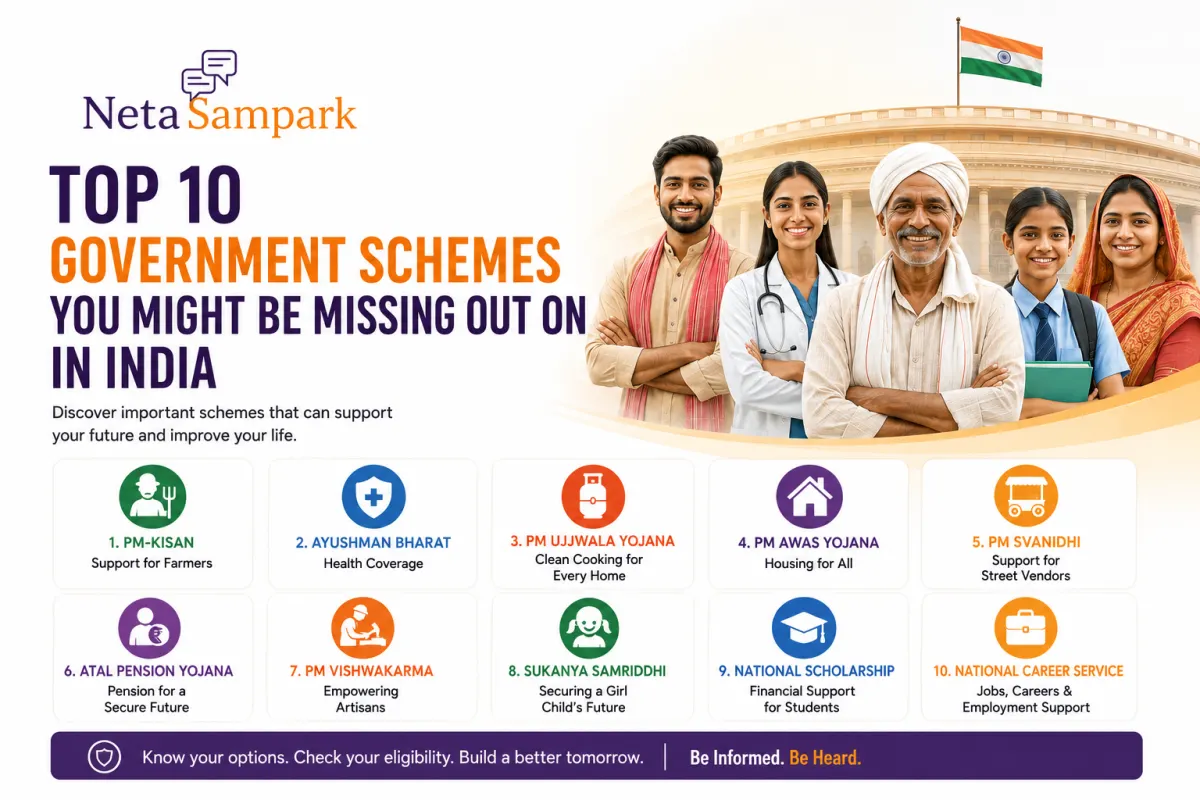
Government schemes can provide support for healthcare, housing, farmers, women, students, small businesses, workers and low-income families.
Yet many eligible citizens never apply.
Sometimes the reason is simple: they don't know the scheme exists, don't know whether they qualify, or don't know where to apply.
This guide highlights 10 important Government of India schemes and programmes that citizens should know about.
Important: Eligibility, benefits, application procedures and scheme rules can change. Always verify the latest details through the relevant official government portal or department before applying.
1 PM-KISAN — Support for Eligible Farmers
The Pradhan Mantri Kisan Samman Nidhi (PM-KISAN) provides income support to eligible landholding farmer families, subject to the scheme's eligibility and exclusion criteria.
Under the scheme, eligible farmers receive financial assistance through direct benefit transfer.
Who should check their eligibility?
Farmers and farming families who meet the scheme's requirements should check whether they are registered and whether their details are correctly recorded.
Why it matters
A farmer may technically qualify but still face issues because of:
- Incorrect land records
- Incorrect bank details
- Aadhaar-related issues
- Registration problems
- e-KYC requirements
What you should do
Check your PM-KISAN beneficiary and payment status through the official portal and make sure your information is updated.
2 Ayushman Bharat — Health Coverage
A major healthcare initiative under Ayushman Bharat is the Pradhan Mantri Jan Arogya Yojana (PM-JAY).
It provides health-cover benefits to eligible beneficiaries for specified hospitalisation and healthcare services under the scheme.
Why you might be missing out
Some eligible families may not realise that they are covered or may not know how to check their eligibility.
What to check
- Whether your family is eligible
- Whether you have the necessary beneficiary identification
- Which hospitals are empanelled
- What treatments and services are covered
Don't assume you are ineligible simply because you have never used the scheme.
3 Pradhan Mantri Ujjwala Yojana — LPG Connections
The Pradhan Mantri Ujjwala Yojana (PMUY) was created to help eligible women from poor households obtain LPG connections.
Access to cleaner cooking fuel can reduce dependence on traditional fuels such as firewood and other solid fuels.
Who should check?
Eligible households, particularly women who meet the applicable criteria, should check whether they qualify under the current scheme provisions.
Why people miss it
Citizens may:
- Not know about the scheme
- Assume LPG assistance is only for rural households
- Be unaware of current eligibility requirements
- Not know where to apply
Always verify current eligibility and benefits before applying.
4 Pradhan Mantri Awas Yojana — Housing Support
Housing is one of the biggest financial challenges for many Indian families.
Pradhan Mantri Awas Yojana (PMAY) provides housing-related assistance under separate urban and rural components, with eligibility and assistance depending on the applicable programme and government rules.
Why check this scheme?
If you are:
- Living in inadequate housing
- From an eligible lower-income household
- A rural household meeting the applicable criteria
- Looking for housing assistance
you may want to check whether you qualify under the relevant PMAY programme.
Important
Don't rely on social-media posts promising guaranteed housing or money.
Use official government channels to verify eligibility and application status.
5 PM SVANidhi — Support for Street Vendors
The PM Street Vendor's AtmaNirbhar Nidhi (PM SVANidhi) scheme was introduced to support street vendors with access to working-capital credit and other benefits under the programme.
It is particularly relevant for people operating small street-vending businesses.
Who should check?
Depending on current scheme rules, eligible street vendors may include people selling:
- Food
- Vegetables
- Fruits
- Clothing
- Household items
- Other goods or services
Why it matters
For a small vendor, access to formal working capital can make a significant difference.
If you operate a street-vending business, check the latest eligibility requirements rather than assuming formal financial support is unavailable to you.
6 Atal Pension Yojana — Pension Planning
The Atal Pension Yojana (APY) is a government-backed pension scheme designed primarily to provide pension income to eligible subscribers in the unorganised sector and others who meet the applicable conditions.
It is particularly relevant for people who do not have access to a formal employer-sponsored pension.
Why should you know about it?
Retirement planning is often postponed because people focus on immediate expenses.
But starting early can make long-term pension planning easier.
Before enrolling, understand:
- Eligibility
- Contribution requirements
- Pension options
- Withdrawal and exit rules
- Applicable conditions
7 PM Vishwakarma — Support for Traditional Artisans
PM Vishwakarma is designed to support traditional artisans and craftspeople working in specified trades.
The programme can include support such as skill training, recognition, toolkit-related assistance and access to credit and other benefits, subject to the applicable rules.
Who should check?
People working in eligible traditional occupations may include artisans such as:
- Carpenters
- Blacksmiths
- Goldsmiths
- Potters
- Sculptors
- Cobblers
- Tailors
- Barbers
- Other recognised traditional trades
The exact list and eligibility requirements should be checked through official sources.
Why it matters
Many skilled artisans operate informally and may not know that government support programmes specifically target their occupations.
8 Sukanya Samriddhi Account — Saving for a Girl Child
The Sukanya Samriddhi Account is a government-backed small-savings scheme designed for the financial future of eligible girl children.
Parents or guardians can open an account subject to the scheme's rules.
Why families should know about it
It provides a structured way to save for long-term goals associated with a daughter's future.
The account has specific rules regarding:
- Eligibility
- Deposits
- Interest
- Withdrawal
- Maturity
Because interest rates and government rules can change, check the latest official information before opening an account.
9 National Scholarship Schemes
Students can miss out on government scholarships simply because they don't know which scholarships are available or when applications open.
The National Scholarship Portal (NSP) brings together various scholarship-related services and schemes from different government departments.
Students may find opportunities based on factors such as:
- Academic level
- Family income
- Social or other eligibility categories
- Course or institution
- Specific government scheme requirements
What should students do?
Don't wait until the last moment.
Check the available scholarships, eligibility conditions, application deadlines and required documents through the official portal.
A scholarship application missed because of a deadline cannot usually be recovered later.
10 National Career Service — Jobs, Careers & Employment Support
The National Career Service (NCS) is a government platform that connects job seekers, employers and career-related services.
It can be useful for people looking for:
- Job opportunities
- Career information
- Employment services
- Skill-related opportunities
- Career guidance
Who should check it?
Students, graduates, job seekers, workers looking for new opportunities and people planning a career change may find it useful.
You don't necessarily need to depend only on private job platforms.
Government employment services can also be part of your job search.
How Do You Know Which Scheme You Qualify For?
This is where many citizens get stuck.
Finding a scheme is only the first step.
Eligibility may depend on factors such as:
- Age
- Income
- Occupation
- Location
- Family status
- Land ownership
- Employment status
- Education
- Gender
- Social category
- Existing government benefits
- Other scheme-specific conditions
Never assume eligibility based on the scheme name alone.
Read the current eligibility requirements.
Keep Your Documents Ready
Many government applications require some combination of identity, address, banking, income, education, occupation or other supporting documents.
Depending on the scheme, you may need documents such as:
- Aadhaar or other accepted identity document
- Bank account details
- Address proof
- Income certificate
- Land records
- Educational documents
- Caste/category certificate where applicable
- Disability certificate where applicable
- Passport-size photograph
- Mobile number
The exact documents vary by scheme.
Don't pay someone simply because they claim a document is required. Verify the requirement through the official scheme or department first.
Beware of Fake Government Scheme Messages
Government schemes are frequently used in scams.
Be cautious if someone sends you a message claiming:
“You have been selected for ₹50,000.”
or:
“Click here to receive your government benefit.”
or:
“Pay ₹999 to activate your government scheme.”
Do not share:
- OTPs
- Banking passwords
- UPI PINs
- Card PINs
- Internet banking credentials
simply because someone claims to represent a government scheme.
Remember:
A government-looking logo does not prove that a website or message is genuine.
Use official government portals and verify the information independently.
Don't Miss a Scheme Because You Didn't Know About It
One of the biggest barriers to accessing government benefits isn't always eligibility.
Sometimes it's simply awareness.
A citizen may qualify for a programme but never apply because:
- They never heard about it
- They don't understand the eligibility rules
- They don't know where to apply
- They assume it is only for someone else
- They miss an application deadline
- They don't know how to check their status
This is why being an informed citizen matters.
Government Schemes Are Not Automatically Available to Everyone
It's important to understand that being mentioned in a scheme's target group does not automatically guarantee a benefit.
Most schemes have specific eligibility criteria, exclusions, documentation requirements and procedures.
For example:
“Farmer” does not automatically mean eligible for every farmer scheme.
“Student” does not automatically mean eligible for every scholarship.
“Low income” does not automatically mean eligible for every welfare programme.
Always check the current rules.
State Government Schemes Matter Too
The 10 programmes above are national-level schemes or programmes.
But your state may offer additional benefits.
For example, a citizen in Karnataka may have access to schemes and programmes that are different from those available in Maharashtra, Tamil Nadu, Kerala or another state.
That's why NetaSampark's government-scheme content can go state by state.
Coming next:
Top 10 Government Schemes You Might Be Missing Out On in Karnataka
And similar guides can be created for other states.
A Simple 5-Step Checklist
Before you start applying for any government scheme:
1. Discover
Find schemes relevant to your age, occupation, income, family and circumstances.
2. Verify
Check the current eligibility criteria through an official government source.
3. Prepare
Keep the required documents and information ready.
4. Apply
Use the official application process or authorised channel.
5. Track
Keep your application/reference number and check the status.
Don't Wait Until You Need the Benefit
Some government programmes involve applications, registrations, deadlines or eligibility conditions.
Don't wait until an emergency to discover what support may be available.
Spend a little time understanding:
What am I eligible for?
What benefits are available?
Where do I apply?
What documents do I need?
When is the deadline?
That small amount of awareness can potentially make a significant difference to a household.
Government Benefits Begin With Awareness
India has a wide range of government programmes designed for different sections of society.
But a scheme can only help you if you know about it, understand whether you qualify and follow the correct process.
You don't need to apply for every scheme.
You simply need to know what may be relevant to you.
Start with your own circumstances.
Are you a farmer?
A student?
A street vendor?
A small business owner?
A parent?
A senior citizen?
A worker?
An artisan?
A job seeker?
Your answer may point you toward different government programmes.
Know your options. Verify your eligibility. Apply through the right channel.
And remember:
A benefit you don't know about is a benefit you may never claim.
Stay informed. Stay empowered. Be Informed. Be Heard.
Official sources
Confirm fees, dates and eligibility on the official page before you act.