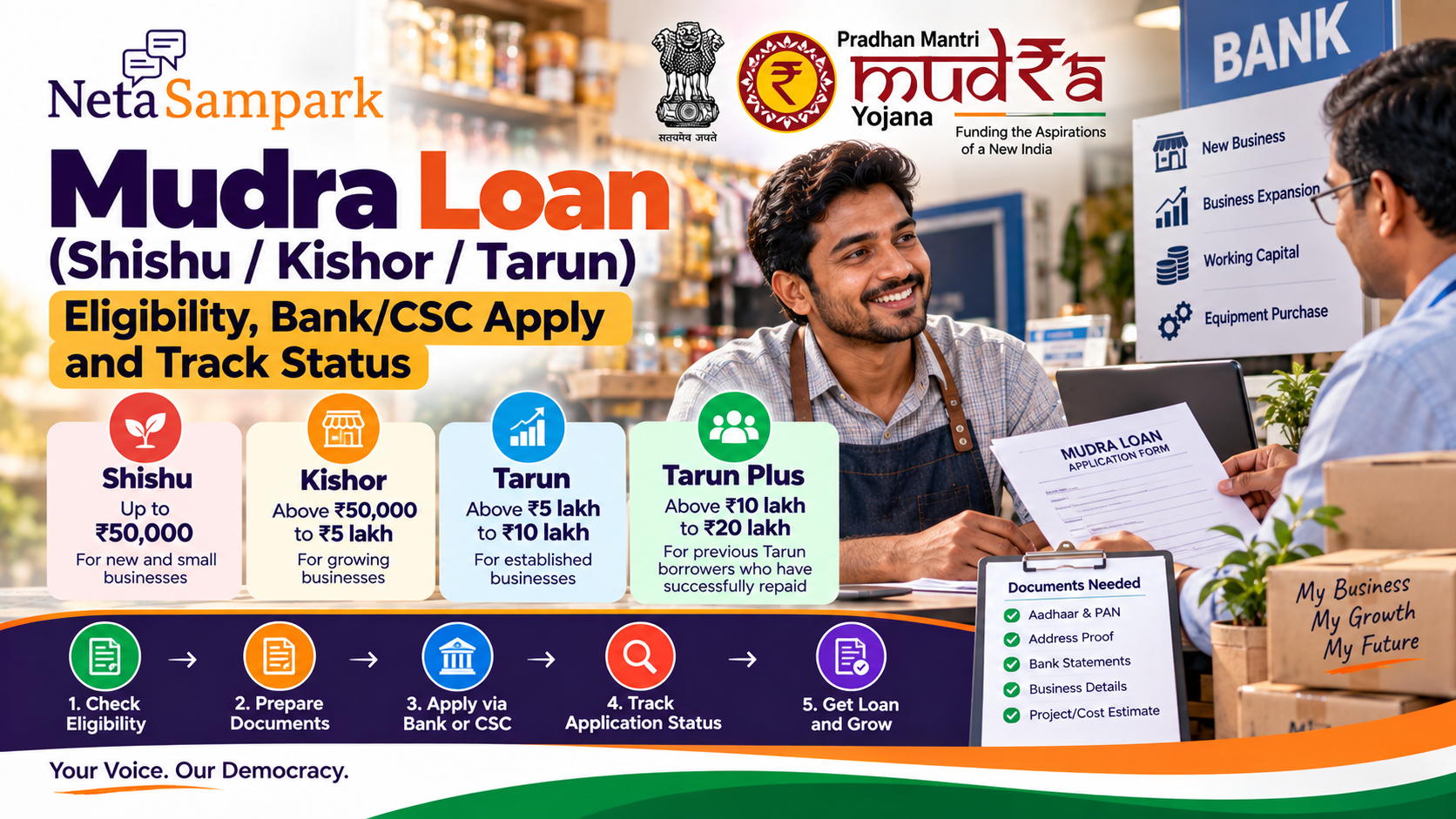
Quick take: The Pradhan Mantri MUDRA Yojana (PMMY) provides collateral-free institutional credit for eligible micro enterprises and income-generating activities. The current structure has four categories: Shishu up to ₹50,000, Kishor above ₹50,000 up to ₹5 lakh, Tarun above ₹5 lakh up to ₹10 lakh, and Tarun Plus above ₹10 lakh up to ₹20 lakh for entrepreneurs who have previously taken and successfully repaid a Tarun loan. (Department of Financial Services)
This is a loan, not a government cash grant or subsidy. The lending institution assesses the application and decides the loan on its applicable credit terms.
What is a Mudra loan?
PMMY was launched in 2015 to improve access to institutional credit for micro enterprises.
Loans can support income-generating activities in:
- Manufacturing
- Trading
- Services
- Activities allied to agriculture, such as dairy, poultry and beekeeping
Both term-loan and working-capital requirements can be covered. (Department of Financial Services)
The scheme is implemented through Member Lending Institutions (MLIs) including banks, Regional Rural Banks, Small Finance Banks, NBFCs and MFIs. (Department of Financial Services)
The four Mudra categories
CategoryLoan amountWho it is generally forShishuUp to ₹50,000Small/new micro-business fundingKishorAbove ₹50,000 to ₹5 lakhBusinesses needing larger working capital or expansionTarunAbove ₹5 lakh to ₹10 lakhMore established/larger micro-enterprise requirementsTarun PlusAbove ₹10 lakh to ₹20 lakhPrevious Tarun borrowers who successfully repaid the Tarun loan
The Tarun Plus category was introduced from 24 October 2024 and has a specific previous-Tarun-repayment requirement. (Department of Financial Services)
Important
Don't read the ₹20 lakh figure as:
“Every first-time applicant can get ₹20 lakh.”
Tarun Plus is specifically for entrepreneurs who have availed and successfully repaid a previous Tarun-category loan. (Press Information Bureau)
Who can apply?
The Government describes PMMY as supporting eligible individuals with a business plan for an income-generating micro enterprise in manufacturing, trading, services and eligible agriculture-allied activities. (Press Information Bureau)
Examples can include:
- Small retail shops
- Repair businesses
- Tailoring units
- Food/service businesses
- Small manufacturing
- Transport-related businesses
- Dairy
- Poultry
- Beekeeping
- Other eligible micro enterprises
Your particular activity still has to satisfy the lending institution's applicable rules.
Is collateral required?
PMMY loans are designed as collateral-free credit. The Department of Financial Services lists "collateral not required" as a scheme feature. (Department of Financial Services)
That does not mean approval is automatic.
The lender can still assess:
- Business viability
- Repayment capacity
- Existing loans
- Credit history
- Bank transactions
- Project/business information
- Required documentation
Where can you apply?
You can approach an eligible lending institution directly.
The PMMY lending network includes:
- Public Sector Banks
- Private Sector Banks
- Regional Rural Banks
- Small Finance Banks
- NBFCs
- Micro Finance Institutions
The Government's PMMY information also identifies these as Member Lending Institutions. (Department of Financial Services)
You can therefore start with your bank branch and ask specifically for a PMMY/MUDRA loan application.
Can I apply online?
Yes. Government digital lending infrastructure can provide an online route for eligible applicants.
JanSamarth is a government digital platform through which applicants can check eligibility for participating credit-linked schemes and proceed with applications where the scheme/lender is available. The Government has specifically cited JanSamarth as one of the measures used to simplify PMMY applications. (Press Information Bureau)
Don't assume that every lender uses exactly the same online workflow.
What about CSC?
A Common Service Centre (CSC) can assist citizens with various digital government services.
If you use a CSC for assistance with a loan application:
- Ask which official portal is being used.
- Review the application before submission.
- Keep the acknowledgement/application number.
- Ask for a receipt for any legitimate service charge.
- Never hand over your banking OTP or UPI PIN to the operator.
The CSC is an assistance channel; the loan decision belongs to the lender.
Documents to keep ready
The exact document list varies by lender and loan category.
A practical file can include:
☐ Aadhaar / identity proof
☐ PAN, where applicable
☐ Address proof
☐ Bank-account details
☐ Recent bank statements
☐ Business/activity details
☐ Business registration/licence documents, where applicable
☐ GST-related documents, where applicable
☐ Quotations for machinery/equipment, if relevant
☐ Business/project estimate
☐ Existing loan details, if any
☐ Photographs
☐ Any documents specifically requested by the lender
Government digital lending portals also identify basic documents such as Aadhaar, voter ID, PAN and bank statements for online applications, while noting that requirements differ by scheme. (PMMY Mudra)
Make a simple business plan before applying
For a small business loan, don't walk into the branch with only:
“I need ₹3 lakh for my shop.”
Prepare a one-page explanation:
Business: What do you sell/provide?
Current position: New business or existing?
Loan required: ₹____
Purpose: Equipment / stock / working capital / expansion
Own contribution: ₹____
Expected monthly sales: ₹____
Expected monthly expenses: ₹____
Expected surplus available for repayment: ₹____
Repayment history: Existing loans, if any
This gives the lender something concrete to assess.
Shishu example
Suppose Priya wants to start a small tailoring business.
She estimates:
- Sewing machine: ₹25,000
- Initial material: ₹10,000
- Shop/setup expenses: ₹8,000
- Working capital: ₹7,000
Total requirement: ₹50,000
She can ask the lender whether the project is suitable for a Shishu-category PMMY loan.
The lender then assesses the application.
The ₹50,000 category ceiling does not mean every applicant automatically receives ₹50,000.
Kishor example
A small existing food business needs ₹3 lakh to purchase equipment and increase working capital.
A Kishor application could potentially cover that requirement because Kishor covers amounts above ₹50,000 up to ₹5 lakh. (Department of Financial Services)
The applicant still needs to satisfy the lender's assessment.
Tarun example
An established micro enterprise wants ₹8 lakh for expansion.
That falls within the Tarun range of above ₹5 lakh up to ₹10 lakh. (Department of Financial Services)
Again, the category is determined by the loan amount; approval depends on the lender's assessment.
Tarun Plus is different
Suppose an entrepreneur previously received a Tarun loan and successfully repaid it.
If the entrepreneur now requires ₹15 lakh for business expansion, the Tarun Plus category can cover loans above ₹10 lakh up to ₹20 lakh, subject to the applicable conditions. (Department of Financial Services)
This is not the same as a first-time applicant simply requesting ₹15 lakh.
Interest rate
There isn't one universal PMMY interest rate that every borrower receives.
The Government says lending rates are governed by applicable RBI guidelines and lender policies; the rate can depend on factors including the lender's assessment and loan characteristics. (Department of Financial Services)
So be cautious with advertisements claiming:
“MUDRA loan guaranteed at exactly X%.”
Ask the actual lender for:
- Interest rate
- Processing fee
- Documentation charges
- Repayment period
- EMI/repayment schedule
- Other applicable charges
How to apply at a bank
Step 1 — Identify your requirement
Write down the amount you actually need.
Don't automatically request the maximum category limit.
Step 2 — Identify the category
For example:
₹40,000 → Shishu
₹2 lakh → Kishor
₹7 lakh → Tarun
₹15 lakh → Tarun Plus only if the previous-Tarun condition is satisfied
Step 3 — Prepare your documents
Take originals where requested and keep copies.
Step 4 — Visit the lender
Tell the branch:
“I want to apply for a PMMY/MUDRA loan for my micro-enterprise.”
Step 5 — Submit the application
Read the form before signing.
Step 6 — Keep the acknowledgement
Do not leave without knowing how your application can be tracked.
Record:
- Application/reference number
- Branch
- Date of submission
- Contact person
- Official contact number
Online application workflow
Where the applicable digital route is available:
Check eligibility
↓
Enter applicant/business details
↓
Upload/verify documents
↓
Select lender/loan option
↓
Submit application
↓
Receive application/reference number
↓
Lender processing
↓
Approval / rejection / additional-document request
The JanSamarth platform is designed to allow eligible applicants to check schemes, apply digitally and receive digital updates/approval where applicable. (Press Information Bureau)
How to track your Mudra application
This is where many applicants make a mistake.
There isn't one universal status page that replaces every bank's own tracking system.
If you applied through a bank
Use the application/reference number given by the bank and contact the branch or lender's official tracking channel.
If you applied through a digital government lending platform
Log into the relevant portal using your registration credentials and check the application/status section.
The government-linked lending portal information instructs applicants to use their registration credentials and the status function to view an application. (PMMY Mudra)
If a CSC submitted it
Ask the CSC for:
“Please give me my application/reference number and submission receipt.”
Don't rely on:
“It has gone into the system, sir.”
You need a reference you can independently verify.
What common status messages mean
Submitted
Your application has been received.
It does not mean approved.
Under processing
The lender is assessing the application.
Documents required
Something additional is needed.
Respond through the official lender/portal channel.
Sanctioned
The lender has approved the loan subject to the stated terms and documentation.
Check the sanction letter carefully.
Rejected
The lender has not approved the application.
Ask for the applicable reason/process rather than paying an agent who claims they can “fix” the rejection.
Disbursed
The approved amount has actually been released according to the lender's process.
Sanctioned ≠ disbursed.
Don't pay an agent for "guaranteed approval"
A legitimate loan involves lender assessment.
Be suspicious if someone says:
“Give me ₹5,000 and your MUDRA loan will definitely be approved.”
Or:
“Send me your Aadhaar OTP and I will complete the loan.”
Never share:
- OTP
- UPI PIN
- ATM PIN
- Internet-banking password
- Card CVV
- Net-banking credentials
A CSC operator or loan agent does not need your banking PIN.
MUDRA loan is not free money
This distinction deserves emphasis.
Loan: You borrow money and repay it with applicable interest/charges.
Subsidy: Government assistance that may reduce project cost under a specific scheme.
Grant: Money provided under a programme without the normal loan-repayment structure.
PMMY is a credit scheme.
Don't confuse it with a government scheme that simply deposits ₹10 lakh or ₹20 lakh into your account.
What if the lender asks for collateral?
PMMY itself is designed around collateral-free credit. If a lender asks for security or other conditions, ask them to explain which loan product and terms are being applied and whether the application is actually being processed under PMMY. The scheme's official description states that collateral is not required. (Department of Financial Services)
Keep the written communication.
A practical applicant folder
Create one folder containing:
01 — Identity
Aadhaar, PAN and address proof
02 — Bank
Bank statements and account information
03 — Business
Registration/licences/GST documents where applicable
04 — Project
Business plan, quotations and estimates
05 — Loan
Application form, acknowledgement and reference number
06 — Communication
SMS, emails and letters from the lender
07 — Sanction
Sanction letter and repayment schedule
This makes follow-up considerably easier.
10-minute Mudra checklist
Before submitting:
☐ I know how much I actually need
☐ I know which PMMY category fits the requested amount
☐ I have a basic business/project plan
☐ I have identity and bank documents ready
☐ I know the lender's official application channel
☐ I have received an application/reference number
☐ I know how to track the application
☐ I have not paid anyone for guaranteed approval
☐ I understand this is a repayable loan
☐ I will read the sanction letter before accepting it
The simple workflow
Business requirement
↓
Choose appropriate PMMY category
↓
Prepare documents + business plan
↓
Bank / eligible lender / applicable digital channel
↓
Submit application
↓
Save reference number
↓
Lender assessment
↓
Track status
↓
Sanction / rejection / additional documents
↓
Disbursement if approved
How NetaSampark helps
MUDRA is a national credit programme, but the citizen journey often happens at a bank branch, lending institution or assisted digital centre.
Use NetaSampark Explore Guides to understand the difference between the loan categories, prepare your documents and keep track of the application without depending entirely on an intermediary.
Be Informed. Be Heard.
Re-checked against the Department of Financial Services' PMMY information and Government of India releases available in 2026. The current four-category structure includes Tarun Plus up to ₹20 lakh, with the specific previous-Tarun repayment condition. Interest rates, processing charges, documentation and lender-level procedures can vary, so confirm the applicable terms with the actual lender before signing. (Department of Financial Services)