
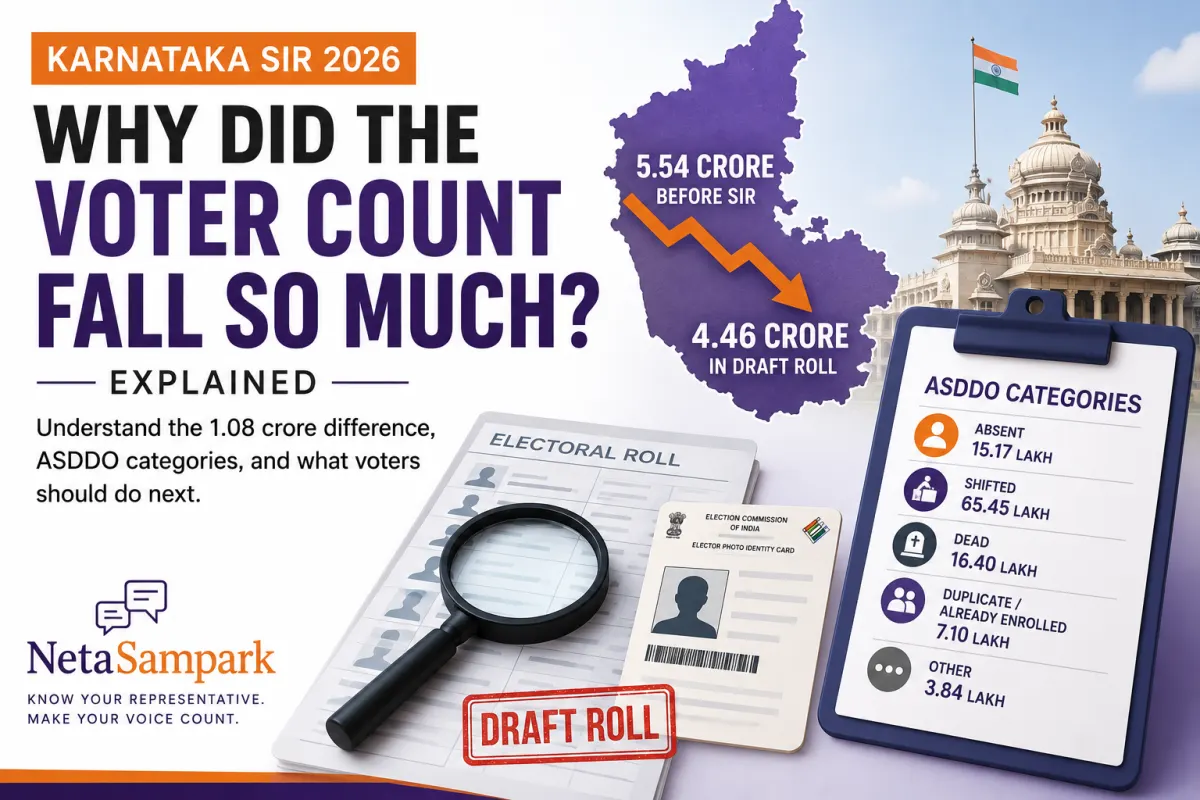
Karnataka's draft electoral roll published on 24 August 2026 has drawn attention because the number of electors in the draft is substantially lower than the electorate recorded before the Special Intensive Revision (SIR).
The electorate stood at 5,54,32,314 as of 16 June 2026. The newly published draft roll contains 4,46,80,151 electors, a difference of roughly 1.08 crore. (Moneycontrol)
At first glance, this can look like more than one crore voters have simply been "deleted."
That is not the correct way to understand the draft roll.
The large difference is primarily explained by the ASDDO classification, the house-to-house enumeration process and the fact that the draft roll is still subject to claims, objections, verification and due process.
Here's what actually happened.
The Numbers at a Glance
StageElectorsElectorate before SIR5,54,32,314Electors in draft roll4,46,80,151ASDDO category1,07,96,339Difference~1.08 crore
The draft roll was published for all 224 Assembly constituencies in Karnataka after the house-to-house enumeration exercise conducted from 30 June to 17 August. (NewKerala.com)
So why did such a large number of names move out of the draft roll?
1 The Biggest Reason: ASDDO
The largest factor is the ASDDO category.
ASDDO covers electors identified as:
- Absent
- Permanently Shifted
- Dead
- Duplicate/Already Enrolled
- Other
In the final draft-stage figures, 1,07,96,339 electors were placed in this category. (Prajaa)
That represents roughly 19.5% of the electorate that existed before the SIR exercise.
But there is an important distinction:
Being placed in the ASDDO category is not the same thing as a final deletion from the electoral roll.
The draft-roll stage is followed by a process through which eligible voters can raise claims and objections.
2 Most ASDDO Entries Are Not Simply "Fake Voters"
The ASDDO numbers contain several very different situations.
According to the published breakdown, approximately:
- 65.45 lakh — permanently shifted
- 16.40 lakh — deceased
- 15.17 lakh — absent
- 7.10 lakh — already enrolled/duplicate
- 3.84 lakh — other
These figures account for the approximately 1.08 crore placed in ASDDO. (Bhaskar Hindi)
This matters because a person marked "shifted" is very different from a person identified as deceased.
The ASDDO figure is therefore not a single category of people who are all suspected of being ineligible.
3 Why Are So Many People Marked "Shifted"?
This is particularly important in Karnataka's major cities.
People frequently move because of:
- Employment
- Education
- Marriage
- Rental housing
- Moving between Bengaluru neighbourhoods
- Moving from one district to another
- Returning to their hometown
- Relocating to another state
A voter who was registered at an old address may continue to appear on the electoral roll even after moving.
The SIR exercise attempts to identify such records.
This is one reason the permanently shifted category is by far the largest component of ASDDO — around 65.45 lakh electors. (Bhaskar Hindi)
4 What About People Marked "Absent"?
Another 15.17 lakh electors were placed in the absent category in the draft-stage figures. (Bhaskar Hindi)
"Absent" does not necessarily mean that a person has permanently left their home.
Someone may have been:
- Away for work
- Travelling
- Living temporarily somewhere else
- Unavailable during the enumeration visit
- Unable to complete the enumeration process
This is why voters should check their individual status rather than assuming that an ASDDO classification means they are no longer eligible to vote.
5 Why Were Deceased Voters Removed?
The SIR exercise also attempts to identify voters who have died.
Approximately 16.40 lakh electors were classified as deceased in the latest draft-stage breakdown. (Bhaskar Hindi)
Removing deceased persons is a normal part of maintaining an accurate electoral roll.
Without periodic updating, a voter database can continue carrying records belonging to people who are no longer alive.
The purpose of the revision is therefore not simply to reduce the number of voters, but to make the electoral roll reflect the eligible electorate as accurately as possible.
6 What Does "Duplicate" Mean?
The SIR exercise also identified approximately 7.10 lakh electors in the already-enrolled/duplicate category. (Bhaskar Hindi)
A person can potentially appear more than once in electoral records, particularly after moving between locations.
For example:
Old address → new address → new voter registration
If the old record is not removed or updated, the same person could appear in more than one place.
The revision process attempts to identify such overlapping records.
7 The Enumeration Process Is a Major Reason for the Change
The SIR was not simply a computer exercise.
Booth Level Officers conducted house-to-house enumeration between 30 June and 17 August. (NewKerala.com)
The objective was to verify existing electoral records and collect enumeration information.
The Election Commission had distributed enumeration forms for the existing electorate, and the forms that were completed and digitised formed the basis of the draft roll.
Earlier figures showed that around 80.5% of the existing electorate had their enumeration forms digitised for inclusion in the draft roll. (India Today)
This helps explain why the draft roll is significantly smaller than the earlier electoral roll.
8 Does This Mean 1.08 Crore Voters Have Lost Their Right to Vote?
Not automatically.
This is one of the most important points for voters to understand.
The draft electoral roll is not the final electoral roll.
The Election Commission has stated that a name cannot simply be deleted without the prescribed notice and due process. Reporting on the draft publication also notes that electors in the affected categories have an opportunity to seek inclusion or correction. (Moneycontrol)
The claims and objections period began on:
24 August 2026
and is scheduled to continue until:
23 September 2026
The final electoral roll is scheduled for publication on:
27 October 2026. (Outlook India)
So the process is not over.
9 What Should You Do If Your Name Is Missing?
If you were previously registered as a voter but cannot find your name in the draft roll, check your status immediately.
Do not rely on a WhatsApp message or a social-media list.
Use official Election Commission/Karnataka election resources to check your electoral record.
You should verify:
- Your name
- EPIC/Voter ID details
- Assembly Constituency
- Part number
- Polling station
- Current address
- Previous electoral-roll information
If your name is missing and you are an eligible voter, check the applicable claims process.
10 What If You Are in the ASDDO List but You Are Alive and Still Living There?
This is particularly important.
Suppose you:
- Are alive
- Still live at your registered address
- Are an eligible voter
- Were previously registered
but your record has been classified as Absent or Shifted.
Don't assume that the classification is final.
Check your record and follow the official process for making a claim or providing the required verification.
The same applies if you believe you have been incorrectly classified as:
- Dead
- Duplicate
- Other
11 Why Bengaluru Is Seeing Such a Large Impact
Bengaluru is particularly significant because of its highly mobile population.
People frequently change:
- Rental homes
- Apartments
- Jobs
- Constituencies
- Cities
This creates a greater possibility of outdated electoral addresses and duplicate records.
Reports following publication of the draft roll show that Bengaluru accounts for a substantial share of Karnataka's ASDDO records. (Dailyhunt)
That makes checking your electoral record particularly important if you live in Bengaluru.
12 Is the Lower Voter Count Actually a Bad Thing?
The answer depends on what happens to the records during the next stage.
An electoral roll should ideally contain:
Eligible voters who are correctly registered at the appropriate place.
Removing genuine voters would obviously be a serious problem.
But removing:
- Deceased voters
- Duplicate records
- Permanently shifted voters
- Other ineligible or unverified records
can improve the accuracy of an electoral roll.
The important question is therefore not simply:
"Why did the voter count fall?"
It is:
"Were eligible voters correctly retained, and can those incorrectly excluded get back onto the roll?"
That is why the claims, objections and verification stages matter.
13 Don't Judge Your Status From the Statewide Number
A statewide figure of 1.08 crore ASDDO records can sound alarming.
But that number tells you very little about your individual electoral status.
Your Assembly Constituency may have a very different percentage.
Your polling part may have a different situation again.
And your personal record may be perfectly valid.
So don't conclude:
"1.08 crore names are gone, therefore my vote is gone."
Instead:
Check your own name.
14 What Happens Next?
The Karnataka SIR process now moves into the claims, objections and verification stage.
The broad sequence is:
Draft electoral roll published
↓
Voters check their names
↓
Claims and objections
↓
Verification / notices / hearings where applicable
↓
Decisions on claims and objections
↓
Appeals where applicable
↓
Final electoral roll
The final roll is scheduled for publication on 27 October 2026. (Outlook India)
That means the numbers in the draft roll should not be treated as the final shape of Karnataka's electorate.
Karnataka SIR: What You Should Do Today
If you voted in Karnataka previously, take a few minutes to check your record.
Your checklist:
1. Search your name in the draft electoral roll.
2. Check your EPIC/Voter ID information.
3. Verify your Assembly Constituency.
4. Check your address and polling details.
5. If your name is missing, find out why.
6. Check whether you appear under ASDDO.
7. If something is incorrect, use the official claims/correction process.
8. Don't wait until the final roll is published.
The claims and objections window is currently scheduled to remain open until 23 September 2026. (Outlook India)
Karnataka SIR: The Bottom Line
The Karnataka voter count appears to have fallen by roughly 1.08 crore between the pre-SIR electoral roll and the newly published draft roll.
But the number should not be interpreted as 1.08 crore confirmed permanent deletions.
The difference is largely accounted for by voters placed in the ASDDO category after the SIR enumeration exercise — including people recorded as absent, permanently shifted, deceased, duplicate/already enrolled or falling into other categories. (NewKerala.com)
The draft roll is also not the final roll.
For voters, the most important takeaway is simple:
Don't debate the statewide number before checking your own name.
Check your electoral record, understand your status, and if something is wrong, use the official process before the deadline.
Your name on the electoral roll matters. Check it. Verify it. Act if needed.
NetaSampark — Know Your Representative. Make Your Voice Count.