
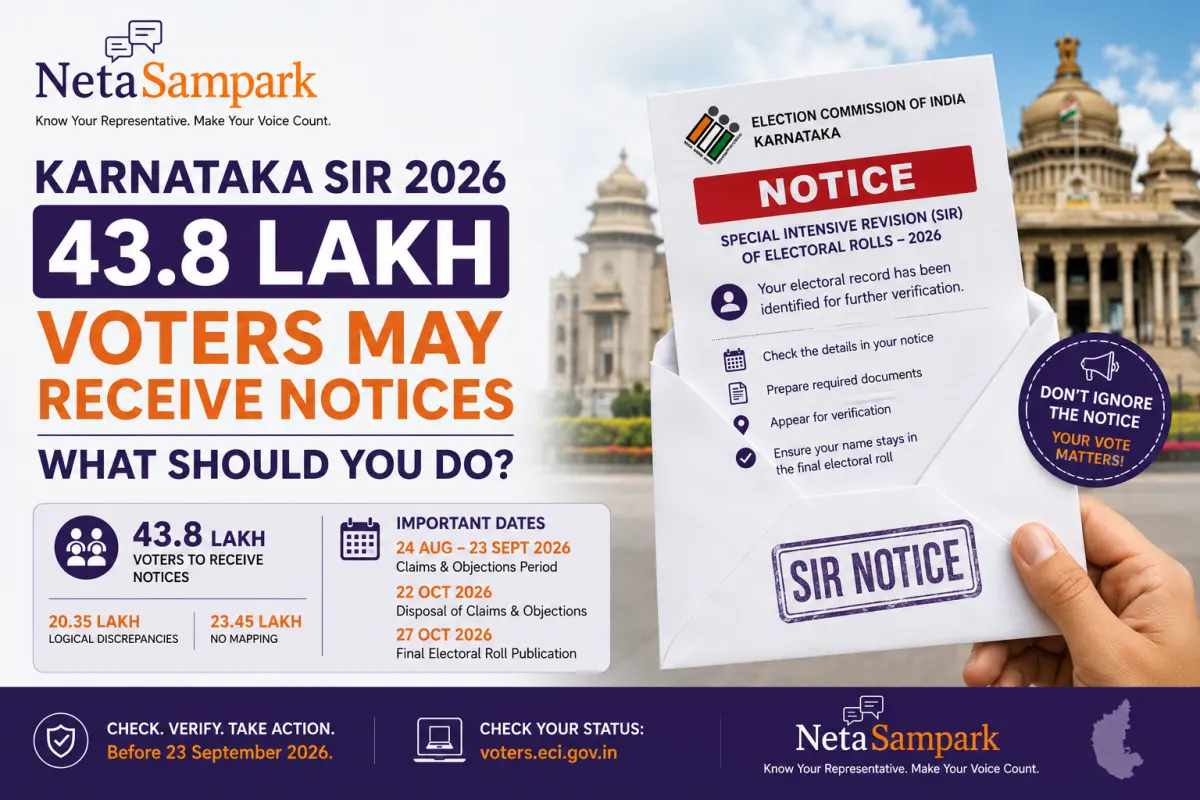
Karnataka's Special Intensive Revision (SIR) of electoral rolls has entered an important stage. Following publication of the draft electoral roll on 24 August 2026, around 43.8 lakh voters in Karnataka are expected to receive notices for verification.
If you receive an SIR notice, don't panic and don't ignore it. A notice means that the Election Commission needs additional verification of your electoral record. It is an opportunity to clarify your details and establish your eligibility.
Here's what Karnataka voters need to know.
Why Are 43.8 Lakh Voters Receiving Notices?
During the SIR exercise, Karnataka's election authorities mapped around 5.54 crore existing electors.
Of these, approximately 4.46 crore voters are included in the draft electoral roll. Around 1.07 crore were classified under ASDDO — Absent, Shifted, Dead, Duplicate and Other — and are not included in the draft roll at this stage. (The Indian Express)
Among the voters included in the draft roll, 43.8 lakh have been identified for additional verification:
- 20.35 lakh — Electors with anomalies or logical discrepancies
- 23.45 lakh — Electors under the No Mapping category
These two groups together account for approximately 43.8 lakh voters who may receive notices. (The Indian Express)
What Does an SIR Notice Mean?
An SIR notice does not simply mean that your voter registration has been cancelled.
It means that your electoral record requires additional verification.
The notice is generated by the Electoral Registration Officer (ERO) or Assistant Electoral Registration Officer (AERO) and is served to the voter through the election machinery, including Booth Level Officers (BLOs). The notice is expected to specify the date, time and location for verification or hearing, along with the documents that may be required. (India Today)
If you receive one, read it carefully and follow the instructions given in the notice.
Who Will Receive an SIR Notice?
There are two main categories.
1 Electors With Logical Discrepancies
Around 20.35 lakh voters have been identified with what the election authorities describe as logical discrepancies in their electoral information or mapping.
These discrepancies can include things such as:
- Differences in the elector's name between the current and previous SIR records
- Differences in the father's name
- Unusual age relationships between a parent and child
- Unusual age relationships between siblings
- Unusual age relationships involving grandparents
- A parent being marked invalid, affecting linked records
- Other inconsistencies in the mapping of current and previous electoral records
There are nine identified categories of such discrepancies. (The Indian Express)
Important:
A discrepancy does not necessarily mean that you have done anything wrong.
Names can change spelling across records. Dates and ages can also contain historical errors. The verification process is intended to resolve such discrepancies.
2 No Mapping
Approximately 23.45 lakh voters fall under the No Mapping category.
This broadly refers to voters whose current electoral record could not be mapped to the relevant 2002 SIR electoral-roll information, including cases where the voter could not provide their own or their parents' relevant details from that earlier roll. (The Indian Express)
This does not automatically mean that the person is ineligible to vote.
It means the voter may need to establish their eligibility through the prescribed verification process.
What Should You Do If You Receive a Notice?
Step 1: Don't Ignore It
The first and most important step is to read the notice carefully.
Check:
- Your name
- Electoral details
- Reason for the notice
- Date of verification/hearing
- Time
- Location
- Documents requested
Step 2: Check Your Voter Details
Before attending the verification, check your electoral information through the official Election Commission voter services.
You can search using your EPIC number or other voter details.
The ECI's SIR portal also provides a facility to search your name in the previous SIR electoral roll. (Voter's Portal)
If you cannot find your previous record immediately, try variations of your name. The ECI notes that spelling differences between current and previous records can affect search results. (Voter's Portal)
Step 3: Check Your 2002 SIR Information
If your notice relates to No Mapping, it is particularly important to check whether you can locate your own or your family's relevant information in the previous SIR electoral roll.
The ECI's search facility allows you to search the previous SIR roll using details such as:
- State
- District
- Assembly Constituency
- Polling station
- Part/serial number
- Elector name
- Age
- Relative's name
If an exact name search doesn't work, try alternate spellings.
Step 4: Prepare the Required Documents
Your notice should indicate what documentation is required for your particular case.
Reports on Karnataka's SIR process indicate that voters receiving notices may be asked to establish aspects including identity, citizenship and residence, depending on the reason for verification. (The News Minute)
Important:
Do not submit random documents simply because someone on social media tells you to.
Follow the requirements mentioned in your official notice and the instructions provided by the election authorities.
If you are unsure about what is required, contact the relevant BLO, ERO or AERO.
Step 5: Attend the Verification
If your notice asks you to appear before the election authorities, attend at the specified:
Date + Time + Location
Carry:
- The notice
- Original documents where required
- Photocopies of relevant documents
- Your voter/EPIC information
- Any additional records specifically requested
Keep copies of documents you submit for your own records.
What Happens During Verification?
The purpose of the process is to examine the discrepancy or establish the required electoral linkage/eligibility.
The election authorities may review:
- Your identity
- Your residence
- Your electoral history
- Your previous SIR information
- Your family/parent mapping, where relevant
- Documents submitted in support of your claim
The exact process can vary depending on the category mentioned in your notice.
What If My Name Has a Spelling Difference?
Don't panic.
A spelling difference between your current name and an older electoral record can be one of the reasons a record is flagged as a logical discrepancy.
For example, an old record might contain a slightly different spelling of:
- Your name
- Your father's name
- Your mother's name
- Another relative's name
The existence of a spelling difference does not by itself establish that you are an ineligible voter.
The purpose of verification is to resolve such discrepancies.
What If My Father's Name Is Different?
A difference in the father's name between the current electoral roll and the previous SIR record can also trigger an anomaly.
This can happen because of:
- Spelling variations
- Transliteration between Kannada and English
- Historical data-entry errors
- Different naming conventions
If your notice identifies this as the issue, take the relevant supporting documentation with you and follow the instructions in the notice.
What If I Cannot Find My 2002 Record?
This is particularly relevant to voters under No Mapping.
First, don't assume that you have no voter history simply because you cannot find the record immediately.
Try:
- Searching with your EPIC information.
- Searching using your name.
- Trying alternate spellings.
- Checking your district.
- Checking your Assembly Constituency.
- Checking the relevant polling station/part.
- Searching using your relative's name.
- Contacting your BLO or ERO if you still cannot locate the information.
The ECI itself recommends trying variations of names when searching the previous SIR database. (Voter's Portal)
What If I Never Received an SIR Notice?
Not every voter will receive a notice.
The notices are specifically connected to the categories identified for additional verification.
If your name is correctly present in the draft electoral roll and you have not received a notice, you should still check your electoral information.
Make sure:
- Your name is present.
- Your address is correct.
- Your constituency is correct.
- Your polling station information is correct.
Checking your voter record is useful even if you have not received a notice.
What If My Name Is Missing From the Draft Electoral Roll?
This is a different situation from receiving an anomaly/no-mapping notice.
If you are an eligible voter and your name is missing from the draft electoral roll, you should check the official claims and objections process.
For the current Karnataka SIR schedule, the claims and objections period runs from:
24 August 2026 to 23 September 2026
The disposal of claims and objections is scheduled to continue until 22 October 2026, with the final electoral roll scheduled for publication on 27 October 2026. (India Today)
Do not wait until the final roll is published if you already know there is a problem.
What Happens If You Ignore the Notice?
This is why voters should take an official notice seriously.
The verification process exists so that affected voters can establish their eligibility and resolve discrepancies.
According to reporting on the Karnataka process, voters who fail to respond may face removal from the electoral roll and could subsequently need to apply for inclusion through the prescribed process. (The News Minute)
Therefore:
If you receive an official SIR notice, respond within the prescribed process rather than ignoring it.
Bengaluru Voters Need to Pay Particular Attention
Bengaluru accounts for more than half of Karnataka's expected SIR notices.
Around 24.05 lakh voters across Bengaluru's four electoral districts are expected to receive notices. (The News Minute)
The proportion is particularly high in some Assembly constituencies.
Reports indicate that more than half of voters in the draft roll are expected to receive notices in:
- CV Raman Nagar — 60.34%
- KR Puram — 58.61%
- Bangalore South — 54.57%
- Shantinagar — 53.14%
If you live in Bengaluru and have moved between rented homes, apartments or constituencies, checking your electoral record is especially important.
ASDDO Notice vs SIR Verification Notice
Don't confuse the two.
ASDDO
A — Absent
S — Shifted
D — Dead
D — Duplicate
O — Other
These voters have been identified under the ASDDO classification and are not included in the draft roll at this stage. (The Indian Express)
SIR Verification Notice
The current notice process mainly concerns voters in:
Logical Discrepancy / Anomaly
and
No Mapping
categories.
These voters are included in the draft roll but require additional verification. (The Indian Express)
Don't Believe Every SIR Message on WhatsApp
The SIR process has generated significant discussion on social media.
You may see messages claiming:
"Your voter ID has been cancelled."
or:
"Everyone on this list has lost their vote."
Don't rely on such messages.
Your individual electoral status should be checked through official election authorities and voter-service systems.
A notice is a verification step, not something you should interpret based on an unofficial WhatsApp forward.
Karnataka SIR: Your Quick Checklist
If you receive an SIR notice:
☑ Read the notice carefully
☑ Check the reason for verification
☑ Check your current voter details
☑ Search your previous SIR record
☑ Gather the documents specifically requested
☑ Attend the verification at the specified time and location
☑ Keep copies of submitted documents
☑ Follow up if necessary
☑ Check your electoral status again
And if your name is missing from the draft roll:
☑ Check the official claims process
☑ Submit the appropriate application/claim
☑ Keep your acknowledgement/reference number
☑ Complete the process before the applicable deadline
Frequently Asked Questions
What is a Karnataka SIR notice?
It is a notice issued as part of the Special Intensive Revision process when an elector's record requires additional verification, particularly for cases classified as logical discrepancies or no mapping.
How many Karnataka voters are receiving notices?
Approximately 43.8 lakh voters have been identified for notices — around 20.35 lakh for anomalies/logical discrepancies and 23.45 lakh for no mapping. (The Indian Express)
Does receiving an SIR notice mean I am not a voter?
No. A notice means your record requires verification. Follow the process specified in the notice.
What is No Mapping in Karnataka SIR?
It generally refers to voters whose current records could not be mapped to the relevant previous SIR information, including cases where the voter could not establish the required linkage to the 2002 electoral roll. (The Indian Express)
What is a logical discrepancy?
It is an inconsistency identified in the electoral data or its mapping, such as certain differences in names, father's names or age relationships between linked records. (The Indian Express)
What is the deadline for claims and objections?
For Karnataka's current SIR process, the claims and objections period is scheduled from 24 August to 23 September 2026. (India Today)
When will the final Karnataka electoral roll be published?
The final electoral roll is scheduled for 27 October 2026. (India Today)
Check. Verify. Take Action.
The Karnataka SIR process is affecting millions of voters, but the most important thing is to understand your individual electoral status.
If you receive a notice, don't panic.
Read it. Verify your details. Prepare the required documents. Attend the verification.
If your name is missing from the draft roll or your details are incorrect, use the official claims and correction process before the deadline.
Your electoral record is your responsibility — and checking it now can help avoid problems later.
Know Your Representative. Make Your Voice Count.
NetaSampark helps citizens discover their elected representatives and stay connected with public life beyond election day.