
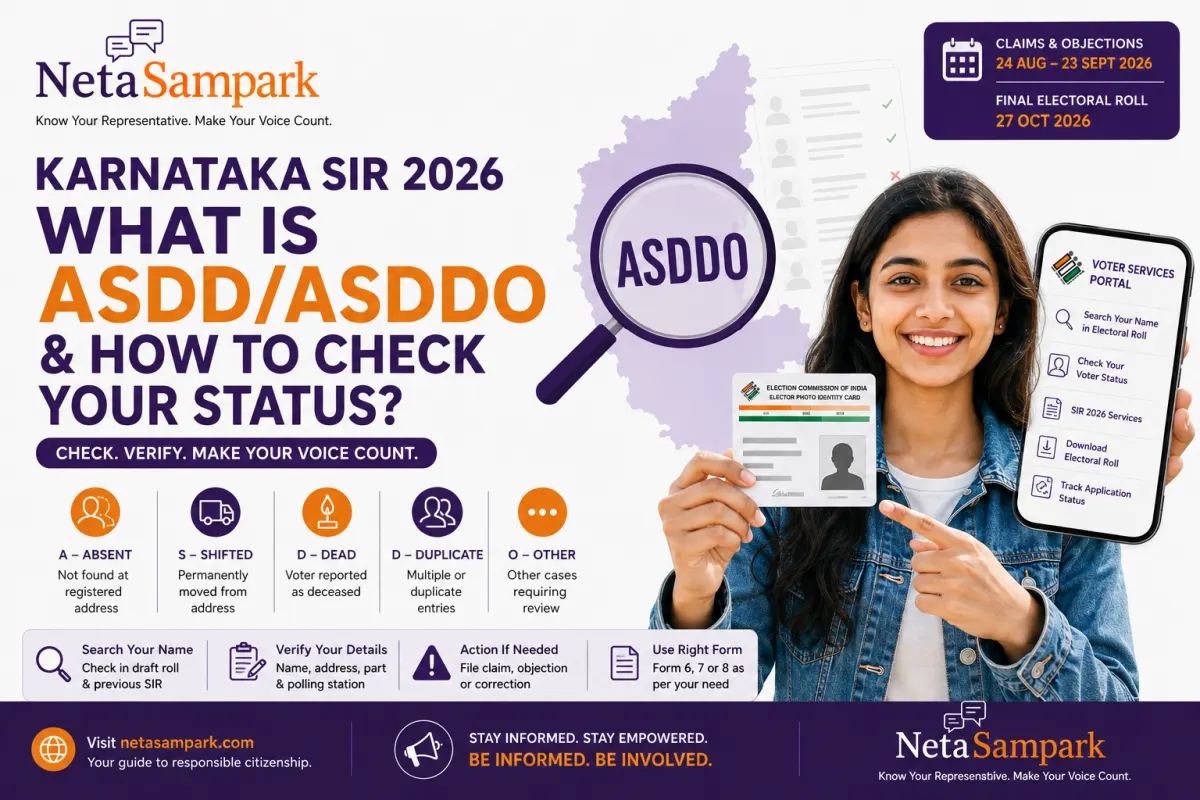
If you are a voter in Karnataka, you may have come across the terms ASDD or ASDDO while checking the 2026 Special Intensive Revision (SIR) of electoral rolls.
With the Karnataka SIR draft electoral roll published on 24 August 2026, this is an important time for every voter to check their name and verify their electoral-roll details. The claims and objections period is scheduled from 24 August to 23 September 2026, with the final electoral roll scheduled for 27 October 2026.
The most important thing to understand is:
Being identified in an ASDDO category does not automatically mean that your voting rights have been permanently cancelled.
The draft electoral roll is part of an ongoing verification process. Eligible voters who find an issue with their record can use the prescribed claims, objections and correction procedures.
What Does ASDDO Mean?
ASDDO refers to electoral-roll entries identified under the following categories during the SIR process:
- A — Absent
- S — Shifted
- D — Dead/Deceased
- D — Duplicate
- O — Other
The classification is used during the electoral-roll verification process to identify records that require further verification or action.
The Election Commission's SIR process involves house-to-house verification by Booth Level Officers (BLOs), followed by publication of the draft electoral roll and a period for claims and objections.
Why Is the ASDDO List Important?
During the SIR enumeration exercise, BLOs attempted to verify existing electors and collect their enumeration information.
Where an elector could not be verified or the record appeared to fall into one of the relevant categories, the entry could be classified under ASDDO.
Karnataka's draft-roll exercise has identified more than one crore electors under ASDDO categories. Reports on the draft publication put the figure at approximately 1.08 crore electors.
However, this number should not be interpreted as meaning that all those people have permanently lost their right to vote.
The purpose of the draft-roll stage is to allow voters to check their records and raise claims or objections where necessary.
What Does Each ASDDO Category Mean?
1 Absent
An elector may be classified as Absent when the voter could not be contacted or verified at the registered address during the enumeration process.
This does not necessarily mean that the person is ineligible to vote.
For example, you may have been:
- Travelling
- Working in another city
- Temporarily away from home
- Living elsewhere for a period of time
If you are a genuine eligible voter, check your current electoral-roll status and follow the official process if your record is incorrect.
2 Shifted
Shifted generally refers to voters who appear to have moved away from the address where they were previously registered.
This can be particularly relevant in Bengaluru and other rapidly growing urban areas, where people frequently move between:
- Rental properties
- Apartments
- Cities
- Districts
- Assembly constituencies
If you have moved, check whether your electoral-roll entry reflects your current ordinary residence.
3 Dead or Deceased
This category relates to electoral-roll entries believed to belong to voters who have died.
If you are alive but your entry has incorrectly been classified this way, you should take action immediately through the appropriate election authorities.
Do not assume that the classification is correct simply because it appears in a list.
4 Duplicate
A voter may be identified as a Duplicate when the electoral system indicates that the person may have more than one registration or an overlapping electoral entry.
This can happen, for example, when someone moves but remains registered at an old address.
If you are a genuine voter and believe your record has been incorrectly identified as a duplicate, verify your entries and use the appropriate official process.
5 Other
The Other category covers cases that do not fall neatly into the primary classifications.
If your record appears under this category, check the information available through the election authorities and determine whether you need to provide clarification or take further action.
If you are unsure, contact your Booth Level Officer (BLO) or Electoral Registration Officer (ERO).
ASDD vs ASDDO: What's the Difference?
You may see both ASDD and ASDDO used when searching online.
The full classification is generally referred to as ASDDO:
Absent + Shifted + Dead + Duplicate + Other
Some articles and social-media posts use the shorter term ASDD.
If you are searching for information about your Karnataka SIR status, try both terms:
- Karnataka ASDD list
- Karnataka ASDDO list
- Karnataka SIR ASDD
- Karnataka SIR ASDDO
- ASDDO voter list Karnataka
How to Check Your ASDDO Status in Karnataka
The safest approach is to use official Election Commission and Karnataka government election resources.
Step 1: Search Your Name in the Electoral Roll
Start by checking whether your name appears in the current electoral roll.
The Election Commission's Voter Service Portal provides voter-search and SIR-related services.
You should verify:
- Your name
- EPIC/Voter ID details
- Address
- Assembly Constituency
- Part number
- Polling station
Step 2: Check the SIR Information
The ECI has a dedicated SIR 2026 section where voters can select their state and access the relevant services.
Select Karnataka and use the services available for your electoral record.
Step 3: Check the Previous SIR Electoral Roll
The ECI also provides a facility to search your name in the previous SIR electoral roll.
You can search using information such as:
- State
- District
- Assembly Constituency
- Polling station
- Part/serial number
- Elector name
- Age
- Relative's name
The ECI advises users to try spelling variations if an exact name search does not produce a result.
Search Your Name in the Previous SIR Electoral Roll
Step 4: Check Your Constituency's ASDDO Information
ASDDO information may also be made available through constituency or district-level election resources.
When checking a list, make sure you are looking at the correct Assembly Constituency and polling part.
Do not assume that finding a similar name means that the entry belongs to you. Compare the available identifying details carefully.
What If My Name Is in the ASDDO List?
Don't panic.
The next step is to understand why your record has been classified.
For example:
If you are marked Absent
Check your current electoral-roll entry and contact your BLO/ERO if the classification is incorrect.
If you are marked Shifted
Check whether your address or electoral registration needs to be updated.
If you are marked Dead
If you are alive and have been incorrectly classified, contact the election authorities and follow the prescribed correction/claim process.
If you are marked Duplicate
Check whether you have another electoral registration and determine which entry should be retained.
If you are marked Other
Check the reason provided and follow the instructions of the election authorities.
What If My Name Is Missing From the Draft Electoral Roll?
This is one of the most important situations to address.
The draft electoral roll is not the final electoral roll.
If you are an eligible voter and cannot find your name, you should not simply wait for the final roll.
Karnataka's current SIR schedule provides a claims and objections period from:
24 August 2026 → 23 September 2026
The final electoral roll is scheduled for publication on:
27 October 2026.
If your name has been wrongly omitted, check the official process for submitting a claim or application.
What If My Name Is Present but My Details Are Wrong?
You should also check the details associated with your entry.
Look at:
- Name spelling
- Age/date-of-birth information
- Gender
- Address
- Constituency
- Part number
- Polling station
- EPIC details
If something is incorrect, use the appropriate voter-service process rather than waiting until an election is approaching.
What If I Have Moved?
If you have moved from your previous address, don't assume that your electoral registration automatically moves with you.
Check your current electoral-roll entry.
Depending on your circumstances, you may need to update or shift your registration through the appropriate Election Commission process.
The important thing is to ensure that your electoral record reflects your current ordinary residence.
What If I Receive an SIR Notice?
Some voters may receive notices as part of the SIR verification process.
If you receive an official notice:
- Read it carefully.
- Check what information or documents are being requested.
- Follow the instructions provided.
- Respond within the applicable timeframe.
- Keep a copy of anything you submit.
Do not ignore an official notice.
At the same time, be careful about sharing sensitive personal information with unofficial people or websites.
Use official Election Commission channels whenever possible.
ASDDO Does Not Automatically Mean Your Vote Is Cancelled
This is perhaps the biggest misconception surrounding the SIR process.
Seeing your name or record associated with an ASDDO category should not automatically be interpreted as a final cancellation of your voting rights.
The draft electoral roll is a stage in the revision process.
Eligible voters have an opportunity to raise claims or objections during the prescribed period.
The ECI's SIR framework provides for public scrutiny of draft rolls and processes for addressing eligible electors who have been left out or records that require correction.
So don't rely on a social-media post saying:
"Your vote has been cancelled."
Check your individual electoral record instead.
Which Form Should You Use?
Different voter situations require different forms.
Form 6 — New Registration
Form 6 is generally used when an eligible citizen is applying for inclusion in the electoral roll as a new voter.
Form 7 — Objection/Deletion
Form 7 is used for prescribed objections and deletion-related applications.
Form 8 — Correction/Updates
Form 8 is used for correction of entries and certain updates to an existing electoral record.
Do not choose a form simply because you see the term ASDDO.
First identify what is actually wrong with your electoral record and then use the applicable official process.
Bengaluru Voters Should Pay Particular Attention
Bengaluru has a highly mobile population, with many residents moving between rental properties, apartments, constituencies and cities.
That makes electoral-roll verification particularly important.
If you have:
- Moved recently
- Changed your rental address
- Moved from another city
- Changed constituency
- Registered at an old address
- Not checked your voter information for several years
Check your electoral-roll entry now.
Don't assume that your previous voter registration automatically reflects your current address.
What If I Cannot Find My Name?
Don't immediately assume that you have been removed.
Try these steps:
1. Search using your EPIC number.
2. Search using your personal details.
3. Try different spellings of your name.
4. Check your previous SIR electoral-roll information.
5. Confirm your Assembly Constituency.
6. Check the relevant electoral-roll PDF.
7. Contact your BLO or ERO if the issue remains unresolved.
The ECI's previous-SIR search facility specifically notes that spelling variations may affect search results.
Don't Rely on WhatsApp Forwarded Lists
SIR has generated significant discussion on social media.
But your electoral status is individual and constituency-specific.
Don't rely solely on:
- WhatsApp forwards
- Instagram posts
- Screenshots
- Political messages
- Unverified websites
- Social-media claims
A list circulating on social media is not a substitute for checking your official electoral record.
Use the Election Commission's voter-service facilities to verify your information.
Karnataka SIR: What You Should Do Today
Follow this simple checklist:
1. Search your name
Check the official electoral-roll search.
2. Check the draft roll
Confirm that your name appears.
3. Verify your details
Check your address, constituency, Part and polling information.
4. Check ASDDO information
If applicable, check the ASDDO list for your constituency.
5. Check for notices
If your record requires further verification, follow the official instructions.
6. Take action if necessary
Use the appropriate claims, objection or correction process.
7. Don't wait
The current claims and objections period ends on 23 September 2026.
Know Your Voter Status. Know Your Representative.
Checking your electoral-roll status is an important part of participating in democracy.
But civic participation doesn't stop with the voter list.
Once you know your constituency, you should also know:
Who is your MLA?
Who is your MP?
What issues are affecting your constituency?
How can you provide constructive feedback?
What work is being done in your area?
NetaSampark is designed to help citizens discover their elected representatives and stay engaged with public representatives between elections.
Know Your Representative. Make Your Voice Count.
Karnataka SIR ASDDO — Quick FAQ
What is ASDDO in Karnataka?
ASDDO refers to Absent, Shifted, Dead, Duplicate and Other categories used during the SIR electoral-roll verification process.
Does ASDDO mean my name has been permanently deleted?
No. An ASDDO classification should not automatically be interpreted as permanent cancellation of your voting rights. Check your individual record and use the prescribed claims, objections or correction process where necessary.
How can I check my ASDDO status?
Start by checking your electoral-roll information through the official ECI Voter Service Portal and relevant SIR services. You can also check constituency-level information where published.
What if my name is missing from the draft roll?
Check the official claims and objections process and act within the applicable deadline. For Karnataka's current SIR schedule, the claims and objections period runs until 23 September 2026.
What if my name is present but my details are incorrect?
Use the appropriate Election Commission correction/update process. Do not wait until the final electoral roll if you already know there is an error.
What if I have received an SIR notice?
Read the notice carefully, identify what information or documents are requested, and respond through the official process.
Is ASDDO the same as No Mapping?
No. ASDDO is a separate classification from other SIR categories such as No Mapping or records identified with anomalies. If you receive a notice or see a particular status, check the specific reason associated with your record.
Final Reminder for Karnataka Voters
The Karnataka SIR draft electoral roll is now available.
If you are a voter, take a few minutes to check your record.
Search your name.
Verify your details.
Check your constituency and polling information.
Check whether your record requires action.
And if something is wrong, don't wait for the final electoral roll.
The current claims and objections window is scheduled to remain open until 23 September 2026.
Your name on the electoral roll matters. Check it today.
NetaSampark — Know Your Representative. Make Your Voice Count.