The Karnataka Special Intensive Revision (SIR) has now entered an important stage after the draft electoral roll was published on 24 August 2026.
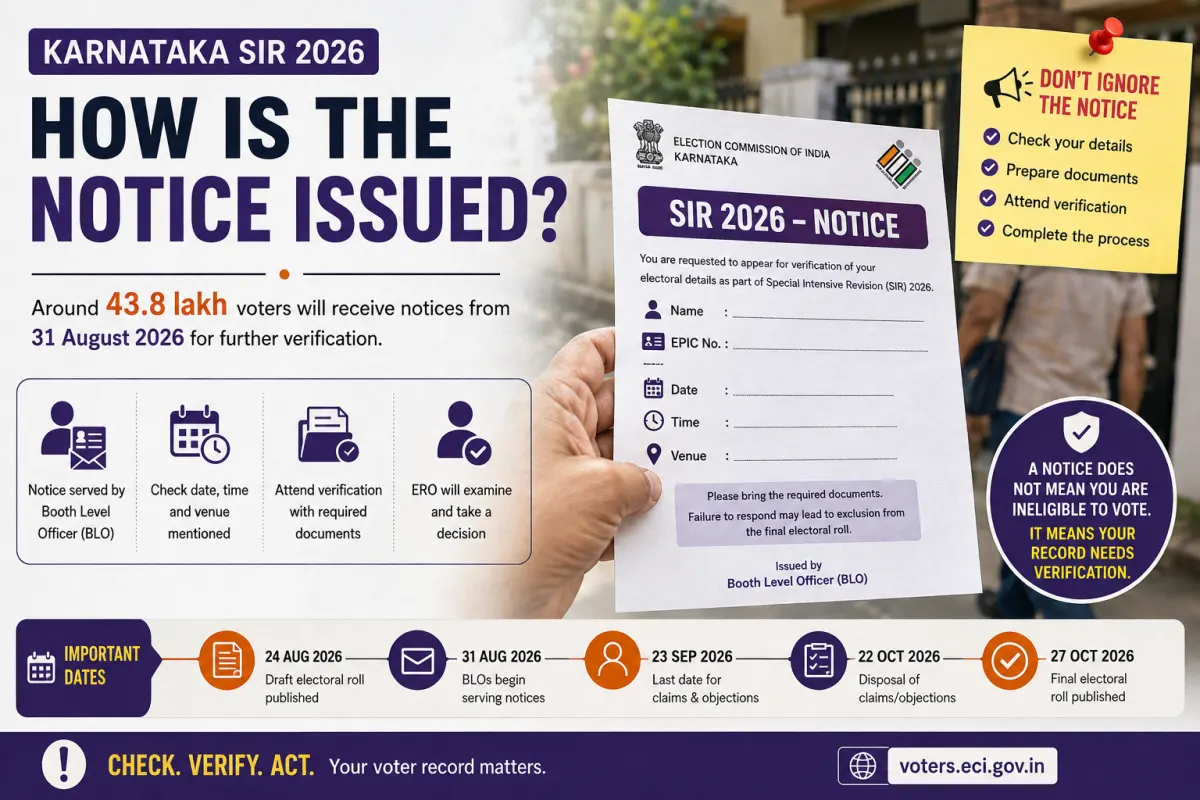
More than 43.8 lakh voters in Karnataka are expected to receive notices for further verification. These voters are primarily those whose records were identified as having logical discrepancies or whose details could not be mapped to the previous electoral-roll data.
But an important question remains:
How is the SIR notice actually issued?
Here's what Karnataka voters need to know.
Who Will Receive a Karnataka SIR Notice?
Not every voter in the draft electoral roll will receive a notice.
According to the latest information from the Karnataka Chief Electoral Officer's office, around 43.81 lakh voters fall into two broad groups:
1. Logical discrepancies
Around 20.35 lakh voters have been identified with discrepancies in their electoral information or mapping.
These can include issues such as:
- Differences in names
- Inconsistent father's or parent's names
- Unusual age differences between family members
- Differences between current and previous electoral records
- Other mapping-related discrepancies
2. No Mapping
Around 23.45 lakh voters could not establish a link with the relevant previous electoral-roll data, including the 2002 SIR roll.
Together, these two categories account for approximately 43.8 lakh voters who are expected to receive notices.
Who Delivers the Notice?
The notice is not simply sent as a normal SMS or email.
The Booth Level Officer (BLO) will serve the notice.
According to the latest reports, BLOs will begin handing over notices from 31 August 2026.
The BLO is the election official responsible for the relevant polling area.
The notice process is therefore intended to happen at the local level, rather than requiring every affected voter to independently visit an election office to discover that they have been flagged.
What Will the Notice Tell You?
The notice will contain important information about the verification process.
It is expected to specify:
- Date of the hearing/verification
- Time
- Place or venue
- Details of the verification required
- Documents that may need to be produced
The notice will therefore tell the voter when and where they need to appear.
Don't ignore the notice.
If you receive one, read it carefully and note the date and location.
Will the BLO Come to Your Home?
The process involves BLOs serving notices to affected voters.
Officials have also indicated that additional election officials will assist with verification and document-related queries.
In certain situations, such as voters who are ill or unable to travel, verification may be conducted at the person's home by the ERO or Assistant ERO.
So if you have difficulty attending the venue because of a genuine inability to travel, contact the appropriate election authorities rather than simply ignoring the notice.
What Happens After You Receive the Notice?
The process broadly looks like this:
Notice served by BLO
↓
Read the date, time and venue
↓
Attend verification/hearing
↓
Submit the required documents
↓
ERO examines your claim
↓
Decision recorded
↓
Eligible voter retained/included in final roll
or
Claim rejected → appeal process
The purpose of the notice is to give the affected voter an opportunity to establish their eligibility before the final electoral roll is prepared.
What Documents Will You Need?
The exact documents required can depend on the nature of the issue identified in your record.
Reports indicate that voters will be asked to provide documents establishing relevant aspects such as identity, citizenship and residence.
The notice/enumeration documentation contains a list of eligible documents, and officials have said that an ERO may seek additional documents where required.
Important:
Don't assume that Aadhaar alone automatically resolves every SIR verification issue.
Carry the documents specified in your notice and follow the instructions given by the election authorities.
Can the Documents Be Submitted Online?
The notice process also has a digital component.
Reports indicate that notices will contain a mechanism, including a scanner/QR facility, through which required forms or documents can be uploaded.
However, physical verification is still part of the process, and voters may be required to appear with the relevant physical documents.
So don't assume that uploading a document online means you can automatically skip the hearing.
What Happens If You Don't Attend?
This is one of the most important points.
Don't ignore your notice.
If an affected voter fails to respond, their name may ultimately be excluded from the final electoral roll, subject to the applicable process.
Officials have indicated that voters who do not respond may subsequently need to use Form 6 to seek inclusion in the electoral roll.
If you cannot attend on the scheduled date, contact the relevant election official and ask what procedure applies to your situation.
What If You Believe the Notice Is Wrong?
Receiving a notice does not automatically mean that you are ineligible to vote.
It means your record requires further verification.
For example, you may have:
- Lived at the same address for years
- Voted previously
- A valid voter ID
- Correct personal details
but still receive a notice because of a discrepancy in the mapping or previous electoral records.
In that situation, attend the verification and provide the relevant documents.
What Happens After the Hearing?
The Electoral Registration Officer (ERO) examines the information and documents submitted.
If the ERO accepts the claim, a decision can be recorded through a speaking order.
If the claim is rejected, the reasons for rejection are also required to be recorded.
According to current reporting, a rejected claim can be appealed first to the District Election Officer, and subsequently to the Chief Electoral Officer, Karnataka, under the applicable process.
What If You Never Receive a Notice?
This is also important.
Not receiving a notice does not mean you should stop checking your name.
Around 4.02 crore voters in the draft roll are not currently expected to receive SIR notices, while approximately 43.81 lakh are flagged for further verification.
You should still check that:
- Your name appears
- Your address is correct
- Your Assembly Constituency is correct
- Your polling information is correct
- Your voter details have not changed unexpectedly
Karnataka SIR Notice Timeline
Here are the important dates currently relevant to voters:
EventDateDraft electoral roll published24 August 2026BLOs begin serving notices31 August 2026Claims & objections deadline23 September 2026Disposal of claims/objectionsUp to 22 October 2026Final electoral roll27 October 2026
The current schedule is based on the latest reports following publication of the draft roll.
⚠️ Be Careful of Fake SIR Notices
Because millions of voters are now expecting SIR-related communication, fraudsters may try to exploit the situation.
Be cautious if someone:
- Calls claiming to be an election official
- Requests an OTP
- Asks for your bank details
- Sends an unknown APK or app
- Sends a suspicious payment link
- Requests money for "voter verification"
- Asks you to share sensitive information through an unofficial website
Never pay anyone to keep your name on the electoral roll.
If you receive a suspicious message, verify it through official election authorities before taking action.
What Should You Do If You Receive a Karnataka SIR Notice?
Follow these 7 steps:
1. Don't panic.
A notice means your record requires verification; it is not by itself a declaration that you cannot vote.
2. Read the notice carefully.
Check the date, time and venue.
3. Check your voter details.
Verify your name and EPIC information.
4. Prepare your documents.
Take the documents relevant to your case.
5. Attend the verification.
Don't simply ignore the notice.
6. Keep copies of what you submit.
Maintain your documentation for future reference.
7. Follow up if your claim is rejected.
Ask about the applicable appeal process.
The Bottom Line
Karnataka's SIR notice phase is beginning after publication of the draft electoral roll.
Around 43.8 lakh voters are expected to receive notices because their records were identified under logical discrepancies or no-mapping categories.
The notice will generally be served by the Booth Level Officer (BLO) and will provide details of the verification process, including where and when the voter needs to appear. BLOs are expected to begin serving these notices from 31 August 2026.
If you receive one:
Don't panic. Don't ignore it. Check your details, prepare your documents and complete the verification process.
And if you don't receive one, still check that your name and details are correctly present in the draft electoral roll.
Your voter record matters. Check. Verify. Act.
Official sources
Confirm fees, dates and eligibility on the official page before you act.