
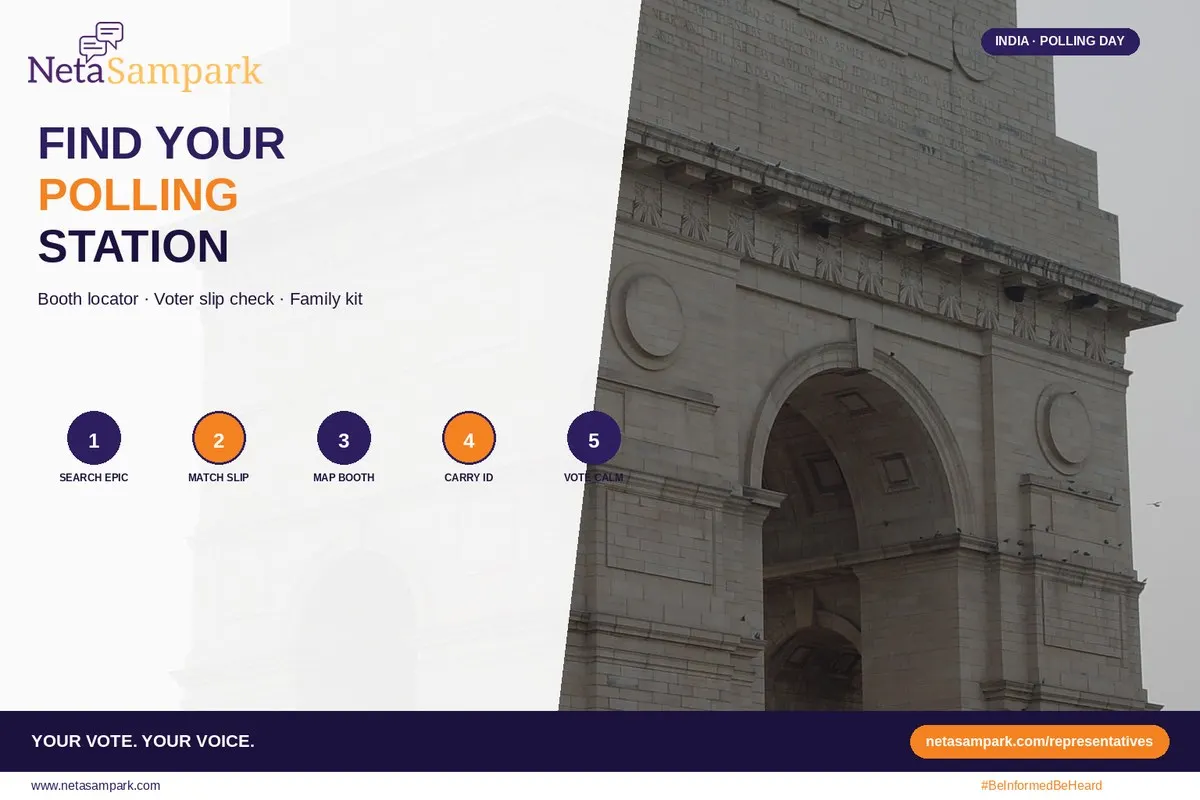
Quick take: The worst civic surprise isn't a long queue—it’s reaching school gate A when your name is assigned to school gate B. Before election day, confirm your name on the electoral roll, EPIC details, polling station and voter information. A few minutes of preparation can save confusion on polling day.
This is a practical last-mile checklist for voters and families. It is not a guide to SIR claims, voter registration, or election campaigning. The focus is simple: know where you have to vote, what information you need, and what to do if something looks wrong.
Why polling-station confusion happens
Polling arrangements can change between elections. People also move homes, electoral parts can be reorganised, and polling stations can be shifted or renumbered.
Common situations include:
- Moving to a different address within the same city.
- A polling station being relocated.
- Electoral parts being reorganised.
- A family member being assigned to a different polling station.
- Continuing to rely on the booth used in a previous election.
- Confusing an Assembly constituency with a Parliamentary constituency.
- Relying on an old voter information slip.
The important point is simple:
Having your name on the electoral roll is only part of the preparation. You should also verify the polling station assigned to your electoral entry.
Start with the official voter search
Before election day, use the Election Commission of India’s official voter services to check your electoral information.
The official starting points include:
- Voters' Services Portal: https://voters.eci.gov.in/
- Electoral Search: https://electoralsearch.eci.gov.in/
Use official Election Commission and Chief Electoral Officer websites or applications rather than third-party websites that request unnecessary personal information.
When searching, check the information carefully rather than simply confirming that your name appears.
Step 1: Check every eligible voter in your household
If several adults in your family are voting, check each person's details separately.
For every voter, verify:
- Name and spelling
- EPIC number
- Part number
- Serial number
- Assembly constituency
- Polling station name
- Polling station address
Don't assume that everyone living at the same address will necessarily have identical polling information.
This is particularly important for people who have recently:
- moved house;
- turned 18;
- changed their address;
- changed their name;
- moved after marriage; or
- applied for a correction or transfer.
Save the result
Once you've confirmed the details, take a screenshot or save the relevant information for reference.
It's useful to keep a small family checklist containing:
Name → EPIC → Part → Serial → Polling Station → Address
Do this before election day, when you have time to resolve discrepancies.
Step 2: Understand the voter information slip
A voter information slip can be useful for locating your polling station and identifying your electoral details.
However, don't treat an old slip as a permanent record of your polling arrangement.
Your polling information should be checked against the latest official electoral information and instructions issued for that election.
If the details on an older slip don't match the current information available through official election services, don't assume that the old slip is correct simply because you used that booth previously.
A good rule
Use the slip as a convenience. Use official election information as your source of truth.
If you are unsure, contact your Booth Level Officer (BLO) or the relevant election officials.
Step 3: Check the location before polling day
Knowing the polling-station name isn't always enough.
A large school, college or government building may have several entrances or polling locations.
Before election day:
- Look up the complete address.
- Check the location on your preferred maps application.
- Identify the most practical entrance.
- Estimate travel time.
- Consider parking or drop-off arrangements.
- Plan for elderly family members.
- Check accessibility requirements if someone in your household needs assistance.
If the polling station is in an unfamiliar area, doing a quick location check beforehand can prevent unnecessary confusion.
Don't wait until election morning
The goal is to make election day boring.
You should ideally know:
Who is voting → where they are voting → how to reach the polling station.
What should you carry?
The exact requirements can depend on the election and the instructions issued by the Election Commission and the relevant Chief Electoral Officer.
As a practical preparation, keep your:
- EPIC / voter ID available;
- authorised alternative identification document, where applicable;
- polling-station information;
- relevant official voter information saved offline; and
- any other documents specifically required by the latest election instructions.
If you are unsure about accepted identification, check the official instructions for your election rather than relying on social-media forwards.
Also remember the basic polling-station rules: follow the instructions of polling officials and do not photograph or record inside the voting compartment.
What if your family member can't find their polling station?
Don't panic.
First, go back to the official voter search and verify the person's details.
Check whether:
- the polling station address has changed;
- the electoral part has changed;
- the person's address is recorded differently;
- the person has been shifted to another electoral part; or
- there is another discrepancy in the electoral record.
If the problem remains unresolved, contact the relevant election officials or BLO using the official channels available for that election.
Keep the person's EPIC number and reference/application details, if applicable, ready when asking for assistance.
What if your name isn't found?
This is different from simply forgetting your polling-station address.
If an eligible voter cannot find their name in the current electoral roll, do not wait until polling day to investigate it.
Depending on the circumstances and the stage of the electoral process, the appropriate route may involve:
- checking the official electoral roll again;
- contacting the BLO;
- contacting the Electoral Registration Officer (ERO);
- using the appropriate voter-service application or portal; or
- filing the relevant electoral application or claim within the applicable deadline.
The correct procedure depends on the circumstances and the election schedule.
A polling station cannot simply add a person's name to the electoral roll at the last minute because they have arrived with an identity document.
That is why checking your electoral information in advance matters.
What if the polling station cannot find your entry?
If you arrive at the polling station and officials cannot immediately locate your entry, remain calm.
Provide the information available to you and ask the polling officials to check the relevant electoral records.
Have your EPIC details available.
If there is a genuine problem, note the relevant details, such as:
- polling station;
- part number, if known;
- approximate time;
- nature of the problem; and
- any reference number or information provided by officials.
For unresolved election-related complaints, use the official election grievance mechanism applicable to your election and state.
Do not rely on social-media posts to resolve an electoral-roll problem.
Five things to verify before election day
You can reduce most last-minute confusion by checking five things:
1. Your name
Is your name present in the current electoral roll?
2. Your EPIC
Does your EPIC information correspond to your electoral entry?
3. Your part and serial number
Do you know the relevant part and serial information?
4. Your polling station
Do you know the exact polling-station name and address?
5. Your route
Do you know how you are going to get there?
If all five are confirmed, you have already removed much of the avoidable uncertainty from polling day.
Common myths about polling stations
“I voted at this booth last time, so I'll vote there again.”
Not necessarily.
Polling arrangements and electoral parts can change. Check your current information before every election.
“The party's voter slip is enough.”
A party-distributed slip may help you locate your polling station, but don't treat an old or unofficial slip as a substitute for checking current official electoral information.
“My Aadhaar automatically means I can vote.”
Identity documentation and electoral-roll inclusion are different things. Your name must be present in the electoral roll according to the applicable election rules.
“If my name is missing, the polling staff can add it immediately.”
Do not assume this. Electoral-roll inclusion and correction follow prescribed procedures and timelines.
“My entire family will automatically have the same polling station.”
Not necessarily. Check every voter individually.
A 10-minute family polling checklist
Before election day, sit down with everyone in the household who is eligible to vote.
CheckDoneName found in official electoral search☐EPIC details checked☐Part and serial number noted☐Polling station name confirmed☐Polling station address saved☐Route checked☐Elderly / accessibility requirements planned☐Official identification requirements checked☐Any discrepancy reported through the correct channel☐
Save the information somewhere accessible to the family.
Don't manage someone else's vote
Helping an elderly parent understand how to check their polling station is useful.
Managing another adult's political choice is not.
If you are helping someone:
- use their own documents;
- obtain their consent;
- let them make their own electoral choices; and
- protect their personal information.
The purpose of preparation is to make voting easier—not to influence how another person votes.
After the election: don't forget your electoral details
Polling day shouldn't be the only time you think about your electoral record.
If you move house, change relevant personal details, or otherwise need an electoral correction, address it through the appropriate official process rather than waiting for the next election.
A useful habit is:
New address → check electoral record → update if necessary → verify again.
That turns electoral-roll maintenance into a routine civic task rather than an election-week emergency.
Know who represents your area
Voting is only one part of civic participation.
Between elections, residents still have questions about:
- roads;
- streetlights;
- water;
- sanitation;
- public services;
- local infrastructure;
- government schemes; and
- other issues affecting their communities.
Knowing your local representative, MLA and MP can help you understand where political follow-up fits into the wider administrative process.
NetaSampark helps citizens identify representatives and understand their constituency and local political geography.
Find your representatives:
https://netasampark.com/representatives
Explore NetaSampark:
https://netasampark.com/explore
Your polling-day plan should be simple
You don't need a complicated election-day strategy.
Before leaving home:
1. Confirm your name.
2. Confirm your polling station.
3. Check the latest official instructions.
4. Carry the required identification.
5. Leave enough time to reach the correct location.
And if something goes wrong, stay calm and use the official election channels.
The bottom line
Election day is not the right time to discover that your polling station changed six months ago.
Check your electoral information early. Save the polling-station details. Verify the route. Help elderly family members if they want assistance. And if something doesn't match, resolve it through the official election system before polling day whenever possible.
Democracy doesn't have to be complicated. Sometimes it starts with knowing which school gate to enter.
Be Informed. Be Heard.
Non-partisan civic explainer. Election schedules, polling arrangements, identification requirements and portal features can change. Always verify the latest instructions issued by the Election Commission of India and the relevant Chief Electoral Officer before acting.