
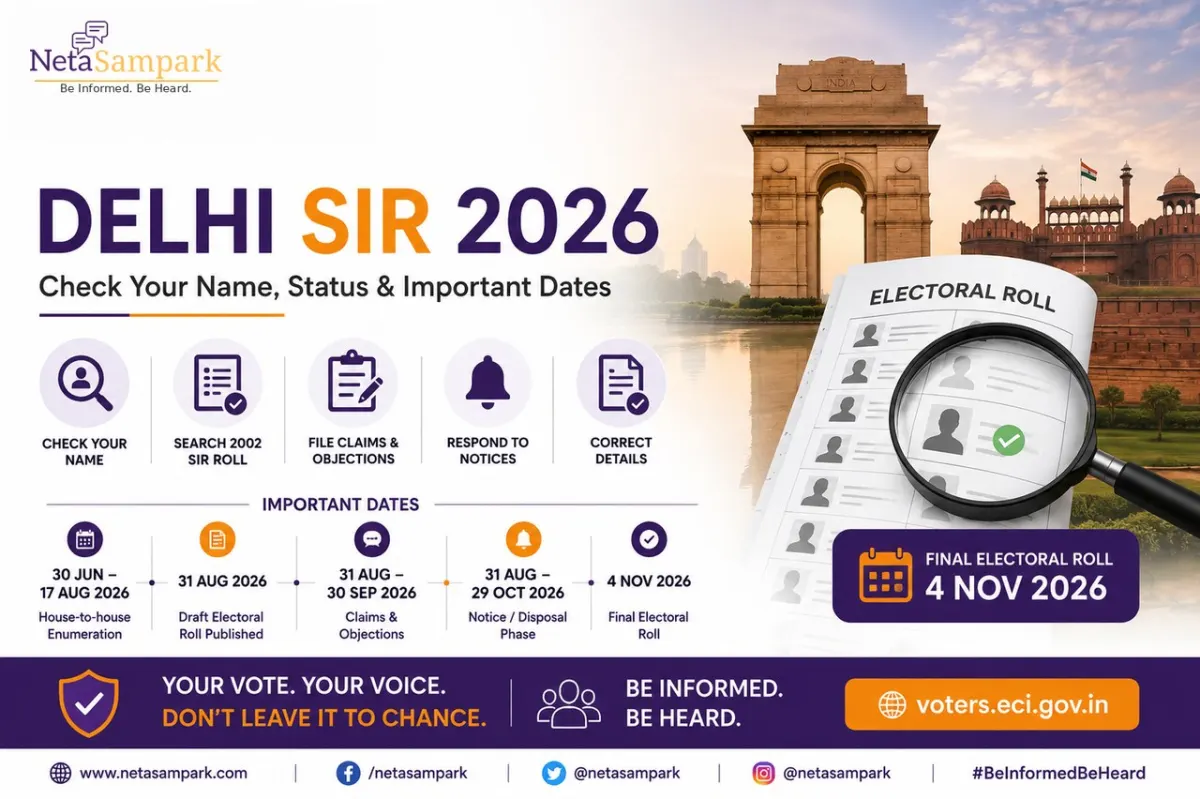
A Special Intensive Revision (SIR) of electoral rolls is not the final voter list. It is a detailed revision exercise through which election authorities verify and update electoral-roll information before publishing the final roll.
If your name is missing from the draft roll, your details are incorrect, or you believe an ineligible or duplicate entry appears in the roll, this is the stage at which you should check the record and use the appropriate electoral process.
The most important rule is simple:
Don't rely on a social-media post saying your name was deleted. Check the official electoral roll and the instructions issued by your Chief Electoral Officer (CEO).
The Election Commission of India (ECI) has published state-wise SIR schedules, while the actual claims, objections and notices are handled through the relevant electoral authorities.
What Is SIR?
Special Intensive Revision (SIR) is an electoral-roll revision exercise involving detailed verification of electors.
The process can involve Booth Level Officers (BLOs), enumeration and verification, publication of a draft electoral roll, a period for claims and objections, disposal of those claims and objections, and finally publication of the electoral roll.
The important distinction is:
Draft electoral roll ≠ final electoral roll.
The draft is published so that eligible citizens can check their entries and raise legitimate claims or objections.
The ECI's FAQ explains that claims and objections can be viewed through the website of the concerned State's Chief Electoral Officer and at the office of the Electoral Registration Officer.
Why You Should Check the Draft RollA voter should not assume that an old EPIC card automatically means everything is correct in the current electoral roll.
Check whether:
- Your name appears in the draft roll.
- Your name is spelled correctly.
- Your address is correct.
- Your polling station details are correct.
- Your family members' entries are present where expected.
- A duplicate entry exists.
- A family member who has moved or died is still incorrectly listed.
- A newly eligible voter needs to be included.
The ECI provides online electoral-roll services, including searching your name, tracking applications and updating electoral-roll information.
Draft Roll vs Final RollThis distinction matters.
The draft electoral roll is published before claims and objections are processed.
Citizens can use this stage to:
- Check their entry.
- Submit a claim if their name is missing.
- Request correction of an incorrect entry.
- Raise an eligible objection where appropriate.
- Respond to a notice if one has been issued.
After the claims and objections have been considered and disposed of, the electoral authority publishes the final electoral roll according to the applicable schedule.
Therefore, seeing an entry in a draft roll—or seeing that an entry is missing from it—should not automatically be treated as the final outcome.
The 2026 SIR Schedule: Why State Dates MatterThere is no single claims-and-objections deadline for every SIR state.
The ECI's published schedule divides states and Union Territories into different phases. The dates therefore need to be checked state by state.
Phase involving Telangana and Punjab
The ECI's schedule specifies:
- Draft electoral roll: 31 July 2026
- Claims and objections: 31 July–30 August 2026
- Notice/disposal phase: 31 July–28 September 2026
- Final electoral roll: 1 October 2026
Phase involving Karnataka, Maharashtra, Jharkhand, Delhi, Meghalaya and Nagaland
The ECI schedule specifies:
- Draft electoral roll: 5 August 2026
- Claims and objections: 5 August–4 September 2026
- Notice/disposal phase: 5 August–3 October 2026
- Final electoral roll: 7 October 2026
This is important because the claims-and-objections deadline is not necessarily the same thing as the end of the entire SIR process.
If your state or CEO has subsequently issued an amended schedule, follow that latest official notification.
Which Form Do You Need?The correct form depends on what you are trying to accomplish.
Form 6 — Inclusion / New Registration
Form 6 is used for registration of a new elector/inclusion in the electoral roll.
The ECI's current electoral services specifically identify registration in the electoral roll as a citizen service, and its FAQ explains the process for inclusion through Form 6.
You may need Form 6 if, for example:
- You are eligible but your name is not enrolled.
- You have become eligible for registration.
- You need to make a new inclusion claim under the applicable process.
Do not file multiple Form 6 applications simply because one application is taking time. First check its status.
Form 7 — Objection or DeletionForm 7 is used for objections to inclusion and for specified deletion requests.
The ECI states that a person who is a voter in the concerned constituency can object to the inclusion of a name on specified grounds. Form 7 is also used for deletion of entries such as those relating to a person who has shifted, died, or where there is a duplicate entry.
This is not a form to use simply because you dislike a person's political affiliation or because somebody forwarded a message claiming that an individual is “not a real voter.”
Use the official criteria and provide relevant information or evidence.
Form 8 — Correction, Shifting and Replacement EPICForm 8 is used for several existing-elector services, including:
- Shifting residence
- Correction of entries
- Replacement of EPIC
- Marking as a person with disability (PwD), where applicable
The ECI's official forms page identifies Form 8 for shifting of residence, correction of existing electoral-roll entries, replacement of EPIC and marking of PwD.
If your name is present but something about the entry is wrong, Form 8 may be the relevant route rather than Form 6.
A Simple Decision GuideMy name is missing
→ Check the official roll first.
If you are eligible and your name genuinely needs inclusion:
→ Form 6
My name is present but the details are wrong
→ Form 8
I have shifted residence
→ Form 8
My EPIC needs replacement
→ Form 8
I believe another entry should be deleted or an inclusion should be objected to on a legitimate ground
→ Form 7
If you're uncertain, check the ECI instructions or contact the relevant electoral officer rather than guessing.
Where Can You File?1 ECI Citizen Services
The ECI's official voter-services ecosystem provides online services for registration, application tracking, e-EPIC and updating electoral-roll information.
Start with the official ECI citizen portal:
2 Check the SIR Electoral Roll
The ECI's SIR service allows citizens to search the relevant previous SIR electoral-roll data.
The portal provides search options including EPIC number and elector details, along with State, district, Assembly Constituency and polling-station information.
The ECI also notes that the historical SIR data displayed on its platform is received from the relevant State CEO and hosted by the ECI without modification.
That makes the official portal a much better starting point than a screenshot circulating on social media.
3. Contact Your BLOYour Booth Level Officer (BLO) is part of the field-level electoral machinery.
If your case involves verification or you have a question about your electoral-roll entry, the BLO may be an important point of contact.
Keep these ready before contacting the officer:
- EPIC number
- Application/reference number
- Address
- Relevant documents
- Screenshot of the current electoral-roll entry
- One clear question
For example:
“My name appears in the previous roll but I cannot find it in the current draft. My EPIC number is XXXXX. What is the appropriate process for filing my claim?”
That is considerably more useful than simply saying:
“My name has been deleted.”4. Contact the ERO / AERO
The Electoral Registration Officer (ERO) is responsible for decisions concerning electoral-roll registration and related applications.
The Assistant Electoral Registration Officer (AERO) may also handle relevant processes.
If your application involves a formal claim, objection or hearing, keep the acknowledgement/reference number and follow the instructions issued by the election authorities.
The ECI's FAQ confirms that decisions on inclusion applications are communicated to applicants and that electoral rolls are available through the concerned State CEO website.
Don't Miss a NoticeIf an electoral authority issues a notice relating to your entry, don't ignore it.
Read:
- The reason for the notice
- The date
- The authority issuing it
- The documents requested
- The deadline
- Where you need to appear or respond
Keep a copy of everything you submit.
A clean paper trail can make a later follow-up much easier.
What Documents Should You Keep Ready?The exact documents required depend on the application and the instructions applicable to your case.
As a practical preparation step, keep copies of relevant:
- Age/date-of-birth documents
- Ordinary-residence documents
- Existing EPIC
- Application acknowledgements
- SIR/enumeration-related documents
- Relevant supporting records
Do not hand over original documents to an unofficial intermediary.
And remember:
Government forms should not become an opportunity for someone to charge you simply for accessing an official form.
Use the official ECI/CEO channels wherever possible.
What Happens After You File?Filing an application does not necessarily mean the change is immediately approved.
Depending on the case, the process can involve:
Application → verification → scrutiny → decision → updated electoral roll
The ECI notes that the ERO may ask the BLO to visit the applicant's residence and verify information where required.
You should therefore:
- Save your reference number.
- Track the application.
- Respond to any notice.
- Attend a hearing if required.
- Keep copies of your documents.
- Check the final electoral roll.
Don't immediately conclude that you have been permanently removed from the electoral roll.
First:
Step 1
Search the current electoral roll.
Step 2
Try variations of your name if the search permits it.
The ECI's SIR search tool specifically warns that spelling variations can affect results and suggests trying different name variations.
Step 3
Check the relevant previous SIR roll where applicable.
Step 4
Check with your BLO/ERO.
Step 5
Use the appropriate claim/application process.
Step 6
Save the acknowledgement.
Step 7
Check the final roll after the claims process.
Don't Trust “X Crore Names Deleted” Graphics Without CheckingSIR has generated significant discussion online, including claims about very large numbers of names being removed.
The safest approach is not to treat a viral graphic as your electoral status.
The ECI provides official electoral-roll and SIR search facilities, and the relevant State CEO is responsible for electoral-roll preparation, revision and correction in the State.
The question that matters to your household is much simpler:
Is my name correctly present in the electoral roll for my constituency?
Check that first.
State-by-State: Delhi, Maharashtra, Karnataka and TelanganaBecause SIR schedules differ, don't copy a deadline from another State.
Delhi
Delhi is included in the ECI's phase with Karnataka, Maharashtra, Jharkhand, Meghalaya and Nagaland.
The ECI schedule lists:
- Draft roll: 5 August 2026
- Claims and objections: 5 August–4 September 2026
- Notice/disposal: 5 August–3 October 2026
- Final roll: 7 October 2026
For any later extension or state-specific instruction, check the latest notification from the Chief Electoral Officer, Delhi.
Maharashtra
Maharashtra is in the same ECI SIR phase as Delhi and Karnataka.
The published ECI schedule lists:
- Draft roll: 5 August 2026
- Claims and objections: 5 August–4 September 2026
- Notice/disposal: 5 August–3 October 2026
- Final roll: 7 October 2026
Do not substitute a media-reported date for the latest official CEO notification if the schedule has subsequently changed.
Karnataka
Karnataka is also included in the same phase.
The ECI schedule lists:
- Draft roll: 5 August 2026
- Claims and objections: 5 August–4 September 2026
- Notice/disposal: 5 August–3 October 2026
- Final roll: 7 October 2026
If your draft entry requires correction or your name is missing, use the appropriate official process rather than waiting for the final roll.
Telangana
Telangana is in a different phase.
The ECI schedule lists:
- Draft roll: 31 July 2026
- Claims and objections: 31 July–30 August 2026
- Notice/disposal: 31 July–28 September 2026
- Final roll: 1 October 2026
Therefore, the Telangana timeline should not be presented using the same deadline as Delhi or Maharashtra.
Your Family SIR ChecklistDo this before the applicable deadline or notice date.
- Search every eligible family member's name.
- Check spelling.
- Check address.
- Check polling-part information.
- Check whether recently moved family members have the correct entry.
- Check newly eligible voters.
- Check previous SIR information where relevant.
- Identify any discrepancy.
- Choose Form 6, 7 or 8 as appropriate.
- File through the official channel.
- Save the acknowledgement/reference number.
- Respond to any notice.
- Track the application.
- Check the final electoral roll.
Don't wait until the last evening.
Take 10–15 minutes and check your household's electoral-roll entries.
If everything is correct:
Save the confirmation/reference information and move on.
If something is wrong:
Identify the correct form and file the appropriate claim or application.
If you receive a notice:
Read it carefully and respond within the specified process and deadline.
If you're unsure:
Contact the BLO, ERO/AERO or the official voter helpline rather than relying on a forwarded message.
The ECI lists 1950 as its voter-services helpline.
And Once Your Voter Entry Is Sorted…Electoral participation doesn't end with checking a name on a list.
You also need to know who represents your area between elections.
Your MP, MLA and local representatives are part of the accountability chain when issues involving roads, sanitation, public services, local infrastructure and government delivery arise.
That's where NetaSampark can complement the official electoral system.
Find your representatives:
NetaSampark Representatives
Explore civic tools:
NetaSampark Explore
ECI handles the official electoral process.
NetaSampark helps citizens stay connected with their representatives and civic life between elections.
The Bottom LineA draft electoral roll is an opportunity to check, question and correct—not a reason to panic.
Check the official roll.
Use the right form.
Keep your documents.
Save your reference number.
Respond to notices.
And verify the final roll when it is published.
Most importantly, use the deadline that applies to your State—not a deadline copied from a social-media graphic or another State.
Be Informed. Be Heard.
Non-partisan civic explainer. SIR schedules and administrative instructions can change. The dates above reflect the Election Commission of India's published SIR schedule checked on 10 September 2026; citizens should verify the latest notification from their State Chief Electoral Officer before filing a claim or objection.
Official sources
- Election Commission of India — SIR 2026 schedule
- ECI — Electors services
- ECI — SIR electoral-roll search
- ECI — Electoral-roll FAQs
- ECI — Electoral-roll forms