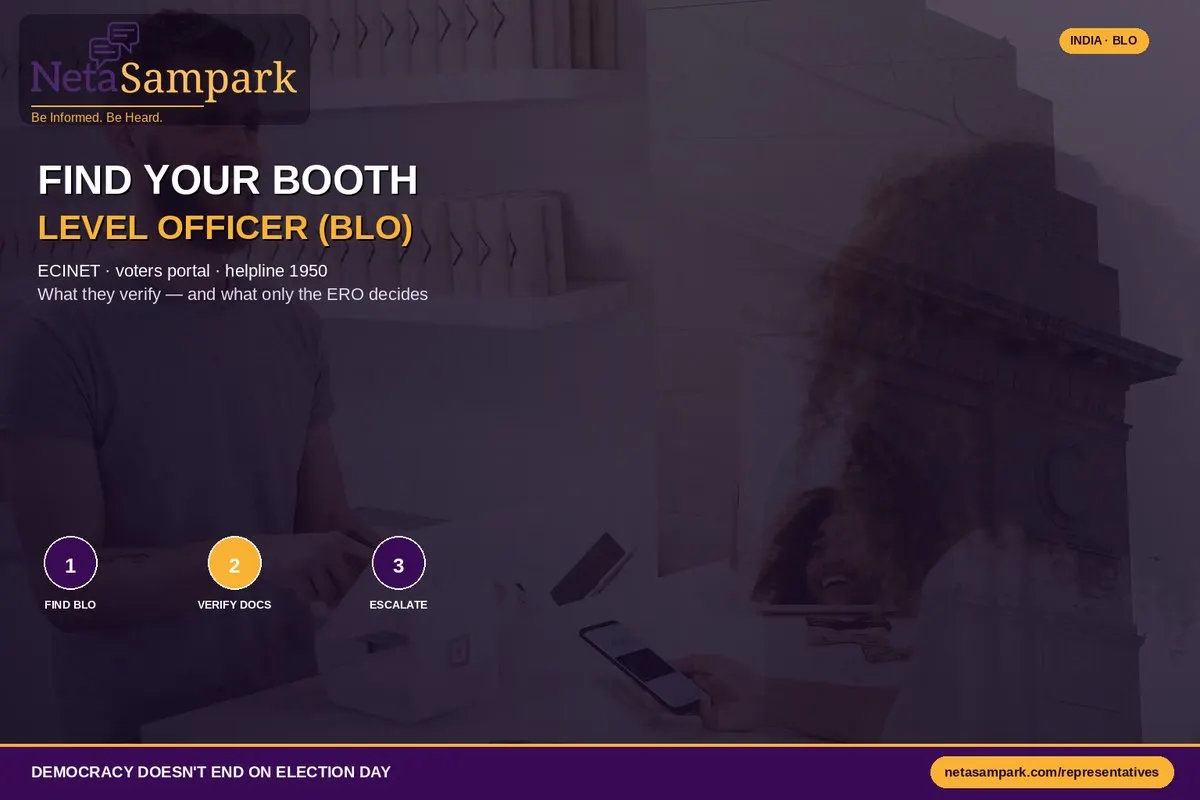
Quick take: The Booth Level Officer (BLO) is one of the election system’s most important neighbourhood-level contacts. A BLO can help voters understand forms, verify information during electoral-roll revision, and communicate issues to the election authorities. But a BLO does not personally decide every claim, objection, inclusion or deletion. Those statutory decisions are handled by the appropriate Electoral Registration Officer (ERO).
Understanding who does what—and where to go when something gets stuck—can save voters a lot of unnecessary confusion.
This guide focuses specifically on the BLO relationship:
Find → Ask → Document → Follow up → Escalate
For the broader ECINET voter-services guide, see our ECINET Citizen Guide: Voter Services in 2026.
Who is a Booth Level Officer?
A Booth Level Officer, commonly called a BLO, is an election official assigned to a particular polling part.
BLOs are generally drawn from government or public-sector personnel who are assigned election duties. Their work connects the electoral-roll administration with voters at the local level.
Depending on the election and revision exercise, BLO responsibilities can include:
- conducting or supporting house-to-house verification;
- helping voters understand electoral forms;
- collecting or receiving information during revision exercises;
- verifying information and documents where required;
- identifying potential cases involving shifted, deceased or duplicate electors;
- assisting with electoral-roll-related field verification; and
- reporting relevant information to the appropriate election authorities.
The BLO therefore acts as an important field-level link between citizens and the electoral administration.
However, it is important to understand the distinction between field verification and statutory decision-making.
A BLO's report or recommendation does not mean that the BLO personally has unlimited authority to alter the electoral roll.
BLO vs ERO: the distinction matters
A common source of confusion is the statement:
“The BLO deleted my name.”
In many situations, what actually happened is that a BLO conducted field verification or reported information, after which the competent election authority followed the prescribed process.
The Electoral Registration Officer (ERO) is responsible for statutory decisions concerning claims and objections relating to electoral-roll entries, subject to the applicable law and procedure.
That distinction matters if you disagree with an outcome.
Instead of arguing only with the BLO, ask:
What is the status of my application or objection, and what order has been passed by the competent authority?
That gives you a document trail that can actually be followed up.
How to find your BLO
Use official election channels rather than relying on old contact lists circulating on social media.
1. Check official voter services
Start with the Election Commission's voter-services ecosystem:
Voters' Services Portal:
Depending on the service and election phase, your electoral information may provide details that help you identify the relevant polling part and election officials.
2. Check your Chief Electoral Officer website
Your state's Chief Electoral Officer (CEO) website may provide polling-part information, BLO directories or other election-contact information.
The exact format varies by state and election.
3. Call 1950
The national voter helpline 1950 can be used for voter-service assistance.
Keep your:
- EPIC number;
- name;
- address; and
- polling-part information, if available
ready when contacting the helpline.
4. Contact the ERO/AERO election office
If you cannot identify your BLO through digital channels, contact the relevant Electoral Registration Officer (ERO) or Assistant Electoral Registration Officer (AERO) office.
Take your EPIC and relevant address information with you if visiting in person.
5. Look for official notices
During electoral-roll revision and election periods, information about BLOs and polling arrangements may also be displayed through official local notices.
Avoid unofficial BLO lists
Be careful with social-media posts offering:
“Latest BLO number list”
or
“BLO WhatsApp contact PDF.”
Election personnel change, phone numbers become outdated, and unofficial lists can expose voters to scams.
Never share your OTP, password or sensitive documents with an unknown person claiming to be a BLO.
Use Book-a-Call when it is available
The Election Commission's digital voter-services ecosystem may provide a Book-a-Call facility in applicable circumstances.
If the feature is available to you, it can be more convenient than repeatedly trying to contact an official during working hours.
If you schedule a call:
- save the booking/reference details;
- keep your EPIC number ready;
- write down your questions beforehand; and
- keep relevant documents available.
The objective should be a short, specific conversation.
What can a BLO help you with?
The exact duties can vary depending on the election and revision exercise, but voters may approach their BLO for assistance with matters such as:
Electoral-roll verification
A BLO may help with field verification relating to your electoral entry.
Forms and applications
A BLO can provide guidance about the appropriate electoral form and the information required for the process.
Depending on the circumstances, this can include forms such as:
- Form 6 — registration/inclusion;
- Form 7 — objection/deletion-related applications; and
- Form 8 — correction and other applicable electoral updates.
Always use the form and process applicable to the current election/revision.
Address and residence verification
During relevant revision exercises, BLOs may conduct or assist with verification of residence and other electoral information.
Shifted, deceased or duplicate entries
BLOs can identify or report information relevant to potential:
- shifted electors;
- deceased electors; or
- duplicate entries.
The final statutory process remains with the competent election authority.
Hearing-related information
If a voter has been called for a hearing or verification, the BLO may be able to explain the local process or direct the voter to the appropriate election office.
What a BLO cannot simply decide
Understanding the limits of the role is just as important as knowing what the BLO can do.
“The BLO rejected my application.”
A BLO may identify incomplete information or conduct field verification, but don't assume that every negative outcome is a final statutory decision by the BLO.
Ask for the status of the application and, where applicable, the order of the competent ERO.
“The BLO guaranteed that my name will be added tomorrow.”
A BLO cannot necessarily guarantee the date or outcome of a statutory electoral-roll decision.
Processing involves the prescribed election procedure.
“The BLO can delete anyone immediately.”
Electoral-roll deletion is subject to the applicable statutory process. A field-level report should not be confused with the final decision of the competent authority.
“The BLO must come to my house whenever I call.”
Election officials have assigned duties and schedules. Use the notified channels and appropriate contact mechanisms rather than expecting an official to respond at any time.
“BLO and BLA are the same thing.”
They are not.
A BLO is part of the official election administration.
A BLA (Booth Level Agent) is associated with a political party.
Do not confuse the two.
How to speak to your BLO effectively
You don't need a ten-minute explanation.
Give the official enough information to identify your case and understand the specific problem.
A simple format is:
“Namaste. I am [Name]. My EPIC number is [number], and my part number is [if known].”
“I need help with [inclusion/correction/address verification/another specific issue].”
“These are the documents I have.”
“Please tell me what information or document is required next.”
“If this needs to go to the ERO, what reference or acknowledgement should I keep?”
If a hearing is involved, also ask:
“How will I receive the hearing notice and where should I check the status?”
Write down the answer.
A notebook entry with the date, officer, issue and reference number is far more useful later than trying to remember a conversation from three weeks ago.
Bring the right documents
If you are meeting a BLO about an electoral-roll issue, carry the documents relevant to your specific case.
Depending on the matter, these may include:
- EPIC / voter details;
- application or reference number;
- address or residence documents;
- age/DOB documents where relevant;
- copies of previously submitted forms;
- acknowledgements; and
- any official notice you received.
Carry copies where appropriate and keep your originals secure.
Never hand over original documents unless the authorised procedure specifically requires it.
When should you escalate beyond the BLO?
A BLO is often the right starting point for a local electoral-roll issue.
But there are situations where you should move up the chain.
Consider escalating when:
- you cannot reach the BLO through official channels;
- repeated attempts produce no acknowledgement or progress;
- you are asked for money for an official electoral service;
- documents have been submitted but you have no usable acknowledgement;
- you are told that your name has been deleted but are not given information about the applicable process;
- you receive an adverse decision and need to understand the appeal process;
- a hearing or notice was not properly communicated; or
- a recurring problem affects many voters in the same polling part.
The election-administration escalation ladder
A practical escalation path is:
BLO
↓
AERO / ERO
↓
District Election Officer (DEO)
↓
Chief Electoral Officer (CEO) / applicable grievance channel
↓
Election Commission of India, where the matter falls within the relevant Commission process.
The exact route and appeal structure can depend on the type of application, decision and election exercise.
When escalating, don't simply write:
“Nobody is helping me.”
Instead provide:
- your name;
- EPIC/reference number;
- polling part;
- date of application;
- date of BLO interaction;
- documents submitted;
- response received; and
- the specific action you are requesting.
A short factual chronology is much easier for another officer to act upon.
BLO vs ERO vs DEO
OfficialPrimary roleCan make the statutory first-instance decision on electoral-roll claims/objections?BLOLocal field verification, voter assistance and reportingNoAERO / EROElectoral-roll administration and statutory decisionsYes, within the applicable jurisdiction and procedureDEODistrict-level election administration and supervisionHandles matters within the applicable supervisory/appeal frameworkCEOState-level election administrationHandles matters within the applicable state-level framework
The important lesson is:
Do not fight the wrong desk.
If a BLO has completed field verification but the issue concerns a formal ERO decision, your next step may need to be with the ERO rather than repeatedly asking the BLO to reverse something they do not have authority to reverse.
What if you are asked for money?
Routine voter services and electoral-roll processes should follow the officially prescribed procedures and fees, if any.
If someone claiming to be an election official asks you for an unofficial payment:
- Don't hand over money simply because the person claims to be a BLO.
- Ask for the official basis for the payment.
- Keep any relevant receipt, message or reference.
- Verify the person's identity through the appropriate election office.
- Report suspected misconduct through the appropriate official channel.
Most importantly:
Never share an OTP or banking credentials with someone claiming they need them to “update your voter ID.”
What if your BLO is overworked or difficult to reach?
Election administration involves large numbers of voters, particularly during intensive revision exercises and election periods.
If the BLO is unavailable, don't let the entire process stop there.
Use the official alternatives:
BLO → 1950 → AERO/ERO → CEO/grievance channel
Keep a record of each attempt.
For example:
DateChannelWhat happenedReference11 SeptBLONo response—12 Sept1950Guidance receivedXXXXX13 SeptERODocuments submittedXXXXX
That small record can become valuable if you eventually need to escalate.
A family BLO checklist
If you're helping your family prepare for an electoral-roll revision, create a simple list:
PersonEPIC checkedBLO detailsDocuments readyFollow-upAdult 1☐☐☐☐Adult 2☐☐☐☐New voter☐☐☐☐Elder☐☐☐☐
Do this before a deadline or hearing becomes urgent.
If someone needs help, assist them with their consent and let them retain control of their own documents and electoral decisions.
Keep your reference numbers
This is one of the simplest habits that can improve any interaction with election authorities.
Whenever you submit something, save:
- application number;
- grievance number;
- acknowledgement;
- date of submission;
- officer/office contacted; and
- next expected step.
Take screenshots where appropriate and keep copies offline.
If a matter needs escalation, you can then say:
“Application XXXXX was submitted on 4 September. Documents were provided on 6 September. The status has not changed.”
That is much stronger than:
“Nobody has done anything.”
Where NetaSampark fits
Election officials administer the electoral process. NetaSampark serves a different purpose: helping citizens understand who represents their area and how political representation fits into civic life between elections.
If an electoral or civic issue reveals a broader local problem, you can identify your:
- corporator/councillor;
- MLA; and
- MP
through NetaSampark.
Find your representatives:
https://netasampark.com/representatives
Explore NetaSampark:
https://netasampark.com/explore
A representative cannot replace the ERO or election authority. But when a recurring issue affects a community, giving a representative a documented pattern of complaints and reference numbers can make political follow-up more meaningful.
The bottom line
Your BLO is often the closest official contact in the electoral system.
Use that relationship properly:
Find the right BLO.
Ask one clear question.
Carry the relevant documents.
Save every reference number.
Follow up through official channels.
Escalate to the ERO or higher authority when necessary.
And remember the most important distinction:
The BLO is the field-level link. The ERO is the statutory decision-maker for electoral-roll claims and objections.
Don't waste your time arguing with the wrong desk.
Find → Ask → Document → Follow up → Escalate.
Be Informed. Be Heard.
Non-partisan civic explainer. BLO assignments, contact details, portal features and election procedures can change between revision exercises and elections. Always verify current information through the Election Commission of India and the relevant Chief Electoral Officer before acting. Last editorial pass: 11 September 2026 (IST).