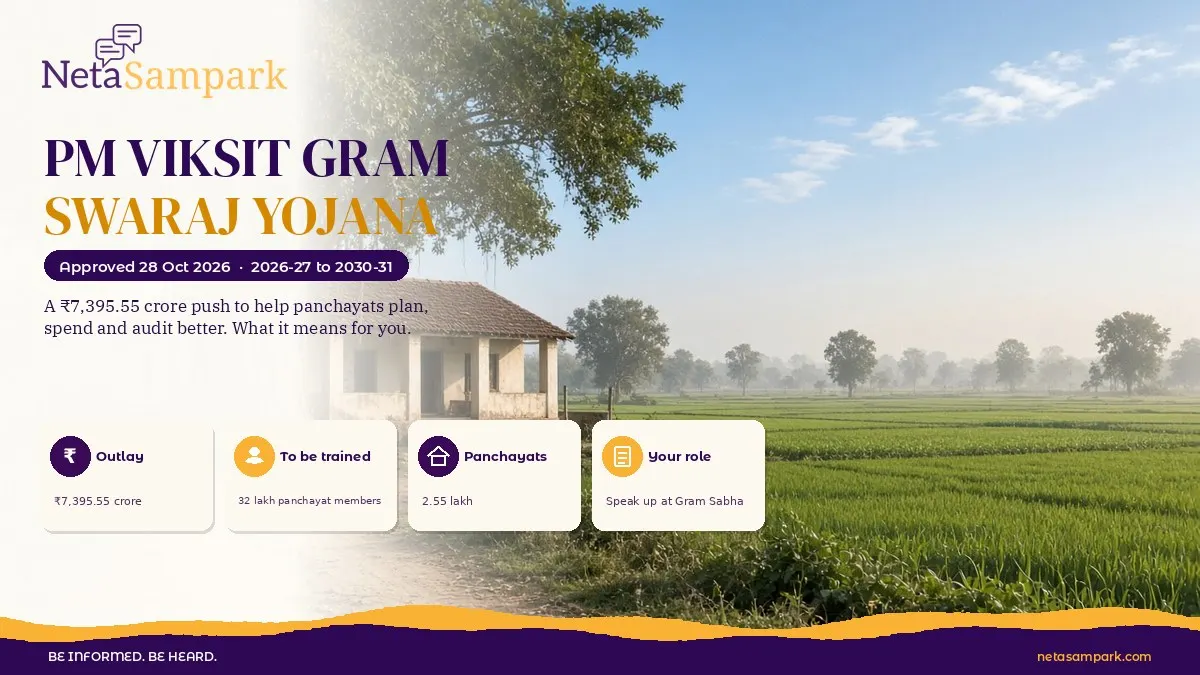
PM Viksit Gram Swaraj Yojana is a new centrally sponsored scheme, approved by the Union Cabinet on 28 October 2026, to help 2.55 lakh panchayats plan, spend and audit better from 2026-27 to 2030-31. It costs ₹7,395.55 crore and will train about 32 lakh elected panchayat members. It's not a cash scheme for individuals.
Updated 30 October 2026
Quick facts
| Item | Details |
|---|---|
| Official portal | eGramSwaraj for your panchayat's plan and spending; Ministry of Panchayati Raj |
| Helpline | Your Gram Panchayat secretary or Block Development Officer; scheme queries to the state Panchayati Raj department |
| Fee | None; citizens don't apply or pay |
| Deadline | Scheme period 2026-27 to 2030-31; your Gram Sabha decides the yearly plan |
| Documents | None for citizens; bring your demand in writing to the Gram Sabha |
| Outlay | ₹7,395.55 crore (Centre ₹4,869.48 crore, States ₹2,526.07 crore) |
| Related posts | Check if your demand entered the GPDP, VB-G RAM G's 375 works |
What exactly did the Cabinet approve?
On 28 October 2026, the Union Cabinet approved the Pradhan Mantri Viksit Gram Swaraj Yojana (PM VGSY) as a Centrally Sponsored Scheme. It runs for five years, from 2026-27 to 2030-31, the same period as the Sixteenth Finance Commission.
The money is meant for building the capacity of panchayats, not for direct benefit transfers. Think of it as training, digital tools and support staff so that panchayats can use the much bigger grants coming their way properly.
How big? The PIB release says the Sixteenth Finance Commission has recommended around ₹4.35 lakh crore in grants for rural local bodies over 2026-27 to 2030-31. PM VGSY is meant to help panchayats plan and spend that money well.
What will the scheme actually do?
The PIB release lists four big outcomes:
1. A proper village plan every year. Support for 2.55 lakh holistic Gram Panchayat Development Plans (GPDPs) each year on the eGramSwaraj portal, bringing together village needs, central and state schemes and available money.
2. Awareness for citizens. Each awareness drive should reach at least 1 crore citizens, through Gram Sabhas, digital platforms and other panchayat forums.
3. Training for elected members. Around 32 lakh elected representatives, plus panchayat staff, will get training and digital handholding every year.
4. Audits that actually happen. At least 2.55 lakh online audit plans a year, with audits completed on AuditOnline, plus better accounting, public disclosure and more own-revenue collection.
The scheme also brings in PANCHAM, an AI-enabled two-way communication platform that works in 17 Indian languages, to explain schemes in simple language.
Who are the beneficiaries?
The direct beneficiaries are elected panchayat representatives, panchayat functionaries and other stakeholders across over 2.55 lakh panchayats and traditional local bodies. The scheme also covers traditional local bodies in areas where Part IX panchayats don't exist, such as some Northeast and tribal regions.
Ordinary villagers benefit indirectly, through better plans, more open accounts and faster work on the ground.
Will this create government jobs?
No permanent posts will be created. The scheme may hire contractual staff at state, district and block levels for technical support, depending on need. So if you see a social media post promising "PM VGSY recruitment" with a fee, be very careful and check your state Panchayati Raj department's website first.
How will it be run?
States and UTs will prepare Annual Action Plans listing what they want to do. A Central Empowered Committee will appraise and approve these. The Centre and the states then implement their parts, using existing training institutes, digital systems and communication channels.
What is a GPDP, in simple words?
A Gram Panchayat Development Plan (GPDP) is your village's yearly to-do list with a budget. It lists the works the panchayat wants to take up, like drains, roads, water supply, school repairs or anganwadi upgrades, and shows which fund will pay for each. The Gram Sabha is supposed to discuss and approve it, and it's then uploaded on eGramSwaraj. Under PM VGSY, the idea is to make this plan "holistic", so central and state departments put their village-level work into the same plan instead of working separately. The PIB release says existing department arrangements for delivering individual schemes will continue, so your pension, ration or housing scheme doesn't change.
Why should a villager care?
Because the Gram Sabha is where this money turns into roads, drains, water tanks and school repairs. If your Gram Sabha doesn't raise your demand, it won't enter the plan, and if it's not in the plan, it won't get funded. This scheme makes planning more structured and makes it easier to see on eGramSwaraj what's been approved and spent.
How can you use this, step by step?
1. Find your panchayat on eGramSwaraj. Open egramswaraj.gov.in, pick your state, district, block and panchayat, and look at the approved plan and spending reports.
2. Attend the Gram Sabha. Ask your panchayat secretary for the next date. Every adult voter in the village is a member.
3. Raise your demand in writing. A short letter with the problem, location and what you want done. Ask for it to be recorded in the minutes.
4. Check if it entered the GPDP. After the plan is uploaded, search for your work on eGramSwaraj. Our GPDP follow-up guide shows how.
5. Follow the money. Look at payments and audit status. With AuditOnline being pushed under this scheme, audit reports should be easier to find.
6. Escalate if ignored. Go to the BDO, then the district panchayat officer, and raise it with your MLA or MP.
Real-life examples
Example 1, a ward member in Odisha. Sunita, a first-time ward member, gets PM VGSY training on reading the GPDP and using eGramSwaraj. She can now show villagers which works were approved.
Example 2, a farmer in Maharashtra. Ganesh wants a check dam. He raises it at the Gram Sabha, gets it minuted, and later finds it listed in the GPDP.
Example 3, a fake job message. Rekha gets a WhatsApp message asking for ₹500 to apply for "PM VGSY coordinator" posts. She checks the state website, finds nothing, and ignores it.
Checklist for citizens
☐ Find your panchayat's plan on eGramSwaraj
☐ Note the next Gram Sabha date
☐ Write your demand with location and details
☐ Get it recorded in the Gram Sabha minutes
☐ Check the uploaded GPDP for your work
☐ Ignore any "recruitment" message that asks for money
Final reminder
PM VGSY won't put money in your account, but it can change how your village money is planned and spent. Show up at your Gram Sabha, put your demand in writing, and check eGramSwaraj. If the panchayat won't listen, your MLA should. Find them on NetaSampark's Know Your Neta.
Frequently asked questions
What is PM Viksit Gram Swaraj Yojana?
A centrally sponsored scheme approved on 28 October 2026 to strengthen panchayats through planning support, training, awareness and online audits from 2026-27 to 2030-31.
What is the budget of PM VGSY?
₹7,395.55 crore in total, with ₹4,869.48 crore from the Centre and ₹2,526.07 crore from the states.
Can I apply for PM VGSY benefits?
No. It isn't an individual benefit scheme. It supports panchayats and their elected members.
Will PM VGSY create jobs?
No permanent posts will be created. Some contractual technical staff may be hired at state, district and block levels.
What is PANCHAM?
An AI-enabled, two-way communication platform in 17 Indian languages that will be used to explain government schemes to people in simple language.
Sources
PIB: Cabinet approves Pradhan Mantri Viksit Gram Swaraj Yojana, 28 October 2026