
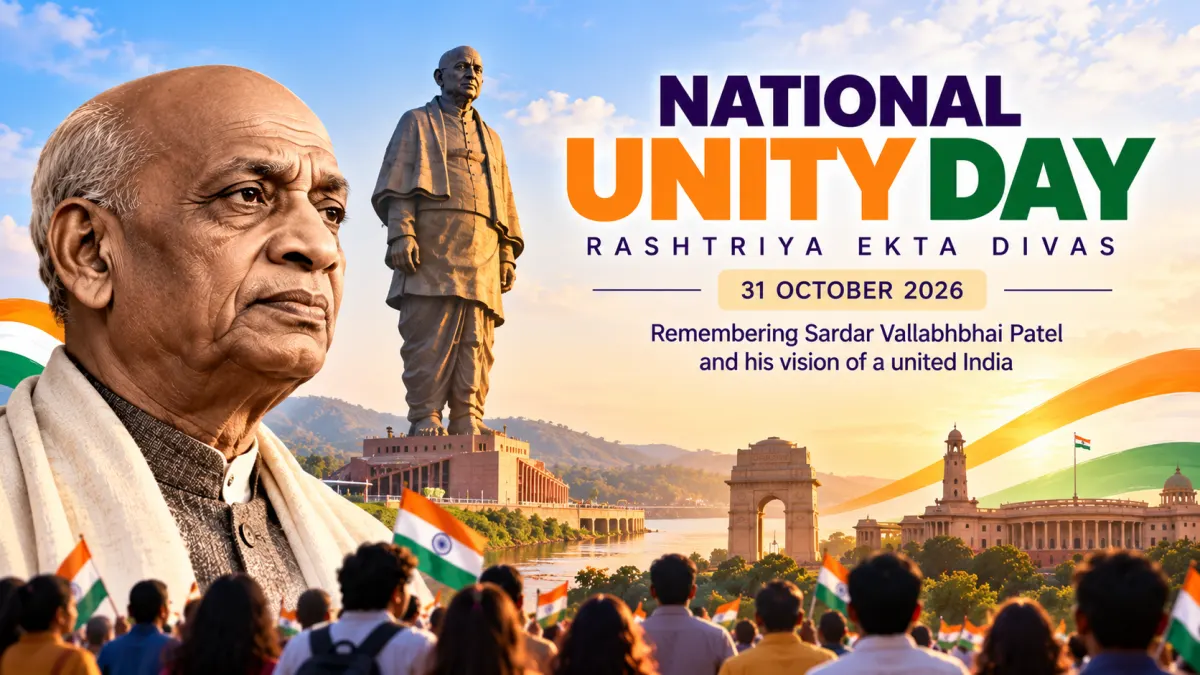
National Unity Day 2026: History, Significance and Sardar Vallabhbhai Patel
Every year on 31 October, India observes National Unity Day, also known as Rashtriya Ekta Diwas, to commemorate the birth anniversary of Sardar Vallabhbhai Patel, one of the most influential leaders of India's freedom struggle and its early years of independence.
The day celebrates an idea that remains central to Indian democracy: a nation as diverse as India can move forward when its people recognise their shared identity, respect their differences and work towards common goals.
India is home to hundreds of languages, numerous religious traditions, diverse cultural practices and communities with different histories and aspirations. Preserving this diversity while strengthening national unity is an ongoing responsibility shared by citizens, institutions and public representatives.
In 2026, National Unity Day marks the 151st birth anniversary of Sardar Vallabhbhai Patel, who was born on 31 October 1875. It is an opportunity to revisit his contribution to India's political integration, understand why the day was established and reflect on what national unity means in everyday life.
What Is National Unity Day (Rashtriya Ekta Diwas)?
National Unity Day is a national observance dedicated to promoting the unity, integrity and security of India. It honours Sardar Vallabhbhai Patel's contribution to bringing the country together following independence in 1947.
The Government of India announced the observance in October 2014, designating 31 October as Rashtriya Ekta Diwas. The first celebrations took place that year, with activities intended to encourage public participation and strengthen awareness of Patel's role in nation-building.
| Detail | Information |
|---|---|
| Official name | Rashtriya Ekta Diwas |
| English name | National Unity Day |
| Date | 31 October every year |
| Person commemorated | Sardar Vallabhbhai Patel |
| First observed | 2014 |
| Central message | Unity, integrity and national solidarity |
The observance is not limited to remembering a historical figure. It encourages people to consider how their actions can strengthen social harmony, mutual respect and the country's collective well-being.
Who Was Sardar Vallabhbhai Patel?
Sardar Vallabhbhai Patel (1875–1950) was an Indian freedom fighter, lawyer and statesman who played a major role in India's independence movement and the integration of princely states after independence.
Popularly known as the Iron Man of India, Patel served as independent India's first Deputy Prime Minister and first Home Minister.
Patel was born on 31 October 1875 in Nadiad, in present-day Gujarat. He initially established himself as a lawyer before joining the national movement under the influence of Mahatma Gandhi.
His leadership became particularly prominent during peasant movements in Gujarat, including the Kheda Satyagraha of 1918 and the Bardoli Satyagraha of 1928. His work during the Bardoli movement strengthened his reputation as an organiser and leader, and the title Sardar became widely associated with him.
After India gained independence in August 1947, Patel took on significant responsibilities in the new government. He helped address the challenges of Partition, administrative uncertainty and the political future of hundreds of princely states.
His contribution to India's political integration is one of the principal reasons National Unity Day is observed in his memory.
Why Is National Unity Day Celebrated on 31 October?
National Unity Day is celebrated on 31 October because it is the birth anniversary of Sardar Vallabhbhai Patel.
In 2014, the Government of India formally announced that his birth anniversary would be observed as Rashtriya Ekta Diwas. The stated purpose was to recognise his contribution to the freedom movement and national integration, while encouraging citizens to reaffirm their commitment to India's unity, integrity and security.
The first observance included initiatives such as the Run for Unity, unity pledges and public programmes. Since then, educational institutions, government departments and other organisations have marked the day through activities intended to bring people together.
The significance of 31 October therefore extends beyond a birthday commemoration. It is a reminder that national unity must be built, maintained and renewed across generations.
Sardar Patel's Greatest Contribution: Integrating India After Independence
One of the most significant challenges facing India in 1947 was the political integration of the princely states.
At independence, British India consisted of territories directly administered by the British as well as hundreds of princely states ruled by their own monarchs. The end of British rule created uncertainty about the future political relationships of these states.
Under the Indian Independence Act of 1947, the princely states' relationship with the British Crown ended, and their future political arrangements had to be resolved.
Sardar Patel, working closely with V. P. Menon and other officials, led the effort to integrate these states into the Indian Union. Through negotiation, political persuasion and administrative action, the government brought together more than 560 princely states. Official accounts commonly cite the figure of 562 states in describing this achievement.
Why was this integration so important?
Without political integration, India could have faced serious challenges in governance, transport, economic development, national security and the movement of people and goods.
The integration process helped establish the territorial and administrative foundations of a united India. Although it involved the contributions of many leaders and officials, Patel's leadership was central to this achievement.
His legacy demonstrates that national unity requires more than a shared identity. It also depends on institutions, negotiation, cooperation and the ability to resolve differences.
Why Is Sardar Vallabhbhai Patel Called the Iron Man of India?
The title Iron Man of India reflects Patel's reputation for determination, firmness and administrative resolve.
His leadership during the freedom movement demonstrated his ability to organise people around shared objectives. His work after independence showed his commitment to building a stable political union during a period of considerable uncertainty.
Three aspects of his legacy stand out:
- Political integration: He played a leading role in bringing the princely states into the Indian Union.
- Administrative institution-building: He supported a strong, professional civil service to help maintain continuity and effective governance.
- Collective action: His work in peasant movements demonstrated the power of organised public participation.
Patel's contribution should also be understood within the broader independence movement. India's freedom and nation-building were the result of the efforts of numerous leaders, freedom fighters, administrators and ordinary citizens.
National Unity Day provides an opportunity to recognise Patel's distinctive role while remembering this wider collective contribution.
The Statue of Unity: A Landmark Dedicated to National Integration
One of the most recognisable tributes to Sardar Vallabhbhai Patel is the Statue of Unity, located at Ekta Nagar in Gujarat, overlooking the Narmada River.
Standing 182 metres tall, the monument is the world's tallest statue. It was inaugurated on 31 October 2018, on Patel's birth anniversary.
The statue represents Patel's role in India's national integration and has become a major landmark associated with his legacy.
The surrounding Ekta Nagar area also hosts commemorative programmes and public attractions. National Unity Day celebrations there have included the unity pledge, ceremonial parades, cultural performances and activities involving security forces and young people.
The site gives visitors an opportunity to learn about Patel's life and reflect on the historical process through which modern India was consolidated.
How Is National Unity Day Celebrated Across India?
National Unity Day is observed through public events, educational activities and community initiatives. The exact programme varies by institution and location.
1. Run for Unity
Public runs and walks encourage people from different backgrounds to participate in a shared activity. The event promotes cooperation, physical participation and a common commitment to national unity.
2. National Unity Pledge
Government offices, schools and other institutions may organise pledge-taking ceremonies. Participants reaffirm their commitment to preserving the country's unity, integrity and security.
3. School and College Activities
Students can participate in debates, essays, quizzes, speeches, poster-making competitions and cultural programmes on national integration and India's diversity.
These activities encourage young people to explore India's history, understand the importance of shared civic values and appreciate the traditions of different communities.
4. Parades and Public Ceremonies
Official observances may include ceremonial parades, police and security-force participation, tributes to Patel and public addresses on national unity.
5. Cultural Programmes
Music, dance, exhibitions and presentations can showcase India's regional traditions and help people appreciate cultures beyond their own.
The Government of India's original 2014 instructions highlighted unity pledges, the Run for Unity and participation by educational institutions and public organisations.
What Does National Unity Mean in a Diverse Country Like India?
India's diversity is one of its defining characteristics. People speak different languages, follow different religions, celebrate different festivals and maintain distinct cultural traditions.
National unity does not require these differences to disappear. Rather, it means people can retain their identities while recognising that they share a common constitutional and civic framework.
The principle of unity in diversity is particularly important in a democratic society. Citizens may disagree on policies, political parties, economic priorities or social issues while still respecting one another's rights and dignity.
Unity is therefore not the same as uniformity. A strong democracy makes room for differences of opinion and provides peaceful ways to discuss and resolve disagreements.
National Unity Day encourages citizens to consider how these principles can be reflected in daily life: through respect for other communities, responsible public discussion, cooperation during difficult times and participation in democratic institutions.
Why National Unity Day Matters Today
Remembering historical achievements is important, but the relevance of National Unity Day lies equally in the challenges India faces today.
1. Promoting social harmony
Rumours, prejudice and hostility between communities can undermine trust. Citizens can contribute to social harmony by verifying information before sharing it, avoiding inflammatory content and engaging respectfully with people whose views differ from their own.
2. Respecting India's linguistic and cultural diversity
India's languages, literature, art, food and festivals are important parts of its collective heritage. Learning about other regions and traditions can encourage mutual understanding without requiring people to abandon their own identities.
3. Encouraging responsible citizenship
National unity is strengthened when citizens respect the law, understand their rights and responsibilities, participate in civic life and hold public institutions accountable through lawful and democratic means.
4. Building trust across communities
Cooperation often develops through everyday interactions: neighbours helping one another, students working together, community organisations solving local problems and people participating in shared public initiatives.
5. Strengthening democratic participation
A democracy depends on people being able to express concerns, discuss public issues and participate in decisions that affect their lives. Constructive disagreement is compatible with national unity when people respect constitutional principles and one another's rights.
These everyday actions help turn the idea of national integration into a lived experience rather than a value remembered only on a designated day.
National Unity Day and the Role of Young Indians
Young people have an important role in shaping how India's communities interact in the future.
Schools, colleges and universities can use National Unity Day to encourage students to explore India's history, understand constitutional values and learn about cultures outside their own.
Here are five practical ways young Indians can participate:
- Learn: Read about the freedom movement, the integration of princely states and the making of the Indian Constitution.
- Connect: Interact with people from different linguistic, regional and cultural backgrounds.
- Verify: Check the accuracy of information before forwarding political or communal claims.
- Volunteer: Participate in local clean-up drives, community initiatives and public-service activities.
- Engage: Discuss civic issues, listen to different viewpoints and take part in peaceful democratic processes.
These activities do not need to be large or expensive. Small efforts that build understanding and cooperation can contribute to stronger communities.
The Role of Citizens and Public Representatives in National Unity
National integration is not the responsibility of government alone. Citizens, elected representatives, public institutions, civil society groups and educational organisations all influence how people relate to one another.
Public representatives can help strengthen unity by addressing local needs fairly, encouraging dialogue between communities, communicating transparently and ensuring that public services reach eligible people without discrimination.
Citizens, in turn, can raise local concerns, participate in consultations, evaluate the work of their representatives and engage constructively with public institutions.
Democracy works best when people are informed about public affairs and feel that their voices can be heard.
For this reason, national unity and civic participation are closely connected. A society becomes stronger when people with different experiences can contribute to public life while respecting the rights of others.
How Can You Celebrate National Unity Day on 31 October 2026?
You do not need to attend a large official ceremony to observe Rashtriya Ekta Diwas meaningfully.
Here are some simple ideas for individuals, families, schools and community groups.
Your National Unity Day checklist
- Learn about Sardar Vallabhbhai Patel and his contribution to national integration.
- Read about the history and diversity of another Indian state.
- Take part in a school, college or community unity activity.
- Have a respectful conversation with someone whose perspective differs from yours.
- Share a verified message about unity and constitutional values.
- Volunteer for a local community initiative.
The most meaningful celebration is one that continues beyond 31 October. Treating people fairly, helping neighbours and contributing to shared civic goals are ways to practise unity throughout the year.
Frequently Asked Questions About National Unity Day
When is National Unity Day celebrated?
National Unity Day, or Rashtriya Ekta Diwas, is observed every year on 31 October, the birth anniversary of Sardar Vallabhbhai Patel.
Why is Rashtriya Ekta Diwas celebrated?
It honours Patel's contribution to India's independence and the integration of princely states after independence. It also encourages citizens to uphold national unity, integrity, security and social harmony.
When was National Unity Day first observed?
The Government of India announced the observance in October 2014, and the first National Unity Day celebrations took place that year.
Who was Sardar Vallabhbhai Patel?
Patel was an Indian freedom fighter and statesman who served as independent India's first Deputy Prime Minister and Home Minister. He played a leading role in integrating the princely states into the Indian Union.
How many princely states did Sardar Patel help integrate?
Official government accounts commonly refer to 562 princely states in describing the integration effort led by Patel and his colleagues. Historical accounts may use different totals depending on how states and territorial arrangements are counted.
What is the Statue of Unity?
The Statue of Unity is a 182-metre-tall monument dedicated to Sardar Vallabhbhai Patel in Ekta Nagar, Gujarat. It was inaugurated on 31 October 2018.
What activities are organised on National Unity Day?
Activities can include the Run for Unity, pledge ceremonies, school competitions, cultural programmes, public events and ceremonial parades. The exact programme depends on the organiser and location.
Is National Unity Day a public holiday?
National Unity Day is a national observance, but it is not automatically a nationwide public holiday. Whether an office or institution closes depends on the applicable holiday notification and its own rules.
Conclusion: Unity Is a Shared Responsibility
National Unity Day is an opportunity to remember Sardar Vallabhbhai Patel's role in bringing together a newly independent India and to reflect on the values that help a diverse country remain united.
His contribution to national integration was particularly significant during a period when the country's political future was uncertain. The annual observance reminds us that unity requires leadership, cooperation, strong institutions and a willingness to work towards shared goals.
But unity is not built through commemorations alone. It grows when citizens respect differences, reject prejudice, engage responsibly with public issues and recognise the dignity and rights of fellow Indians.
On 31 October 2026, let us remember Sardar Vallabhbhai Patel by putting the spirit of unity into practice—not just in words, but through our everyday actions.
For a diverse democracy like India, national unity is not about everyone thinking alike. It is about people with different identities and opinions being able to build a common future together.
Your Voice. Our Democracy.
— NetaSampark
Official References
- Press Information Bureau — National Unity Day background
- Press Information Bureau — 2014 announcement
- Prime Minister of India — Statue of Unity inauguration