
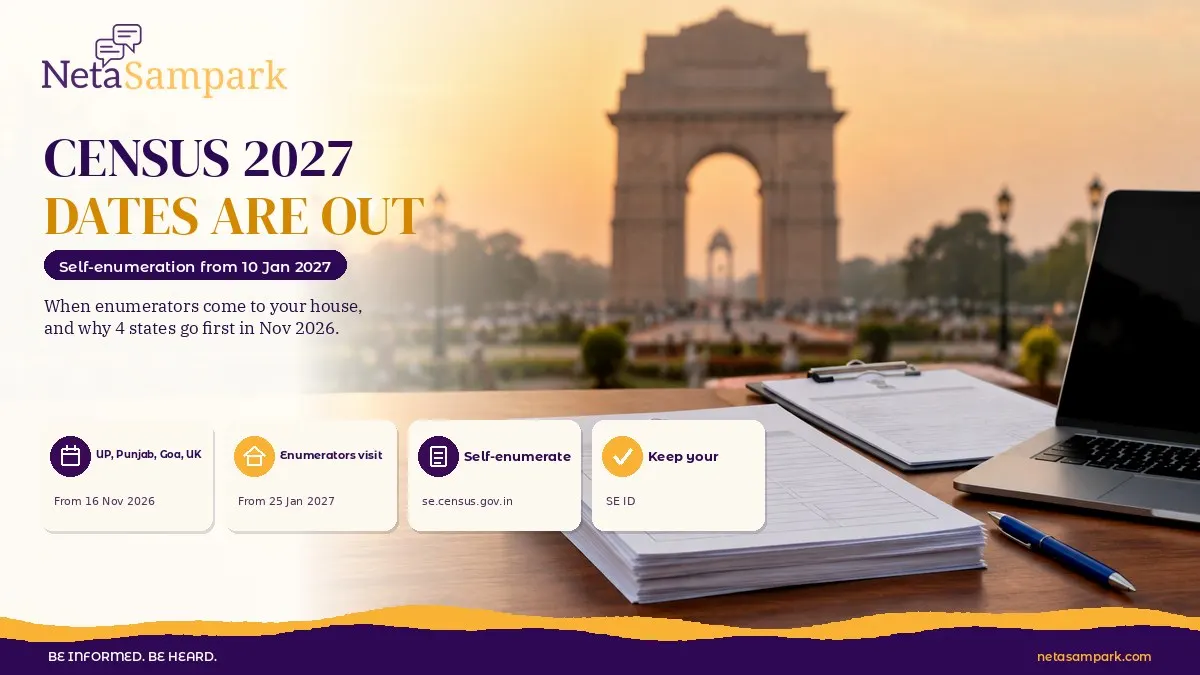
The Census 2027 headcount now has fixed dates. Most of India can fill its own form online from 10 January 2027 to 24 January 2027, and enumerators visit homes from 25 January 2027 to 28 February 2027. UP, Punjab, Goa and plains Uttarakhand go earlier, with self-enumeration from 16 November 2026.
Updated 31 October 2026
Quick facts
| Item | Details |
|---|---|
| Official portal | se.census.gov.in for self-enumeration; censusindia.gov.in for notices |
| Helpline | Your local enumerator or the Census office of your district; check the toll-free number shown on the self-enumeration portal once it opens |
| Fee | Free. Nobody can charge you for the Census or for the self-enumeration ID |
| Deadline | Most states: self-enumeration 10 January 2027 to 24 January 2027, house visits 25 January 2027 to 28 February 2027. UP, Punjab, Goa, plains Uttarakhand: self-enumeration 16 November 2026 to 30 November 2026, house visits 1 December 2026 to 4 January 2027 |
| Documents | No documents are collected. Keep basic details handy: date of birth of each member, mobile number, education, work details |
| Legal basis | S.O. 5913(E) dated 30 October 2026 (most states) and the ORGI notification dated 5 September 2026 (UP, Punjab, Goa, Uttarakhand) under the Census Act, 1948 |
What exactly did the government notify on 30 October 2026?
The Office of the Registrar General and Census Commissioner, under the Home Ministry, published a gazette notification (S.O. 5913(E)) on 30 October 2026. It fixes the second and final phase of Census 2027, which is the actual population count. The first phase, houselisting, already ran from 1 April 2026 to 30 September 2026.
For most states and UTs, the notification says:
| Step | Dates |
|---|---|
| Self-enumeration (optional, online) | 10 January 2027 to 24 January 2027 |
| House-to-house enumeration | 25 January 2027 to 28 February 2027 |
| Revisional round | 1 March 2027 to 5 March 2027 |
| Reference date | 00:00 hours on 1 March 2027 |
The reference date matters more than people think. The Census is a snapshot of India at midnight on 1 March 2027. A baby born on 2 March 2027 won't be counted, and a person who dies on 28 February 2027 won't be counted either. The revisional round exists to fix births, deaths and missed households around that date.
Which states are not in the January 2027 schedule?
Three groups are handled separately.
1. Uttar Pradesh, Punjab, Goa and the non-snow-bound parts of Uttarakhand. These states have Assembly elections due in early 2027, so the Census there was pulled forward under a separate ORGI notification dated 5 September 2026. Their dates:
| Step | Dates |
|---|---|
| Self-enumeration | 16 November 2026 to 30 November 2026 |
| House-to-house enumeration | 1 December 2026 to 4 January 2027 |
| Revisional round | 5 January 2027 to 9 January 2027 |
| Reference date | 00:00 hours on 5 January 2027 |
So if you live in Lucknow, Ludhiana, Panaji or Dehradun, your window opens in just over two weeks, on 16 November 2026.
2. Ladakh and the snow-bound areas of Himachal Pradesh, Jammu and Kashmir and Uttarakhand. These places can't be reached in peak winter, so they were counted in September 2026, with 1 October 2026 as their reference point. Their count is already done.
3. Manipur. The notification keeps Manipur out for now. Its dates will be declared later.
Is self-enumeration compulsory?
No. It's optional. You can fill the Census form yourself online during your window, or simply wait for the enumerator. Either way you're counted. The upside of doing it yourself is that you control what's typed in, spelling of names included, and the visit later is quick.
How does self-enumeration work, step by step?
Based on how the portal worked during the houselisting phase earlier in 2026, here's the flow. Check the portal instructions when your window opens, since small steps can change.
1. Open se.census.gov.in only during your state's window. Don't trust links on WhatsApp.
2. Pick your language and enter your mobile number. You'll get an OTP.
3. Enter your household's location details as asked, like state, district and town or village.
4. Fill details for every member who normally lives in the house, including children and elderly parents. The form has 40 questions in total, covering things like age, marital status, religion, caste, mother tongue, education, work and migration.
5. Review and submit. You'll get a Self-Enumeration ID (SE ID). Save it as a screenshot and write it down.
6. Share the SE ID with the enumerator when they come during the house-to-house phase. They'll verify and close your household without asking everything again.
For the full list of all 40 questions and which ones are optional, read our earlier explainer: Census 2027: all 40 questions the enumerator will ask.
What will the enumerator ask and what should I keep ready?
No papers are taken. You just answer. Keep these handy so the visit takes ten minutes, not forty:
• Date of birth or age of every member
• Highest education of each person
• What each working member does and where
• Mother tongue and other languages
• Caste and tribe details, if applicable
• Whether anyone moved in from another place, and when
The enumerator is usually a government teacher or official with a Census ID card. Ask to see it. If something feels off, call your local municipal or block office before sharing anything.
Is my data safe? Can it be used against me?
Under the Census Act, 1948, individual Census records are confidential. They can't be used as evidence in court, and they're not shared as personal records with other departments. What gets published is aggregate data, like totals for a village, ward or district.
That said, scammers love Census season. Real enumerators never ask for OTPs, bank PINs, card numbers or money. If someone does, it's a fraud. Report it on 1930 or cybercrime.gov.in. We've covered the first-hour steps in what to do after a UPI fraud.
Why should I bother? Isn't the Census just a government exercise?
Census numbers decide a lot of things that hit your daily life:
• How many seats your area gets in future delimitation
• How much central money flows to your state for schemes
• Where new schools, hospitals and ration shops are planned
• Reservation data, since caste is being counted for the first time since Independence
If your family is missed, your area looks smaller on paper than it is. That's real money and real representation lost. Once the numbers are out, it's also worth knowing who represents your area right now. Look up your MP and MLA on NetaSampark's Know Your Neta.
Real-life examples
Example 1, a family in Kanpur. Ramesh fills the form for his family of five on se.census.gov.in on 20 November 2026 and saves the SE ID. When the enumerator comes on 8 December 2026, the visit is over in a few minutes.
Example 2, a working couple in Pune. Sneha and Rahul are out all day. They self-enumerate on 12 January 2027, then leave the SE ID with their society office, so the enumerator can confirm it with a quick call or visit.
Example 3, a newborn in Patna. A baby is born on 27 February 2027, after the family was counted. During the revisional round from 1 March 2027 to 5 March 2027, the enumerator adds the child, since the birth was before the reference date.
Documents checklist
☐ Mobile number for OTP (self-enumeration)
☐ Ages or dates of birth of all members
☐ Education and work details of each member
☐ Caste or tribe details, if applicable
☐ Saved SE ID screenshot, if you self-enumerated
☐ Enumerator's ID card checked before answering
Final reminder
Mark your window now. If you're in UP, Punjab, Goa or plains Uttarakhand, it's 16 November 2026 to 30 November 2026. Everyone else, it's 10 January 2027 to 24 January 2027. Make sure every person in your home is counted, including domestic workers who live with you and elderly parents.
Frequently asked questions
When will the Census enumerator come to my house?
In most states, between 25 January 2027 and 28 February 2027. In UP, Punjab, Goa and plains Uttarakhand, between 1 December 2026 and 4 January 2027.
What is the reference date for Census 2027?
00:00 hours on 1 March 2027 for most of India, and 00:00 hours on 5 January 2027 for UP, Punjab, Goa and plains Uttarakhand.
Do I have to self-enumerate online?
No. It's optional. If you don't, the enumerator will fill the form during the house visit.
Will I need Aadhaar or any document?
No documents are collected. Some questions ask for details like mobile number, but you only answer; you don't hand over papers.
Why is Manipur not included?
The 30 October 2026 notification leaves Manipur out for now. Its dates will be notified separately.
What if I'm away from home during the count?
You're counted where you normally live. Ask a family member to give your details, or self-enumerate for the household during the window.
Sources
• Office of the Registrar General and Census Commissioner, India
• e-Gazette of India (S.O. 5913(E) dated 30 October 2026, Census 2027 population enumeration)
• Census self-enumeration portal
• The Hindu, 30 October 2026: Census 2027 door-to-door enumeration from 25 January 2027