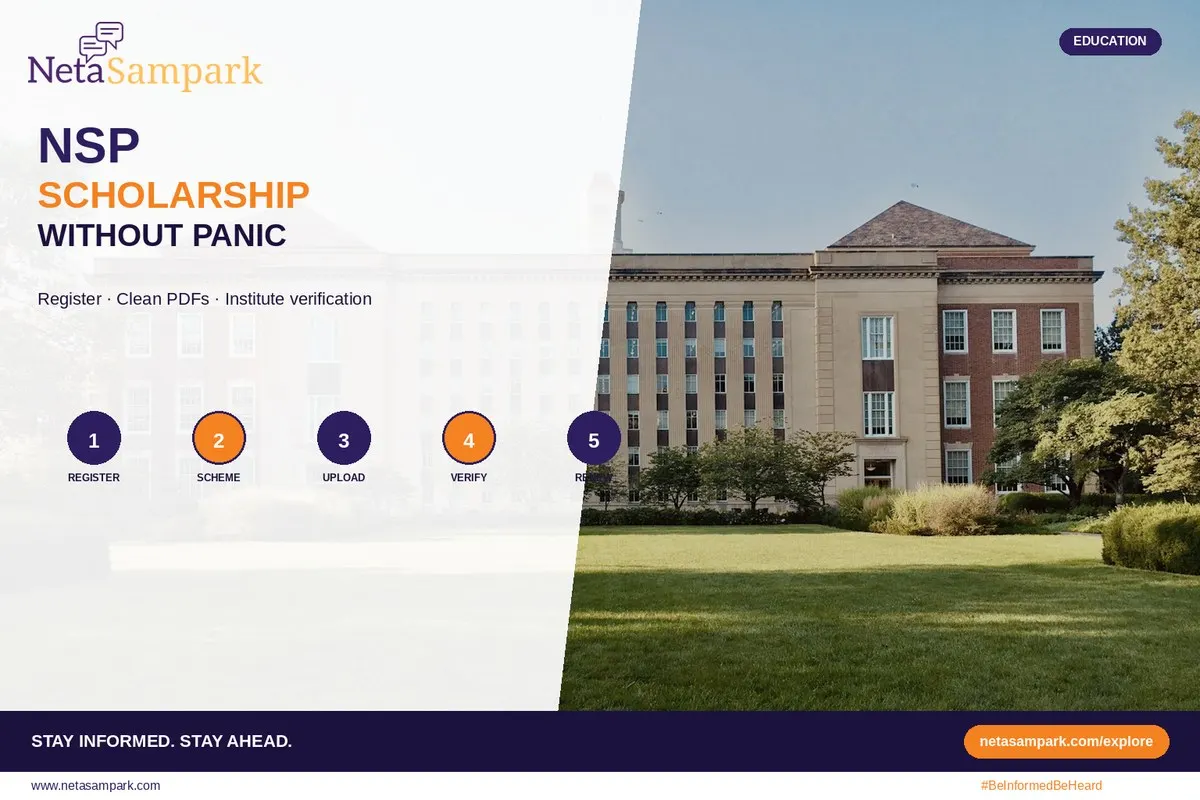
Quick take: A scholarship application can be perfectly eligible and still get stuck because the wrong scheme was selected, a document doesn't match, or the application never clears institute verification. The good news is that most of these problems are preventable. Check the scheme first, get your documents ready, complete your NSP registration properly, submit early, and then track what happens after you press “Submit.”
For the 2026–27 academic year, the National Scholarship Portal (NSP) is open from 1 June 2026. The live scheme list has different deadlines, so there is no single “NSP last date” that applies to everyone. For example, several major schemes currently show student applications closing on 31 October 2026, while some schemes and renewals close earlier on 30 September 2026. Always check the deadline shown against the particular scheme you are applying for. (Scholarships Government of India)
What is the National Scholarship Portal?
The National Scholarship Portal, or NSP, is the Government of India's common online platform for scholarship schemes offered by different ministries and departments.
It brings multiple schemes into one system, but that does not mean every scholarship in India is available there.
Depending on the academic year, you may find schemes from bodies such as:
- Ministry of Education
- Ministry of Social Justice and Empowerment
- Ministry of Tribal Affairs
- Ministry of Minority Affairs
- Department of Empowerment of Persons with Disabilities
- AICTE
- UGC
- Ministry of Labour & Employment
- other Central government departments and organisations
The important distinction is this:
NSP is a common application platform. The eligibility rules still belong to the individual scholarship scheme.
So don't start by asking, “How do I fill NSP?”
Start with:
“Which scholarship am I actually eligible for?”
That one decision can save you from submitting the wrong application.
The official portal is:
Before anything else: get your OTR
One important change for current NSP applications is One Time Registration (OTR).
For the 2026–27 academic year, NSP states that OTR is mandatory to avail scholarships. The OTR is a unique 14-digit number linked to the student and is intended to remain applicable throughout the student's academic career. (Scholarships Government of India)
That means your first job is not to rush into a scholarship application.
It is to get your registration sorted.
Keep the OTR number somewhere safe.
Don't depend on an old SMS that may disappear when you change phones.
Write it down. Save it in your email. Keep a copy in your scholarship folder.
The portal also provides an OTR registration route through NSP. (Scholarships Government of India)
Step 1: Find the right scholarship before filling anything
This is where many students make their first mistake.
NSP currently lists scholarships under different ministries and categories, including merit-based and welfare-based schemes. The portal itself says that from AY 2026–27, students may apply for one merit-based scholarship scheme and one or more welfare-based scholarship schemes, subject to the eligibility rules of those schemes. (Scholarships Government of India)
Don't interpret that as permission to apply for everything you see.
Open the scheme details and check:
- course and class requirements
- academic performance requirements
- family income limit
- category requirements, where applicable
- institute requirements
- domicile or state conditions
- disability requirements, where applicable
- renewal or fresh-application status
- documents required
- application closing date
The NSP scheme directory displays the opening and closing dates and provides access to scheme specifications and FAQs. (Scholarships Government of India)
The wrong scholarship application doesn't become right because you submitted it early.
Step 2: Check whether your college or school is on NSP
This is easy to overlook.
Your personal eligibility is only one part of the process.
The institute also has to participate in the NSP process where the particular scheme requires institute verification.
NSP maintains a registered-institute facility, and institutes have their own NSP registration and login process. (Scholarships Government of India)
Before spending an evening scanning documents, ask your scholarship office:
“Is our institute registered on NSP for this scholarship scheme?”
If they say yes, ask for the name or contact details of the Institute Nodal Officer (INO) or scholarship contact.
Save that information.
You may need it later.
Step 3: Get your documents ready before you startDon't begin the application and then discover that your income certificate expired three months ago.
Make a folder on your phone or computer.
Call it something simple:
NSP 2026–27
Depending on the scheme, you may need documents such as:
- marksheets
- income certificate
- caste/category certificate
- disability certificate or UDID information, where applicable
- bank account details
- bonafide certificate
- fee details
- admission or institute information
- photograph and signature
- other scheme-specific documents
The exact list is not universal.
Your scheme's specification and FAQ are the authority.
The name-mismatch problem
This deserves more attention than it gets.
Suppose your marksheet says:
Rahul Kumar
Your bank account says:
Rahul K. Kumar
And another document says:
Rahul Kumar Singh
You may spend weeks explaining that all three refer to the same person.
Where possible, identify these mismatches before submitting.
Check:
Name → Date of birth → Category → Bank details → Institute details
Don't assume the system will automatically understand what you meant.
Step 4: Keep your bank account ready for paymentGetting selected is not the same thing as receiving the money.
NSP provides a facility to track scholarship payment through the PFMS system, and the student dashboard also provides Aadhaar-linked bank-seeding checks. (Scholarships Government of India)
Before the application gets to the payment stage, check:
- Is the bank account active?
- Is the account in the student's name where required?
- Is the account number correct?
- Is the IFSC correct?
- Is Aadhaar seeding required for your scheme?
- Is the bank account capable of receiving the relevant DBT?
NSP currently provides a facility to check Aadhaar-bank account seeding status. (Scholarships Government of India)
A scholarship approved on paper is of little comfort if the payment cannot reach the account.
Step 5: Fill the application yourself where possibleStudents often hand the entire process to a cybercafe operator.
That's convenient.
But there is a problem.
The scholarship belongs to you. The login belongs to you. The OTP belongs to you.
If you use a CSC or another helper, sit beside them.
Check every screen before they click submit.
Never give someone permanent control of your password simply because they helped you apply.
NSP has also announced that its services are available through Common Service Centres (CSCs) for students who need assistance. (Scholarships Government of India)
That's useful for students who don't have reliable internet access—but assistance should not mean surrendering control of your account.
Step 6: Don't treat “submitted” as “approved”This is probably the most important thing to understand about NSP.
You submit the application.
Then other stages can follow.
Depending on the scheme, this can include:
Student application → Defective application verification → Institute verification → District/State/Ministry-level verification → sanction/payment
The exact workflow varies by scheme.
The current NSP scheme directory explicitly shows separate timelines for student applications, defective application verification, institute verification and higher-level verification for many schemes. (Scholarships Government of India)
So when your dashboard says Submitted, don't close the file and forget about it.
You've only finished your part.
Institute verification: the stage students forgetImagine this.
You spent three hours completing the form.
Everything looks perfect.
Then your application sits at the institute.
No rejection.
No payment.
Just silence.
This is why you should know the institute verification deadline.
For many 2026–27 schemes currently listed on NSP, institute verification continues after the student application deadline. For example, several schemes with student applications closing on 31 October show institute verification continuing until 15 November. (Scholarships Government of India)
So don't wait until the last student-application day to discover that your college still hasn't verified your application.
After submission:
- Save your application details.
- Note the institute verification deadline.
- Contact the scholarship/nodal office.
- Ask whether your application is visible to them.
- Follow up before the verification deadline.
- Keep copies of your emails or written requests.
A polite message with an application number is much more useful than:
“Sir please check my scholarship.”
Give the officer something they can actually locate.
What if your application becomes “Defective”?Don't panic.
“Defective” does not automatically mean “rejected forever.”
It generally means something in the application requires correction or further action.
Read the exact defect remark.
It might relate to:
- a document
- a photograph
- an eligibility field
- an incorrect entry
- a certificate
- another scheme-specific requirement
Don't simply upload the same file again.
If the problem says the income certificate is invalid, fix the income certificate.
If the photograph doesn't meet the requirement, replace the photograph.
If your name is wrong, understand whether the underlying document or the application field needs correction.
Fix the reason, not just the status.
And watch the correction deadline. NSP publishes separate defective-application verification timelines for schemes. (Scholarships Government of India)
What if the college says “we haven't received it”?Don't argue.
Get specific.
Ask:
“Could you please check using my NSP application/OTR details and confirm whether the application is visible in the institute login?”
If it isn't visible, record the date of your visit or email.
If it is visible but pending, ask when institute verification is expected.
If they say a document is missing, ask which document.
This turns:
“Nobody is helping me.”
into:
“Application X was submitted on this date and remains pending at institute verification.”
The second sentence can actually be escalated.
What if the scholarship is sanctioned but the money hasn't arrived?Now stop treating it as an application problem.
Treat it as a payment problem.
First check the payment status through the available NSP/PFMS tracking facility. NSP directs students to PFMS for scholarship disbursement tracking. (Scholarships Government of India)
Then check:
- bank account status
- Aadhaar seeding where required
- account number
- IFSC
- whether the payment was returned
- whether there is a scheme-specific payment issue
Save the payment status screen.
If the portal shows a specific failure reason, don't write a generic grievance.
Write:
“Scholarship application [ID] shows sanctioned, but payment has not been credited. PFMS/payment status shows [exact message]. Kindly clarify the action required.”
That gives the receiving officer something to work with.
What if your scholarship doesn't appear on NSP?Don't assume you are ineligible.
NSP is not the entire scholarship universe.
Some scholarships are administered directly through:
- state government portals
- universities
- UGC
- AICTE
- institutional scholarship offices
- private foundations
- trusts
- other government platforms
NSP itself is a gateway for scholarships offered by different ministries, not a directory of every scholarship available in India. (Scholarships Government of India)
If your scholarship isn't listed, check your:
- State scholarship portal
- University website
- College scholarship office
- UGC/AICTE scheme pages
- Relevant ministry website
Don't conclude:
“NSP doesn't show it, so there are no scholarships.”Parents: help without taking over
Parents can make this process much easier.
But there is one rule:
The student should remain the owner of the application.
Sit together for the first login.
Let the student keep the OTP.
Help collect:
- income certificates
- marksheets
- bank documents
- category certificates
- disability documents
- fee receipts
Help with follow-ups.
But don't create an account that only the parent can access.
A student may need the same OTR and scholarship records for years. NSP describes OTR as applicable throughout the student's academic career. (Scholarships Government of India)
Build the student's record once and protect it.
Don't lose your OTRPut the following in one secure place:
NSP 2026–27
- OTR number
- NSP login details
- application ID
- scheme name
- acknowledgement
- submitted application PDF
- important documents
- institute nodal officer details
- grievance correspondence
- payment records
Then keep a backup.
Changing phones should not mean losing your scholarship history.
What about students with disabilities?This is one area where you should read the scheme instructions particularly carefully.
NSP currently states that students with disabilities must first log in to the UDID portal, provide consent to share their UDID details, and then submit the NSP application. (Scholarships Government of India)
The process is therefore not necessarily the same as a standard application.
Don't wait until the final day to discover that an additional authentication or consent step is required.
Don't believe scholarship WhatsApp forwardsEvery scholarship season produces the same messages:
“Last date tonight!”
“Government giving ₹50,000 to every student.”
“Pay ₹500 and scholarship will be guaranteed.”
“Send Aadhaar and OTP to this number.”
Stop.
Open the official portal.
Check the scheme.
Check the deadline.
Check the eligibility.
The NSP website itself warns users not to enter personal information such as Aadhaar number, bank account number, password, PIN or OTP into its chatbot. (Scholarships Government of India)
Your OTP is not a scholarship document.
Never give it to an agent who promises approval.
Your 2026–27 NSP checklistTaskDoneCheck the correct scholarship scheme☐Read scheme eligibility and FAQ☐Confirm institute is registered/participating☐Complete NSP OTR☐Save 14-digit OTR number☐Check income/category certificates☐Check name and DOB across documents☐Check student's bank account☐Check Aadhaar-bank seeding if required☐Upload readable documents☐Submit application before deadline☐Save application/acknowledgement☐Confirm institute verification☐Check defective status☐Track higher-level verification☐Track payment through PFMS when applicable☐One simple rule that can save your scholarshipNever stop at “Submitted.”
Submitted is a milestone.
Verified is another.
Sanctioned is another.
Paid is the finish line.
Keep checking the status through the official system until you know what happened to your application.
And if something goes wrong, don't send ten angry messages to ten different people.
Write down:
Application ID + date + status + exact problem + specific request.
That is the paper trail that makes escalation possible.
Where NetaSampark fits
A scholarship problem is usually solved by the education department, scholarship authority, institute or designated grievance officer—not by a political representative directly.
But when a systemic problem affects an entire college, district or group of students, a documented citizen brief can help bring the issue to the attention of the appropriate representative.
Keep the evidence.
Don't send a politician a 200-message WhatsApp conversation.
Send:
50 students → same issue → application IDs → dates → institute response → specific request.
That's a civic issue, not a rant.
You can use NetaSampark to identify the representatives for your area and keep track of the wider civic issues that affect your community.
Explore NetaSampark
Find your representatives
The boring process usually wins
Scholarships aren't won by knowing the right person.
They're usually won by doing the boring things correctly:
Choose the right scheme.
Register properly.
Upload clean documents.
Submit early.
Get the institute to verify.
Fix defects quickly.
Track the payment.
Keep every acknowledgement.
If something goes wrong, don't lose the file.
Follow the number.
Be informed. Be heard.
Non-partisan student-information guide. Scholarship eligibility, deadlines and verification stages vary by scheme and academic year. Always verify the live details on the official National Scholarship Portal before applying. Information checked against the NSP 2026–27 portal on 11 September 2026. (Scholarships Government of India)