
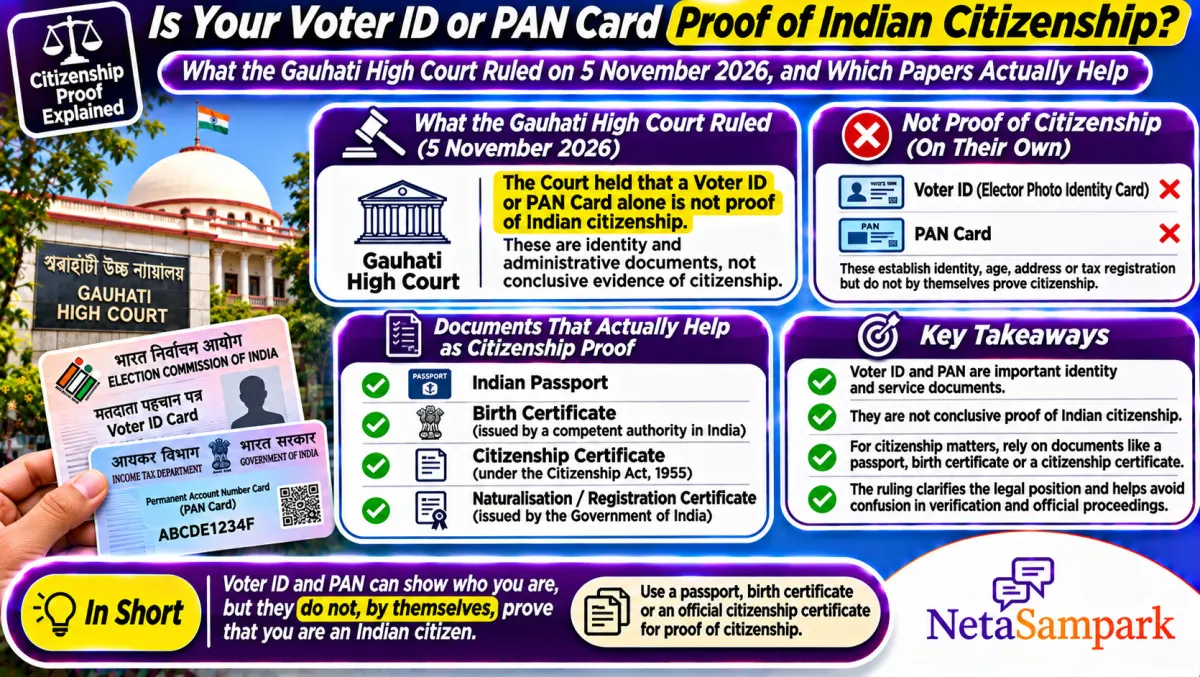
No. The Gauhati High Court ruled on 5 November 2026 that a PAN card and a voter ID (EPIC) are not proof of Indian citizenship, because they're issued on self-application without a formal inquiry. Aadhaar isn't proof either, under Section 9 of the Aadhaar Act. What helps is records that link you to Indian parents and residence.
Updated 14 November 2026
Most of us carry a voter ID, PAN and Aadhaar and assume that settles it. For daily life, it mostly does. But when someone's citizenship is actually questioned, like before a Foreigners Tribunal in Assam, courts look at it very differently. A ruling reported on 13 November 2026 has made a lot of people ask: so what does count?
This explainer breaks down what the court said, why it said it, what it means for people outside Assam, and which documents are worth keeping safe.
Quick facts
| Item | Details |
|---|---|
| Official portal | indiacode.nic.in for the Citizenship Act, 1955 |
| Helpline | Not applicable. For a Foreigners Tribunal notice, contact a lawyer or the District Legal Services Authority (free legal aid) |
| Fee | None to read the law. Legal aid through DLSA is free for eligible people |
| Deadline | Not applicable. Answer any tribunal or court notice by the date on it |
| Documents | Records linking you to Indian parents or grandparents and to residence, like old electoral rolls, land records, birth and school certificates |
| Case | Kulchan Begum v. Union of India, WP(C) 2459/2020, Gauhati High Court, decided 5 November 2026 |
| Main finding | PAN and EPIC are not proof of citizenship unless the records behind them are proved |
What did the Gauhati High Court actually say?
The case was about a woman from Darrang district in Assam. A Foreigners Tribunal had declared her a foreigner of the post-25 March 1971 stream in an opinion dated 21 August 2018. She challenged it in the High Court in 2020. A division bench dismissed her petition on 5 November 2026.
The key line, from paragraph 25 of the judgment: the PAN card and EPIC "are documents that are issued on self-application without any formal enquiry by the Income Tax Department and Election Commission of India." So unless the records supporting those cards are proved, they "cannot be accepted as a proof of citizenship of India."
The court also said:
• A ration card is not proof of citizenship, and hers didn't link her to her claimed parents.
• A photocopy of an NRC application receipt wasn't admissible because the original wasn't called for.
• A certificate from an area sabha representative wasn't admissible because its author wasn't examined as a witness.
• Her claimed father having contested elections and served as a municipal councillor didn't prove she was his daughter.
• There was a 27-year gap (1970 to 1997) with no evidence of her family's continuous residence in Assam, which mattered under Section 6A of the Citizenship Act, 1955, the special provision for Assam.
Because none of her documents helped her discharge the burden under Section 9 of the Foreigners Act, 1946, the court upheld the tribunal's opinion and cancelled her interim bail.
Why aren't voter ID and PAN enough?
It comes down to how they're made. You fill a form, give some documents and get the card. Nobody from the government formally inquires into whether you're a citizen. So in law, the card shows that you applied and were given an ID. It doesn't independently prove where you or your parents were born.
Aadhaar is even clearer. Section 9 of the Aadhaar Act, 2016 says the Aadhaar number or its authentication doesn't by itself confer any right of, or proof of, citizenship or domicile. UIDAI has said the same in public.
None of this means these cards are useless. They're valid ID for voting, banking, tax and government schemes. They're just not the final word on citizenship when it's challenged.
Who has to prove citizenship, and when?
In most of India, you'll never be asked. Citizenship questions mostly come up in three places:
1. Foreigners Tribunals in Assam. Under Section 9 of the Foreigners Act, 1946, which the court applied here, the burden of proving you're not a foreigner is on you, not the state. That Act has since been replaced by the Immigration and Foreigners Act, 2025, which keeps a similar burden rule (to verify the exact section).
2. Passport applications. The passport office checks birth and parentage documents and does police verification.
3. Voter roll checks. During Special Intensive Revision (SIR) drives, the ECI has asked some voters for documents. That's about eligibility to be on the roll, which is a related but different question.
Which documents actually help?
There's no single magic paper. What courts look for is a chain: proof that links you to a parent or grandparent, and proof that they were Indian and living here at the right time. Under the Citizenship Act, 1955, citizenship by birth depends on your date of birth and, for later births, your parents' citizenship.
Papers that usually carry more weight:
• Your birth certificate from the municipal or panchayat registrar. If you don't have one, see our birth certificate guide.
• Old electoral rolls showing your parents or grandparents, especially certified copies.
• Land and property records, like jamabandi or khatian in the family name.
• School certificates with parents' names, preferably from the original school register.
• Passport issued after verification.
• Certified copies of any of these, not just photocopies. The court in this case refused a photocopy.
And the most important thing: the names, ages and spellings must line up across documents. In this case, mismatched names and missing years hurt more than missing cards.
What should you do now? A practical checklist
☐ Collect your own birth certificate. Apply for a late registration if it was never done.
☐ Get certified copies of old voter lists with your parents' or grandparents' names from the district election office.
☐ Keep land records in the family name safe, with mutation papers.
☐ Fix spelling differences between your Aadhaar, voter ID and school records. Our Aadhaar name correction guide explains the rules.
☐ Keep your voter ID updated using Form 8 if details are wrong. See how continuous updation works.
☐ Store everything in DigiLocker or a safe folder, with originals in one place.
If you or a family member gets a Foreigners Tribunal notice
1. Don't ignore it. Note the date and appear on time.
2. Get a lawyer. If you can't afford one, ask the District Legal Services Authority for free legal aid.
3. Gather originals and certified copies. Photocopies alone may not be admitted.
4. Line up witnesses who can prove documents, like the official who issued a certificate.
5. Show continuous linkage, year by year if you can. Gaps are what sink most cases.
Frequently asked questions
Is voter ID proof of citizenship in India?
Not on its own. The Gauhati High Court said on 5 November 2026 that an EPIC is issued on self-application without a formal inquiry, so it isn't proof of citizenship unless the records behind it are proved.
Is Aadhaar proof of citizenship?
No. Section 9 of the Aadhaar Act, 2016 says an Aadhaar number doesn't confer or prove citizenship or domicile.
Does this ruling apply outside Assam?
The case was under Assam's special framework (Section 6A and the 25 March 1971 cut-off). But the court's reasoning on PAN and EPIC is general, and it relied on its own earlier ruling in Md. Babul Islam v. Union of India (9 May 2018). Legal advice is best for your exact case.
Is a ration card proof of citizenship?
No. The court said a ration card isn't proof of citizenship. It's proof of entitlement to subsidised food.
Which document is the strongest?
There isn't one. Courts look for a consistent chain: your birth record, plus records linking you to Indian parents or grandparents and their residence, ideally as certified copies.
Final reminder
Your voter ID and PAN are still fine for daily life, but don't treat them as your only papers. Get your birth certificate and your family's old records in order now, while there's no notice and no hurry. If someone in your area is struggling with a citizenship case or a roll deletion, raise it with your MLA. Find them on NetaSampark's Assam representatives page or the all-India list. You can also read about downloading your e-EPIC.
Sources
• Citizenship Act, 1955 on India Code
• UIDAI: The Aadhaar Act, 2016
• Ministry of Home Affairs: Foreigners Division
• Business Today on the ruling, 13 November 2026 (news report)