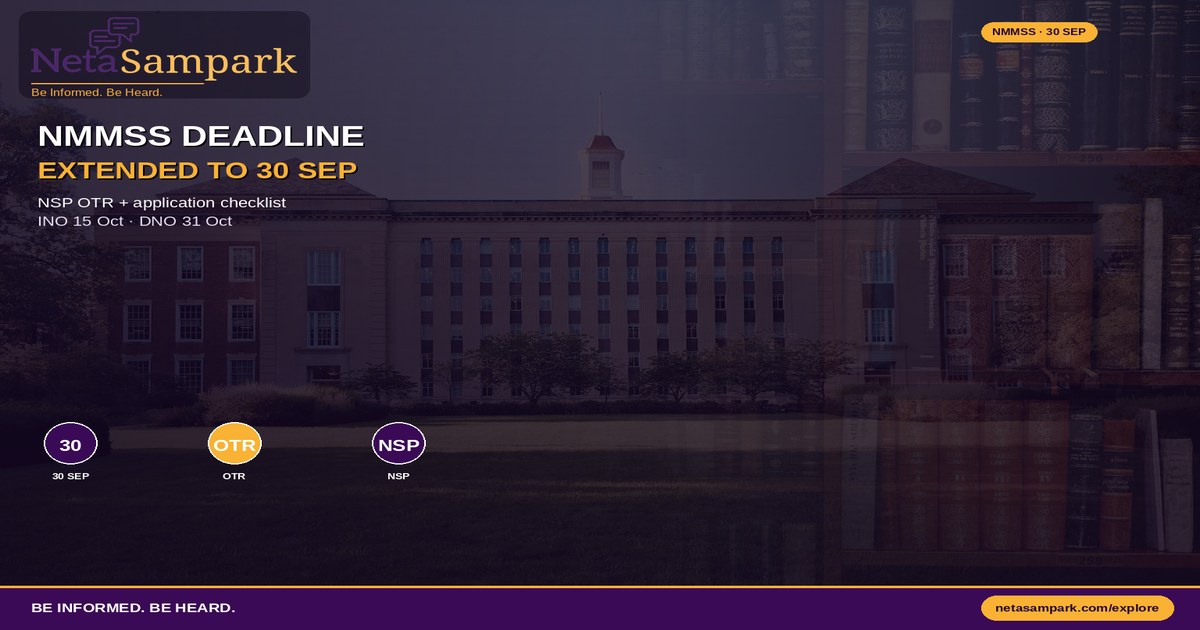
Quick take: The National Means-cum-Merit Scholarship Scheme (NMMSS) application deadline for 2026–27 has been extended to 30 September 2026 on the National Scholarship Portal (NSP).
If you're applying, don't treat 30 September as the only deadline that matters.
The sequence is:
OTR → NMMSS application → Institute verification → District verification → further processing
The current verification dates in your draft are:
- Student application deadline: 30 September 2026
- INO Level-1 verification: 15 October 2026
- DNO Level-2 verification: 31 October 2026
So submitting the form is only the first checkpoint.
Important: Check the latest NMMSS scheme guidelines and Ministry of Education/NSP notices before publication or application. Eligibility conditions and portal workflows can be updated.What is NMMSS?
The National Means-cum-Merit Scholarship Scheme is intended to support meritorious students from economically weaker sections studying in eligible government/government-aided schools, subject to the scheme's conditions.
The scholarship generally starts from Class 9, with continuation/renewal subject to the applicable requirements.
Eligibility isn't determined simply by saying:
"My family income is low."
The NMMSS guidelines specify conditions relating to matters such as:
- Family income
- Academic performance
- School type
- Eligibility category
- Other scheme requirements
Read the current NSP scheme guidelines before applying.
Why the 30 September extension mattersFor many families, September is already crowded with:
- School examinations
- Admission paperwork
- Certificates
- Aadhaar-related corrections
- Scholarship applications
- NSP OTR registration
The extension gives eligible students additional time to complete the application.
But there's a catch:
Don't wait for 30 September evening.
Scholarship portals can experience heavy traffic near deadlines.
If your:
- OTR isn't complete
- Aadhaar information doesn't match
- Income certificate has an issue
- School details are incorrect
- Documents aren't ready
you may need additional time to fix the problem.
Step 1: Complete NSP OTRBefore applying for the scholarship, complete your One-Time Registration (OTR) on the National Scholarship Portal.
The official portal is:
scholarships.gov.in
OTR creates the student's unique registration identity for scholarship applications.
Treat OTR as the foundation
Check your details carefully, particularly:
- Name
- Date of birth
- Aadhaar/identity details
- Mobile number
- Other information requested by NSP
A mistake at the OTR stage can create problems later.
So don't rush through OTR just to reach the scholarship form.
Step 2: Check NMMSS eligibilityBefore spending an evening completing the application, read the current NMMSS guidelines.
Check:
Family income
Does your family satisfy the applicable income condition?
Academic requirement
Do you meet the required marks/academic criteria?
School eligibility
Is your school type covered by the scheme?
Class/renewal status
Are you applying as a fresh candidate or under renewal/continuation?
Other conditions
Check the complete NSP scheme guidelines rather than relying on another student's experience.
Step 3: Complete the NMMSS applicationOnce OTR and eligibility are sorted, complete the NMMSS application on NSP.
Check:
- Student details
- School details
- Academic information
- Bank information, where required
- Income/certificate information
- Category information, where applicable
- Other scheme-specific fields
Before final submission:
Read the entire application once more.
A five-minute review can save days of correction work.
Step 4: Save proof of submissionDon't close the browser after pressing submit.
Save:
- Application ID/reference
- Screenshot of successful submission
- Submitted application PDF/printout, where available
- Date of submission
- Relevant documents
Create a folder:
NMMSS 2026–27
Inside it:
01 — OTR
02 — Application
03 — Income Certificate
04 — Academic Documents
05 — Bank Details
06 — Verification
This makes follow-up much easier.
Submission is not sanctionThis is the most important thing for parents to understand.
Your child submitting an NMMSS application does not mean the scholarship has been approved.
There are verification stages.
The dates in the current schedule you provided are:
StageDeadlineStudent application30 Sep 2026INO Level-1 verification15 Oct 2026DNO Level-2 verification31 Oct 2026
INO and DNO are part of the institutional/district verification process.
So the process continues after the student clicks submit.
What should parents do after submission?Don't wait until 15 October.
The day after submission:
1. Confirm the application was actually submitted
Don't confuse "saved" with "finally submitted."
2. Tell the school
Let the appropriate school official know that the student has submitted the application.
3. Keep the application number
The school may need it during verification.
4. Check NSP periodically
Look for:
- Defect
- Verification status
- Rejection
- Correction request
- Other portal notifications
If you've completed the application, a simple follow-up can be:
"Good morning. My NMMSS application has been submitted on NSP. Could you please confirm whether it is visible for institute verification? My application/reference number is ______."
Keep the conversation factual.
If the designated official isn't available, ask when you should follow up.
You don't need to visit the school every day.
A weekly check is generally more practical unless the portal shows an urgent defect/deadline.
What if NSP shows a defect?Don't panic.
First read the exact defect reason.
For example, the portal may identify a missing or incorrect document/information.
Then:
Read defect → correct the specified issue → submit as instructed → save proof
Don't automatically create another fresh application.
A second application can create unnecessary confusion unless the official portal specifically instructs you to reapply.
Income certificate: check it earlyIncome documentation is a common place where families get caught out.
Don't simply ask:
"Do we have an income certificate?"
Ask:
"Does this certificate satisfy the current NMMSS/NSP requirement?"
Check:
- Issue date
- Validity requirements
- Issuing authority
- Name/details
- Income period covered
- State-specific requirements
If your existing certificate is old, investigate renewal before verification starts.
Don't discover the problem on 14 October.
Aadhaar/name mismatchCheck the student's name across:
- Aadhaar
- OTR
- School records
- Scholarship application
- Bank information, where relevant
Small spelling differences can create disproportionately large administrative problems.
If something is wrong, fix the underlying record rather than repeatedly submitting the scholarship form.
What if two siblings are applying?Each student needs their own OTR and scholarship application.
Family members can share relevant supporting documents where legitimately applicable, but don't share:
- NSP passwords
- OTPs
- Individual student accounts
Think of each student as having their own scholarship file.
If your school hasn't verified the applicationFirst check the status and the applicable verification deadline.
If the application is still awaiting institute verification as the deadline approaches:
- Contact the school
- Show the application/reference number
- Ask whether the application is visible in the institute's NSP workflow
- Record the date of your follow-up
- Escalate through the appropriate education/scholarship authority if necessary
Don't rely on:
"Sir is on leave, come next week."
if a statutory/portal deadline is approaching.
A simple family calendarPut these dates somewhere visible:
30 September
Student application deadline.
15 October
INO Level-1 verification deadline.
31 October
DNO Level-2 verification deadline.
Then add reminders a few days before each date.
The important mindset is:
The scholarship deadline isn't the end of the process.What if NMMSS isn't suitable for you?
If you clearly don't satisfy a core eligibility condition, don't spend weeks trying to force an application through.
Use the NSP to look for other scholarships for which the student may qualify.
This is especially useful if the problem is:
- School type
- Income criterion
- Academic eligibility
- Class/year
- Scheme-specific condition
A student can be ineligible for NMMSS while still being eligible for another scholarship.
Parent vs student: divide the workA simple division works well.
Student
- OTR
- Application
- Checking personal details
- Saving application number
- Monitoring portal status
Parent/guardian
- Certificate preparation
- Document folder
- School follow-up
- Deadline calendar
- Backup copies
The student should still know what has been submitted.
Don't let the child discover six months later that nobody knows the scholarship application number.
Common mistakes to avoid❌ Waiting until 30 September
Portal traffic and document problems can make the final day risky.
❌ Assuming OTR = scholarship application
OTR is a prerequisite/registration step; the NMMSS application is separate.
❌ Assuming submission = approval
Verification still follows.
❌ Ignoring school verification
Your application doesn't finish at student submission.
❌ Using an old certificate without checking
Current scheme requirements matter.
❌ Creating duplicate applications
Follow the portal's correction/reapplication instructions.
❌ Trusting another student's eligibility
Two students in the same class can have different eligibility circumstances.
NMMSS 2026–27 checklistBefore applying
- ☐ Read current NMMSS guidelines
- ☐ Check income eligibility
- ☐ Check academic eligibility
- ☐ Confirm school eligibility
- ☐ Gather documents
OTR
- ☐ Create OTR
- ☐ Check name/DOB
- ☐ Check identity details
- ☐ Save OTR information
Application
- ☐ Complete NMMSS form
- ☐ Review all fields
- ☐ Submit
- ☐ Save application/reference number
- ☐ Save submission proof
After submission
- ☐ Tell school
- ☐ Monitor NSP
- ☐ Check for defects
- ☐ Follow up before INO deadline
- ☐ Check district verification status
- ☐ Keep every acknowledgement
Scholarship applications are often treated as a single event:
"I filled the form."
They're actually a chain:
Eligibility → OTR → Application → Institute verification → District verification → Further processing → Scholarship
If one link breaks, the money can stop moving.
That's why a family should track status, not just submission.
How NetaSampark fits inNMMSS is a central scholarship scheme, but verification happens through institutions and administrative systems on the ground.
If one student's application has a document problem, solve that individual case.
But if a school repeatedly fails to verify eligible students' scholarship applications before deadlines, that can become a broader education-service accountability issue.
Document:
- Student applications
- Reference numbers
- Dates
- Verification status
- School responses
Then use the appropriate education grievance route.
NetaSampark can help citizens explore education-related civic guides and public-service/representative channels when a recurring local implementation problem needs attention.
Be Informed. Be Heard.
Primary sources to re-check: National Scholarship Portal and the Ministry of Education's current NMMSS scheme/extension notification for 2026–27. Application, verification, eligibility and certificate requirements can change; the latest official NSP/MoE instructions should control.