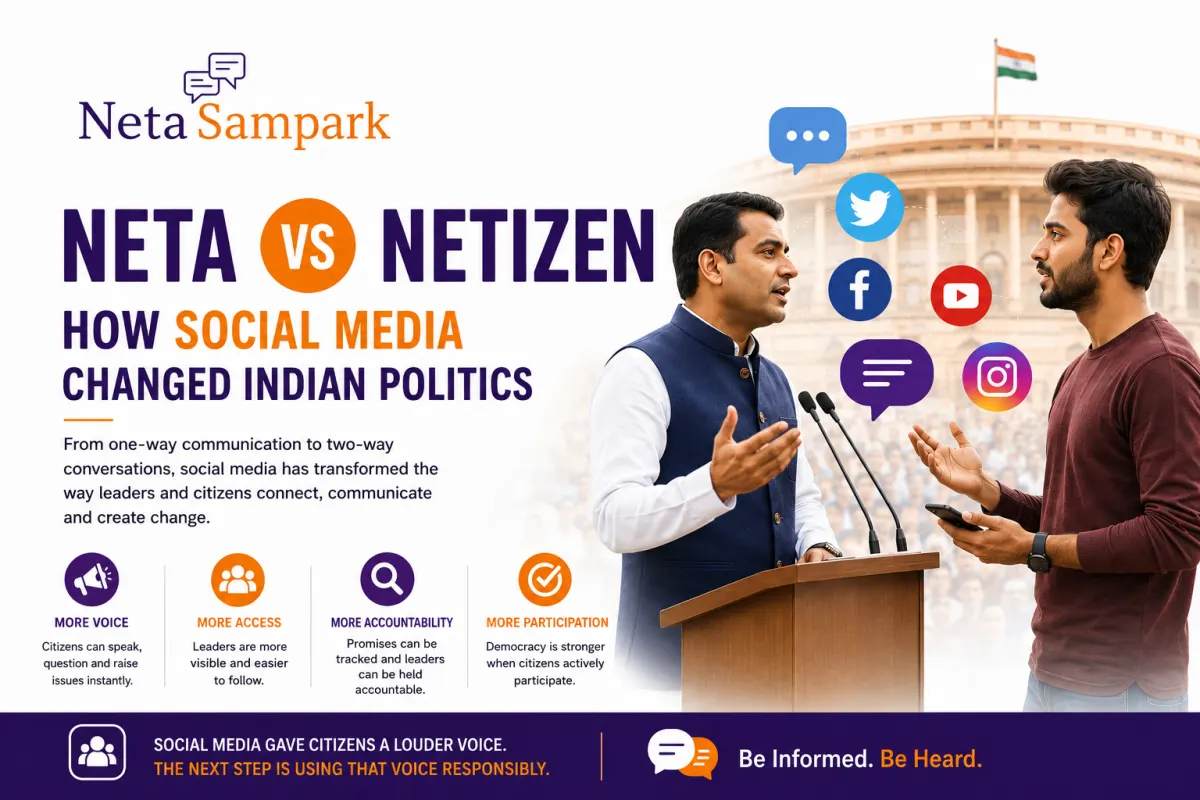
For decades, politics in India largely moved through rallies, newspapers, television debates, posters, party offices and door-to-door campaigning.
Today, a citizen can question a politician from a smartphone, watch a speech within minutes, share a government announcement instantly, or publicly discuss a local issue with thousands of people.
The rise of the netizen—an internet-connected citizen—has changed the relationship between political representatives and the people they represent.
The Neta still has political authority.
But the netizen now has something equally powerful: a public digital voice.
Who Is a Neta?
The word Neta is commonly used in India to refer to a political leader or elected representative.
Depending on the level of government, this could include:
- Member of Parliament (MP)
- Member of Legislative Assembly (MLA)
- Municipal corporator or councillor
- Panchayat representative
- Other elected or political leaders
Traditionally, citizens interacted with representatives through physical meetings, constituency offices, public events and party organisations.
Social media has added another layer to that relationship.
Who Is a Netizen?
A netizen is essentially a citizen who participates in the digital world.
In political life, a netizen can:
- Follow elected representatives
- Comment on public issues
- Share political information
- Ask questions
- Post videos of local problems
- Participate in online discussions
- Compare political claims with public information
- Organise community conversations
- Express support or criticism
The smartphone has therefore become more than a communication device.
For many citizens, it has become a political participation tool.
The Political Conversation Has Changed
Earlier, a citizen might have had to attend a public meeting to ask a representative a question.
Today, that question can be posted publicly in seconds.
Earlier, a local issue might have remained within one neighbourhood.
Today, a photograph or video can potentially reach thousands of people.
Earlier, political communication was largely one-way:
Leader → Citizen
Social media has made it increasingly two-way:
Leader ↔ Citizen
And sometimes even multi-directional:
Citizen ↔ Citizen ↔ Media ↔ Leader ↔ Government
This has fundamentally changed political communication in India.
Social Media Has Made Politicians More Accessible
Platforms such as Instagram, Facebook, YouTube and X have created new channels through which politicians can communicate with citizens.
Representatives can now:
- Announce initiatives
- Explain decisions
- Share constituency work
- Respond to criticism
- Provide updates
- Communicate during emergencies
- Highlight public issues
For citizens, this can make political leaders easier to follow than ever before.
But being visible online is not the same as being accessible offline.
A politician can have millions of followers and still be difficult for an ordinary citizen to reach personally.
That distinction matters.
The Netizen Can Now Set the Agenda
One of the biggest changes is that citizens don't always have to wait for politicians or traditional media to decide which issue deserves attention.
A local road.
A broken streetlight.
A water problem.
A school issue.
A traffic problem.
A public-service complaint.
A citizen can record it, publish it and start a conversation.
If enough people engage with it, the issue can attract wider attention.
This means political agendas can increasingly emerge from citizens upward, rather than only from political organisations downward.
But Virality Is Not the Same as Importance
This is where social media becomes complicated.
The most important public issue isn't necessarily the one that gets the most views.
A dramatic video may receive millions of views.
A detailed policy document may receive very little attention.
An angry argument may attract more engagement than a constructive discussion.
This creates a major challenge:
Social media measures attention extremely well. It does not necessarily measure public importance accurately.
Citizens therefore need to distinguish between what is viral and what is actually important.
Social Media Has Changed Political Accountability
Before social media, documenting a political promise or public statement often required newspaper reports, television recordings or physical documentation.
Today, citizens can save, share and revisit public statements almost instantly.
This creates a stronger digital record.
A representative can say:
“We will address this issue.”
Citizens can later ask:
“What happened to that commitment?”
This doesn't mean every promise can be fulfilled immediately.
Government decisions involve budgets, departments, permissions, laws and administrative processes.
But social media has made it easier for citizens to remember, question and follow up.
The Citizen Is No Longer Just an Audience
This may be the biggest transformation.
Traditionally, political communication often treated citizens primarily as an audience.
A speech was delivered.
Citizens listened.
A newspaper published a report.
Citizens read it.
Television broadcast a debate.
Citizens watched it.
Social media changed this model.
Now citizens can become:
Viewer + Commentator + Publisher + Critic + Participant
A person with a smartphone can publish their perspective without owning a newspaper, television channel or political organisation.
That is a significant democratising force.
The Problem: Everyone Can Publish, Including Those Who Spread False Information
The same technology that gives citizens a voice also makes misinformation easier to distribute.
A misleading post can spread rapidly.
An edited video can remove important context.
An old photograph can be presented as a new event.
A false claim can be repeated thousands of times until it appears credible.
This is why digital political participation requires digital responsibility.
Before sharing political content, citizens should ask:
- Who originally published this?
- Is the information current?
- Is there supporting evidence?
- Has the claim been reported by credible sources?
- Is the image or video being presented in its original context?
- Is this fact, opinion or political messaging?
Being politically active online is valuable.
Being careless online can be damaging.
Social Media Has Also Changed Political Campaigning
Political campaigns increasingly use digital platforms to reach specific audiences.
Instead of relying only on large rallies, parties and candidates can communicate through:
- Short videos
- Livestreams
- Digital posters
- Interviews
- Podcasts
- Social-media posts
- Messaging platforms
- Constituency updates
This allows political communication to happen every day—not just during elections.
The campaign therefore doesn't necessarily end when the polling booth closes.
The digital political conversation continues.
The Rise of the “Always-On” Politician
Social media has created expectations of constant communication.
Citizens may expect representatives to:
- Post regularly
- Respond quickly
- Address criticism
- Share development updates
- Comment on breaking events
- Explain decisions
But this creates a difficult balance.
A representative cannot realistically respond personally to every citizen or every post.
The more important question is whether there are effective systems for citizen communication and grievance follow-up.
That is where digital political engagement needs to evolve beyond simply posting content.
Followers Are Not the Same as Citizens
A politician's follower count can look impressive.
But 500,000 followers do not necessarily mean 500,000 people actively support the representative.
Similarly, a post receiving 100,000 views does not mean 100,000 people agree with it.
Social-media metrics such as:
- Followers
- Likes
- Views
- Shares
- Comments
measure digital activity.
They do not automatically measure:
- Quality of representation
- Constituency satisfaction
- Problem-solving
- Accessibility
- Transparency
- Integrity
- Development performance
This is an important distinction for voters.
From Likes to Accountability
Political communication can easily become a competition for likes.
But democracy requires more than popularity.
A representative's performance can be considered through questions such as:
Can citizens reach them?
Do they respond?
Are public issues followed up?
Is constituency development receiving attention?
Do they communicate clearly?
Are decisions explained transparently?
Do citizens have confidence in their representation?
These are deeper questions than:
“How many followers does this Neta have?”
Social Media Can Give Citizens a Direct Voice
When used responsibly, social media can help citizens:
Raise issues
A local problem can receive public attention quickly.
Ask questions
Citizens can directly question representatives and public institutions.
Share information
Government announcements and public information can reach communities faster.
Organise
People can coordinate around community concerns and civic initiatives.
Monitor
Citizens can follow public commitments and updates.
Participate
Political participation can happen beyond election day.
This is where the netizen becomes an important part of modern democracy.
But Digital Participation Should Not Replace Real-World Participation
A tweet is not a grievance redressal system.
A comment is not necessarily a formal complaint.
A viral video is not always evidence of the complete situation.
And a social-media argument is not a substitute for democratic institutions.
Citizens should use the right channel for the right purpose.
Social media can create visibility.
Formal government systems can create official records.
Constituency offices can facilitate direct engagement.
Elections provide the ultimate democratic mechanism for choosing representatives.
All of these can work together.
What Should Citizens Expect From a Modern Neta?
A modern representative doesn't necessarily need to be online 24 hours a day.
But citizens can reasonably expect effective communication systems.
That could include:
- Clear contact channels
- Constituency office information
- Regular public updates
- Responsiveness to important issues
- Transparent communication
- Appropriate use of social media
- Follow-up on citizen concerns
The objective isn't to turn politics into a popularity contest.
It is to make representation more accessible and accountable.
What Should Netizens Expect From Themselves?
The digital citizen also has responsibilities.
Before posting or sharing political content:
Think. Verify. Understand. Then share.
Citizens should try to:
- Verify information
- Avoid spreading rumours
- Debate ideas rather than attack people
- Respect different political opinions
- Ask constructive questions
- Give credit for genuine good work
- Criticise failures responsibly
- Protect personal information
- Report serious misinformation when appropriate
A stronger democracy requires not only better leaders, but also better-informed citizens.
The Future: Neta + Netizen
The real future of Indian political communication isn't necessarily about Neta versus Netizen.
It can be about:
Neta + Netizen
A representative communicates.
Citizens respond.
Citizens raise issues.
Representatives listen.
Government action is communicated.
Citizens provide feedback.
Performance can then be evaluated over time.
This creates a more continuous relationship between representation and public participation.
Beyond Likes: Measuring What Actually Matters
This is where structured citizen feedback can play an important role.
Instead of asking only:
“How popular is this Neta online?”
we can ask:
- How accessible is the representative?
- How responsive are they?
- How well are they working on constituency development?
- How effectively do they communicate?
- How transparent are they?
- How strong is their leadership?
- How effectively are public problems addressed?
- How well do they engage with citizens?
- How do citizens perceive their integrity and ethics?
- How much confidence do citizens have in them?
These questions provide a much broader picture of representation than social-media metrics alone.
Social Media Changed Politics. Citizens Can Change What Comes Next.
The smartphone has transformed the relationship between Indian citizens and political representatives.
The Neta can now speak directly to citizens.
The netizen can now speak directly back.
But the real opportunity lies beyond likes, shares and viral posts.
It lies in creating a culture where citizens stay informed, ask questions, participate constructively and evaluate performance based on more than popularity.
Social media gave citizens a louder voice.
The next step is learning how to use that voice responsibly.
Because democracy isn't just about having the ability to speak.
It is about being heard—and making that voice count.
Be Informed. Be Heard.
Official sources
Confirm fees, dates and eligibility on the official page before you act.